This last of the three Motor Age articles on the 1912 American Grand Prize race, deals with the pitwork.
With permission of hathitrust hathitrust.org == Text and fotos compiled by motorracinghistory motorracinghistory.com
MOTOR AGE Vol. XXII, No.15, October 10, 1912, page 12 – 13
Pit Work During the Grand Prix
By Darwin S. Hatch
ANNUAL grand prix races are unique from the standpoint of the observer of the work at the pits as they are international events while the others are national events. They are run, therefore, under the rules of the Automobile Club of America instead of under the A. A. A. rules which govern the national contests. The A. C. A. rules do not permit the pit men to render any assistance on the track to the contestants. That is, the driver and his mechanic must do all the work that becomes necessary about the car during the race. They must make all tire changes, and fill oil, water and fuel tanks as well as perform the actual mechanical adjustments. In the national races, pit attendants are permitted to change tires and replenish the supplies so the driver and mechanic are left free to do the mechanical work at the pits.
Special Pit Rules
The fact that the drivers and their mechanics were forced to do all the work about the car resulted in the stops at the pits requiring more time than is usual and probably cut down the average speed of the race quite materially. On the whole, however, the cars got away from the pits in shorter time than was to be expected under the circumstances, for the contestants worked like demons to cut down the time of the enforced stops. The grandstands had a chance to see the acme of team work of driver and mechanic.
When it was necessary to take on another spare tire to replace one that had been used at some other point on the course, the cars would come in to the pits with the drivers slackening speed, while the mechanic was stretched over the tanks behind the seat unbuckling the straps that held on the spare tires and would have them loosened up ready to slap on the new spares before the car came to an abrupt stop. Several times cars came pounding down the stretch to the pits for water with the mechanic stretched full length over the hood, retaining his precarious position with one hand on the hood strap, while with the other removed the radiator cap.
Fast Work at Pits
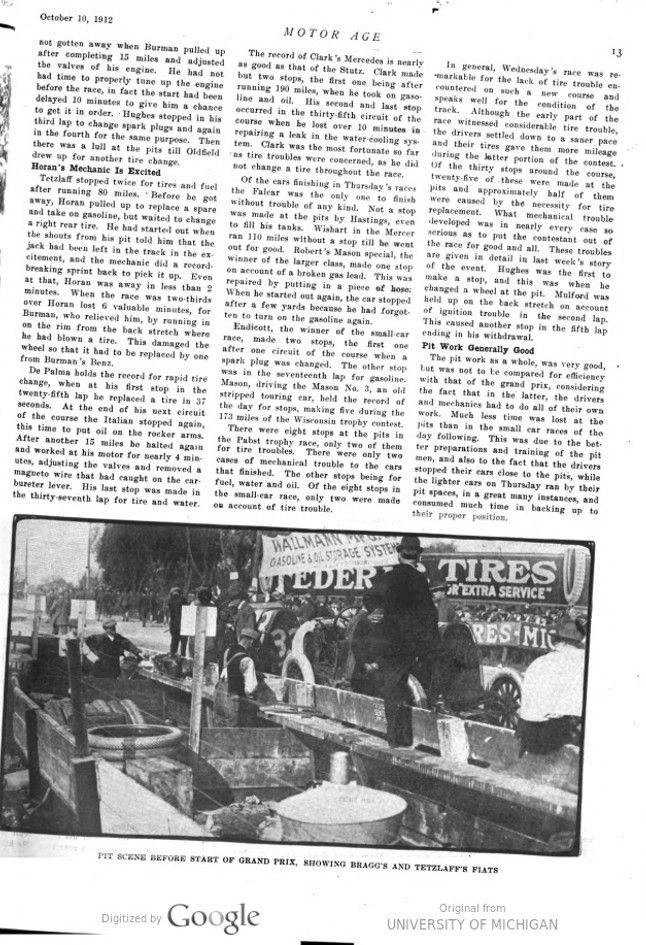
The necessity for quick work at the pits resulted in several interesting arrangements for filling the fuel tanks. Bragg had the gasoline stored at his pit under pressure with a hose from the storage tank which was slipped into the fuel tank of his Fiat. Some of the others had small gasoline cans which could be up-ended into the tank without requiring a funnel. Two of the cars, the Stutz and Hughes’ Mercer, were equipped with wire wheels in the changes and the time required to make hope of cutting down the number of tire them. Nor was any time lost in stopping and getting under way again, for the mechanic usually had leaped to the track before the car had come to a stop and nearly always had to make a flying leap to regain his seat after the driver had started.
There were in all thirty-eight stops at the pits, three of which were permanent. Of the thirty-five temporary halts, only six were for tire replacements alone, although in twenty of them advantage of the enforced stop for other causes was taken to replace worn tires or spares, or other things were done when tire changes became necessary. As may be expected, the majority of the tire changes were on the right rear wheel which has the hardest service.
Stutz Makes Long Non-Stop Run
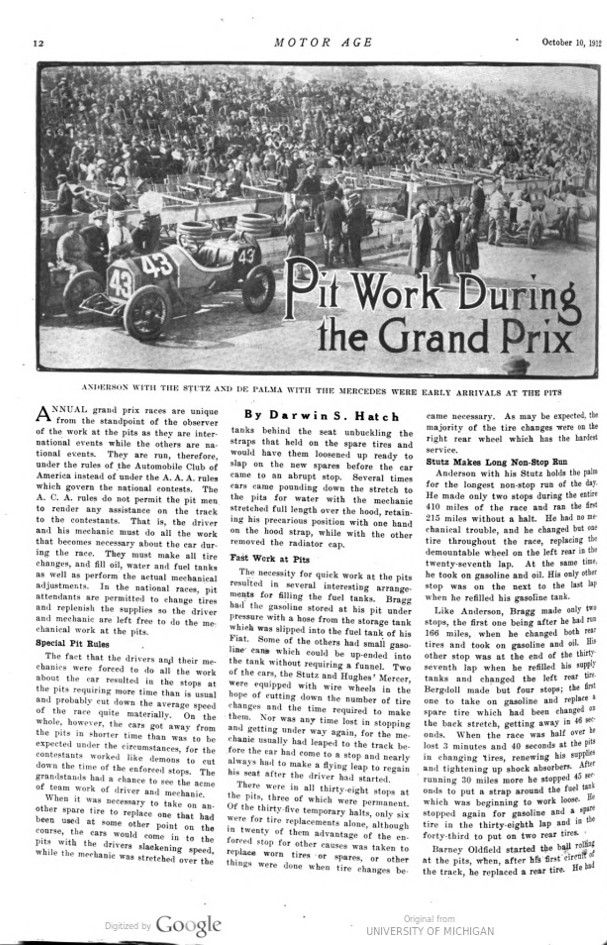
Anderson with his Stutz holds the palm for the longest non-stop run of the day. He made only two stops during the entire 410 miles of the race and ran the first 215 miles without a halt. He had no mechanical trouble, and he changed but one tire throughout the race, replacing the demountable wheel on the left rear in the twenty-seventh lap. At the same time, he took on gasoline and oil. His only other stop was on the next to the last lap when he refilled his gasoline tank.
Like Anderson, Bragg made only two stops, the first one being after he had run 166 miles, when he changed both rear tires and took on gasoline and oil. His other stop was at the end of the thirty-seventh lap when he refilled his supply tanks and changed the left rear tire. Bergdoll made but four stops; the first one to take on gasoline and replace a spare tire which had been changed on the back stretch, getting away in 46 seconds. When the race was half over he lost 3 minutes and 40 seconds at the pits in changing tires, renewing his supplies and tightening up shock absorbers. After running 30 miles more he stopped 45 seconds to put a strap around the fuel tank which was beginning to work loose. He stopped again for gasoline and a spare tire in the thirty-eighth lap and in the forty-third to put on two rear tires.
Barney Oldfield started the ball rolling at the pits, when, after his first circuit of the track, he replaced a rear tire. He had not gotten away when Burman pulled up after completing 15 miles and adjusted the valves of his engine. He had not had time to properly tune up the engine before the race, in fact the start had been delayed 10 minutes to give him a chance to get it in order. Hughes stopped in his third lap to change spark plugs and again in the fourth for the same purpose. Then there was a lull at the pits till Oldfield drew up for another tire change.
Horan’s Mechanic Is Excited
Tetzlaff stopped twice for tires and fuel after running 80 miles. Before he got away, Horan pulled up to replace a spare and take on gasoline, but waited to change a right rear tire. He had started out when the shouts from his pit told him that the jack had been left in the track in the excitement, and the mechanic did a record-breaking sprint back to pick it up. Even at that, Horan was away in less than 2 minutes. When the race was two-thirds over Horan lost 6 valuable minutes, for Burman, who relieved him, by running in on the rim from the back stretch where he had blown a tire. This damaged the wheel so that it had to be replaced by one from Burman’s Benz.
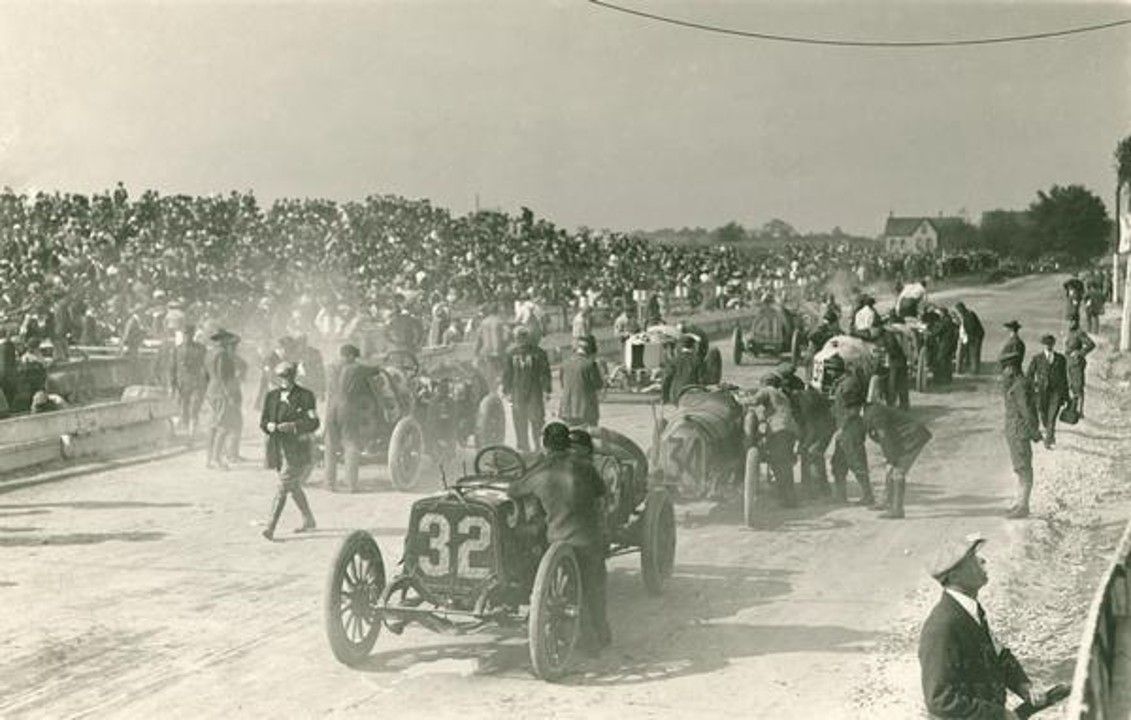
De Palma holds the record for rapid tire change, when at his first stop in the twenty-fifth lap he replaced a tire in 37 seconds. At the end of his next circuit of the course the Italian stopped again, this time to put oil on the rocker arms. After another 15 miles he halted again and worked at his motor for nearly 4 minutes, adjusting the valves and removed a magneto wire that had caught on the carbureter lever. His last stop was made in the thirty-seventh lap for tire and water.
The record of Clark’s Mercedes is nearly as good as that of the Stutz. Clark made but two stops, the first one being after running 190 miles, when he took on gasoline and oil. His second and last stop occurred in the thirty-fifth circuit of the course when he lost over 10 minutes in repairing a leak in the water-cooling system. Clark was the most fortunate so far as tire troubles were concerned, as he did not change a tire throughout the race.
Of the cars finishing in Thursday’s races the Falcar was the only one to finish without trouble of any kind. Not a stop was made at the pits by Hastings, even to fill his tanks. Wishart in the Mercer ran 110 miles without a stop till he went out for good. Robert’s Mason special, the winner of the larger class, made one stop on account of a broken gas lead. This was repaired by putting in a piece of hose, When he started out again, the car stopped after a few yards because he had forgotten to turn on the gasoline again.
Endicott, the winner of the small-car race, made two stops, the first after one circuit of the course when a spark plug was changed. The other stop was in the seventeenth lap for gasoline. Mason, driving the Mason No. 3, an old, stripped touring car, held the record of the day for stops, making five during the 173 miles of the Wisconsin trophy contest. There were eight stops at the pits in the Pabst trophy race, only two of them for tire troubles.
There were only two cases of mechanical trouble to the cars that finished. The other stops being for fuel, water and oil. Of the eight stops in the small-car race, only two were made on account of tire trouble.
In general, Wednesday’s race was remarkable for the lack of tire trouble encountered on such a new course and speaks well for the condition of the track. Although the early part of the drivers settled down to a saner pace race witnessed considerable tire trouble, and their tires gave them more mileage during the latter portion of the contest. Of the thirty stops around the course, twenty-five of these were made at the pits and approximately half of them replacement. What mechanical trouble were caused by the necessity for tire developed was in nearly every case so serious as to put the contestant out of the race for good and all. These troubles are given in detail in last week’s story of the event. Hughes was the first to changed a wheel at the pit. Mulford was make a stop, and this was when he held up on the back stretch on account of ignition trouble in the second lap. This caused another stop in the fifth lap ending in his withdrawal.
Pit Work Generally Good
The pit work as a whole, was very good, but was not to be compared for efficiency with that of the grand prix, considering the fact that in the latter, the drivers and mechanics had to do all of their own work. Much less time was lost at the pits than in the small car races of the day following. This was due to the better preparations and training of the pit men, and also to the fact that the drivers stopped their cars close to the pits, while the lighter cars on Thursday ran by their pit spaces, in a great many instances, and consumed much time in backing up to their proper position.
Photos.
Page 12.
ANDERSON WITH THE STUTZ AND DE PALMA WITH THE MERCEDES WERE EARLY ARRIVALS AT THE PITS
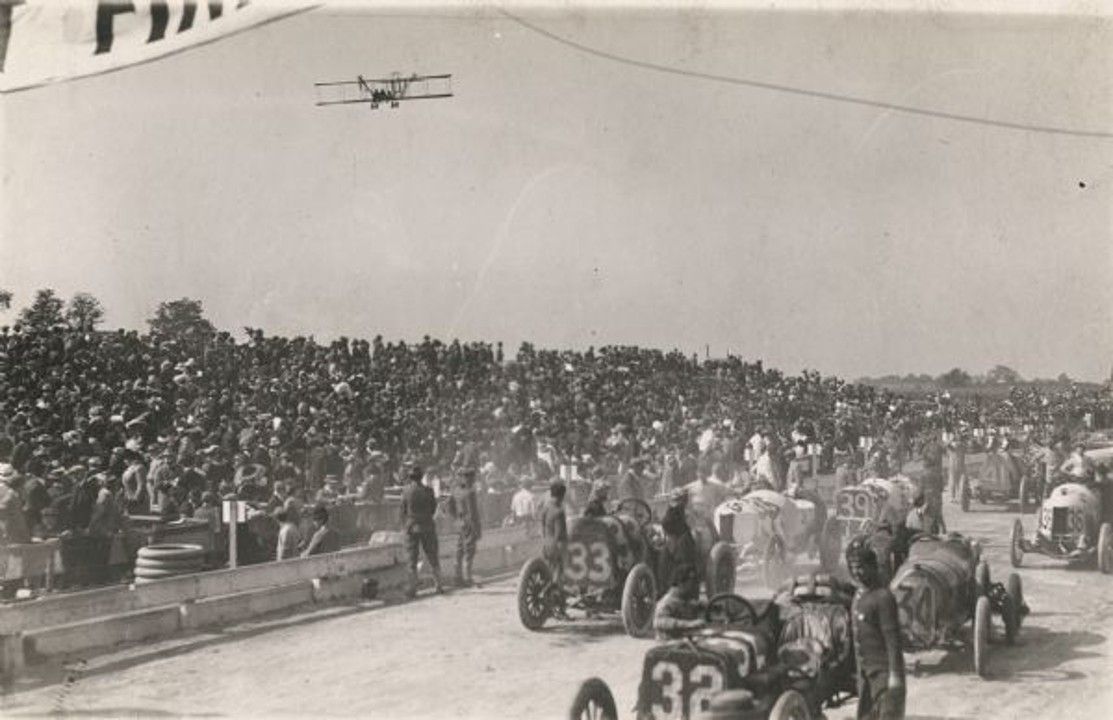
PIT SCENE BEFORE START OF GRAND PRIX, SHOWING BRAGG’S AND TETZLAFF’S FIATS