
After early articles in Automotive Industries appeared on the subject of New 1930 Indianaapolis rules and Stock Cars, July 7 and August 31, now this very long article more or less sumarises it all. The opinions of some experts like Fred Duesenberg and Harry Miller; some industrials of the automotive industry and some influentials from racing management are summarized. A Long Read, Indeed! But a very informative one.


Text and jpegs by courtesy of hathitrust.org www.hathitrust.org, compiled by motorracinghistory.com
Automotive Industries, Vol. 61, No. 11, September 14, 1929
New Race Rules Will Aid Industry By Improving Stock Car Design
Automotive authorities, weighing the Moskovics-Rickenbacker discussion of regulations, predict revival of factory interest and greater public support for contest.
By JAMES W. COTTRELL
COMPETITION between cars similar to stock design, or incorporating features which may be applicable to future standard production, which will result from the new rules for annual Indianapolis Speedway race, will revive factory interest and attract greater public support. There may be some racing freaks in next year’s contest but they will be in the minority and most of the cars entered will be of a type from which information of value to stock car designers can be obtained.
Those who have discussed the views of F. E. Moskovics and Captain E. V. Rickenbacker concerning regulations governing the 1930 race at Indianapolis, with one or two exceptions, hold these opinions and agree with Captain Rickenbacker that no further engineering information of value to designers of stock cars could be obtained from further competition between the highly specialized 91½ in. jobs.
While there is substantial agreement on these points, there are many different ideas about the sort of contest which should take the place of those held in the past four years under the 91½-in. limitation on piston displacement. There are so many different opinions, in fact, that it is evident that no single set of rules will satisfy everyone.
The new rules differ so markedly from those in force this year that there is ample opportunity for „many men of many minds“ to express themselves. Letters which have been received from automotive authorities on this subject leave no doubt that the writers are keenly interested in the new rules. Letters of several pages are not written by busy men on subjects in which they have no concern.
Arranging a private 500-mile test run would be much simpler than drawing a new set of rules for the Indianapolis race. This annual contest is a major sporting event as well as a proving ground for automotive design, and three groups, the public, the Speedway management and the automobile industry, have a common interest in rules governing the race. Unless the race appeals to the public and there is a big gate there will be no race of any kind – and no benefit to automobile designers.
Three factors stand out in discussion of the new rules. First, the effect the rules will have upon the race as a sporting event; second, changes they will bring about in cars entered; third, their influence on future stock car design.
The importance of gate receipts was mentioned by Val Haresnape, secretary, Contest Board, American Automobile Assn., in an article in the August 31st issue of Automotive Industries. Several others have mentioned this point, among them Neal Whalen, former driver, now with Minerva Automobiles, Inc., New York City. He states, „All rules of any contests in the past or those to be decided in the future must be drawn up with the idea first and always in mind that the promoters conducting such a contest will cover expenses and make money if possible.“
All recognize that much engineering information can be obtained from a long-distance event, such as the Indianapolis 500-mile race. However, there are two thoughts about how the engineering information could be obtained. One group favors racing with stock car units with the idea of testing these units, while the other group would permit trying out engineering ideas in the race before they are incorporated in the standard production.
There is general agreement that a better opportunity is provided for automobile engineers to try out designs applicable to stock cars in races under the new rules than in contests between small displacement engines, such as the recent 91½ cu. in. jobs.
F. S. Duesenberg, builder of race cars, states that, „There will be a great deal of good derived from this race, there is no doubt that a number of level-headed engineers or “would-be” engineers will work out a semi-stock chassis with very high-class material and simple construction throughout that will probably carry off the money and surprise all of us. It is from this class that we will probably see the winner and gain the most knowledge that will be of future use to the automotive industry. Certainly, a lot more can be learned from these than from some of the highly specialized jobs that will be built. Then, too, the manufacturers who are building snappy, speedy automobiles will be able to gain considerable knowledge from cars that will be rebuilt by garage mechanics, and some of these will have injected into them new ideas that probably will give a lot more speed and better performance.“
Racing Develops Stock Cars
The same opinion is expressed by T. E. Myers, vice-president, Indianapolis Speedway, who observes: „Our racing now has before it the same problems the passenger car engineer has. I state unequivocally that with conditions similar (and the trend bound definitely in one direction for years to come), the racing clan will once more buckle to its task and as a result of its desire for speed it will aid in the development of the automotive powerplant of today and tomorrow.“
With racing and stock cars once more aligned in structural parts, the industry cannot help but benefit largely along the lines of similarity. They are: engine size, carburetion, brakes, valves and transmission – and the engine is the heart of the automobile.
The value of the contest to a company entering a car under its own name is brought out by Thomas J. Litle, Jr., chief engineer, Marmon and chairman of the S.A.E. Stock Car Contest Advisory Committee, who believes that, „The new racing cars of modified stock design will prove of great publicity value to any company entering. The car does not necessarily have to win the race but may make a remarkably good showing in its class, or function more perfectly than certain cars in classes above. Great stress can be laid to the reliability, freedom from pit stops, gasoline economy, etc.“
Stock Contests in Prospect
Races for stock cars, either alone or in connection with the Indianapolis Memorial Day Race, are proposed in several letters. T. B. Buckwalter, vice-president of the Timken Roller Bearing Co., and another engineer, favors strictly stock events. Neal Whalen suggests staging a stock race the day before the 500-mile contest and Mel Stringer, New York, N. Y., believes that if motor car manufacturers enter cars, they should be confined to the units in current production, but should have the right to modify these units to meet racing conditions. Another suggestion for holding both sporting events and stock car races comes from T. F. Chandler, vice-president, Ross Gear & Tool Co.
There is a possibility that a stock car event may be staged in the future, according to T. E. Myers, who observes, „Our early racing program did not reach its present state in a year nor in a few years, and that by degrees eventually we may be racing bona fide stock cars – If the industry desires it.“
Practically all those commenting on the new rules agree that „we were getting nowhere with the 91½-in. jobs.“ Thomas J. Litle, Jr., states, „A few years back I agreed that the toy racing engines of Lilliputian dimensions might prove of value to our industry, but I have completely changed my opinion within the last year. Unquestionably these races are highly interesting to a large number of fans, as evidenced by the gate receipts each Memorial Day at Indianapolis, but the country at large, more particularly the motor buying public, has undoubtedly lost what little interest they ever had in the affair and certainly the engineers do not take these races seriously from the constructive design standpoint. We all like to attend the race, as we might attend a horse or dog race, but there the interest stops. I have seen too many ridiculous mechanical failures and too much barnyard engineering in conjunction with these races to be at the present time seriously impressed as to their value to the industry.“
Little Value in 91½-in. Jobs
Another, who feels that manufacturers were getting little value from racing 91/2 in. engines is E. Von Hambach, research engineer, Carpenter Steel Co., Reading, Pa., and formerly director of sales for the Boyle Valve Co., sponsors of the Boyle Valve Specials. He says, „Years ago, when we were racing modified stock cars, our races were always well attended, and car manufacturers always secured some very constructive data. Since we have had the highly specialized racing car, the only manufacturers who have interested themselves in them have been Duesenberg and Harry Miller.“ A similar idea is held by a nationally known automotive engineer who believes, „The extremely small very high-speed engine is neither economical nor practical for average automobile use. In other words, I am in favor of providing enough piston displacement so that the desired power can be developed without resorting to engine speeds above 3600 to 4000 r.p.m.“
The purpose of holding the annual race at Indianapolis, other than staging a big spectacle, is mentioned by several engineers. H. L. Horning, Waukesha Motor Co., Waukesha, Wis., states that, „Among the most valuable by-products of experience, has been the experiences and proofs regarding the value of many small cylinders as against a few large cylinders. The other one is the value of front-wheel drive as compared to rear-wheel drive. While this is not yet proved in motor car practice, the chances are entirely in its favor. The balance of engines under high speed and the lubrication lessons have been of great value to the industry.“
Almost all of those who have discussed the new racing rules consider the effect these regulations will have upon design of cars to be entered in the contest next year. There is not a word of comment about piston displacement, weight or four-wheel brake requirements. Discussion centers about two-man bodies, valves, superchargers and carburetors. No one touches upon the possibility of two-cycle engines or those of Diesel or turbine type.
Predicts Small Car Entries
F. S. Duesenberg says, „I have predicted that if the present rules stand there will be 150 entries and about 50 per cent of these will be Fords. From this entry list will emerge probably 12 or 15 high-class race cars, five or six new high-class star drivers and 15 or 20 wrecked ‚would-be‘ race cars and drivers and about 100 more or less disappointed race drivers and builders that are using revamped stock cars.“
It will be recalled that F. E. Moskovics, whose criticism of the new rules was published in Automotive Industries, July 27th issue, predicted that the new rules would develop freak racing cars with 16 cylinders. The new rules may bring about development of engine with even more than 16 cylinders in the opinion of Chester S. Ricker, director of timing and scoring at Indianapolis since 1914. He says, „Let’s look at the valve side from an engineering viewpoint. Forget whether it is for sport or commercial purposes and say our only interest is to get maximum power. The breathing capacity of any engine depends upon its valves, whether it has an artificial respirator in the form of a supercharger or not. * * * To get a modern straight eight with as good breathing apparatus as one of the ninety-ones, it would have to use two 3 3/8 in. valves. * * * The answer is going to be as Mr. Moskovics says, that we are going to see freaks. Sixteen and 24-cylinder engines are the only answer to the restriction on multi-valves in the light of present-day knowledge of combustion chamber design and fuel use.“
The restriction on valves and the elimination of superchargers on four-cycle engines are two provisions of the new rules which have brought out a lot of discussion both favorable and unfavorable. Mel Stringer believes that the question of valves should be left to the discretion of the builder, and F. S. Duesenberg is of the opinion that „barring the three and four valves per cylinder is a calamity, as it takes the place of superchargers and makes it practically impossible to build a high-speed, highly efficient motor that will stand for long, sustained speed, because it brings in the burning of valves. It may, however, help toward the development of better valve steel and fuels that will not burn valves under extreme high compression and speed.“
Superchargers and valves control the amount of mixture which can be worked through a cylinder. For this reason, discussion of superchargers is tied up with that on valves. While Mr. Moskovics believes that superchargers are the best development in years and that they hold many possibilities for use in passenger cars, the high-speed racing type supercharger has few friends, judging from criticism of this unit.
Superchargers Are Impractical
A prominent engineer voices his belief that superchargers are not practical devices to put in the hands of the average automobile user, and he feels that they will never be generally used.
E. Waldo Stein, well-known racing representative of Firestone, says, „The present turbine type of superchargers is too expensive initially and demands expensive and expert maintenance. Due to the use of this instrument, the gasoline consumption has increased materially over what it was in former years. Even in racing the supercharger is always a potential source of trouble, and usually anything happening to it will put the car out of the race.“
Agreeing with Mr. Stein is T. E. (Pop) Myers, who explains this provision of the rules in this way. „We have taken off the supercharger because it is admitted generally, now, that the present type of high-speed centrifugal supercharger is not adaptable to passenger cars. We were willing to aid in its development for the benefit of the industry as long as we felt the industry could profit by it, just as we reduced the engine size by degrees since our first 500-mile race in 1911.“
Blowers Have Advocates
The supercharger, however, is not without its advocates. Lee Oldfield, Merz Engineering Co., Indianapolis, Ind., comes to the rescue by saying, „The elimination of the so-called supercharger has been the most severely condemned of all the provisions of the new rules. I think that the elimination of this device by specific rule was, and is, an error. However, I am of the opinion that the use of this device in the form and manner in which it has been used in our race cars is so unsound that its use would have been sharply cut off by the adoption of a rule controlling the fuel used. The induction of the charge at high pressure is not economical and any claims as to the efficiency of the scheme must be based on the greater output of the engine ‚per cu. in.‘ as it is usually stated rather than on the more correct ‚cu. in. per min.”
Agreeing with Mr. Oldfield are Mel Stringer and Chester S. Ricker. The former states, „I certainly do not believe in barring the supercharger. While it is true that superchargers in use are not practicable for production cars, there are now, in experimental form, superchargers which can be used on stock cars.“ Chester S. Ricker says, „As an engineer I heartily agree with Mr. Moskovics when he champions the use of multi-valve engines and superchargers. You will find every member of the International Sports Commission of a similar opinion. * * * So far as the supercharger goes, there is no question that it adds nearly 40 per cent more power to a standard engine but is more complicated and would be a thorn in the side of the average service station if something went wrong.“
Riley J. Brett, whose conditioning of racing cars has helped many leaders to success, does not agree that a supercharger is very costly to maintain. In defense of his opinion concerning the cost of the device, he says: „It may be of some interest to know that our supercharger in the last 4500 miles of racing has cost us less than $25.“ He, however, does not see any future for superchargers on pleasure cars, stating, „The centrifugal type supercharger, as far as I can see will never be of any benefit for pleasure cars and I am sure that lots can be learned about carburetion and manifolding from the new rules.“
Carrying two men in each car, as required by the new rules, has evoked a spirited argument. F. E. Moskovics opened the attack on this provision of the rules by saying, „Putting two men in each car, as contemplated by the 1930 Rules, to my mind is needlessly endangering the lives of the extra men.“ His position is upheld by F. S. Duesenberg, who says, „I regret very much the ruling that a mechanician is to ride in the race. I had hoped that if two-man bodies were demanded that the race could be run either with or without a mechanician as the driver saw fit. I feel that it is an entirely unnecessary risk.
Driver Needs No Aid
„It is true that the mechanician is the ‚eyes‘ to the rear, but present day rules are such that if drivers follow them they need only to take care of what is ahead and leave those in the rear to look out for themselves, as the slow cars must of necessity keep to the inside and the faster cars can and will take the outside, and passing on the turn is entirely up to the man that comes up from the rear. If a driver is being overtaken in a turn the mechanician would have to signal the driver and give him instructions what to do, which necessarily will divert the driver’s attention from his own car, and I believe will cause as many accidents as it will prevent. I believe we have had less trouble since one-man cars came into vogue than before, and it should not be forgotten that car speed, since the advent of one-man cars, has increased from 20 to 25 m.p.h. and that two-man cars at this higher speed will be quite a different problem from what it was when they were doing 80 and 85 m.p.h.“ Mr. Ricker agrees with this view, which he expresses as follows, „Why place the responsibility of another man’s life on the driver and double the vital hazard in the race? Why jeopardize 34 men’s lives for the sake of one or two close brushes due to some driver not watching? Ray Harroun in 1911 used a rear-view mirror – every automobile and truck is required by law to have one – why not require it on race cars?“
Racing drivers do not favor the idea of carrying a mechanician, according to Riley J. Brett. He gives their opinion, as well as his own, in this way: „Since the new rules were announced preceding the Indianapolis race I have talked with all the drivers, both active and retired, that I could get in contact with. I have yet to find one driver that believes a riding mechanic is of any value, and some go so far as to say that they are an impedance. Had Norman Batton an occupant in his car when he came in on fire in 1927, I would not attempt to predict what might have happened.
„There are also several practical reasons why the two-man car is not so adaptable for racing. First, the driver cannot see all four tires in case of a slow leak or sneaker, which happens very often and is more dangerous than any kind of tire trouble. Secondly, it is a very difficult problem to build a two-man car that will give the driver plenty of arm room. I remember one accident that the driver claimed was caused by the mechanic being thrown over on his arm. It is unreasonable to expect a mechanic that has been riding for 22 hours to be very efficient in his pit work. One time at Chicago a driver came in for gas, the mechanic attempted to stand up in his seat and assist in putting in the gasoline. He was so excited that he poured most of the gasoline down the driver’s neck. Cases of this nature did happen frequently with the two-man cars. Doubtless, it is true that some of our premier drivers have ridden as mechanics. While there are Murphy, Hartz and De Paolo that started as riding mechanics, the majority have never done any riding.“
Two-Man Cars Favored
Captain E. V. Rickenbacker, president of Indianapolis Motor Speedway, explained the rule requiring an extra man in the car, saying, „The rule requiring two men in each car is adopted with the idea of helping the driver. He has all he can do to watch to the front of the car, and the mechanic acts as ‚eyes‘ in the rear. More than one crash has happened because a driver leading into a turn did not know what was taking place a few feet in the rear.“ E. Von Hambach sides with Captain Rickenbacker, with this observation: „I am very much in favor of the two-man cars even though I realize that there will be cases, though I hope not, where two instead of one man will be killed. However, on the other hand, far more important, is the fact that we need a training school for drivers – and in almost every instance I think a check can be made to show that the real good men, who are stars or headliners, are boys who received their earlier training in the mechanic’s seat alongside of some of the old stars now retired.“ Another who approves carrying a mechanic is Mel Stringer, who believes that this should be done for two reasons, „First, to train the race driver of the future, and also to act as an observer of the performance of the car.“
The question of the cost of designing and building a car, or team of cars, to compete in 1930 Indianapolis Race has been discussed by several engineers. One of them says, „There is, of course, something to what Mr. Moskovics says about the possibility of someone spending a large sum to develop a very highly specialized car. But I believe that this would be equally true under almost any workable rules. The same thing is true in boat-racing, or any other racing that I know anything about. Take boat racing, for instance, Gar Wood is very successful, partly because he is a good driver and knows a lot about designing racing boats, but no small part of his success is due to the fact that he has spent enough money to build highly specialized boats. I don’t see that the changes in the rules have changed this situation. I know of several persons who have spent large sums of money building highly specialized 91 cu. in. racing cars. I firmly believe that if they had spent the same amount of money building cars to conform to the new rules, they would have had better results.“
Expenses Run High
Speaking along the same lines, F. S. Duesenberg calls attention to the fact that „Any good race car for the Indianapolis Race is going to cost a lot of money regardless of the winning possibilities. * * * The total cost of one lot of cars, covering a period of three years, has certainly run above a hundred thousand dollars. Their winnings have not been sufficient to pay racing expenses to say nothing about covering the interest on the original investment.”
One feature of the new rules which has attracted little attention is the section which requires the thread to be from 54 to 60 in. Previously there was no regulation of tread. The new rule is along lines of passenger car practice. An objection is made by Riley J. Brett, who says, „I can see no reason for widening the thread as this brings the un-sprung weight up and makes the steering tie rod longer, both of which are very undesirable for racing cars on the Indianapolis track.“
This change is explained by Т. Е. Myers, who replies that: „The change in tread was made because it now approaches standard practice and gets away from highly specialized cars and makes racing more attractive for the manufacturer.“
Whether the 1930 race cars will be speedier than their predecessors is a question about which there are two directly opposite opinions. Some believe that the new cars will be faster, others that they will be slower.
If nothing but piston displacement were involved, it might be taken for granted that the new cars will be faster. The increase in permissible piston displacement from 91½ cu. in. to 366 cu. in. more than offsets the elimination of the supercharger. However, the race at Indianapolis is not a speed trial, but a long-distance event over a course which tries both car and driver.
Val Haresnape brought out this point, saying: „The winning car that results from these specifications must travel 500 miles on a track with four corners in which of the 33 qualifying cars at Indianapolis this year could speed is of its very nature physically restricted. Any easily best Major Segrave’s 231-mile Golden Arrow in a 500-mile race on the Indianapolis track.“
Tires May Be a Factor
Tires may become a major factor in speed, under the rules which call for carrying a mechanic and heavier cars, if the piston displacement is largely increased. F. S. Duesenberg mentions this point, stating: „There probably will be three or four very high-priced, highly specialized speed creations built for this race, and these cars will have a very wide advantage over the average car that is going into this race. These cars will be much faster than present cars, and will make the average race car of today look like ancient history, but add to this speed the extra weight that will have to be carried, both in car weight, to comply with cubic inch displacement, and a mechanic, and the tire question immediately comes up, and this certainly can’t be evaded by anyone. *** Stamina, of course, can be added to the motor so that higher speed may be maintained, but changing tires is about as disastrous as some of the other troubles, and will certainly reduce the speed so that they may have plenty of trouble keeping up with the slow ones.“
Both T. E. Myers and Chester S. Ricker expressed the opinion that the new rules are intended to reduce speed. Mr. Myers says: „The rules were made for two distinct purposes: To reduce the speed of the present type of racing car, which had reached a rate that was dangerous, and to make mandatory the racing of cars that more nearly approach stock cars in their make-up and operation.“
Trend in the United States toward higher road speeds for standard automobiles has been one of the factors which brought about a change in the rules, and this development will continue to influence rule makers in the future, according to several authorities. On this subject T. E. Myers notes: „Our roads are becoming wider and much better paved than in other years. Our business and personal demands are for high speed with safety. America has no horsepower tax as England has. There is no demand that horsepower be kept at a minimum to aid the factory in making sales and the individual in buying. The natural result has been a powerplant of medium size with high car speed and dependability. This trend is definite, in my opinion, and in time engine size may increase in answer to the demand for increased speed, larger and heavier cars.“
Capt. E. V. Rickenbacker brought out this point in his reply to Mr. Moskovics‘ criticism of the new rules. In the interview published in the August 31st issue of Automotive Industries, Capt. Rickenbacker said: „This is the age of speed. Speed in the air has directed attention to more speedy transportation of all forms. The cycle of better roads and higher speeds goes on. Passenger car speeds will advance greatly within the next few years.“
Sixteen-cylinder engines, as predicted by F. E. Moskovics and Ches- ter S. Ricker, may be used in stock car production, according to Thomas J. Litle, Jr. He expresses the thought that the trend is decidedly toward the use of more cylinders. „I expect to see the use of the 16-cylinder engine in the large, luxurious car for the simple reason that if a passenger car weight is over approximately 4500 lb., the eight-cylinder engine becomes too unwieldy as the reciprocating weights composed of the pistons and rods are too great, and very large eight-cylinder engines are rather rough.“
Due to the fact that many of the engineers have commented on the individual paragraphs of the new rules, there are less general opinions for or against these rules than otherwise would be the case.
While this discussion has been going on the official entry blanks have been issued by the Indianapolis Speedway management. Therefore, it is too late, in all probability, to make any change for the 1930 contest. Mr. MacGregor concludes his comments with this re- mark, „As I look at the whole thing, the rules are set and everyone might as well make up his mind to lend his support insofar as it is possible and when actual experience instead of opinion is available for guidance, help to change the rules with whatever modifications may be necessary to accomplish the intended purpose.“
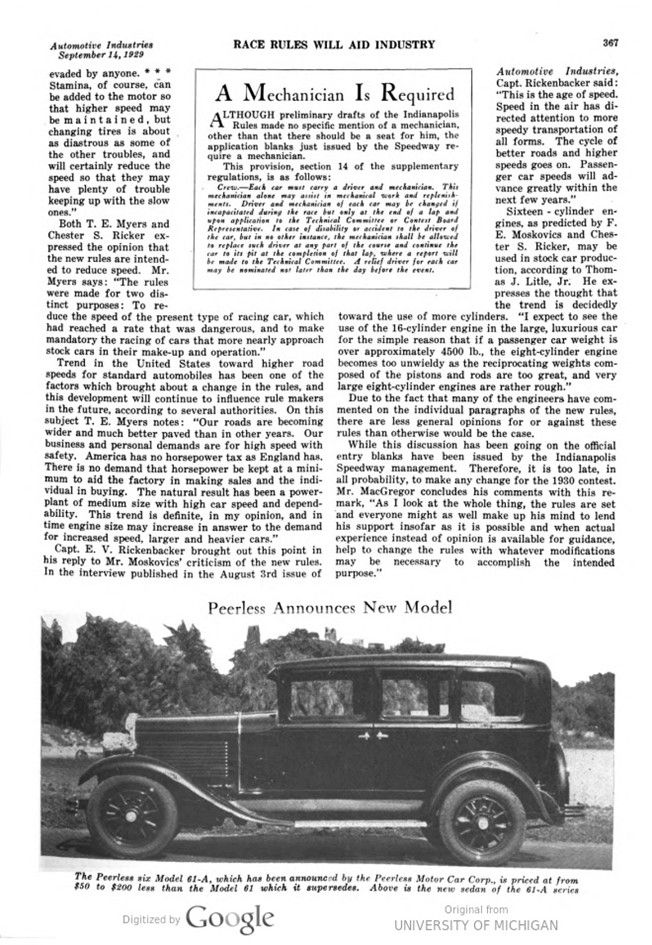
A Mechanician Is Required
ALTHOUGH preliminary drafts of the Indianapolis Rules made no specific mention of a mechanician, other than that there should be a seat for him, the application blanks just issued by the Speedway require a mechanician.
This provision, section 14 of the supplementary regulations, is as follows:
Crew. – Each car must carry a driver and mechanician. This mechanician alone may assist in mechanical work and replenishments. Driver and mechanician of each car may be changed if incapacitated during the race but only at the end of a lap and upon application to the Technical Committee or Contest Board Representative. In case of disability or accident to the driver of the car, but in no other instance, the mechanician shall be allowed to replace such driver at any part of the course and continue the car to its pit at the completion of that lap, where a report will be made to the Technical Committee. A relief driver for each car may be nominated not later than the day before the event.
Photos.
Page 361.
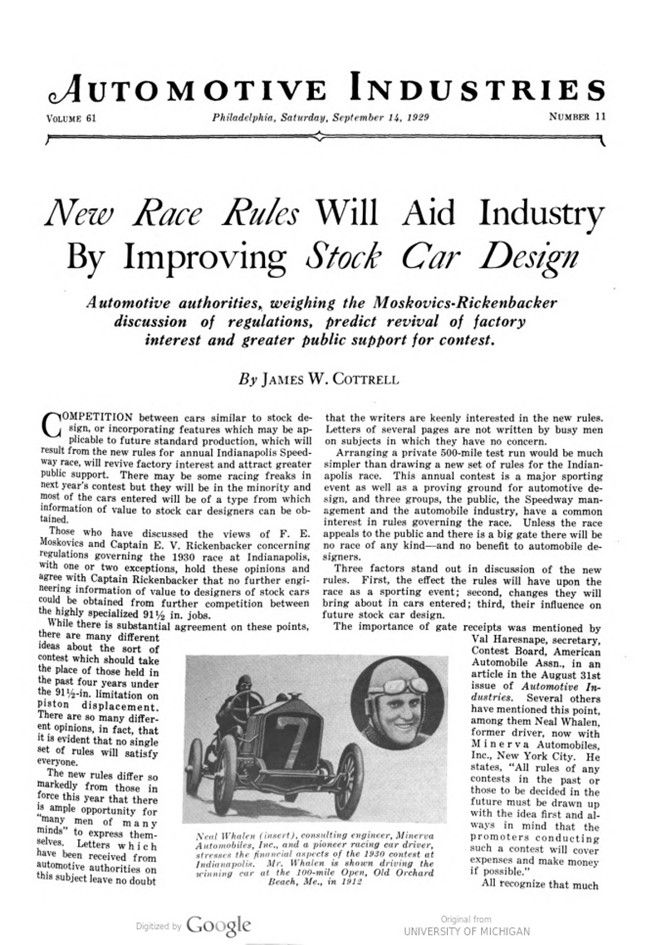
Neal Whalen (insert), consulting engineer, Minerva Automobiles, Inc., and a pioneer racing car driver, stresses the financial aspects of the 1930 contest at Indianapolis. Mr. Whalen is shown driving the winning car at the 100-mile Open, Old Orchard Beach, Me., in 1912
Page 362.
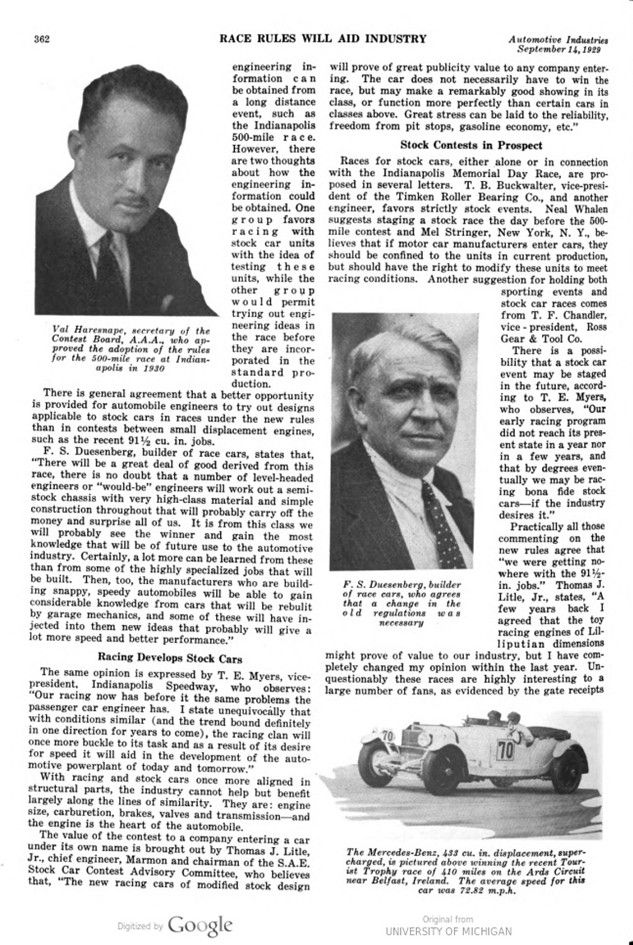
Val Haresnape, secretary of the Contest Board, A.A.A., who approved the adoption of the rules for the 500-mile race at Indianapolis in 1930
F. S. Duesenberg, builder of racecars, who agrees that a change in the old regulations was necessary
The Mercedes-Benz, 433 cu. in. displacement, supercharged, is pictured above winning the recent Tourist Trophy race of 410 miles on the Ards Circuit near Belfast, Ireland. The average speed for this car was 72.82 m.p.h.
Page 363.
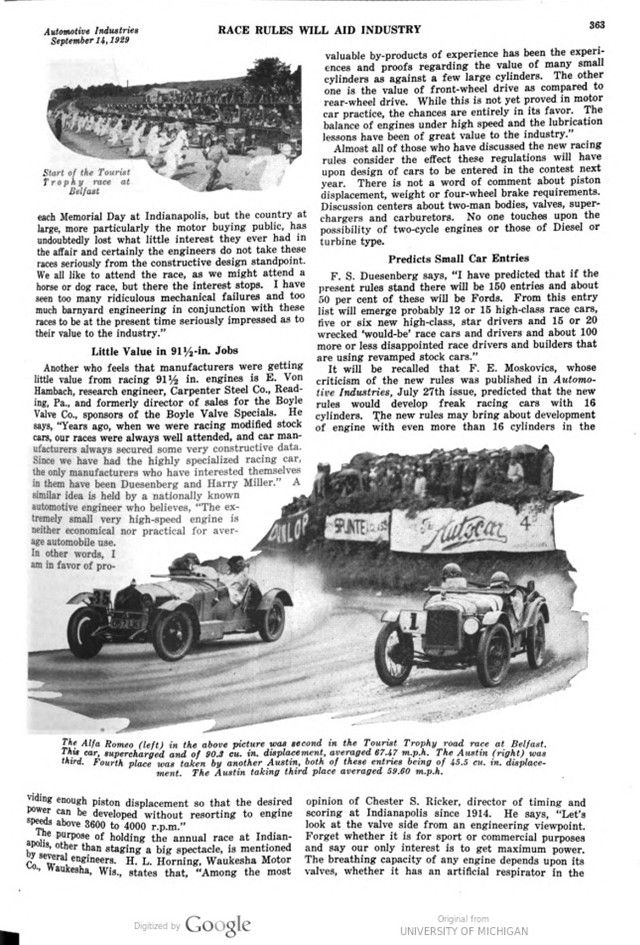
Start of the Tourist Trophy race at Belfast
The Alfa Romeo (left) in the above picture was second in the Tourist Trophy road race at Belfast. This car, supercharged and of 90.3 cu. in. displacement, averaged 67.47 m.p.h. The Austin (right) was third. Fourth place was taken by another Austin, both of these entries being of 45.5 cu. in. displacement. The Austin taking third place averaged 59.60 m.p.h.
Page 364.
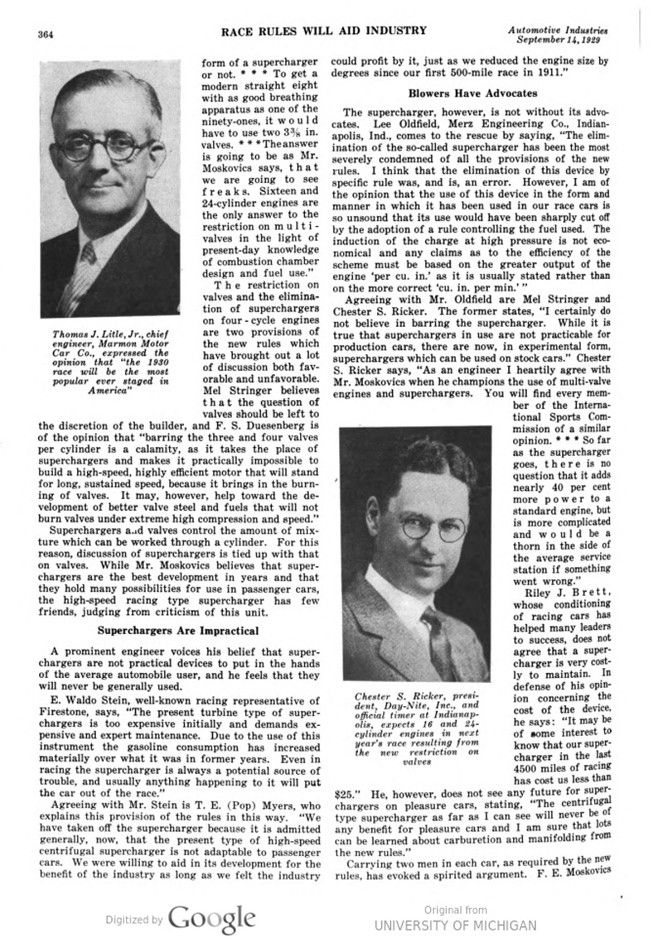
Thomas J. Litle, Jr., chief engineer, Marmon Motor Car Co., expressed the opinion that „the 1930 race will be the most popular ever staged in America“
Chester S. Ricker, president, Day-Nite, Inc., and official timer at Indianapolis, expects 16 and 24-cylinder engines in next year’s race resulting from the restriction valves Page 365.
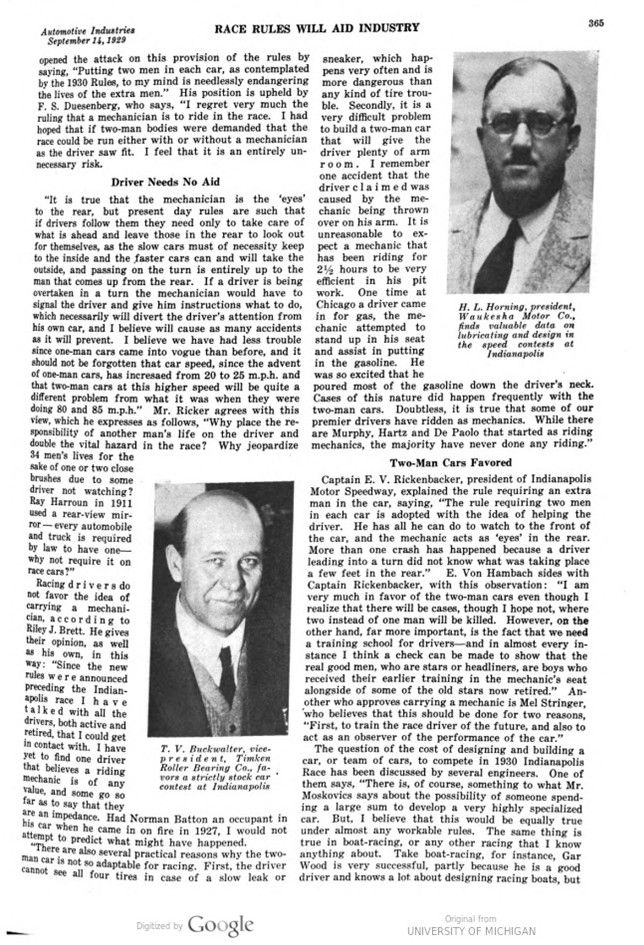
T. V. Buckwalter, vice-president, Timken Roller Bearing Co., favors a strictly stock car contest at Indianapolis
H. L. Horning, president, Waukesha Motor Co., finds valuable data on lubricating and design in the speed contests at Indianapolis
Page 366.
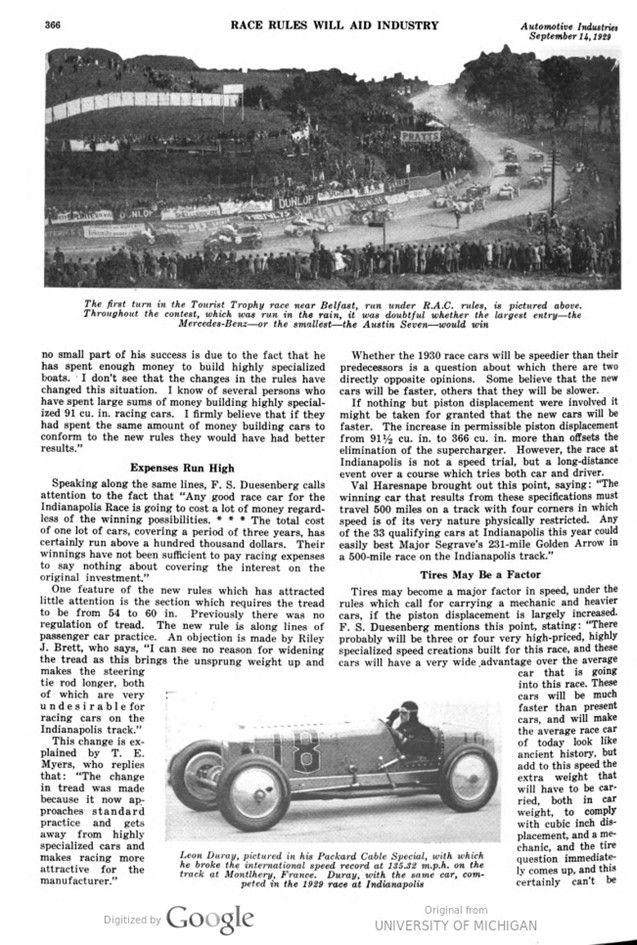
The first turn in the Tourist Trophy race near Belfast, run under R.A.C. rules, is pictured above. Throughout the contest, which was run in the rain, it was doubtful whether the largest entry – the Mercedes-Benz – or the smallest the Austin Seven – would win
Leon Duray, pictured in his Packard Cable Special, with which he broke the international speed record at 135.32 m.p.h. on the track at Montlhery, France. Duray, with the same car, competed in the 1929 race at Indianapolis