

It was January 1929 when the propsed specifications for the new 1930 Indianapolis Race Rules were published in automotive magazines, such as (here) Automotive Industries. The final form was supposed to be issued at the 1929 Indianapolis 500 Race. Here are the major specifications, as given by the secretary of the A.A.A. Contest Board, Val Haresnape, who also was a known racing driver.


Text and jpegs by courtesy of hathitrust.org www.hathitrust.org, compiled by motorracinghistory.com
Automotive Industries, Vol. 60, No. 4, January 26, 1929
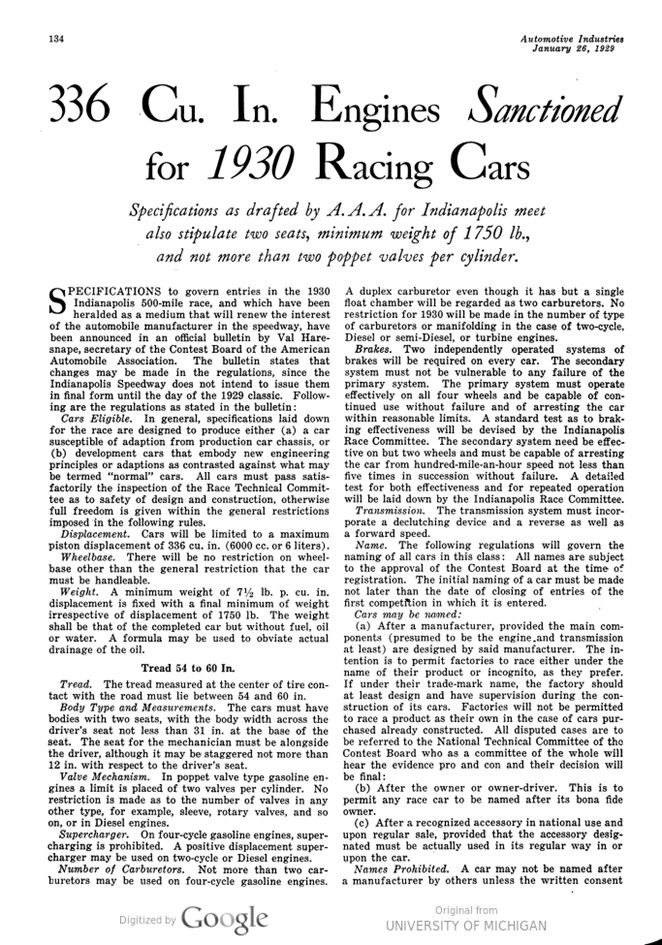
336 Cu. In. Engines Sanctioned for 1930 Racing Cars
Specifications as drafted by A.A.A. for Indianapolis meet also stipulate two seats, minimum weight of 1750 lb., and not more than two poppet valves per cylinder.
SPECIFICATIONS to govern entries in the 1930 Indianapolis 500-mile race, and which have been heralded as a medium that will renew the interest of the automobile manufacturer in the speedway, have been announced in an official bulletin by Val Haresnape, secretary of the Contest Board of the American Automobile Association. The bulletin states that changes may be made in the regulations, since the Indianapolis Speedway does not intend to issue them in final form until the day of the 1929 classic. Following are the regulations as stated in the bulletin:
Cars Eligible. In general, specifications laid down for the race are designed to produce either (a) a car susceptible of adaption from production car chassis, or (b) development cars that embody new engineering principles or adaptions as contrasted against what may be termed „normal“ cars. All cars must pass satisfactorily the inspection of the Race Technical Committee as to safety of design and construction, otherwise full freedom is given within the general restrictions imposed in the following rules.
Displacement. Cars will be limited to a maximum piston displacement of 336 cu. in. (6000 cc. or 6 liters).
Wheelbase. There will be no restriction on wheel- base other than the general restriction that the car must be handleable.
Weight. A minimum weight of 72 lb. p. cu. in. displacement is fixed with a final minimum of weight irrespective of displacement of 1750 lb. The weight shall be that of the completed car but without fuel, oil or water. A formula may be used to obviate actual drainage of the oil.
Tread 54 to 60 In.
Tread. The tread measured at the center of tire con- tact with the road must lie between 54 and 60 in.
Body Type and Measurements. The cars must have bodies with two seats, with the body width across the driver’s seat not less than 31 in. at the base of the seat. The seat for the mechanician must be alongside the driver, although it may be staggered not more than 12 in. with respect to the driver’s seat.
Valve Mechanism. In poppet valve type gasoline engines a limit is placed of two valves per cylinder. No restriction is made as to the number of valves in any other type, for example, sleeve, rotary valves, and so on, or in Diesel engines.
Supercharger. On four-cycle gasoline engines, supercharging is prohibited. A positive displacement supercharger may be used on two-cycle or Diesel engines.
Number of Carburetors. Not more than two carburetors may be used on four-cycle gasoline engines. A duplex carburetor even though it has but a single float chamber will be regarded as two carburetors. No restriction for 1930 will be made in the number of type of carburetors or manifolding in the case of two-cycle, Diesel or semi-Diesel, or turbine engines.
Brakes. Two independently operated systems of brakes will be required on every car. The secondary system must not be vulnerable to any failure of the primary system. The primary system must operate effectively on all four wheels and be capable of continued use without failure and of arresting the car within reasonable limits. A standard test as to braking effectiveness will be devised by the Indianapolis Race Committee. The secondary system need be effective on but two wheels and must be capable of arresting the car from hundred-mile-an-hour speed not less than five times in succession without failure. A detailed test for both effectiveness and for repeated operation will be laid down by the Indianapolis Race Committee.
Transmission. The transmission system must incorporate a declutching device and a reverse as well as a forward speed.
Name. The following regulations will govern the naming of all cars in this class: All names are subject to the approval of the Contest Board at the time of registration. The initial naming of a car must be made not later than the date of closing of entries of the first competition in which it is entered.
Cars may be named:
(a) After a manufacturer, provided the main components (presumed to be the engine and transmission at least) are designed by said manufacturer. The intention is to permit factories to race either under the name of their product or incognito, as they prefer. If under their trade-mark name, the factory should at least design and have supervision during the construction of its cars. Factories will not be permitted to race a product as their own in the case of cars purchased already constructed. All disputed cases are to be referred to the National Technical Committee of the Contest Board who as a committee of the whole will hear the evidence pro and con and their decision will be final:
(b) After the owner or owner-driver. This is to permit any race car to be named after its bona fide owner.
(c) After a recognized accessory in national use and upon regular sale, provided that the accessory designated must be actually used in its regular way in or upon the car.
Names Prohibited. A car may not be named after a manufacturer by others unless the written consent of the manufacturer concerned is filed with the Contest Board on or before the first application for registration, nor is a car to be permitted to resemble the product of any American manufacturer without such written consent. This regulation applies particularly to radiator, hood, hub caps, and other individual characteristics.
No change in name after the initial christening may be made without first obtaining approval of the Contest Board. In general, cars named for a manufacturer or an accessory will be required to be altered substantially in appearance. In no case will they be permitted to be named for a second manufacturer. They may be permitted to be named for a second accessory provided there is a bona fide sale and the new accessory is actually used, as in the first instance. There is no intention to restrict the renaming of cars after new private owners. In all cases, however, notice must be given to the Contest Board not less than 30 days prior to the authorized use of the new name, even where permission is granted.