
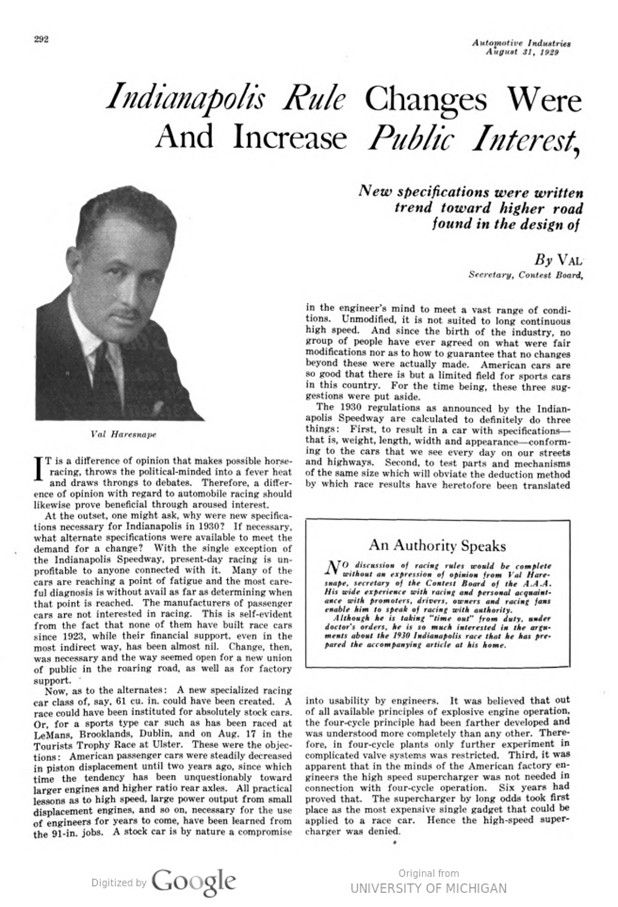
Val Haresnape, Indianapolis 500 race driver ánd Secretary of the A.A.A. Contest Board, writes his opinion in that the foreseen new 1930 Indianapolis race rules were meant for the automotive industry and for the public. At the end of this article, a comment of the new president of the Indianapolis Motor Speedway Company, none less than Eddy Rickenbacher is shown. Pick your opinion on the discussion as so far!


Text and jpegs by courtesy of hathitrust.org www.hathitrust.org, compiled by motorracinghistory.com
Automotive Industries, Vol. 61, No. 9, August 31, 1929
Indianapolis Rule Changes Were Made to Gain Factory Support
And Increase Public Interest, Says Contest Board Secretary
New specifications were written to conform more closely to the trend toward higher road speeds and larger engines found in the design of modern passenger cars.
By VAL HARESNAPE
Secretary, Contest Board, American Automobile Association
An Authority Speaks
No discussion of racing rules would be complete without an expression of opinion from Val Haresnape, secretary of the Contest Board of the A.A.A. His wide experience with racing and personal acquaintance with promoters, drivers, owners and racing fans enable him to speak of racing with authority. Although he is taking „time out“ from duty, under doctor’s orders, he is so much interested in the arguments about the 1930 Indianapolis race that he has prepared the accompanying article at his home.
IT is a difference of opinion that makes possible horse-racing, throws the political-minded into a fever heat and draws throngs to debates. Therefore, a difference of opinion with regard to automobile racing should likewise prove beneficial through aroused interest.
At the outset, one might ask, why were new specifications necessary for Indianapolis in 1930? If necessary, what alternate specifications were available to meet the demand for a change? With the single exception of the Indianapolis Speedway, present-day racing is unprofitable to anyone connected with it. Many of the cars are reaching a point of fatigue and the most careful diagnosis is without avail as far as determining when that point is reached. The manufacturers of passenger cars are not interested in racing. This is self-evident from the fact that none of them have built racecars since 1923, while their financial support, even in the most indirect way, has been almost nil. Change, then, was necessary and the way seemed open for a new union of public in the roaring road, as well as for factory support.
Now, as to the alternates: A new specialized racing car class of, say, 61 cu. in. could have been created. A race could have been instituted for absolutely stock cars. Or, for a sports type car such as has been raced at LeMans, Brooklands, Dublin, and on Aug. 17 in the Tourists Trophy Race at Ulster. These were the objections: American passenger cars were steadily decreased in piston displacement until two years ago, since which time the tendency has been unquestionably toward larger engines and higher ratio rear axles. All practical lessons as to high speed, large power output from small displacement engines, and so on, necessary for the use of engineers for years to come, have been learned from the 91-in. jobs. A stock car is by nature a compromise in the engineer’s mind to meet a vast range of conditions. Unmodified, it is not suited to long continuous high speed. And since the birth of the industry, no group of people have ever agreed on what were fair modifications nor as to how to guarantee that no changes beyond these were actually made. American cars are so good that there is but a limited field for sports cars in this country. For the time being, these three suggestions were put aside.
The 1930 regulations as announced by the Indianapolis Speedway are calculated to definitely do three things: First, to result in a car with specifications – that is, weight, length, width and appearance – conforming to the cars that we see every day on our streets and highways. Second, to test parts and mechanisms of the same size which will obviate the deduction method by which race results have heretofore been translated into usability by engineers. It was believed that out of all available principles of explosive engine operation, the four-cycle principle had been farther developed and was understood more completely than any other. Therefore, in four-cycle plants only further experiment in complicated valve systems was restricted. Third, it was apparent that in the minds of the American factory engineers the high-speed supercharger was not needed in connection with four-cycle operation. Six years had proved that. The supercharger by long odds took first place as the most expensive single gadget that could be applied to a race car. Hence the high-speed supercharger was denied.
Now, the other and more or less untried principles of engine operation – two-cycle, Diesel, semi-Diesel and turbine – are conceded to have vast and incalculable possibilities. No restrictions whatsoever were placed on the development of cars powered by engines with any of these characteristics. The development of a practical Diesel engine for passenger car operation alone would result in multiplication of the available fuel for motorists by 20 times, at a much lesser cost and without fire hazard. And racing, should it develop a practical Diesel motor powerplant, would make a contribution not only to motordom but to aviation.
The same is true regarding carburetion. Experimental four-cycle cars have used any number of carburetors up to one per cylinder. But normal passenger cars are not so equipped and not a single engineer could be found who believed that more than two (or dual) carburetors could be safely placed on the average public vehicle, due to the necessity for sensitive adjustment. But we do need more efficient employment of fuels mixed by the single or dual carburetors that are being used and further study of manifolding and correct mixing can be expected to give valuable result.
The regulations have resulted in intense arguments. That, at least, shows that they are virile. Many objections, the public champion of whom has been Mr. Moskovics, are that there is no restriction against very expensive cars far beyond even the present cars in complications. Let us be practical.
We are not discussing the building of a mile straight-away car. The winning car that results from these specifications must travel 500 miles on a track with four corners in which speed is of its very nature physically restricted. Any of the 33 qualifying cars at Indianapolis this year could easily best Major Segrave’s 231-mile Golden Arrow in a 500-mile race on the Indianapolis track. We have seen many examples of the expensively built car which seemed theoretically the last whisper, but which never won a race. A car has competed at Indianapolis the last three years, in which the eventual investment totaled finally this year $125,000. It was never a racing success. There is nothing to fear from this score.
There can be serious debate on the question of two-man crews and when and where they should be permitted. The Contest Board will probably prohibit the riding mechanic on races of 100 miles or under. It will also likely continue to prohibit the riding of a mechanic on steeply banked tracks on which there is practically no restriction as to speed. But on tracks of a simulated road character, such as Indianapolis, the maximum speed is limited. Over long races, dangerous fatigue can possess a driver without observation. There has been only one fatal accident on this track in years. Probably as many accidents from not knowing of an overtaking car have occurred as from all other causes. The actual number of men exposed to physical injury will probably be the same – surely not more.
The mechanic can assist materially in team spirit, guard his driver against dangerous fatigue, assist in safe passage through dense traffic, read and interpret signals and many otherwise un- noticed incidents. He will be turned out a graduate of a school that will result again in a class of drivers of superior training.
The suggestion that American racing consider fuel limitation could not have had any serious thought or consideration. In formula racing the calculations that determine the winner must be made by experts after the contest proper is concluded. The results are available only through the press. Racing in America for years, and as far as we can see in the future, is dependent for its financial support on the gate receipts from the attending public. No sport in this country will succeed in which the tide of battle is not constantly and clearly in evidence and in which the final and deciding result is not immediately and visually observed. It is possible that with strictly stock cars over a long period such as 12 or 24 hours, fuel allowance might be successful, letting the color and the pageantry of the occasion suffice to satisfy the public, with the dependence largely on factory financial support to defray the costs of the competition and the public’s contribution merely divided between prizes to the drivers and profits to the promoter.
A departure such as this naturally results in discussion. My office has been a chief focal point for it. So far, it is all healthy and beneficial. Most of the critics are not hazarding a penny on racing. To them it is merely academic. Bear in mind that the Indianapolis Speedway is hazarding not less than the $150,000 actual cost of the annual „500“ on the strength of their judgement, but likewise the potential earning of perhaps a quarter of a million dollars which they deserve on a fixed investment of better than a million dollars and an annual operating expense included the race of the same amount. Fortunately, it is quite clear that the new regulations will receive support. I personally look for not less than 75 worth-while American entries next year and the greatest number of foreign entries we have had since prior to the war. If this prediction proves true, then undoubtedly the choice of regulations had a high average of wisdom and selection.
Regulations Adopted
Final draft of regulations for next year’s 500-mile International Sweepstakes, as given in the official entry blank, include several changes which have been made since publication of the preliminary copy of the rules in Automotive Industries, in the May 25 issue.
The first change makes it necessary that two-cycle engines must be equipped with mechanical starting devices and weight of the car, including cooling water.
Second, in the naming of all cars, the following regulations will govern:
All names are subject to the approval of the Contest Board at the time of registration. The initial naming of a car must be made not later than the date of closing of entries of the first competition in which it is entered.
Cars may be named –
(a) After a manufacturer, provided the main components (that is, presumed to be the engine and transmission at least) are designed by said manufacturer. The intention is to permit factories to race either under the name of their product or incognito, as they prefer. If under their trademark name, the factory should at least design and have supervision during the construction of its car. Factories will not be permitted to race a product as their own in the case of cars purchased already constructed. All disputed cars are to be referred to the National Technical Committee of the Contest Board who as a committee of the whole will hear the evidence pro and con and their decision will be final.
(b) After the owner or owner-driver. This is to permit any race car to be named after its bona fide owner;
(c) After a recognized accessory in national use and upon regular sale. Provided that the accessory designated must be actually used in its regular way in or upon the car.
Renaming Cars Restricted
Names Prohibited-A car may not be named after a manufacturer by others unless the written consent of the manufacturer concerned is filed with the Contest Board on or before the first application for registration, nor is a car to be permitted to resemble the product of any American manufacturer without such written con- sent. This regulation applies particularly to radiator, hood, hub caps and other individual characteristics.
No change in name after the initial christening may be made without first obtaining approval of the Contest Board. In general, cars named for a manufacturer or an accessory will be required to be altered substantially in appearance. In no case will they be permitted to be named for a second manufacturer. They may be permitted to be named for a second accessory provided there is a bona fide sale and the new accessory is actually used, as in the first instance. There is no intention to restrict the renaming of cars after new private owners. In all cases notice must be given the Contest Board not less than 30 days prior to the authorized use of the new name even where permission is granted.
INDIANAPOLIS MOTOR SPEEDWAY ASSOCIATION – Indianapolis, Ind. Aug. 26, 1929.
Editor, Automotive Industries:
My statement that no man is quite so well qualified to take advantage of racing rules as Mr. Moskovics referred entirely to constructing racing cars under rules for the 1930 contest at Indianapolis. His long and varied experience in racing places him in a position to plan a car which complies with the rules but may be of unusual construction and very high speed.
I had no thought of suggesting anything about taking an „unfair“ advantage of rules, and I regret that Mr. Moskovics should have misunderstood that part of my statement.
Very truly yours,
E. V. RICKENBACKER, President, Indianapolis Motor Speedway Association.
Photos.
Page 292. Val Haresnape
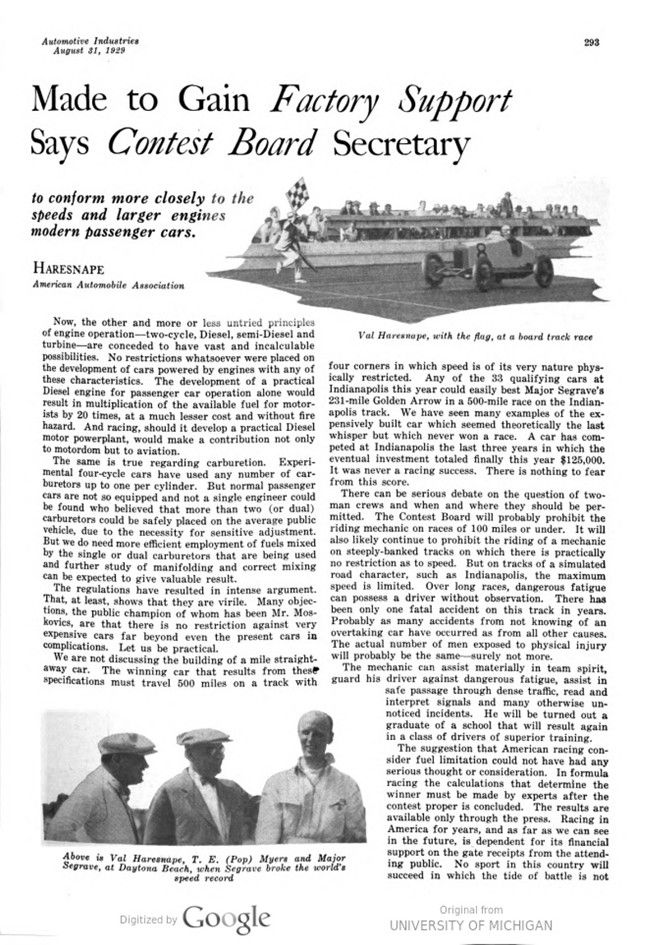
Page 293. Above is Val Haresnape, T. E. (Pop) Myers and Major Segrave, at Daytona Beach, when Segrave broke the world’s speed record – Val Haresnape, with the flag, at a board track race
Page 294. The Battle Creek, Mich., plant of the Clark Equipment Co., illuminated with floodlights