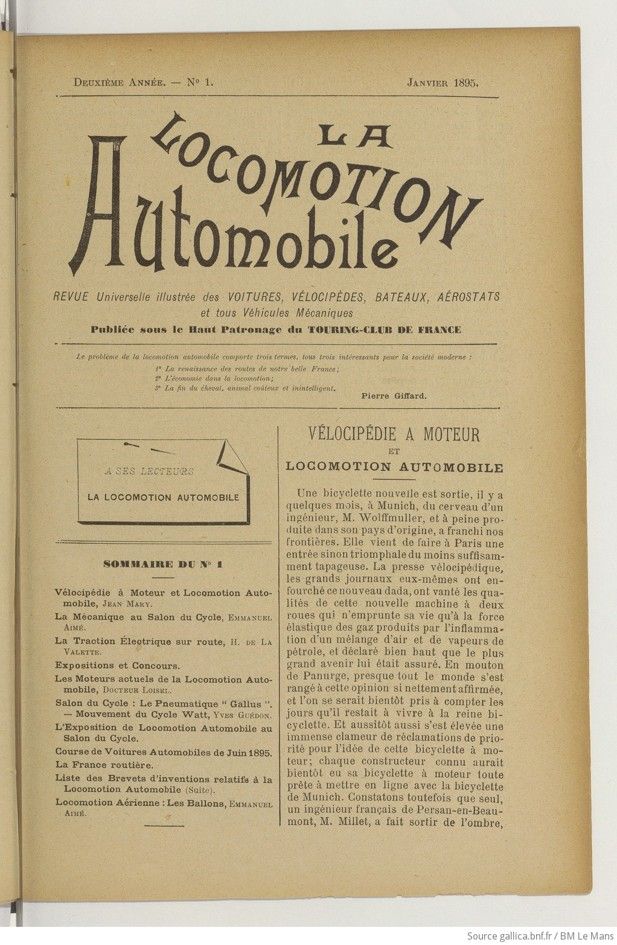
In the first 1895-issue of La Locomotion Automobile, the first meetings in preparation of the Paris-Bordeaux race were published. These were the very first two meetings held in november and december 1894. A long read indeed; but it becomes clear how serious and meticulous the preparations were, already more than half a year ahead. (Translation separately).
With courtesy of the Bibliothèque national francais gallica.bnf.fr
Text and photos compiled by motorracinghistory, Translation by DeepL deepl.com
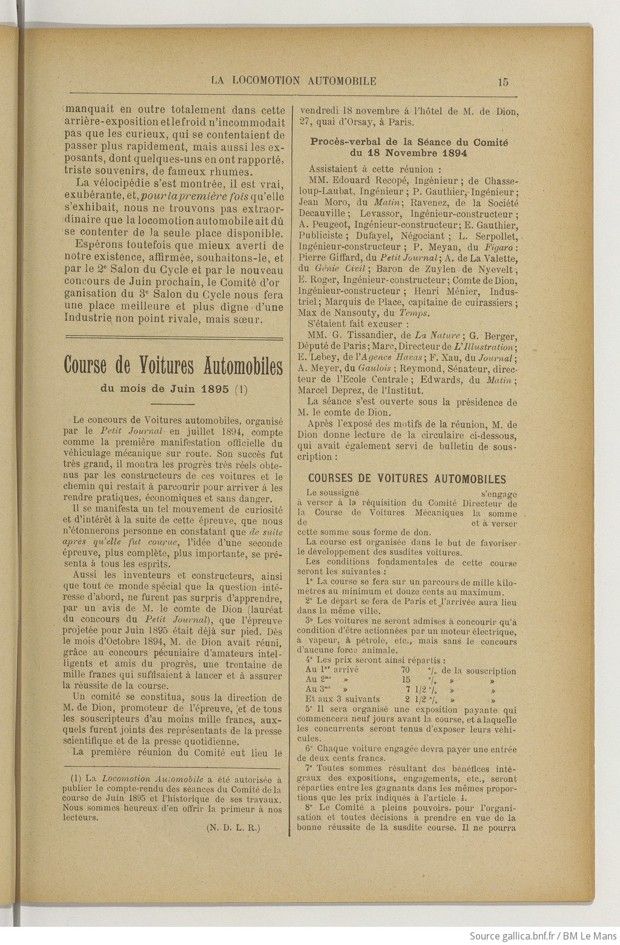
La Locomotion Automobile — 2e Année, No. 1, janvier 1895, pages 15-17
Automobile Race
In the month June 1895 (1)
The automobile race, organized by Le Petit Journal in July 1894, is considered the first official event featuring motorized vehicles on public roads. It was a tremendous success, demonstrating the very real progress made by automobile manufacturers and the ground that still needed to be covered to make these vehicles practical, economical, and safe.
Such a surge of curiosity and interest followed this event that it will come as no surprise to anyone to note that, immediately after it was held, the idea of a second, more comprehensive and larger-scale event came to everyone’s mind.
Consequently, inventors and manufacturers, as well as all those in the specialized community most directly interested in the matter, were not surprised to learn, through an announcement by Count de Dion (winner of the *Petit Journal* competition), that the race planned for June 1895 was already in the works. As early as October 1894, thanks to financial support from knowledgeable enthusiasts and friends of progress, Count de Dion had raised some thirty thousand francs, enough to launch the race and ensure its success.
A committee was formed under the leadership of Mr. de Dion, the race’s promoter, and all subscribers who had contributed at least one thousand francs, joined by representatives of the scientific press and the daily press.
The committee’s first meeting took place on Friday, November 18, at Mr. de Dion’s residence, 27 Quai d’Orsay, in Paris.
Note: (1) *La Locomotion Automobile* has been authorized to publish the minutes of the June 1895 Race Committee meetings and a history of its work. We are pleased to offer this exclusive report to our readers. (Editor’s Note)
Minutes of the Committee Meeting of November 18, 1894
Present at this meeting were:
Messrs. Edouard Recopé, Engineer; de Chasseloup-Laubat, Engineer; P. Gauthier, Engineer; Jean Moro, of *Le Matin*; Ravenez, of the Decauville Company; Levassor, Engineer and Manufacturer; A. Peugeot, Engineer and Manufacturer; E. Gauthier, Journalist; Dufayel, merchant; L. Serpollet, engineer and builder; P. Meyan, of *Le Figaro*; Pierre Giffard, of *Le Petit Journal*; A. de La Valette, of *Génie Civil*; Baron de Zuylen de Nyevelt; E. Roger, engineer and builder; Count de Dion, engineer and builder; Henri Ménier, industrialist; Marquis de Place, captain of cuirassiers; Max de Nansouty, of *Le Temps*.
The following had sent their apologies:
Messrs. G. Tissandier, of *La Nature*; G. Berger, Member of Parliament for Paris; Marc, Editor of *L’Illustration*; E. Lebey, of Y Agence Havas; F. Xau, of *Le Journal*; A. Meyer, of *Le Gaulois*; Reymond, Senator and Director of the École Centrale; Edwards, of *Le Matin*; Marcel Deprez, of the Institut.
The session opened under the chairmanship of Count de Dion.
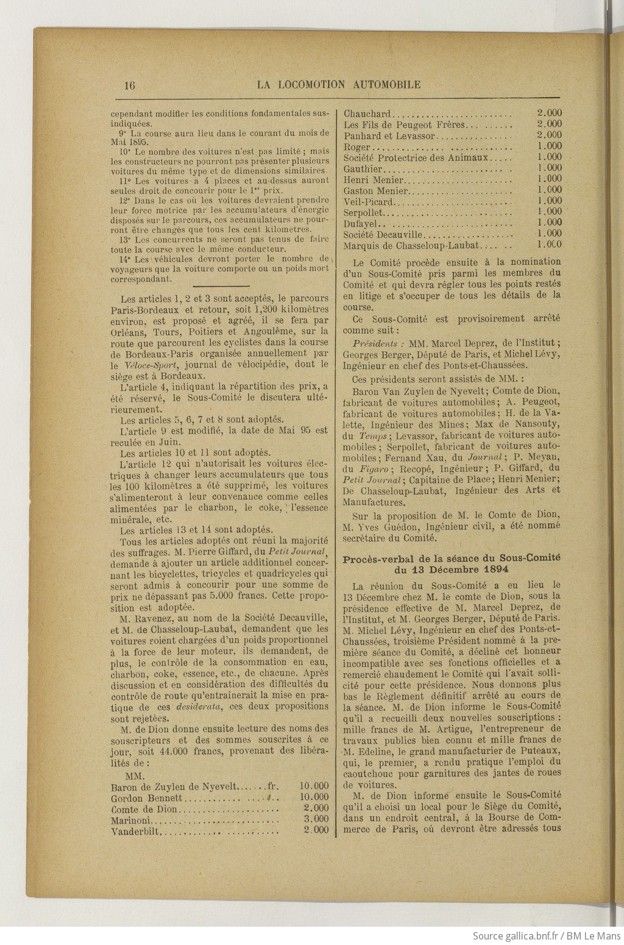
After explaining the purpose of the meeting, Count de Dion read aloud the circular below, which had also served as a subscription form:
AUTOMOBILE RACES
The undersigned, ***, agrees to pay, at the request of the Steering Committee of the Motor Car Race, the sum of *** and to contribute this amount as a donation.
The race is organized with the aim of promoting the development of the aforementioned automobiles.
The basic conditions of this race shall be as follows:
1. The race will take place over a course of at least one thousand kilometers and no more than twelve hundred kilometers.
2. The race will start in Paris and finish in the same city.
3° Vehicles will be admitted to the race only if powered by an electric, steam, or gasoline engine, etc., but without the use of any animal power.
4° The prizes will be distributed as follows:
To the 1st-place finisher: 70% of the prize fund
To the 2nd-place finisher: 15% » »
To the third-place finisher: 7½% » »
And to the next three finishers: 2½% » »
5. A paid exhibition will be organized, beginning nine days before the race, at which competitors are required to display their vehicles.
6. Each entered vehicle must pay an entry fee of two hundred francs.
7. All sums derived from the total proceeds of the exhibitions, entry fees, etc., shall be distributed among the winners in the same proportions as the prizes indicated in Article 4.
8. The Committee has full authority for the organization and all decisions to be made to ensure the success of the aforementioned race. However, it may not modify the fundamental conditions set forth above.
9. The race will take place during the month of May 1895.
10. There is no limit on the number of cars; however, manufacturers may not enter more than one car of the same type and similar dimensions.
11. Only cars with four seats or more will be eligible to compete for first prize.
12. In the event that the vehicles derive their power from energy storage units placed along the route, these units may be replaced only every 100 kilometers.
13. Competitors are not required to complete the entire race with the same driver.
14. Vehicles must carry the number of passengers for which the vehicle is designed or a corresponding dead weight.
———-
Articles 1, 2, and 3 are accepted; the Paris–Bordeaux round-trip route, approximately 1,200 kilometers, is proposed and approved. It will pass through Orléans, Tours, Poitiers, and Angoulême, following the route taken by cyclists in the Bordeaux–Paris race organized annually by *Véloce-Sport*, a cycling magazine headquartered in Bordeaux.
Article 4, specifying the distribution of prizes, has been deferred; the Subcommittee will discuss it at a later date.
Articles 5, 6, 7, and 8 are adopted.
Article 9 is amended; the date of May 95 is postponed to June.
Articles 10 and 11 are adopted.
Article 12, which restricted electric vehicles to changing their batteries only every 200 kilometers, was deleted; vehicles will be refueled at their convenience, just like those powered by coal, coke, mineral oil, etc.
Articles 13 and 14 were adopted.
All adopted articles received a majority of the votes. Mr. Pierre Giffard, of *Le Petit Journal*, requested the addition of a supplementary article concerning bicycles, tricycles, and quadricycles, which would be eligible to compete for a prize not exceeding 5,000 francs. This proposal was adopted.
Mr. Ravenez, on behalf of the Decauville Company, and Mr. de Chasseloup-Laubat, requested that the vehicles be loaded with a weight proportional to their engine power; they also requested monitoring of each vehicle’s consumption of water, coal, coke, gasoline, etc. After discussion and in light of the difficulties in conducting road tests that implementing these requests would entail, both proposals were rejected.
Mr. de Dion then read aloud the names of the subscribers and the amounts subscribed to date, totaling 44,000 francs, contributed by:
Messrs.
Baron de Zuylen de Nyevelt.. fr. 10.000
Gordon Bennett……………….. 10.000
Comte de Dion…………………… 2.000
Marinoni……………………………… 3.000
Vanderbilt……………………………. 2.000
Chauchard…………………………… 2.000
Les Fils de Peugeot Frères… 2.000
Panhard et Levassor………….. 2.000
Roger…………………………………. 1.000
Society for the Protection of Animals.. 1.000
Gauthier……………………………… 1.000
Henri Menier……………………… 1.000
Gaston Menier…………………… 1.000
Veil-Picard…………………………… 1.000
Serpollet……………………………… 1.000
Dufayel……………………………….. 1.000
Société Decauville……………. 1.000
Marquis de Chasseloup-Laubat… 1.000
The Committee then proceeds to appoint a Subcommittee drawn from among the members of the Committee, which shall settle all outstanding issues and handle all the details of the race.
This Subcommittee is provisionally established as follows:
Chairmen: Messrs. Marcel Deprez, of the Institute; Georges Berger, Member of Parliament for Paris; and Michel Lévy, Chief Engineer of the Department of Public Works.
These chairmen will be assisted by Messrs.:
Baron Van Zuylen de Nyevelt; Count de Dion, automobile manufacturer; A. Peugeot, automobile manufacturer; H. de la Valette, Mining Engineer; Max de Nansouty, of *Le Temps*; Levassor, automobile manufacturer; Serpollet, automobile manufacturer; Fernand Xau, of *Le Journal*; P. Meyan, of *Le Figaro*; Recopé, engineer; P. Giffard, of *Le Petit Journal*; Captain de Place; Henri Menier; De Chasseloup-Laubat, engineer of Arts and Manufactures.
Upon the proposal of Count de Dion, Mr. Yves Guédon, civil engineer, was appointed secretary of the Committee.
Minutes of the Subcommittee Meeting of December 13, 1894
The Subcommittee meeting was held on December 13 at the home of Count de Dion, with Mr. Marcel Deprez of the Institute and Mr. Georges Berger, Deputy for Paris, serving as co-chairs. Mr. Michel-Lévy, Chief Engineer of the Department of Public Works, the third Chair appointed at the Committee’s first meeting, declined this honor as incompatible with his official duties and warmly thanked the Committee for having asked him to serve as Chair. We provide below the final Rules of Procedure adopted during the meeting. Mr. de Dion informed the Subcommittee that he had received two new contributions: one thousand francs from Mr. Artigue, the well-known public works contractor, and one thousand francs from Mr. Edeline, the prominent manufacturer from Puteaux, who was the first to put rubber to practical use as a lining for automobile wheel rims.
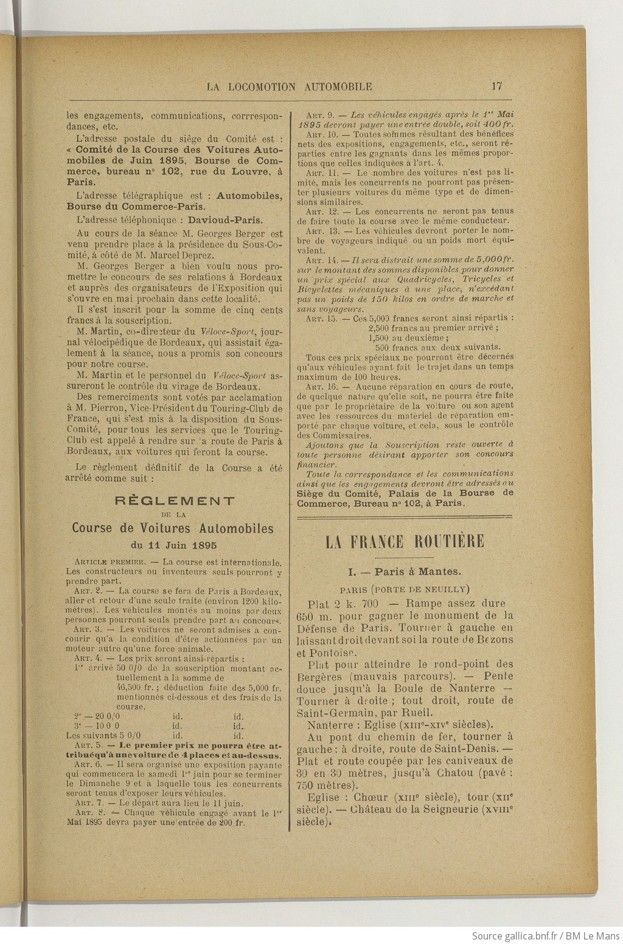
Mr. de Dion then informed the Subcommittee that he had selected a location for the Committee’s headquarters in a central area, at the Paris Stock Exchange, to which all commitments, communications, correspondence, etc., should be addressed.
The mailing address of the Committee’s headquarters is:
“Committee for the June 1895 Automobile Race, Bourse de Commerce, Office No. 102, Rue du Louvre, Paris.”
The telegraph address is: Automobiles, Bourse du Commerce-Paris.
The telephone number is: Davioud-Paris.
During the meeting, Mr. Georges Berger took his seat as chair of the Subcommittee alongside Mr. Marcel Deprez.
Mr. Georges Berger kindly promised to offer the support of his contacts in Bordeaux and among the organizers of the Exhibition opening next May in that city.
He contributed five hundred francs to the fundraising effort.
Mr. Martin, co-director of *Véloce-Sport*, a cycling newspaper in Bordeaux, who was also present at the meeting, promised us his support for our race.
Mr. Martin and the staff of *Véloce-Sport* will oversee the checkpoint at the Bordeaux turn. A vote of thanks was passed by acclamation to Mr. Pierron, Vice President of the Touring-Club de France, who has made himself available to the Subcommittee for all the services the Touring-Club is called upon to provide along the route from Paris to Bordeaux for the cars participating in the race.
The final rules for the race have been established as follows:
RULES FOR THE AUTOMOBILE RACE OF JUNE 11, 1895
Article 1. — The race is international. Only manufacturers or inventors may participate.
Art. 2. — The race will run from Paris to Bordeaux and back in a single stretch (approximately 1,200 kilometers). Only vehicles carrying at least two people may take part in the competition.
Article 3. — Cars will be admitted to the competition only on the condition that they are powered by an engine other than animal power.
Article 4. — The prizes will be distributed as follows:
1st place: 50% of the prize fund, currently amounting to 46,500 francs; less the 5,000 francs mentioned below and the costs of the race.
2nd — 20% of the same.
3rd — 10% of the same.
Subsequent finishers — 5% of the same.
Art. 4. — The first prize may only be awarded to a car with four seats or more.
Art. 6. — A paid exhibition will be held, beginning on Saturday, June 1, and ending on Sunday, June 9, at which all competitors are required to display their vehicles.
Art. 7. — The race will start on June 11.
Art. 8. — Each vehicle entered before May 1, 1895, must pay an entry fee of 200 francs.
Art. 9. — Vehicles entered after May 1, 1895, must pay double the entry fee, or 400 francs.
Art. 10. — All sums resulting from the net profits of the exhibitions, entry fees, etc., shall be distributed among the winners in the same proportions as those indicated in Art. 4.
Art. 11. — There is no limit on the number of cars, but competitors may not enter more than one car of the same type and similar dimensions.
Art. 12. — Competitors are not required to complete the entire race with the same driver.
Art. 13. — Vehicles must carry the specified number of passengers or an equivalent dead weight.
Art. 14. — A sum of 5,000 francs shall be set aside from the available funds to award a special prize to single-seat quadricycles, tricycles, and motorized bicycles weighing no more than 150 kilograms in running order and without passengers.
Art. 15. — These 5,000 francs shall be distributed as follows:
2,500 francs to the first to arrive;
1,500 francs to the second;
500 francs to the next two.
All these special prizes may be awarded only to vehicles that have completed the route in a maximum of 100 hours.
Art. 16. — No repairs of any kind may be made en route except by the owner of the vehicle or his agent, using the repair equipment carried by each vehicle, and only under the supervision of the Commissioners.
It should be noted that the fundraising campaign remains open to anyone wishing to contribute financially.
All correspondence, communications, and commitments must be addressed to the Committee Headquarters, Palais de la Bourse de Commerce, Office No. 102, in Paris.