The book of Pierre Souvestre, „Histoire de l’Automobile“ covers very extensively the very first years of the automotive industry up until 1906. The section „La vitesse et sa griserie“ deals with the very first automobile contest in history, not being a race though: the 1894 Concours de Paris-Rouen. In this second part of the book section, the „great day“ of the contest is memorised, what happened during the day all along the road, the arrival in Rouen with the final results, the awards, the press coverage and short notes on important people of the organisation, baron de Zuylen and Maronin. In all, this chapter of Pierre Souvestre’s book gives a good impression of what happened on that first automobile event. (Translation separately).
With permission of Bibliothèque national francais gallica.bnf.fr
Text and photos compiled by motorracinghistory, Translation by DeepL deepl.com
Histoire de l’Automobile — Pierre Souvestre, Paris 1907
The Paris-Rouen Contest (1894)
The Direction. — Focus on Speed. — The “Petit Journal” Race. — Jean sans Terre. — The Rules. — Entries. — 102 Entries. — The Elimination/Qualifying Rounds. — Race Day. —On the Road. — Arrival in Rouen. — The Results. — Press Reactions. — A Happy Coincidence! — Baron de Zuylen. — Marinoni.
The Great Day of the Race
With the qualifying rounds over, twenty-one competitors remained in the running; in accordance with the rules, they gathered at the Inkermann roundabout at the crack of dawn on Sunday, July 22.
A large and, I must say, elegant crowd—boding well for the future clientele of horse-less carriage manufacturers—had come out of curiosity to watch the start.
The competition schedule was as follows:
Departure from Paris ………… 8:00 a.m.
Arrival in Mantes …….… noon.
Departure from Mantes …….. 1:30 p.m.
Arrival in Rouen ……….. 8:00 p.m.
The preliminary rounds had already narrowed down the field. Bad luck caused a second round of eliminations, and there were still a few withdrawals to be noted on the very morning of the race.
There had been some curiosity regarding the participation in this competition of an electric vehicle built by an Italian, Count Garli. However, the car had not appeared in the qualifying rounds. Yet it had indeed arrived in Paris—by train—but the customs administration—already quite witty! — had seen fit to hold it in storage until the day after the race, under vague pretexts of paperwork that needed to be completed.
An English car—also electric—and dubbed “the Vehicle of the Future” withdrew at the last minute. However, the manufacturer, Mr. G. R. Garrard, excused this failure by awarding himself the following certificate of competence:
“My electric car,” he wrote to the Petit Journal, “has run perfectly since June 15, notably in front of members of ‘The Birmingham Association of Engineers’ on the busiest streets in Birmingham.”
Anyone wishing to obtain further information may contact its purchaser, Mr. Alfred Fairley, of Shadwell Street, Birmingham, who unfortunately declined to send it to Paris for your magnificent competition, and I did not have time to build another one…
On the Road
However, there were still enough competitors to satisfy the curiosity of the crowd gathered at the Inkermann roundabout and all along the route,
“The wonderful weather,” writes a reporter for *Le Petit Journal* on this subject, “which made for a perfect Sunday, allowed thousands of people to watch the cars go by.” On the main road from Paris to Rouen, the vehicles drove almost constantly between two rows of onlookers.
From all sides, people had come to set up positions early in the morning at the best vantage points to enjoy this spectacle, the likes of which had never been seen before. Some had chosen flat ground to watch the cars approach from a distance and gauge their speed; others had preferred to position themselves at the bottom of a hill to witness the always impressive sight of the descent.
The shrewdest spectators waited on the crest of a hillock. This way, they could see how the cars handled the climb and then follow them with their eyes as they sped down the slope.
Many families had made themselves comfortable along the roadside and had lunch there. A few had even brought tables and chairs.
While the lucky competitors had no mishaps and will be mentioned only when we get to their arrival in Rouen, the same could not be said for the… others, whose adventures along the way were, at times, extraordinary.
The question of the driver was of the utmost importance. There were only a limited number of them. They were in high demand.
Thus, Maurice Le Blant, competing with two enormous vehicles, found himself short a driver at the last moment for his second car.
The first was to be driven by himself and Bechtald, his chauffeur.
Serpollet had raised hopes—without offering any guarantees—that his brother-in-law, Mr. Avezard, and a mechanic from the factory would drive Le Blant’s second vehicle, a delivery truck commissioned by the “Belle Jardinière.”
At 8:30 a.m., at the Porte Maillot, Maurice Le Blant waited in vain for a driver for this substantial vehicle.
Mr. Etienne Le Blant, an engineer at the Compagnie de l’Est—a man of good will but insufficient automotive knowledge—had previously driven the “Belle Jardinière” onto a sidewalk and demolished a bench… Despite this inauspicious start, he did not hesitate, however, to get his brother out of a bind, — since Mr. Avezard had not yet arrived — to take the wheel of the vehicle all the way to Rouen, with Mr. Cassigneul Jr. on board as a steward—who was anything but reassured—and Maurice’s chauffeur, whom Maurice was replacing on his carriage with a man of more or less equal competence.
Most of the vehicles reached Mantes without too much difficulty:
The fifty tables set up at the Hôtel du Soleil d’Or were surrounded by about two thousand people, some of whom, according to the chronicle, managed to have lunch.
Then the exodus continued, with the complications of the route—hills, curves, etc.—contributing to the gradual elimination of a good portion of the competitors. Between Vernon and Gaillon, one of the Field tubes in the Scotte tractor’s boiler lost its plug inside the firebox just as the driver was stoking the fire, bringing the vehicle to an irreparable halt. The driver also sustained a minor knee injury while jumping out of the car while it was still moving.
He was bandaged immediately; fortunately, it was nothing serious; but bad news spread, and word reached as far as Pont-de-l’Arche that an accident had occurred, resulting in a fatality and numerous injuries. This is how history is usually written…
As one newspaper reported, the accident involving the Scotte carriage is all the more regrettable because it was a vehicle destined to cause a sensation had it been able to reach Rouen. It was entirely garlanded with strings of bells that jingled merrily at the slightest movement. Mr. Scotte, a hatmaker in Épernay, had been forced to adopt this signal by the prefect of his department, who had told him: “The sound of the bells will not only drown out the noise of the engine but will also trick the horses into believing, upon hearing it, that they are dealing with their own kind…” The idea was original, to say the least.
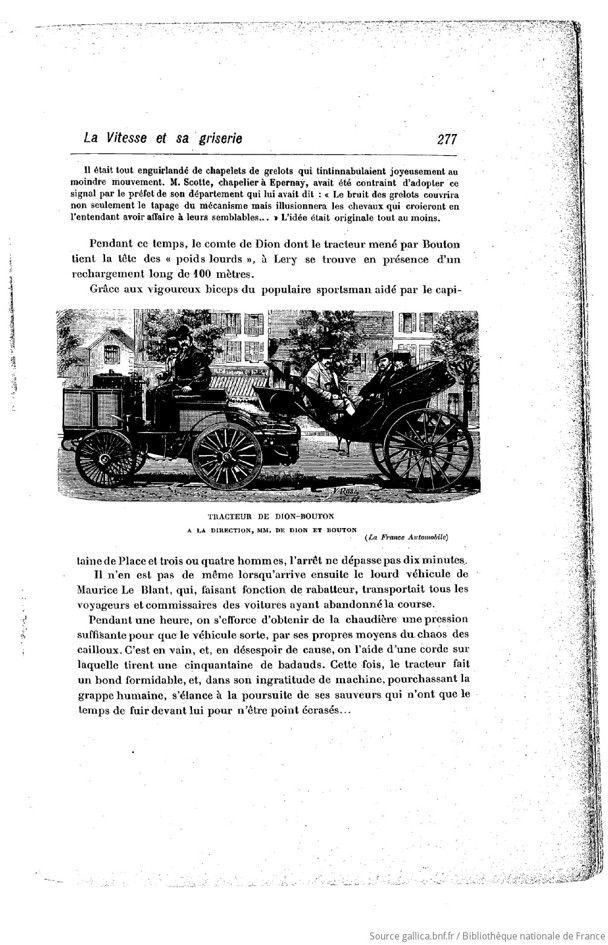
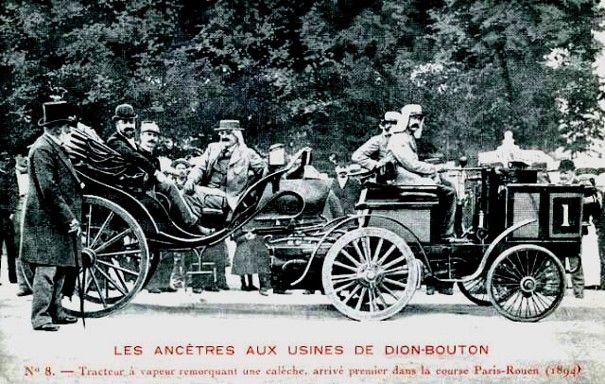
Meanwhile, the Count of Dion—whose tractor, driven by Bouton, was leading the “heavyweights”—found himself at Lery facing a 100-meter-long refueling stop.
Thanks to the powerful biceps of the popular sportsman, assisted by Captain de Place and three or four men, the stop lasted no more than ten minutes. The same could not be said when Maurice Le Blant’s heavy vehicle arrived next; acting as a support vehicle, it was transporting all the passengers and officials from the cars that had dropped out of the race.
For an hour, they struggled to get enough pressure from the boiler to allow the vehicle to extricate itself under its own power from the chaos of rocks. It was in vain, and, in desperation, they helped it with a rope pulled by about fifty onlookers. This time, the tractor made a tremendous leap, and, in its machine-like ingratitude, chasing after the cluster of people, it surged forward in pursuit of its rescuers, who had just enough time to flee before it so as not to be crushed…
Meanwhile, they are approaching Rouen: the crowd grows increasingly enthusiastic, and as the competitors pass through the villages, some find themselves hit square in the face by bouquets thrown by the pure but brutal hands of young country girls.
We are grateful for the gesture… and we carry on, after the involuntary swerve caused by the surprise!
The steam-powered carriages are plagued by misfortune:
One of them has a driver who “fears the heat”—which is a cardinal flaw for a driver—and the man is, moreover, of a particularly touchy disposition.
As we were traveling at a good pace, he suddenly, from the back of the car where he was sitting, signaled the driver—who was seated in front—to stop.
We stop, and he explains that, since he’s too hot, he needs to rest for a few moments under a tree! The owner gets angry, and the driver then declares that, since he’s being treated with such disrespect, he’s handing in “his apron” and quitting the job!
Fortunately, Serpollet happened to be passing by at that moment; taking pity on his colleague and competitor, he didn’t hesitate to lend him a thirteen-year-old apprentice—a true Parisian street urchin, full of spirit and enthusiasm—who would do a marvelous job handling the driver’s tough duties all the way to Rouen!
Let’s pay tribute to this young hero and condemn the memory of the driver who couldn’t stand the heat!
Arrival in Rouen
In Rouen, excitement is at its peak. The entire population has gathered at the entrance to the city, lining the roadside along which the competitors are arriving.
Mr. Armand Peugeot, who had been delayed by a breakdown in Saint-Germain, had taken the train and was waiting for his company’s vehicles with understandable impatience.“
The crowd cheers the arrivals. They pass by.
A drunkard and his wife come up with the following game to pass the time during the long wait:
— Listen, says the man, I’ll bet you a liter that it’s a car with an odd number coming over there.
— “Sounds good to me; I’ll go for an even number — two, four, and so on.”
An odd number appears; the disappointed woman declares that there’s been “cheating” and delivers a masterful scolding to her husband, much to the delight of the crowd.
Meanwhile, the competitors arrive one after another.
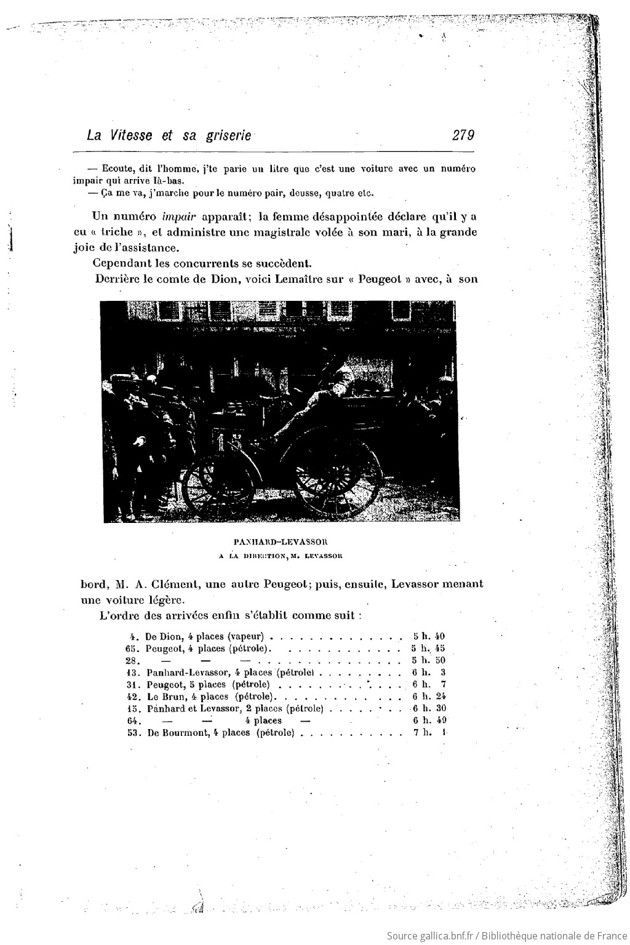
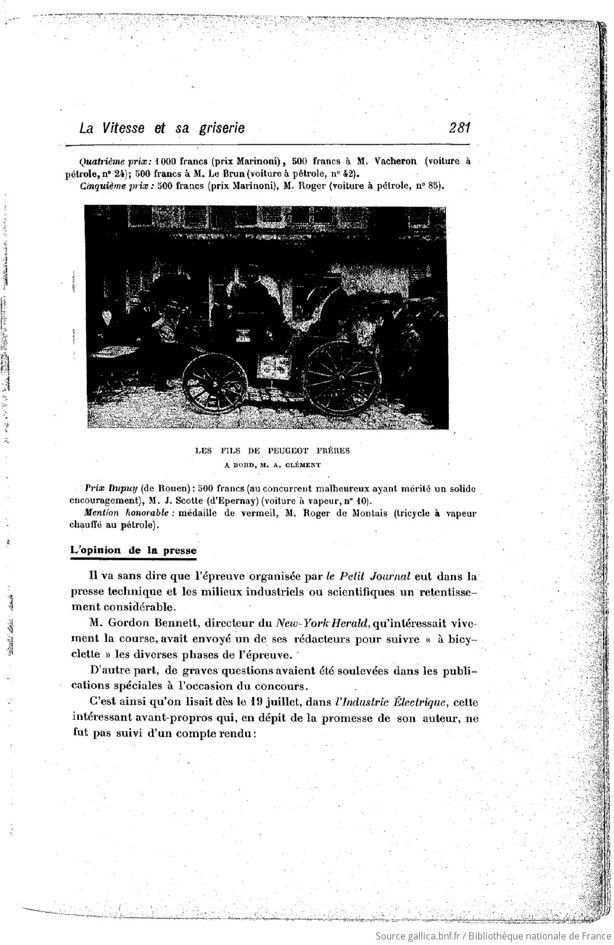
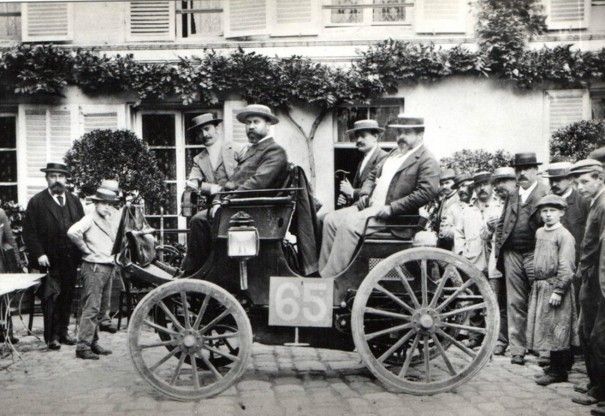
Behind the Count de Dion comes Lemaître in a “Peugeot” with Mr. A. Clément on board, followed by another Peugeot; then Levassor driving a lightweight open-top car.
The final order of arrival is as follows:
4. De Dion, 4-seater (steam) 5:40
65. Peugeot, 4-seater (petroleum) 5:45
28. — — — 5:50
13. Panhard-Levassor, 4-seater (petroleum) 6:03
31. Peugeot, 5-seater (petroleum) 6:07
42. Le Brun, 4-seater (petroleum) 6:24
15. Panhard and Levassor, 2-seater (petroleum) 6:30
64. — — 4-seater — 6:49
53. De Bourmont, 4-seater (petroleum) 7:01
30. Peugeot, 3-seater (petroleum) 7:02
14. Vacheron, 2-seater (gasoline) 7:03
27. Peugeot, 2-seater — 7:05
14. Panhard and Levassor, 4-seater (petroleum) 7:10
85. Roger, 4-seater (petroleum) 8:09 60. Le Blant, 8-seater (steam) 8:50
The Awards
A few days later, the contest jury met at the Petit Journal and drew up the list of winners:
First prize was to be awarded to the horseless carriage that met the following criteria:
It must be safe, easy for passengers to operate, and not too expensive to operate.
After half an hour of deliberation, the jury decided that the first prize of 5,000 francs (the Petit Journal prize) would be shared between:
Messrs. Panhard and Levassor and the Peugeot Brothers.
“The qualities of the cars entered in the competition by these two companies,” reported the Petit Journal the following day, “seemed to us to meet the competition’s requirements so well—without yet fully realizing the dream of the tourist and the merchant—that the first prize was awarded to them by acclamation. 2,500 francs were awarded to one, and 2,500 francs to the other.”
As for the second prize (the Marinoni Prize), amounting to 2,000 francs, it was awarded to Messrs. de Dion, Bouton & Co. (1: The firm of de Dion-Bouton & Co. thus received only the second prize, despite having achieved the highest speed. It nearly received no award at all, because in the jury’s view, its heavy and powerful steam engine did not meet the requirements set forth in the rules. What they were looking for, in fact, was a small tourist car that was easy to handle, elegant, and so on. On this occasion, Pierre Giffard became, within the jury, a passionate advocate for this interesting competitor and, not without difficulty, persuaded his colleagues to award him the second prize, which, all things considered, he certainly deserved.)
For their interesting steam-powered tractor, which is hitched to a car like a horse and delivers (with a powerful engine, it must be acknowledged) a speed that is absolutely beyond comparison, especially when climbing hills.
Finally, the other awards were presented to the various winners in the following order:
Third Prize: 1,500 francs (Marinoni Prize), Maurice Le Blant (9-seater car, Serpollet system),
Fourth Prize: 1,000 francs (Marinoni Prize), 500 francs to Mr. Vacheron (gasoline-powered car, No. 24); 500 francs to Mr. Le Brun (gasoline-powered car, No. 42).
Fifth Prize: 500 francs (Marinoni Prize), Mr. Roger (gasoline-powered car, No. 85).
Dupuy Prize (from Rouen): 500 francs (awarded to the unfortunate competitor who deserved strong encouragement), Mr. J. Scotte (from Épernay) (steam-powered vehicle, No. 10).
Honorable Mention: vermeil medal, Mr. Roger de Montais (petroleum-heated steam-powered tricycle).
Press Coverage / Opinion of the Press
It goes without saying that the race organized by the Petit Journal had a considerable impact in the technical press and in industrial and scientific circles.
Mr. Gordon Bennett, editor of the New-York Herald, who took a keen interest in the race, had sent one of his editors to follow the various stages of the event “by bicycle.”
Furthermore, serious questions had been raised in specialized publications in connection with the competition.
Thus, as early as July 19, L’Industrie Électrique published this interesting foreword, which, despite the author’s promise, was not followed by a report:
In the entry list for the competition organized by the Petit Journal for horseless carriages, we note that, out of a total of 102 entries, only three or four were for electric motors.
Most of the systems presented are vehicles powered by gasoline engines; this is, in fact, the most readily available source of energy along the route. However, in the southeastern departments of France, where electric charging stations exist in every town, it would seem to us that batteries could easily be charged either overnight or during meal breaks.
Furthermore, Mr. A. Collin, in a note addressed to the Society of Civil Engineers, made the following observations:
… The cars in the lead group, led by the Dion-Bouton steam car, achieved commercial speeds exceeding 17 kilometers and average cruising speeds exceeding 20 kilometers.
The actual speeds were:
For gasoline-powered cars: 5 to 7 kilometers on 1/10th-grade inclines; 12 to 16 kilometers on gentler inclines; 20 to 26 on flat terrain.
For the de Dion-Bouton steam car: 10 to 20 kilometers on gradients of one-tenth; 20 to 30 kilometers on level ground.
From the perspective of the competition, the gasoline-powered vehicle demonstrated undeniable superiority over the steam car.
From the much broader perspective of mechanical road transportation, one must choose between petroleum and steam depending on the specific conditions that must be met.
The Petit Journal competition has highlighted the persistent efforts of our manufacturers and will likely hasten the emergence of a definitive solution to the problem of mechanical road transportation.
What a happy coincidence! — Baron de Zuylen
Regardless of the technical results achieved following the race, the Paris-Rouen competition was to have other consequences of at least equal significance.
The extensive publicity given by the Petit Journal to the pioneers of this new form of transportation would spark the general public’s interest in their efforts.
An active collaboration would emerge from the partnership between the inventors and financiers, members of high society, and even artists, who were concerned with the aesthetics of the future vehicles intended to replace horse-drawn carriages.
They got to know one another thanks to the Paris-Rouen race. They also came to appreciate one another.
Baron de Zuylen de Nyevelt, whose name would henceforth be intimately linked to the history of the automotive industry, recalled—twelve years later, in an article published in l’Écho de Paris—his trip to Rouen for the competition, writing:
I attribute to the chance encounter with the Count de Dion on July 23, 1895, in Rouen, a decisive influence on the future of this new form of transportation. What a happy coincidence!
Marinoni
While the Petit Journal is credited by name with organizing the first horseless carriage competition, the glory for this initiative clearly belongs to its contributor Pierre Giffard. But Giffard could never have accomplished anything—and certainly could not have overcome the routine opposition from within the “company”—had he not been supported by the powerful Marinoni.
Marinoni, a mechanic by heart and by trade, had a marked fondness for all inventions aimed at practical applications of scientific progress.
The velocipede had filled him with enthusiasm. As the only one to share Giffard’s view at the Petit Journal, he had to use all his authority to secure the organization of the Paris-Brest race in 1894.
It was the same story three years later, on the occasion of the Paris-Rouen race.
After being informed by Giffard in 1893 of the invention of the Hildebrand and Wolfmüller gasoline-powered bicycles, Marinoni became so interested in these curious little machines that he nearly undertook their manufacture. Marinoni automobiles!
We would, of course, have seen that come to pass had the eminent man not found himself too old to launch such a venture, especially since his family seemed utterly hostile to the project.
Until his final moments, Marinoni never ceased to follow with keen interest the rapid progress of the new industry, to the development of which he could rightly claim to have contributed significantly.
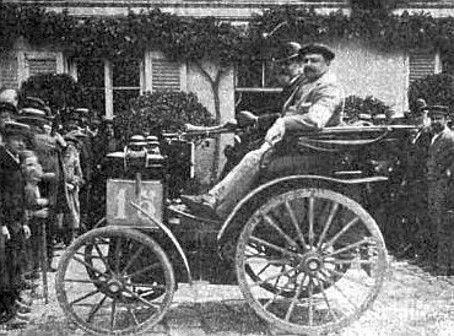
Photos.
Page 277: DE DION-BOUTON TRACTOR AT THE WHEEL, MRS. DE DION AND BOUTON (La France Automobile) (#1)
Page 279: PANHARD-LEVASSOR, AT THE WHEEL, MR. LEVASSOR (#15)
Page 281: THE SONS OF PEUGEOT FRÈRES—ON BOARD, MR. A. CLÉMENT (#65)