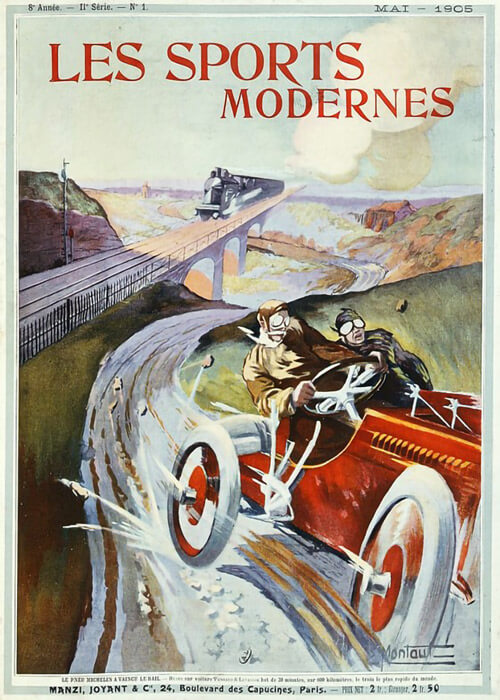
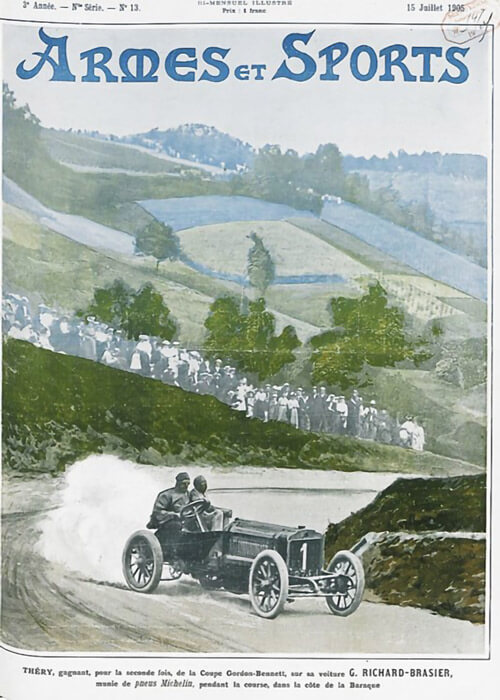
The book of Pierre Souvestre, „Histoire de l’Automobile“ covers very extensively the very first years of the automotive industry up until 1906. The section „La vitesse et sa griserie“ deals with the very first automobile race in history: the 1895 Course de Paris-Bordeaux. (Translation).
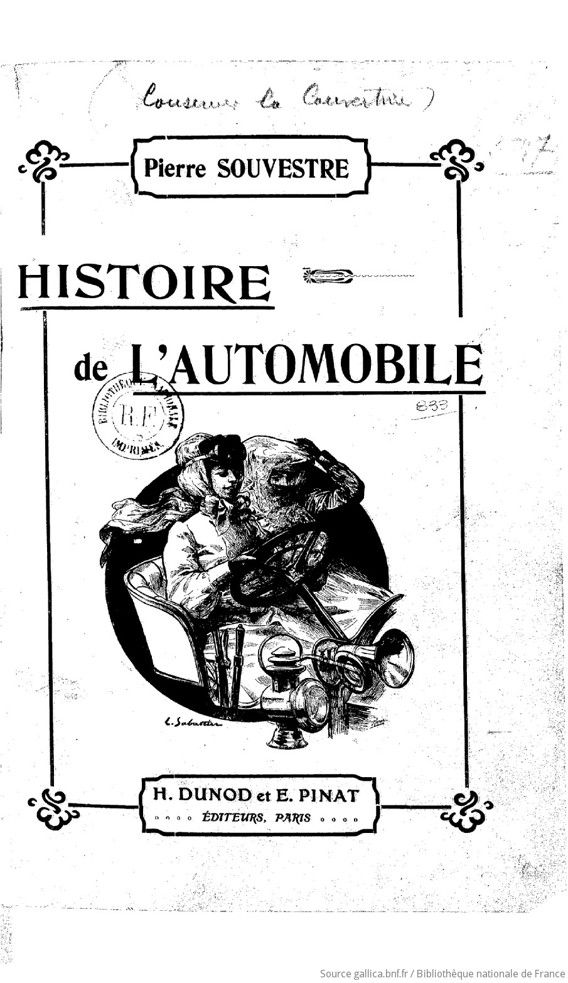
With permission of the Bibliothèque national francais gallica.bnf.fr
Text and fotos compiled by motorracinghistory motorracinghistory.com Translation by DeepL DeepL.com
Histoire de l’Automobile — Pierre Souvestre, Paris 1907
The Paris–Bordeaux–Paris Race (1895)
Count de Dion’s initiative. — The Paris–Bordeaux Committee. — The subcommittee and the rules. — Race day. — About fifty entries. — Place de l’Étoile. — The starting order at Versailles. — On the road. — At the checkpoint in Bordeaux. — Michelin’s “L’Éclair.” — The final standings.
The Count de Dion’s Initiative
Pierre Giffard recounts in *The End of the Horse*:
Eager to take on the challenge and keen to lure his former competitors onto new ground, the Count de Dion proposed that I organize a pure speed race over, say, 1,200 kilometers—from Paris to Bordeaux and back. It was a bold move. For my part, I would have seen no objection to launching this new event; but a signal was given to me: the newspaper’s management, ever timid, feared getting involved in a speed race where accidents could occur and be used against them.
“I understand why you’re holding back,” the Count de Dion told us then. “We’ll go ahead with this 1,200-kilometer race without you, and you’ll see if it makes a splash and if it takes automobile transportation one step further.”
The Count de Dion was not a man to let a passing remark stand, and obstacles did not seem likely to deter him; on the contrary,
Thanks to his infectious faith, he would instill in his entire entourage—perhaps still hesitant—the drive and enthusiasm necessary to organize a phenomenal event, the consequences of which could be magnificent… or disastrous.
The organizer of the Paris-Bordeaux race did not consider this second possibility for a single moment. He was right.
In the wake of the Paris-Rouen race and despite the silence of the major daily newspapers, such a surge of curiosity and interest emerged that the idea of another, more comprehensive and significant event implicitly took root in everyone’s minds. Consequently, no one in the relevant and influential circles of inventors, researchers, manufacturers, and enthusiasts of motor vehicles was surprised to learn, as early as October 1894, that, thanks to the initiative of the Comte de Dion, a race for horseless carriages would be organized for June 1895.
The Paris-Bordeaux Committee. — The Subcommittee and the regulations
However, a committee was formed at the promoter’s invitation, and on Wednesday, November 18, 1894, the committee’s first meeting took place at the Hôtel du Comte de Dion, 29 Quai d’Orsay. At the conclusion of this meeting, the principle of the race was approved and the route for the Paris-Bordeaux bicycle race was selected.
After reading aloud the first list of donations—which already totaled 44,000 francs and included the names of the leading manufacturers of the time, such as Baron de Zuylen, Gordon Bennett, Marinoni, Vanderbill, and even… as one might expect, the Society for the Protection of Animals—Count de Dion invited the dignitaries present to appoint a subcommittee tasked with resolving all outstanding issues and handling all the details of the race. This subcommittee was composed as follows:
Chairmen: Messrs. Marcel Deprez, of the Institute; Georges Berger, Member of Parliament for Paris; and Michel Lévy, Chief Engineer of Bridges and Roads.
Assisted by Messrs. Baron van Zuylen de Nyevelt; Count de Dion, automobile manufacturer; A. Peugeot; H. de La Valette, mining engineer; Max de Nansouty, of *Le Temps*; Levassor; Serpollet; Fernand Xau, of *Le Journal*; P. Meyan, of *Le Figaro*; Recopé, engineer; P. Giffard, of *Le Petit Journal*; Captain de Place; Henri Menier; de Chasseloup-Laubat, engineer of Arts and Manufactures; and Yves Guédon, civil engineer and secretary of the committee.
As early as December 13, the subcommittee began drafting the final rules, which—as a precaution—were preceded by a warning urging competitors to exercise the utmost caution during the race in which they were to participate:
This could prove decisive in terms of the current and future practical use of automobile transportation.
As for the rules, they stipulated that the race would take place on June 11, following a preliminary exhibition of the vehicles. Repairs along the route were prohibited, except using the vehicles’ own tools, and the duration of the race was limited to a maximum of one hundred hours.
Race Day. — About fifty entrants. — Place de l’Étoile
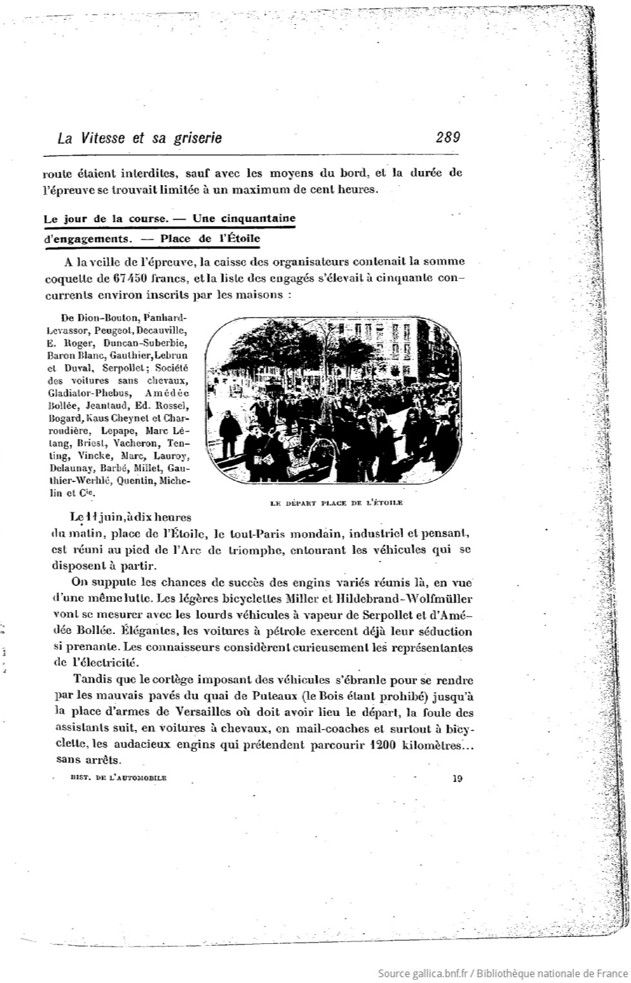
On the eve of the race, the organizers’ coffers contained the tidy sum of 67,450 francs, and the list of entrants numbered about fifty competitors registered by the following manufacturers:
De Dion-Bouton, Panhard-Levassor, Peugeot, Decauville, 13. Roger, Duncan-Suberbie, Baron Blanc, Gaulhier, Lebrun and Duval, Serpollet; Société des voitures sans chevaux, Gladialor-Phebus, Amédée Bollée, Jeantaud, Ed. Rossel, Bogard, Kaus Cheynet and Charroudière, Lepape, Marc Lélang, Briest, Vacheron, Tenting, Vincke, Marc, Lauroy, Delaunay, Barbé, Millet, Gauthier-Werhlé, Quentin, Michelin and Co.
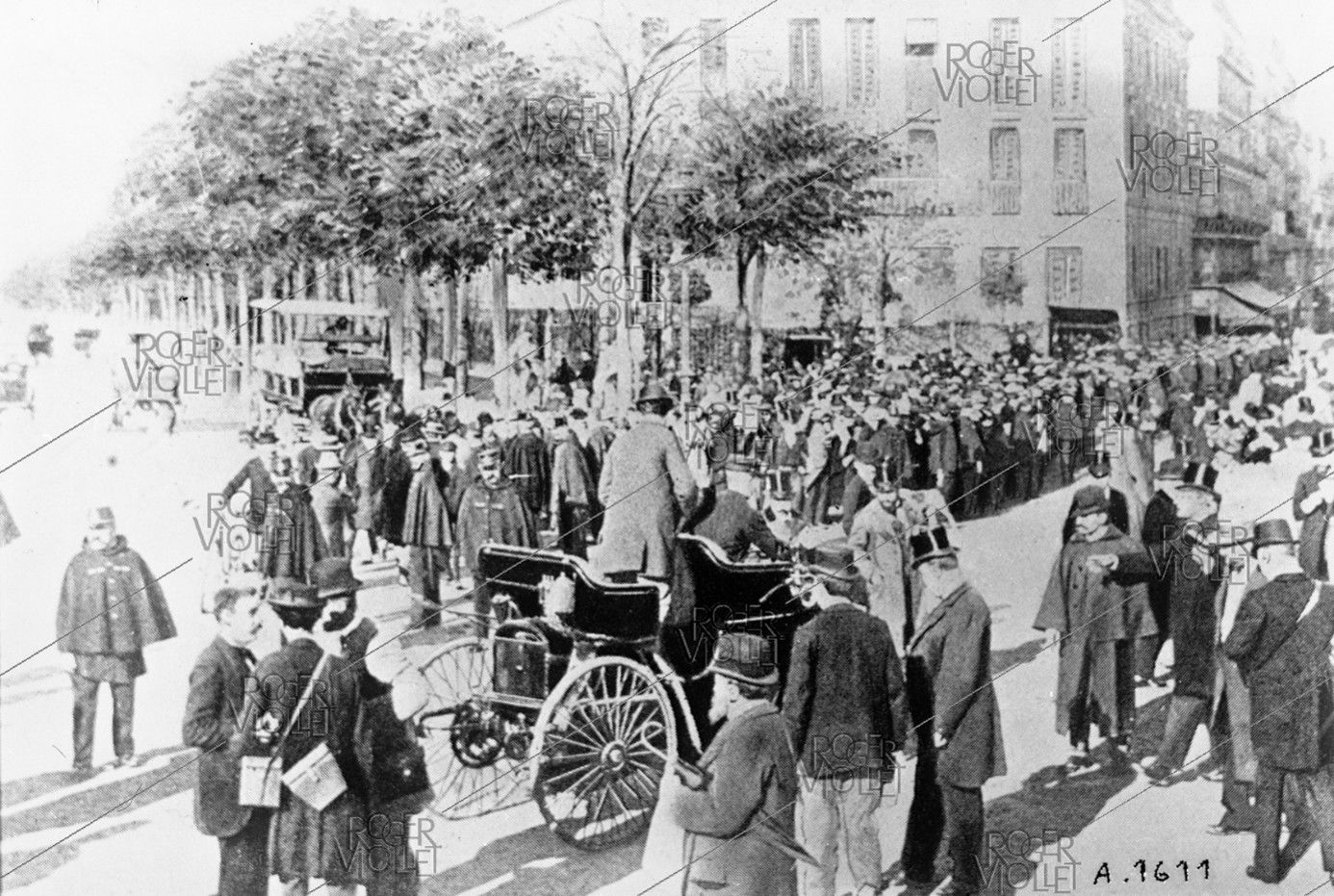
On June 11, at ten o’clock in the morning, at Place de l’Étoile, the cream of Parisian society—socialites, industrialists, and intellectuals—gathered at the foot of the Arc de Triomphe, surrounding the vehicles preparing to depart.
Speculation ran high regarding the chances of success for the various vehicles assembled there, all set to compete in the same race. The lightweight Miller and Hildebrand-Wolfmüller bicycles were set to compete against the heavy steam-powered vehicles of Serpollet and Amédée Bollée. The elegant gasoline-powered cars were already exerting their captivating allure. Connoisseurs eyed the electric vehicles with curiosity.
As the imposing procession of vehicles sets off to make its way over the rough cobblestones of the Quai de Puteaux (the Bois being off-limits) to the Place d’Armes in Versailles, where the start is to take place, the crowd of onlookers follows—in horse-drawn carriages, mail coaches, and above all on bicycles— the daring machines that claim to cover 1,200 kilometers… without stopping.
The procession is picturesque.
The two self-propelled bicycles, reports the editor of *La Locomotion automobile*, struggle to maintain their balance on the enormous, rounded, and disjointed sandstone blocks, but their performance is flawless after Suresnes. The Serpollet car, in which I ride as far as Versailles, runs admirably: barring one of those accidents that are, unfortunately, quite likely given the grueling conditions of the race, it has everything it needs to triumph. As we chat about its chances and the prospects for steam-powered cars in general, we spot a broken-down car on the Suresnes hill that’s having a hard time getting back on the road. It’s number 16, from Fils de Peugeot frères.
That car, however, will finish fourth!
Meanwhile, Lepape spends three hours stranded on the banks of the Seine, nailing who-knows-what pieces of leather to who-knows-what pieces of wood, along with his mechanic Tilloy.
A few others are falling by the wayside…
The Starting Order at Versailles
As a result, only nineteen steam-powered vehicles and two automobiles were lined up on the parade ground at Versailles at the scheduled time.
The Marquis de Chasseloup-Laubat, assisted by Mr. Berger, gave the starting signal at five past noon, with vehicles departing every two minutes in the following order:
15. Peugeot. — 3. De Dion-Bouton (steam). — 8. Peugeot. — 12. Em. Roger. — 5. Panhard and Levassor. — 24. Bollée (steam). — 10. Peugeot. — G. Panhard and Levassor. — 20. Serpollet (instantaneous steam). — 21. Serpollet (instantaneous steam). — 18. P. Gautier. — 7. Panhard and Levassor. — 13. E. Roger. — 25. Jeantaud (electric). — 1. De Dion-Boulon (steam). — 37. Vincke and Delmer. — 26. Rossèl. — 4-3. Gauthier and Werhlé (steam). — 28. Panhard and Levassor. — 14. Duncan and Suberbie. — 42. Millet.
Electricity is thus represented by one car, steam by six sailboats, and petroleum by twelve sailboats and two bicycles; even without considering the advantages of petroleum, it is clear that it must prevail based on the calculation of probabilities.
On the Road
A reporter sent by the Journal, who took a seat aboard car 37 (Vincke and Delmer), describes his first impressions of the journey as follows:
Our car was, of all of them, the most stylish and also the most comfortable; but I don’t want to delay in introducing the crew: in the driver’s seat, holding the steering wheel in a way that inspired complete confidence, was Frédéric, an expert mechanic, and his assistant, a fine Belgian named Léopold, after his king; inside the car, standing on the front bench like a ship’s captain on the bridge, was Paul Thuillier, a renowned cyclist who had already traveled this route several times on his bicycle and knew every twist and turn; Thuillier is our guide—he’s also a pleasant companion, full of good humor and very resourceful; finally, as passengers, the young Arthur Wincke, the manufacturer’s son, and myself, a tourist.
At the time, all the cars were similarly overloaded with passengers, and it was groaning under the weight of their passengers that these mechanical vehicles completed the magnificent 1,200-kilometer journey—a feat that will remain eternally famous in the history of motoring.
The Dion and Bouton steam dog-cart (No. 3) took the lead at Châteaufort, closely followed by the Peugeot phaeton (No. 16), which, however, fell behind at Forêt-le-Roi due to the steam-powered vehicles and bicycles, while the Panhard-Levassor (No. 5)—remember this—gradually rose to second place!
In Orléans, the same names were cheered: de Dion! Panhard! Peugeot! Bollée, closing in! Serpollet!
And the astute observation is made that the less rugged the terrain, the greater the lead that gasoline-powered vehicles gain over the steam-powered ones. For example, the race’s sole electric car suffered the most unfortunate breakdowns right from the start. It deserved better.
Mr. Jeanlaud had designed a special type of vehicle and placed fifteen spare batteries at various points along the route. An axle failure forced his car to stop for twenty-four hours in Orléans. However, they set off again and, all in all, covered 600 kilometers at an average speed of 16 kilometers per hour.
Having departed from Versailles at 12:11:32 p.m., the Amédée Bollée Sr. steam car—the old and famous “Obéissante” (the obidient) —arrived in Limours just four minutes behind the leader, the Dion car (No. 3), which had left eight minutes before it.
“We could therefore hope, to a certain extent, for success,” Léon Bollée—who was on the trip—would later write, “but upon noticing that our left connecting rod was overheating, due to the bearing being too tight, we spent ten minutes cooling it down sufficiently to be able to continue on to our water stop at Angervilliers.”
While we were taking on water, my father, intending to cool the connecting rod more thoroughly, placed a bundle of wet rags on it, which we unfortunately forgot when, having replenished our supplies, we set off again; as soon as the engine started moving, the rags, getting caught in the conical control gears of the slide valve, broke the cast-iron bearing housing of the intermediate shaft between the crankshaft and the slide valve, exerting such force that one of our connecting rods bent.
That is when the memorable ordeal began for the courageous drivers of the valiant Bollée—constantly breaking down, constantly being repaired; outpacing all competitors when it was running, lamentably left behind when it stopped, yet still managing to complete the 1,200 kilometers within the scheduled time!
Amusing scenes unfolded along the route. Mr. Armand Peugeot, who had arrived by train in Blois, encountered the Count de Dion and the Count de Chasseloup-Laubat as they were filling an enormous boiler with water, assisted in this endless task by six obliging local firefighters… in full dress uniform!
In Montfort-l’Amaury, the unfortunate Lepape brings the dangerous “death” descent to an end with an irreparable breakdown.
It’s impossible to spend the night at the Alliage, which is crammed with vagrants hired in the region to pick strawberries.
The only place available is… the circular track of a merry-go-round. The carnival workers warmly welcome these other “globe-trotters” who fall asleep at the foot of the barrel organ!…
In Vouvray, a desperate Boulon tries, with Arain’s help, to repair the cardan joint on car number 3; but it’s a lost cause, and he’s stuck there.
Meanwhile, car No. 5, driven by Levassor and in second place in Blois, takes the lead in Tours and goes on to pull further and further ahead of the pack.
Ah! What a magnificent car! Spotted in Tours as early as 8:00 40 p.m., here it is reaching Poitiers at 12:45 a.m.; ahead of schedule by a few hours—so far ahead that the mechanic who is supposed to relieve Levassor as they pass through is still resting somewhere in an unknown hotel in the sleeping city… Levassor doesn’t hesitate, and without stopping to look for him, bravely continues on toward Bordeaux.
At the Checkpoint in Bordeaux
The day of the 12th is spent in Bordeaux amid anticipation and anxiety: what has become of the riders?
The checkpoint is run under the direction of Mr. Maurice Martin of Véloce-Sport.
The turn will take place across from the Palais de l’Électricité, behind the Monument to the Girondins, at a special pavilion decked out with flags for the occasion.
In truth, the checkpoints haven’t had much work yet, and their first task is still pending when dusk falls.
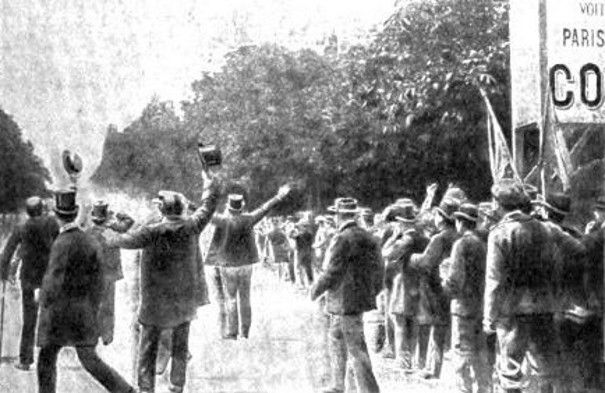
Finally, in the evening, the cyclists, who had gone out on a reconnaissance run, return pedaling furiously, as the joyful procession of their multicolored lanterns precedes, at 10 p.m. 38, the Panhard-Levassor (No. 5), which, under the expert guidance of the tireless Levassor, checks in and sets off again for Paris!!!
Following Levassor, the others arrive in order:
15. Peugeot (June 13), 2:10 a.m. — 8. Peugeot, 3:28 a.m. — No. 16 Peugeot, 3:23 a.m. — No. 28 Panhard and Levassor, 7:20 a.m.—No. 12 Roger, 9:46 a.m.— No. 7 Panhard and Levassor, 12:22 a.m. — No. 20 Serpollet (June 14), 1:00 a.m. — 13. E. Roger, 7:02 a.m. — 24. Bollée, 9:45 a.m. — 40. Michelin, 12:45 p.m.
Michelin’s “L’Éclair”
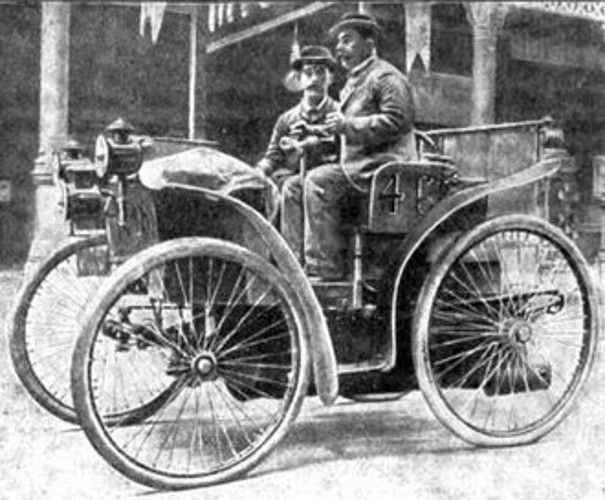
Michelin? Yes, Michelin was competing—eager both to experiment and to promote its new pneumatic tires, in which it was still the only one to believe!
So it entered its famous vehicle, l’Éclair, which weighed 1,400 kilograms. In truth, from the moment it left Paris, one mishap after another had occurred. After breaking down on Avenue MacMahon due to an accidental mix of water and gasoline in the carburetor, Edouard Michelin had been the target of the crowd’s mockery. “He wants to go to Bordeaux and can’t even make it up to the Arc de Triomphe,” people said!
Nevertheless, the Éclair managed to reach Versailles, then Tours, Poitiers, and Bordeaux, where the drivers arrived without stopping, eating a chicken soaked in kerosene while driving to save time.
The 65 tires often went flat, and repairing them was a tedious task: twenty safety bolts held these rudimentary tires to the rim, each of which lasted barely more than 150 kilometers; nevertheless, they still drove at 60 per hour on downhill stretches, taking care to avoid pebbles!
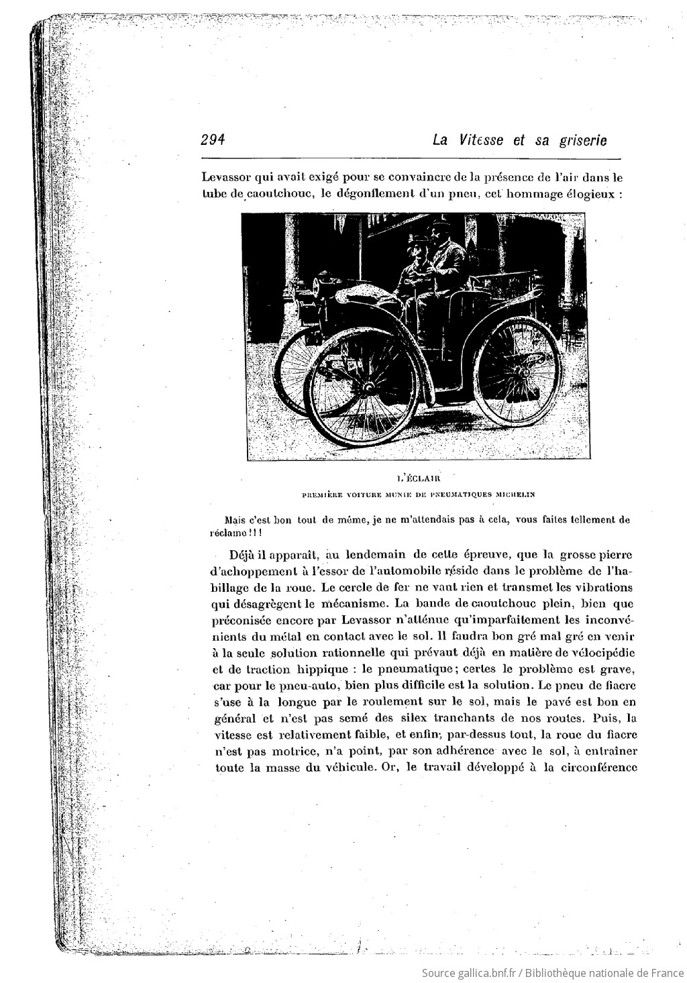
L’Éclair returned to Paris in good enough condition to elicit this glowing tribute from Levassor—who, to convince himself that air was present in the rubber tube, had demanded that a tire be deflated:
L’ÉCLAIR. THE FIRST CAR EQUIPPED WITH MICHELIN TIRES
But that’s fine all the same—I wasn’t expecting that; you’re making such a big fuss!!!
Already, in the aftermath of that test, it became clear that the major stumbling block to the rise of the automobile lay in the problem of wheel covering. The iron rim is worthless and transmits vibrations that break down the mechanism. The solid rubber band, although still recommended by Levassor, only partially mitigates the drawbacks of metal in contact with the ground. Like it or not, we’ll have to resort to the only rational solution that’s already prevailing in the fields of bicycles and horse-drawn vehicles: the pneumatic tire; admittedly, the problem is serious, because for the automobile tire, the solution is far more difficult. A horse-drawn carriage tire wears down over time from rolling on the ground, but the pavement is generally in good condition and is not strewn with the sharp flints found on our roads. Furthermore, the speed is relatively low, and finally—above all—the carriage wheel is not a drive wheel; it does not have to propel the entire mass of the vehicle through its grip on the ground. However, the work done at the circumference of a car tire is such that, in races, temperature increases caused by friction have been recorded, reaching up to 60 degrees Celsius.
Nevertheless, Michelin would overcome all these difficulties: from then on, we would see the company emerge as an increasingly “favorite,” becoming the indispensable partner of the winners of every race.
The Final Standings
A Serpollet car overturned on the return leg, a few kilometers from the finish; car No. 6 (Panhard-Levassor) was disqualified for changing a wheel, as was, incidentally, the Eclair, which a race official in Tours had criticized for replacing various spokes, etc., etc.; nevertheless, nine vehicles accomplished the formidable feat within the prescribed time limit—less than one hundred hours.
They were, in order of classification, according to their times:
1st, No. 5, Panhard and Levassor (2-seater), 48 h. 47′. — 2nd, No. 15, Peugeot (2-seater), 54 h. 35′. — 3rd, No. 8, Peugeot (4-seater), 59 h. 49′. — 4th, No. 16, Peugeot (4-seater), 59 hrs. 48′. — 5th, No. 12, Roger (4-seater), 64 hrs. 30′. — 6th, No. 7, Panhard and Levassor (4-seater), 72 hrs. 14′. — 7th, No. 28, Panhard & Levassor (5-seater), 78 h. 7′. — 8th, No. 13, Roger (4-seater), 82 h. 48′. — 9th, No. 24, Bollée steam omnibus (6-seater), 90 h. 3′.
Photos.
Page 289. THE START AT PLACE DE L’ÉTOILE
Page 294. L’ÉCLAIR. THE FIRST CAR EQUIPPED WITH MICHELIN TIRES
Page 295. LEVASSOR CROSSES THE FINISH LINE IN A PANHARD-LEVASSOR AT THE PORTE-MAILLOT
(These three photos: commons-wikimedia)