This Scientific American article describes the 1895 Paris-Bordeaux race, something like the view through American eyes. Referring to the French magazine „L’Illustration“, it shows that many magazines cooperated with each other already in those days.
With permission of hathitrust hathitrust.org == Text and fotos compiled by motorracinghistory motorracinghistory.com
Scientific American — Volume LXXIII, No. 3, July 20, 1895
AUTOMOBILE CARRIAGES.
Since the early days of the present century a practical road carriage which should carry its own means of propulsion has engrossed the attention of many inventors. Today we are treated to a spectacle of an automobile carriage with four passengers which can travel 750 miles at the rate of nearly 16 miles an hour. We have at various times illustrated all of the leading horseless carriages, and we now present views of the prize winners at the recent Paris-Bordeaux race.
This race began in Paris on June 11; the course was from Paris to Bordeaux and return. The distance was about 360 miles from Paris to Bordeaux. Under the conditions of the race only four-seated carriages could compete for the first prize of 40,000 francs, or $8,000. Special prizes were also to be awarded to automatic and petroleum velocipedes. Sixty-six horseless vehicles propelled by petroleum, steam power, or electricity and five or six petroleum bicycles competed. The preliminaries were arranged with great care, checking stations being provided to ensure the integrity of the race. Special telegraph wires were laid along the route to transmit news of the progress of the race to Paris.
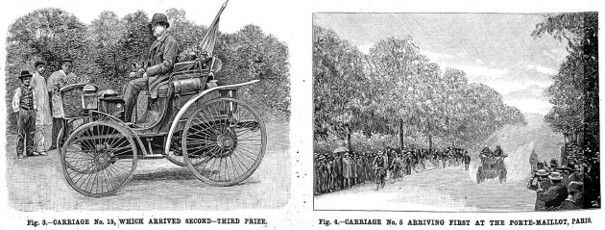
The race was witnessed by many thousand people on the line of march. The first vehicle to arrive at Bordeaux was MM. Panhard and Levassor’s petroleum carriage, which reached Bordeaux at 10:32 on Wednesday morning, the start having been made at Versailles at nine minutes past noon the previous day. A stop of only four minutes was made, when the return trip was begun. M. Levassor’s time to Bordeaux was 22 hours 28 minutes over a distance of 585 kilometers (363 miles). The speed was 24 kilometers 400 meters an hour, equivalent to about 15 miles. The carriage of MM. Panhard and Levassor met with an accident shortly after leaving Bordeaux, which delayed it over an hour, which makes the run more creditable. This carriage made the entire trip in 2 days and 53 minutes for the round trip of 1,170 kilometers (727 miles), being at the average rate of 14.9 miles an hour. Many of the other vehicles made splendid time.
The contest was arranged by Mr. James Gordon Bennett, Baron de Neufeldt, and others, who it is said paid for the prizes. The Panhard and Levassor’s carriages, four in number, were propelled by the well-known Daimler motor, which has achieved so much success in both this country and abroad. In the SCIENTIFIC AMERICAN for February 7, 1891, we illustrated the Daimler motor and some of its applications.
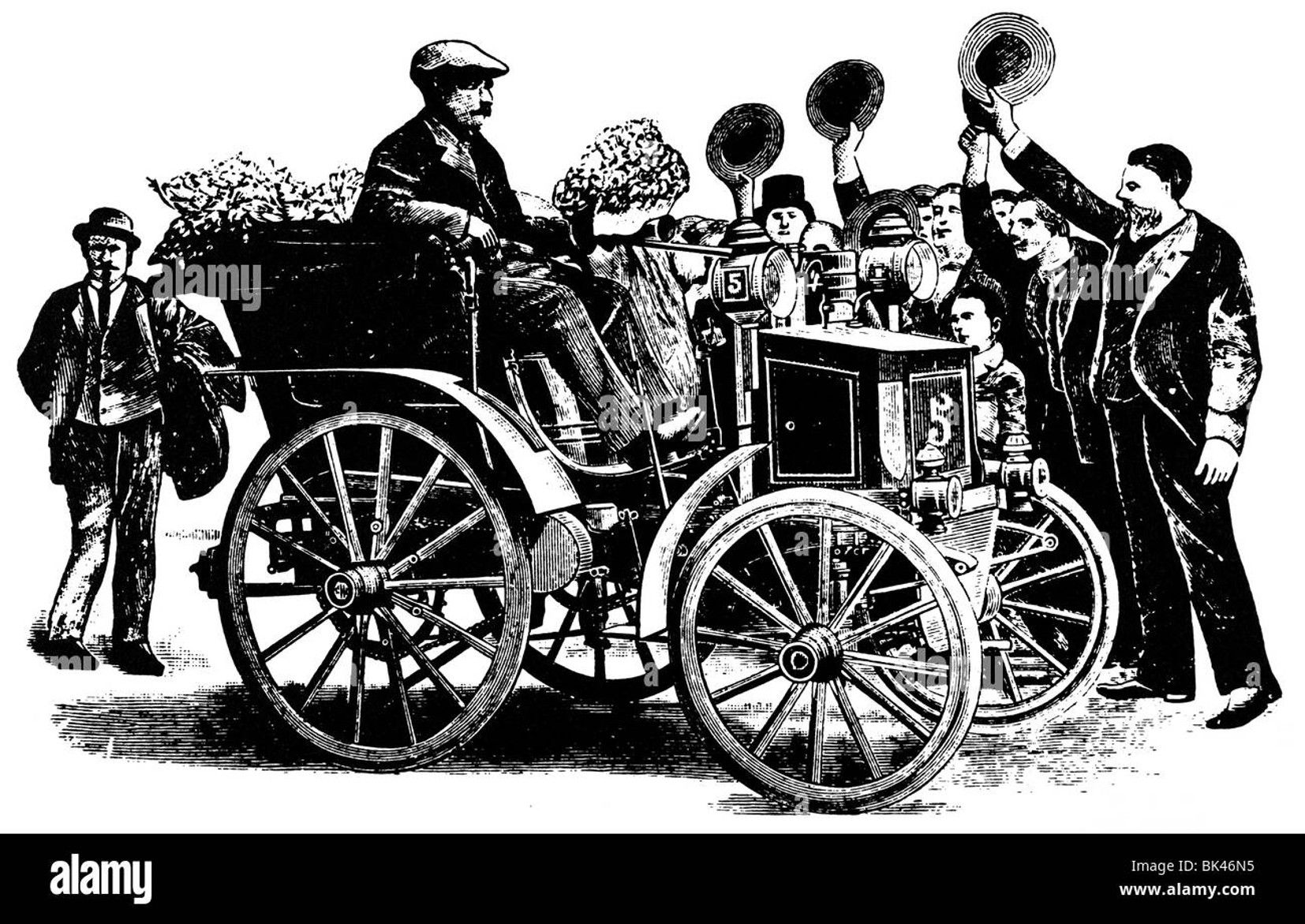
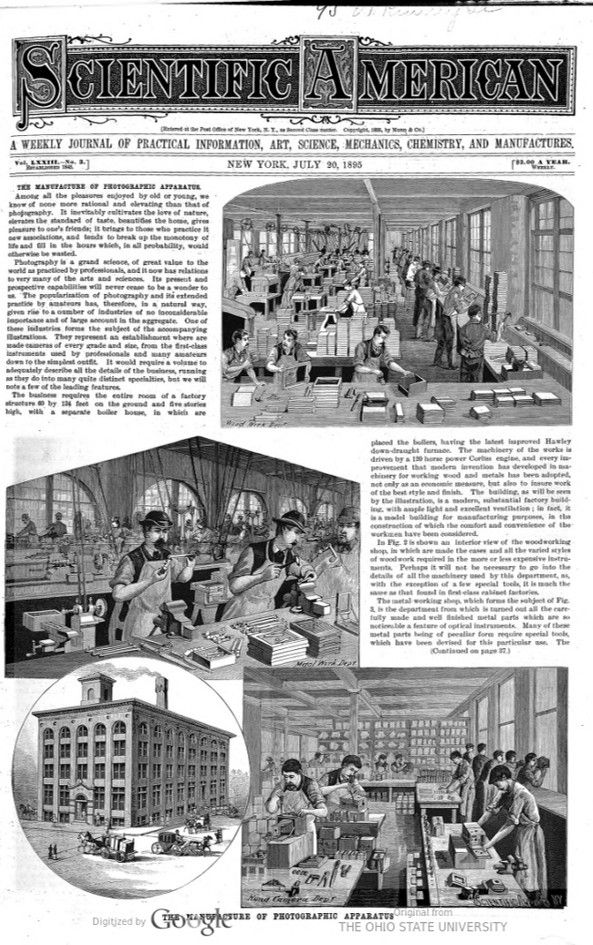
The American company will bring out, within a few months, a carriage adapted to our American roads. Their factory is located at Steinway, Long Island City. We illustrate the small carriage of MM. Panhard and Levassor, which took the second prize, and also its arrival at the Porte-Maillot (Fig. 4), Paris, on the return trip.
The carriages were constantly accompanied by bicycle riders who were soon distanced. The roads along the route were filled with enthusiastic spectators.
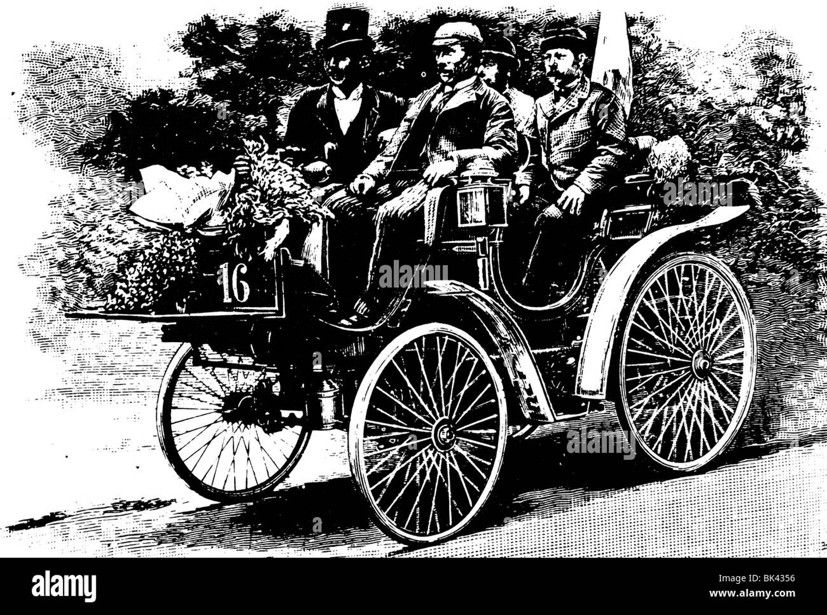
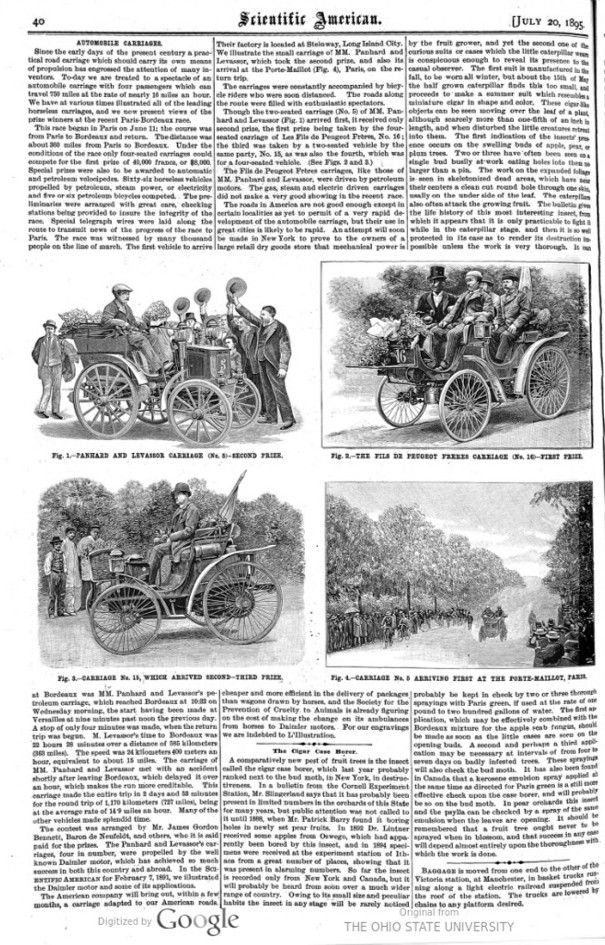
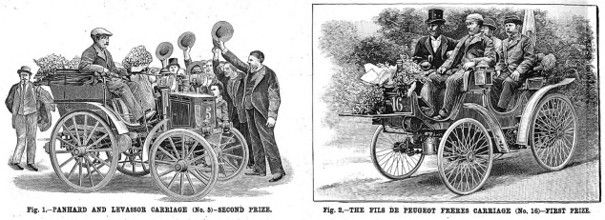
Though the two-seated carriage (No. 5) of MM. Panhard and Levassor (Fig. 1) arrived first, it received only second prize, the first prize being taken by the four-seated carriage of Les Fils de Peugeot Frères, No. 16; the third was taken by a two-seated vehicle by the same party, No. 15, as was also the fourth, which was for a four-seated vehicle. (See Figs. 2 and 3.)
The Fils de Peugeot Freres carriages, like those of MM. Panhard and Levassor, were driven by petroleum motors. The gas, steam and electric driven carriages did not make a very good showing in the recent race.
The roads in America are not good enough except in certain localities as yet to permit of a very rapid development of the automobile carriage, but their use in great cities is likely to be rapid. An attempt will soon be made in New York to prove to the owners of a large retail dry goods store that mechanical power is cheaper and more efficient in the delivery of packages than wagons drawn by horses, and the Society for the Prevention of Cruelty to Animals is already figuring on the cost of making the change on its ambulances from horses to Daimler motors. For our engravings we are indebted to L’Illustration.
Photos. Page 40.
Fig. 1.- PANHARD AND LEVASSOR CARRIAGE (No. 5)-SECOND PRIZE. Fig. 2.- THE FILS DE PEUGEOT FRERES CARRIAGE (No. 16)-FIRST PRIZE.
Fig. 3.- CARRIAGE No. 15, WHICH ARRIVED SECOND-THIRD PRIZE. Fig. 4.- CARRIAGE No. 5 ARRIVING FIRST AT THE PORTE-MAILLOT, PARIS.