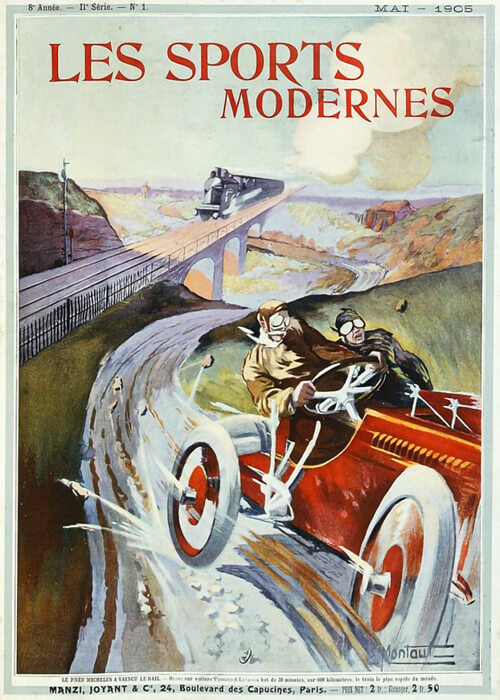
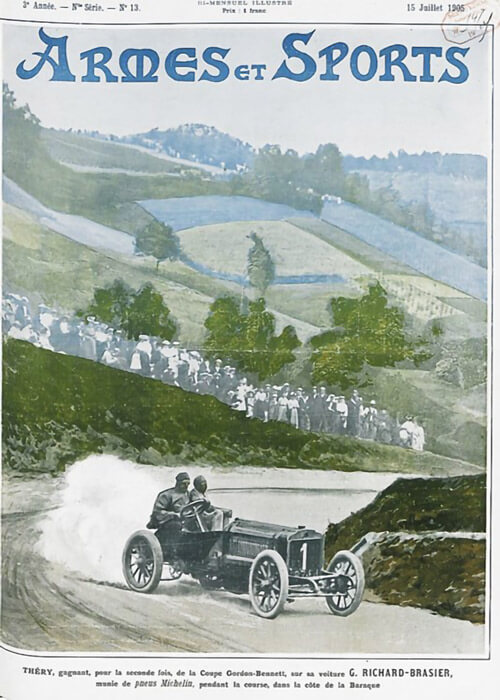
An advance notification for the 1896 Paris-Marseille-Paris race, that was published àfter the race was completed, seems a bit out of timing. But for the popular scientific magazine La Nature, that wasn’t an issue, as they had many more to report on. Nontheless, contests of a new industry always could count on enough interest of the French public. Here, not only the timing of the event, the different vehicle classes as well as a forecast of the course of the race is given.

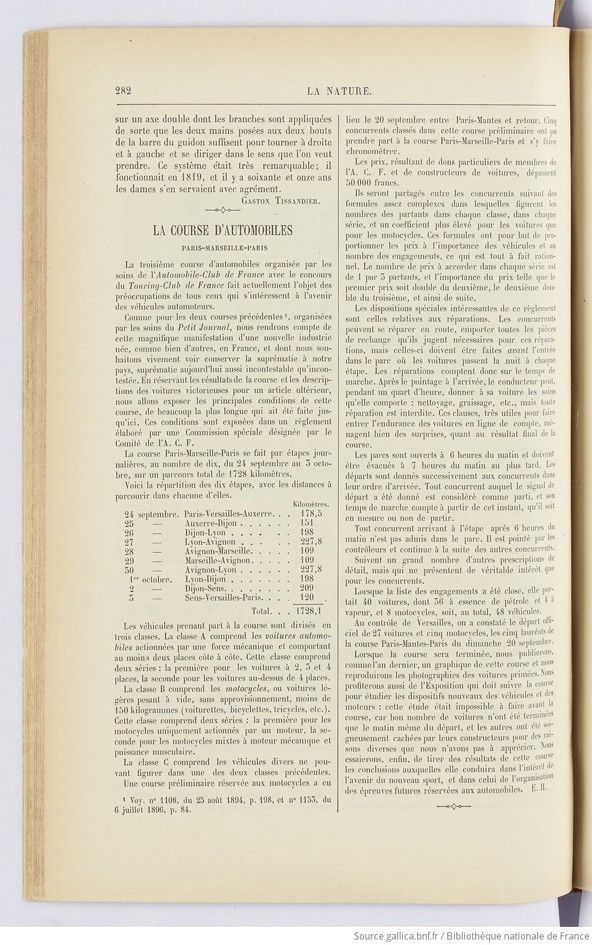
With permission of the Bibliothèque national francais gallica.bnf.fr
Text and photos compiled by motorracinghistory, Translation by DeepL deepl.com
LA NATURE — 24th Year, No. 1225, October 3, 1896
THE AUTOMOBILE RACE – PARIS-MARSEILLE-PARIS
The third automobile race organized by the Automobile-Club de France in collaboration with the Touring-Club de France is currently the focus of attention for all those interested in the future of motor vehicles.
Known for the two previous races (See No. 1108, August 25, 1894, p. 198, and No. 1153, July60, 1896, p. 84), organized by “Le Petit Journal” we will report on this magnificent event showcasing a new industry born, like so many others, in France, and whose supremacy we fervently hope our country will retain — a supremacy that is today as indisputable as it is uncontested. While we will save the race results and descriptions of the winning cars for a later article, we will now outline the main conditions of this race, by far the longest ever held to date. These conditions are set forth in a set of rules drawn up by a special commission appointed by the A.C.F. Committee.
The Paris-Marseille-Paris race consists of ten daily stages, running from September 24 to October 5, over a total distance of 1,728 kilometers. Here is the breakdown of the ten stages, with the distances to be covered in each. (Kilometers).
September 24. Paris-Versailles-Auxerre — 178,5
25 — Auxerre-Dijon ——– 151
26 — Dijon-Lyon ————- 198
27 — Lyon-Avignon ——— 227,8
28 — Avignon-Marseille — 109
29 — Marseille-Avignon — 109
30 — Avignon-Lyon ——— 227,8
October 1st. Lyon-Dijon — 198
2 — Dijon-Sens ————— 209
3 — Sens-Versailles-Paris – 120
Total —————————- 1728,1
Vehicles participating in the race are divided into three classes.
Class A includes motor vehicles powered by a mechanical engine and featuring at least two seats side by side. This class comprises two categories: the first for 2-, 5-, and 4-seater cars, and the second for cars with more than 4 seats.
Class B includes motorcycles or light vehicles with an unloaded weight, excluding fuel, of less than 150 kilograms (microcars, bicycles, tricycles, etc.). This class comprises two categories: the first for motorcycles powered solely by an engine, the second for hybrid motorcycles powered by both a mechanical engine and human muscle power.
Class C includes miscellaneous vehicles that do not fit into either of the two preceding classes.
A preliminary race reserved for motorcycles took place on September 20 between Paris and Mantes and back. Five competitors who placed in this preliminary race were able to take part in the Paris–Marseille–Paris race and have their times recorded there.
The prizes, resulting from private donations by members of the A.C.F. and automobile manufacturers, exceed 50,000 francs.
They will be distributed among the competitors according to fairly complex formulas that take into account the number of entrants in each class and each series, with a higher coefficient applied to automobiles than to motorcycles. The purpose of these formulas is to proportion the prizes to the size of the vehicles and the number of entries, which is entirely reasonable. The number of prizes to be awarded in each series is one for every five entrants, and the prize amounts are structured so that the first prize is double the second, the second double the third, and so on.
The most interesting special provisions of these regulations are those concerning repairs. Competitors may make repairs along the route and carry all the spare parts they deem necessary for these repairs, but such repairs must be completed before entering the park where the cars spend the night at each stage. Repairs therefore count toward the driving time. After checking in at the finish, the driver may, for a quarter of an hour, perform routine maintenance on his car—such as cleaning and lubrication—but no repairs are permitted. These provisions, which are very useful for taking the cars’ endurance into account, often lead to many surprises regarding the race’s final outcome.
The service parks open at 6:00 a.m. and must be vacated by 7:00 a.m. at the latest. Competitors are released one after another in the order in which they arrived. Any competitor who has been given the starting signal is considered to have started, and their driving time is counted from that moment onward, whether or not they are able to start.
Any competitor arriving at the stage after 6:00 a.m. will not be admitted to the park. They will be checked in by the marshals and will continue following the other competitors.
There are a large number of other detailed regulations, but these are of interest only to the competitors.
When the entry list was closed, it included 40 cars—50 gasoline-powered and 4 steam-powered—and 8 motorcycles, for a total of 48 vehicles.
At the Versailles checkpoint, 27 cars and five motorcycles were officially recorded as having started, including the five winners of the Paris-Mantes-Paris race held on Sunday, September 20.
Once the race is over, we will publish, as we did last year, a chart of the race and reproduce photographs of the winning cars. We will also take advantage of the exhibition scheduled to follow the race to examine the new features of the vehicles and engines: this examination was impossible to conduct before the race, as many of the cars were not completed until the very morning of the start, and the others were carefully concealed by their manufacturers for various reasons that are not for us to judge.
Finally, we will attempt to draw conclusions from the results of this race that will benefit the future of this new sport and the organization of future automobile races.
E. Hospitalier