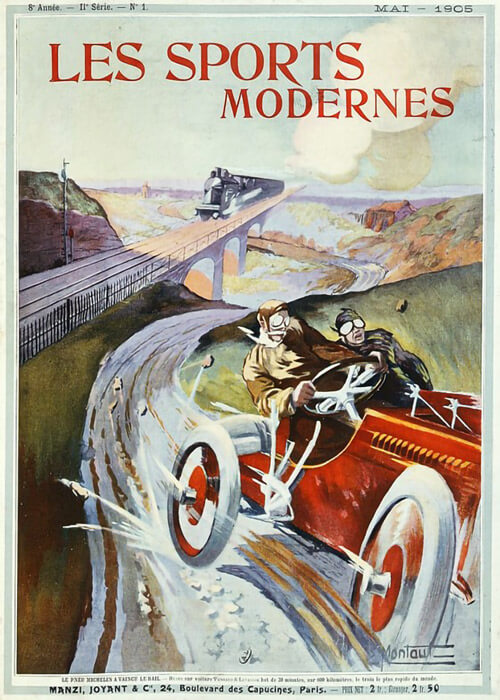
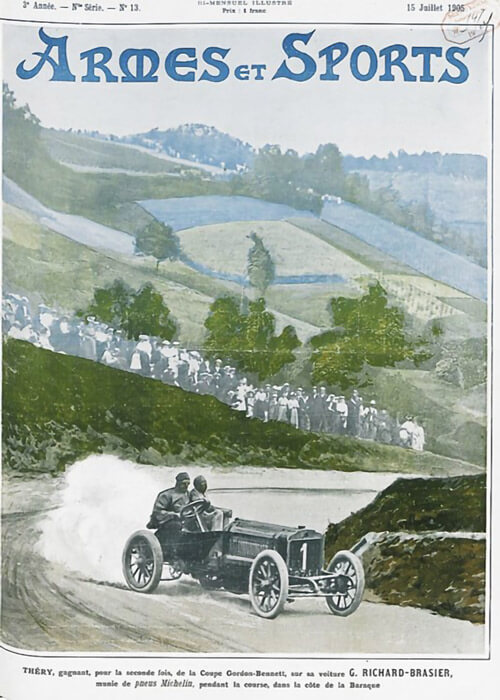
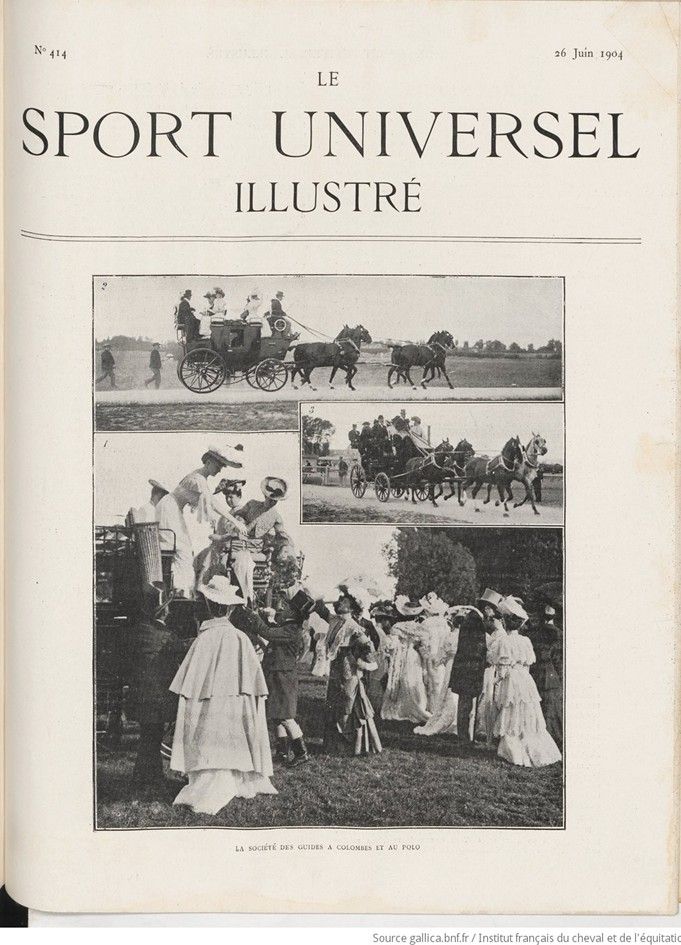
The French magazine „Le Sport Universel Illustré“, mostly handled sport with horses. Hippic sports were very popular in the early years of 1900. But from time to time, other events were highlighted, especially when „les véhicules sans chevaux“ were racing around. This fourth and last article on the 1904 Gordon Bennett Race in Germany, written by Pierre Hanelle, reads his experience as a journalist and spectator of the race. The regularity of the Winner Théry in his Richard-Brasier is highlighted here once more.
With permission of the Bibliothèque national francais – gallica.bnf.fr
Text and photos complied by motorracinghistory.com. Translation by DeepL.com
Le Sport Universel Illustré – Volume 9, No. 414, June 26, 1904
THE GORDON-BENNETT CUP
This race — for some of us — began with a climb. On Friday, at around three o’clock in the morning, we were thrown off the train that had left Paris at midday the day before, carrying the caravan of drivers and sportsmen with a taste for the picturesque and adventure. Threatened with a return to Homburg on the departing train, I had left the sleeping-car in such a hurry – sleeping is a euphemism, the cruel irony of which I was able to appreciate during those long, hot hours of the night journey – that I had forgotten my monocles and binoculars, so much so that without the providential help of a fellow traveler who kindly lent me a pair of lorgnettes, useless in his pocket, I would not have seen, or I would have seen badly, the martial face of the emperor, the Olympian laughter of the victor, and the tragic mask of the vanquished, and so many other sights that make that day of the 17th an indelible memory in my gallery of sporting reminiscences! Alas, I have no longer found my unknown benefactor! At least, if he should happen to come across these lines, he should receive my heartfelt thanks!
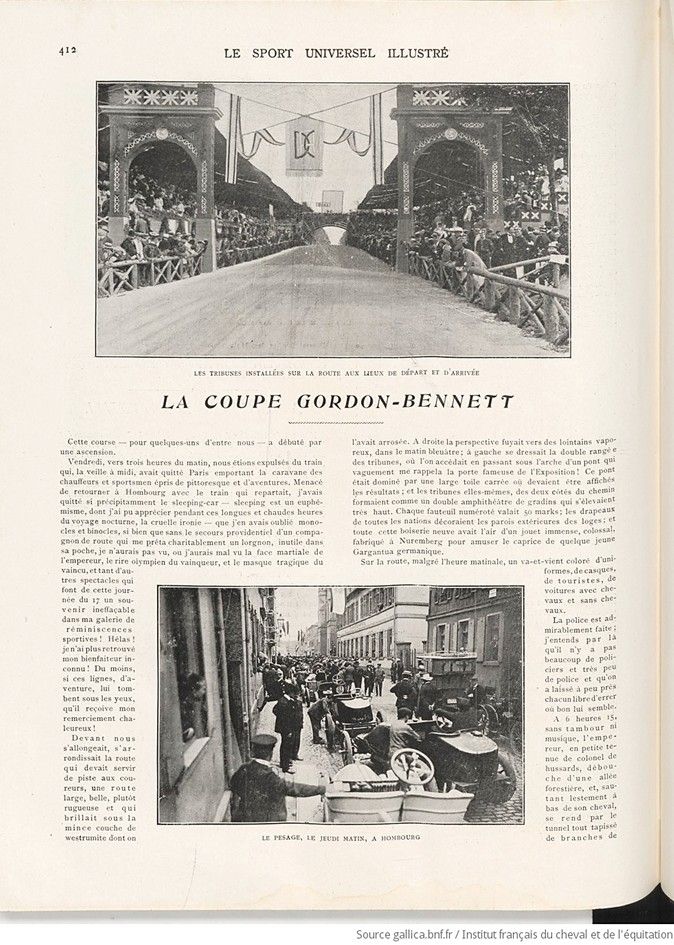
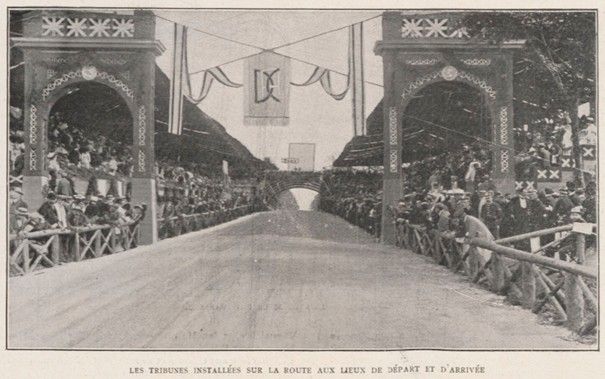
Ahead of us stretched out and rounded off the road that was to serve as a track for the runners, a wide, beautiful, rather rough road that shone under the thin layer of westrumite with which it had been sprinkled. To the right, the view vanished into the hazy distance, into the bluish morning; to the left stood the double row of grandstands, which you reached by passing under the arch of a bridge that vaguely reminded me of the famous gate at the Exhibition! This bridge was dominated by a large square canvas where the results were to be displayed; and the stands themselves, on both sides of the road, formed a double amphitheater of tiers that rose very high. Each numbered seat was worth 50 marks; the flags of all the nations decorated the outside walls of the boxes; and all this new woodwork looked like an immense, colossal toy, made in Nuremberg to amuse the whim of some young Germanic Gargantua.
On the road, despite the early hour, there was a colorful bustle of uniforms, helmets, tourists, horse-drawn and horseless carriages.
The police were admirably organized, by which I mean that there were not many policemen and very few police, and that just about everyone had been left free to roam wherever they pleased.
At 6.15 a.m., without music or drums, the emperor, in the undress of a colonel of hussars, emerged from a forest alley and, jumping lightly from his horse, made his way through a tunnel lined with pine branches to the lodge that had been built for him opposite the finish. The man looked young and his simplicity appealed. He was escorted by a number of officers and dignitaries, the Grand Dukes of Meklenburg and Oldenburg, I am told, Prince Henry of Prussia and Frederick Charles of Hesse; he was soon joined by the Kaiserine, in a delightful pale gown topped off with a mauve hat.
In the neighbouring boxes here and there, in the grandstands, many familiar figures: the Prince of Hohenlohe, the Count of Schœnborn, the Duke of Ratibor, the Baron of Braudenstein, a whole section of the German aristocracy.
The race started at seven o’clock. The circuit, which starts in Saalburg and passes through Musingen, Wielbourg, Limbourg and Hombourg, measures 141 kilometers, the total distance, and 128 kilometers, the race distance, after deducting neutralization, which represent a total of 58 minutes per lap, i.e. for the four laps of the event almost four hours of stopping.
At seven o’clock, the start was given to the first of the 19 registered competitors of the 18 starters, the Swiss having withdrawn. Number 1 was Jenatzy, who had been at his post for over an hour, taking the supreme look at his machine and going through all the workings himself! He sets off in a whirlwind, an impressive figure of a „red devil“, according to the apt epithet bestowed on him by some Irish reporter last year. Edge, the British champion, who was warmly acclaimed by the British clan; 7 minutes later, the Austrian Werner; then Lancia the Italian, who gallantly saluted as he passed the imperial box; finally, number 5, the winner of the Ardennes, our own Théry, in his valiant Richard-Brasier, with which we know and feel that he is one and the same; he was the favorite of the French team, the favorite of the race with the German Jenatzy. The last of the 18, Hautvast, has gone.
The first can’t be far behind now. And indeed, a bugle call soon announced the approach of a competitor; a fierce roar, and Jenatzy „the red devil“ passed by, disappearing; a sight all the more striking for its brevity!
On the great white canvas which, up there, blocks the horizon, some men write a few black signs, and we learn that the German champion covered his first lap in 1h. 26 m. 56 s., after neutralization times. How long will it have taken our Théry? But as he set off 28 minutes after his great rival, it wasn’t him that we were still waiting for; it was him, however, that everyone was thinking about, because we knew from the reports of the intermediate controls that he hadn’t lost anything on Jenatzy, and that both of them had won the lot.
And these reports were correct, because after the passage of S.F. Edge, who took 1 h. 31 m. 44 s. to complete his first lap, the popular 5 appeared and passed by to thunderous applause; once again the big canvas over there was lowered, a few figures were entered, and we saw that our representative had completed his 128 kilometers in 1 h. 26 m. 57 s., i.e. one second more than Jenatzy, and Tampier told me that there had been a mistake and that it was Théry who had put in the second less. What is certain is that within one second, the two men are together, and that never has the race been more open! And the interest is growing in this giant event which is already turning into a match! Does this mean that the race is over, that the others are out of the game? No, not at all; the pack chasing the two leaders is formidable and threatening, and I’ll prove it with figures.
First round standings:
Jenatzy, 1 h. 26 m. 56 s. ; Théry, 1 h. 26 m. 57 s. ; Edge, 1 h. 31 m. 44 s. ; Girling, 1 h. 32 m.55 s. ; Jarrott, 1 h. 35m. 18s. ; Salleron, 1 h. 36 m. 53 s. ; Cagno, 1 h. 42 m. 22 s. ; De Caters, 1 h. 43 m 15 s. ; Hautvaast, 1 h. 46 m. 47 s. ; Lancia, 1 h. 54 m. 53s. ; Braun, 1 h. 56 m. 24 s. ; Werner, 1 h. 58 m. 41 s. ; Rougier, 2 h. 6′ ; Warden, 2 h. 7 m. I4 s. ; Augiéres, 2 h. 23 m. 7 s. ; De Crawhez, 2 h. 28 m. 32 s. ; Opel, abandoned.
Never before, at the end of the first quarter of such a tough race, has the field been so tight – the three Englishmen are in a row – and never has the waste been so low! After 128 kilometers, only one rider dropped out! And it was said that the breakdown would cause a massacre among the starters!
Time marched on and Jenatzy passed again; he completed his two laps in 2 h. 55 m. 29 s., and his second lap in 1 h. 28 m. 33 s. And we’re waiting for Théry! He passed, and the table shows that he completed his second lap in 1 h. 26 m. 46 s., which means that he beat his terrible opponent by 1 m. 47 s. Not much, if you like. But it is something materially and it is a lot morally.
The man in the lead now knows that there’s someone behind him who’s going a bit faster than he is. I’d say that’s enough to take the legs out of an engine, if an engine had legs!
The pack was beginning to break up, still forming an imposing mass led by Girling ahead of Cagno, Jarrott, and de Caters, whose accident at the start – a quirk of the engine which I forgot to mention, but which cost him a good fourteen minutes – took away his chance, if not to win, at least to come close to the winner. The Emperor, with a courtesy much appreciated by his guests, sent for the delegates of the Automobile Club de France, who came, through the mouth of their president, Baron de Zuylen, to greet the imperial spectator. The visit lasted twenty minutes, during which time William II congratulated the French representatives on the progress made in the French car industry, as demonstrated by the excellent state of our cars on that day. Courteous words, no less than the welcome, which were echoed by the Emperor’s guests!
We are now at the climax of the race, which, barring any accidents, is the match between France and Germany. The third lap is likely to decide the outcome; with what anxious curiosity we watch for the third passage of the leading man!
But for the third time Jenatzy passed in front of us; and the implacable canvas up there announced to the dismayed and delighted crowd – I’m taking sides here and there – that it took the German ten minutes longer to complete the third lap than the previous two, i.e. 1 h. 37 m. 46 s.
If Théry maintained his pace right to the end, he would have won. He passed, and the impartial scoreboard showed 1 h. 29 m. 21 s. He was now a good ten minutes ahead; the German crowd fell silent, their hopes dashed. Barring an accident, it was all over. De Caters passed into third place and behind him came Cagno, Rougier, Hautvast, Girling, Lancia, who, without fail, saluted the imperial box as he passed, and Jarrott, Salleron, Werner, Edge and de Crawhez.
The last lap seemed longer than all the others. I can’t think of anything more tiring than watching men go by at 100 kilometers an hour for a whole day!
A single question, but an agonizing one, when the fate of a Cup and all the treasures it contains depends on the answer: will Théry, who, like Jenatzy, has never experienced a breakdown, be as happy as ever? If so, he’s sure to win. If not, I don’t want to think about it, but I am thinking about it all the same, and everyone is thinking about it with me, and even everyone is thinking about nothing else. Breakdown or no breakdown, defeat or triumph?
We are hypnotized by this fixed idea. We pay no attention to anyone passing by who isn’t Jenatzv or Théry. What are they doing wandering around this track? We’re not interested in them anymore, they’re just annoying us and we’re giving them the runaround.
Once again, the bell rang and for the fourth and last time „the red devil“, with his cap inflated by the wind, just as we saw him cross the finishing line victoriously a year ago at Ballyshannon Cron Road, Jenatzy passed, the hurrahs crackled along the railings, flowers were thrown at him. he doesn’t care! he doesn’t want them, he knows he’s beaten, even though this time it only took him 1 h. 27 m. 9 s., in a supreme effort.
Last year, it was he who finished second, – but he was the winner and de Knyff, who had beaten him to the finish, was the loser. Today the positions are reversed; he finishes ahead of the French champion, but the latter has already won, inevitably!
Now we wait for the Frenchman: and it seems to us that the minutes are falling very quickly or that he is going very slowly…. Several times the bell rings, but it’s not for him. Finally this time it’s him! number 5, the triumph of the Ardennes! who has completed his last lap in 1 h. 28 m. 13 s. He passes in front of us to a frenzied ovation. It was delirious. I believe that once the moment of consternation had passed, the contagion of enthusiasm spread to the defeated.
Everyone is clapping their hands, stamping their feet, waving their handkerchiefs, making noise in front of me, behind me and around me, and there are still a few Germans in the Taunus! The Kaiser and the Kaiserine congratulate the modest Brasier whose car, which is his work, has just returned the Cup to us! And down on the pavement, like a huge wave, you can hear the popular cheers around the radiant Théry; they want to carry him off in triumph; everyone shakes his hand, starting with the loser, poor Jenatzy! For weeks he had been living on the track, studying the road and his car, sure of it and of himself: he feared – as he had said – only one man, and that man was Théry! But what can you do against a machine that turns its rounds with the despairing regularity of a clock? Bow down and accept. – The blow that crushes so many hopes is a hard one, and sport, which only makes winners out of losers, is cruel. Jenatzy, who had given his all to this battle, is now nothing more than a body without a soul.
This is the human, dramatic side of the day, the one that will always touch us the most. But the mechanical side is worth mentioning. The results from the Taunus confirm those from the Ardennes! It was the relatively weak engine that triumphed; the Mercédès, which also did so well in this tournament, was hardly stronger than the Richard-Brasier. The case is heard. The monsters lived.
And here is a second comforting observation: on such a tough course, where we were predicting countless accidents and incidents and enormous waste, out of 18 starters, there are 12 finishers. A magnificent proportion, made all the more significant by the times, with the last of the twelve, Jarrott, taking hardly more than 7 hours to cover the 512 kilometers of the race! compared to the 5 hours 50 m. 8 s. of the winner!
But there are a few more figures that will complete the picture of this memorable day.
All four rounds and final standings:
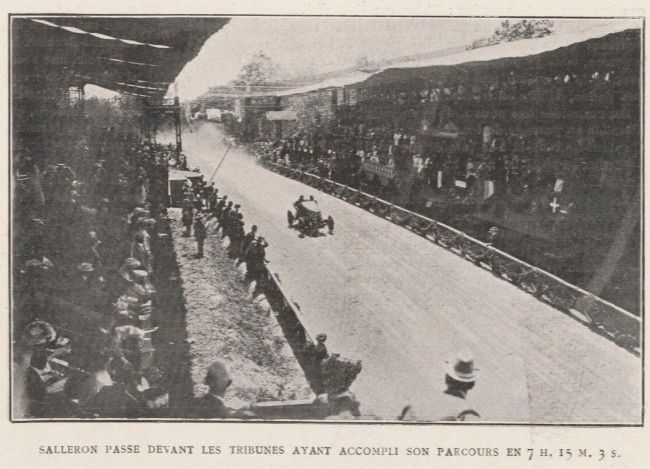
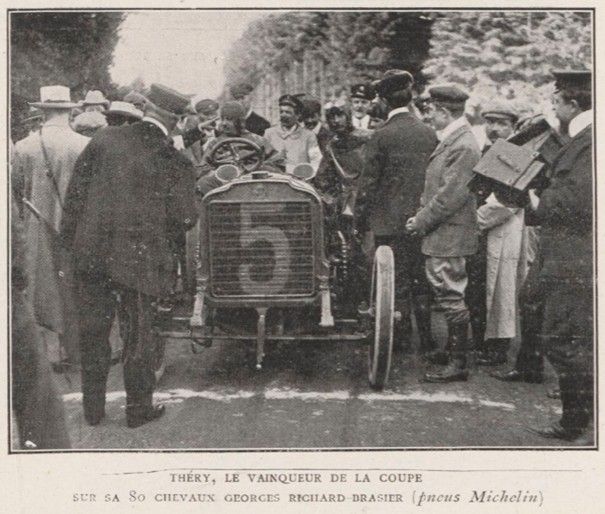
1. Théry, 5 h. 50 m. 8 s. ; 2. Jenatzy, 6 h. 1 m. 28 s. ; 3. de Caters, 6 h. 46 m. 31 s. ; 4. Rougier, 6 h. 48 m. 11 s. ; 5. Braun, 6 h. 59 m. 6 s., 6. Hautvast, 7 h. 23 m. 6 s. ; 7. Salleron, 7 h. 15 m. 3 s. ; 8. Lancia, 7 h. 17 m, 54 s. ; 9. Girling, 7 h. 22 m. 54 s. ; 10. Gagno, 7 h. 23 m. 36 s., 11. Werner, 7 h. 32 m. 14 s. ; 12. Jarrott, 7 h. 36 m. 32 s.
It’s 7 o’clock. The officials are still chatting in front of the abandoned imperial lodge; a few groups of obstinate drinkers linger around the tables and the sparkling jugs; the crowd, the great crowd, through the paths of the old Taunus, in countless happy, babbling streams of people, flows towards Homburg
P. HAMELLE
Photos.
Page 412.
GRANDSTANDS THAT ARE INSTALLED IN THE START AND FINISH AREAS
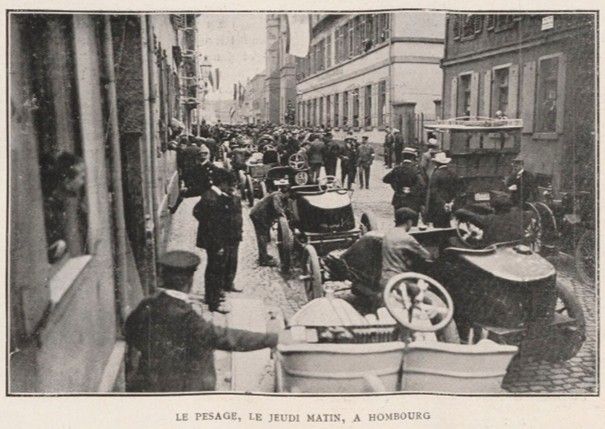
THE WEIGHING AT HOMBOURG ON THURSDAY MORNING
Page 413.
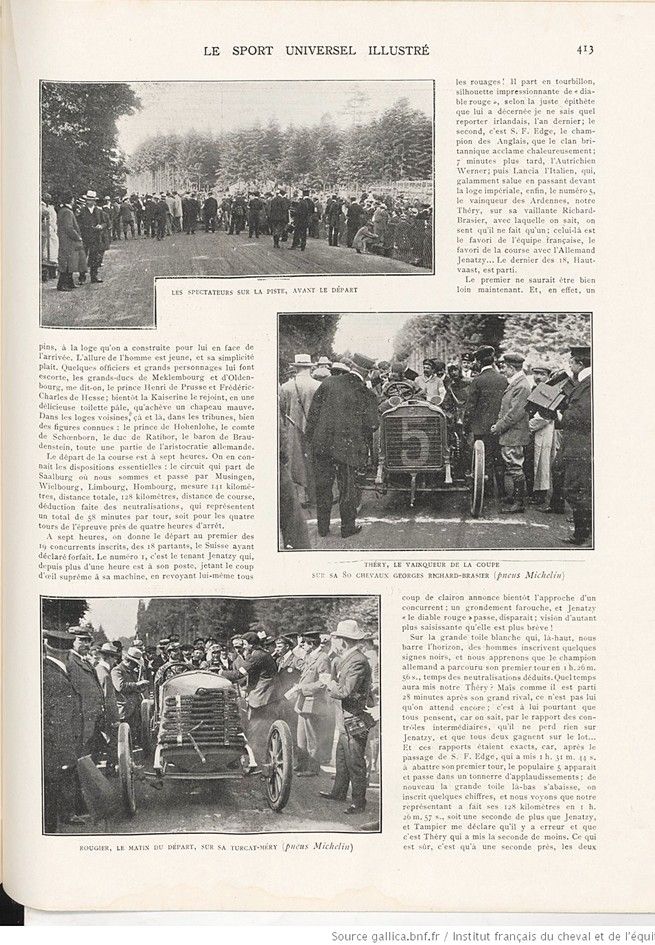
SPECTATORS ON THE TRACK, BEFORE THE START
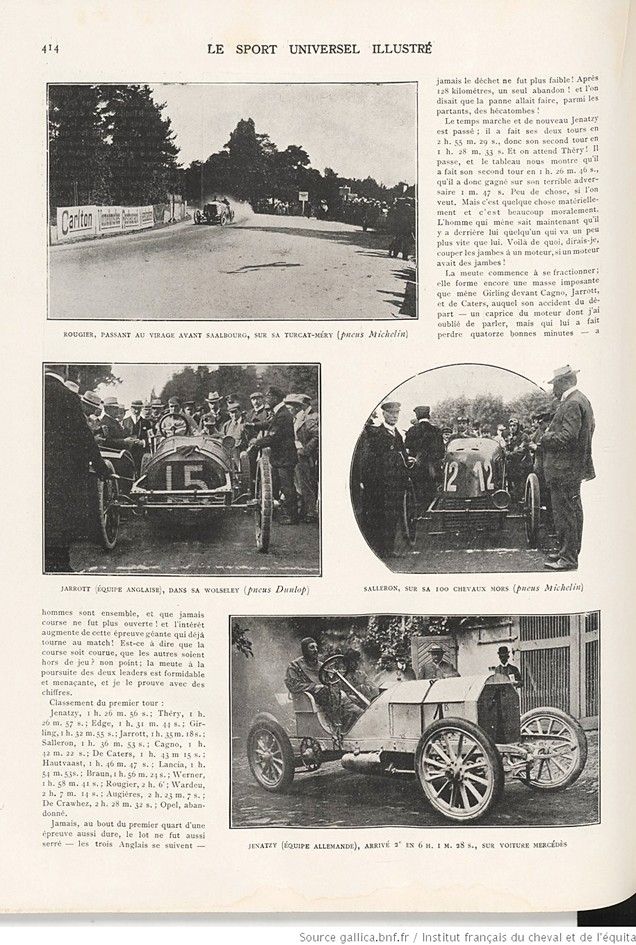
THÉRY, THE CUP WINNER ON HIS 80 H.P. GEORGES RICHARD-BRASIER (Michelin tyres)
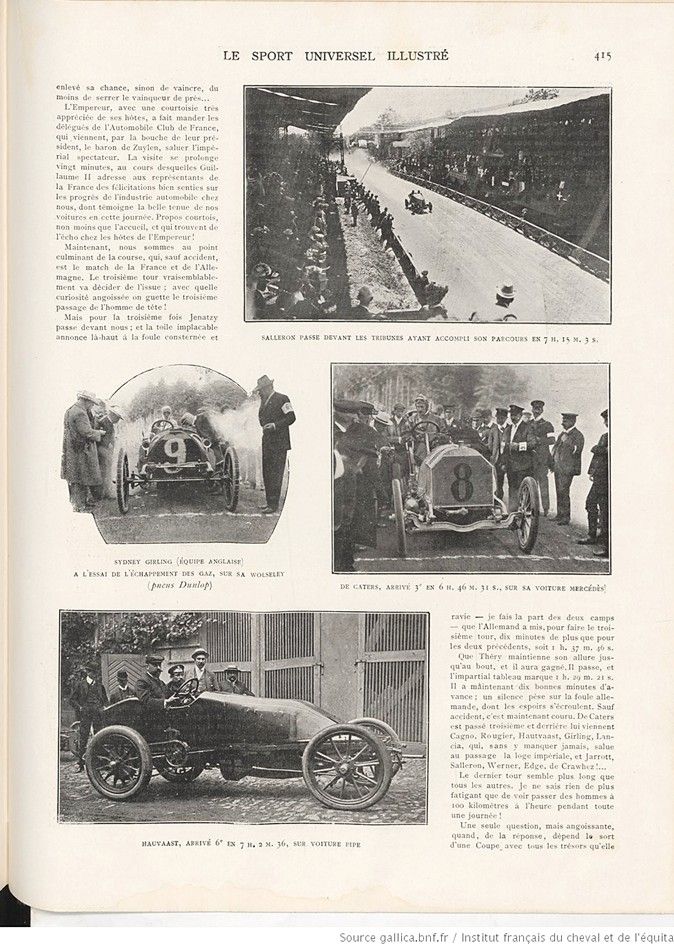
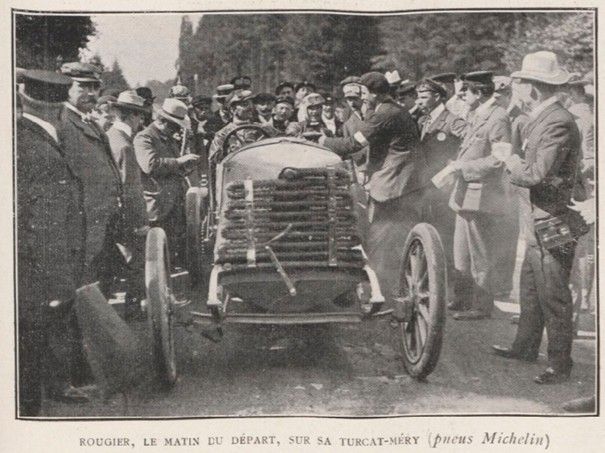
ROUGIER, ON THE MORNING OF THE START, ON HIS TURCAT-MERY (Michelin tyres)
Page 414.
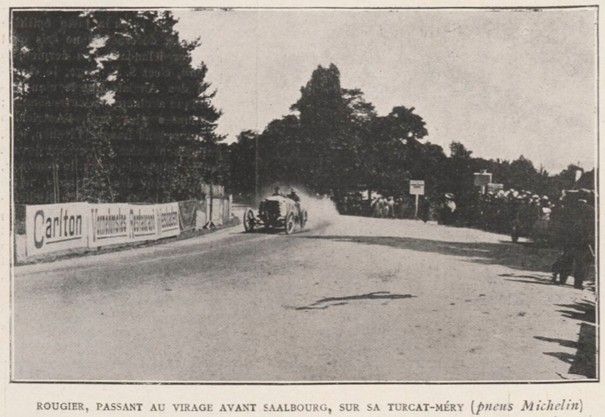
ROUGIER, PASSING THE VIRTAGE BEFORE SAALBOURG, ON HIS TURCAT-MÉRY (Michelin tyres)
JARROTT (ENGLISH TEAM), IN HIS WOLSELEY (Dunlop tyres)
SALLERON, ON HIS 100 H.P. MORS (Michelin tyres)
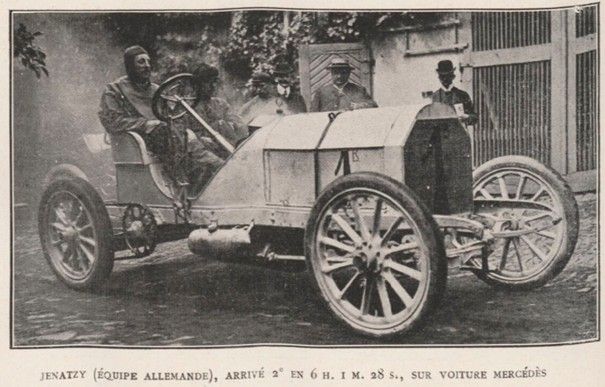
JENATZY (GERMAN TEAM), FINISHED 2nd IN 6 H. 1 M. 28 s., ON MERCEDES CAR
Page 415.
SALLERON PASSES IN FRONT OF THE GRANDSTANDS, HAVING COMPLETED THE COURSE IN 7 H. 15 M. 3 S.
SYDNEY GIRLING (ENGLISH TEAM) AT THE GAS TEST, ON HIS WOLSELEY (Dunlop tyres)
DE CATERS, 3RD IN 6 H. 46 M. 31 S., ON HIS MERCEDES
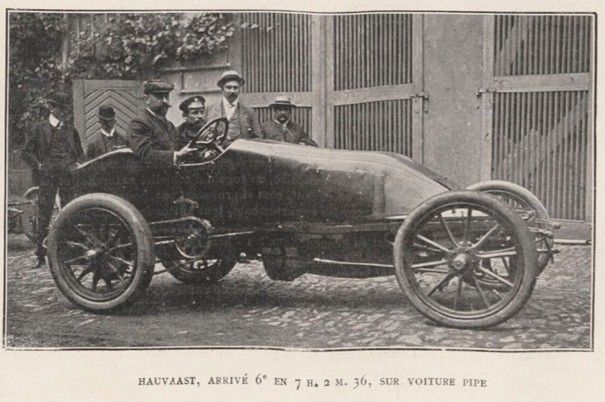
HAUTVAST, 6TH IN 7 H. 2 M. 36, ON PIPE CAR