The year 1900 has just passed the line, the rules for the first Gordon Bennett race in 1900 had been established so as the date ot the race and further agreements were made; then already the conflicts started. It was on some participating druvers, such as Antony (pseudonym for Mr. Debray), Giraud, Lemaaitre and Levegh (pseudonym for Mr. Velghe). It was allabout the way that these names were chosen. In other articles the selection criteria are mentioned. A comparison was even made with the selection system of a sailing contest, America’s Cup.
With courtesy of the Bibliothèque national francais – gallica.bnf.fr
Text and photos compiled by motorracinghistory; translation by DeepL deepl.com.
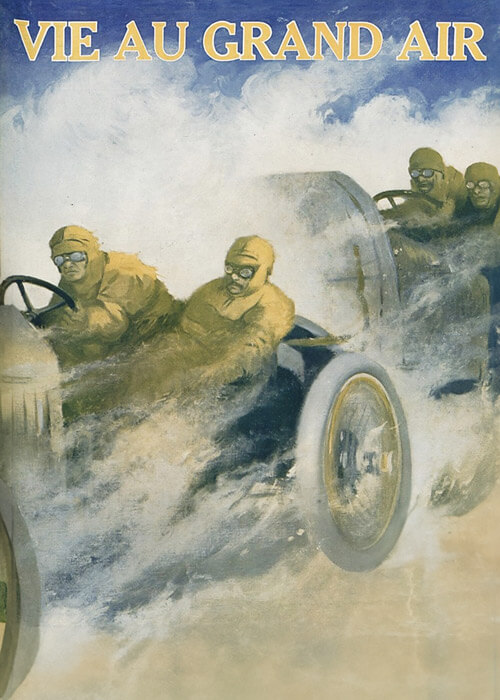
La Vie au Grand Air – No. 92, January 7, 1900
THE GORDON-BENNETT CUP
The automotive world has just received an inheritance—but a dangerous one. Just as in families, there are inheritances that are a source of disputes and lawsuits.
Such was the legacy bequeathed by the Automobile Club of France in the form of the Gordon-Bennett Cup, a generous gift from the excellent sportsman who is the editor of the New York Herald. The Gordon-Bennett Cup is—or will be, for it is still in the future and exists only on paper—an international challenge, the main rules of which are as follows.
The Cup is entrusted to the Automobile Club of France, which is responsible for defending it. Only foreign automobile clubs—provided they are recognized—are eligible to issue a challenge to the French club. Here is how things are to proceed. The Automobile Club issuing the challenge selects a team of no more than three men, though this may be reduced to a single person, in which case it might be an exaggeration to call it a team. The Automobile Club of France, for its part, forms a team; it is already formed. The two teams must compete on a date to be set between May 15 and August 15, over a distance of 550 to 650 kilometers, with the route also to be determined
A veritable war of letters ensued between the president of the Automobile Club of France, Baron de Zuylen—who was representing the club on this occasion—and Antony, the pseudonym of Mr. Debray, the former cycling champion who had since become one of the champions of the automobile. In the end, even though Antony had, all things considered, presented only sound arguments and asked that the decision be made through experimentation—that is, through a race—the unfortunate man was rejected with great fanfare, and his request was not even considered by the Committee on the pretext that it had previously been communicated to the newspapers. Yet this is somewhat the trend today.
Another eliminated candidate, Giraud, along with two who were selected as underdogs—Lemaître and Levegh—announced their intention to cross the border as mere cashiers and come to claim the Cup from the Automobile Club de France on behalf of the Brussels club. A fifth, Loysel, proposed to represent the colors of Germany. All in all, quite a mess.
It would, in fact, have been easy to avoid. No one is claiming that the three defending champions were poorly chosen. It is simply claimed that they were chosen at random based on the preferences of a committee, some of whose members have never even driven a car. And to top it all off, it turns out that the top five have so far driven only one brand and are, so to speak, its designated champions.
Let us cite the example of yachting, the sport that bears the most similarities to auto racing.
What was done for the America’s Cup? Five American yachts, specially built for the occasion, were entered into the competition, and the one that defeated the others was tasked with defending the American colors. It would have been simple to do the same!
For my part, I tried to establish a driver standings system based on the points system adopted by the Americans for their cycling championship.
In every race qualifying for that championship, five points are awarded to first place, four to second, three to third, two to fourth, and one to fifth. At the end of the season, each rider’s points are tallied. And the one at the top of the list is the points champion. He is the one who performed most honorably over the course of the entire season.
I considered all the major events that could be described as international in nature, even if all—or almost all—of the drivers were French. Track events, races abroad, and small provincial races were excluded. This yielded the following results:
1. Girardot ……. 38 points
2. R. de Knyff …. 34 —
3. Levegh ………. 29 —
4. Lemaître ….…. 23 —
5. Charron ……… 20 —
Let’s repeat: this system does not claim to be the ideal ranking. There are certain races—Paris-Bordeaux, for example—in which a victory carries more weight than in others, especially since the winner, who this year was Charron, defeats all his rivals, which does not happen in every race.
It is nonetheless true that this system is still the one that best reflects the year in auto racing. In cycling, a rider’s form does not, in general, vary greatly from one year to the next. In auto racing, nothing could be easier, since the driver is outperformed by his vehicle.
In any case, one can be sure that the French colors will be well defended against the four countries that have expressed their intention to take part in this automotive challenge: Germany, the United States, Belgium, and Italy.
The date has been set for Thursday, June 14, 1900, the Feast of Corpus Christi. The route will be decided at a later date.
It is likely that competitors from each country will be asked to paint their cars in a uniform color. Blue, for example, would be the color for France; red would be assigned to Belgium; white to Germany; green to Italy; and yellow to the United States, in order to clearly distinguish the teams.
GEORGES PRADE.
Photos.
Page 218.
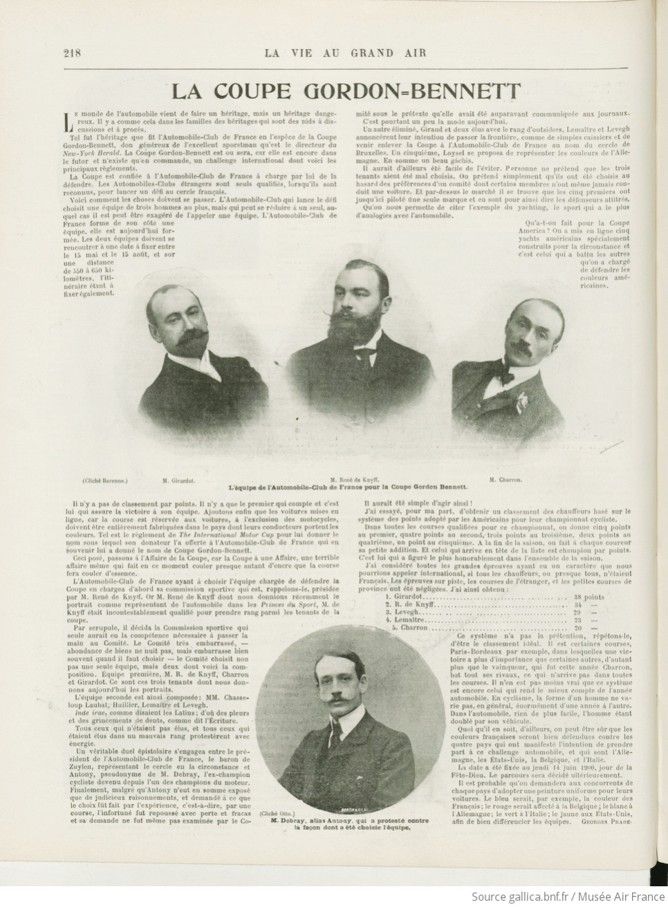
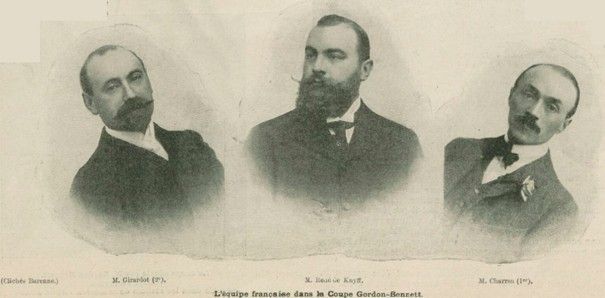
The Automobile Club de France team for the Gordon Bennett Cup.
Mr. Girardot, Mr. René de Knyff, Mr. Charron (Photo by Barenne)
Mr. Debray, alias Antony, who protested the way the team was selected. (Photo by Otto.)