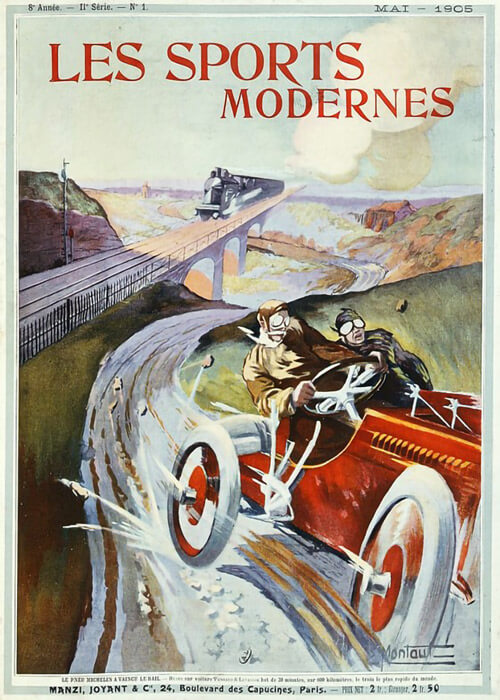
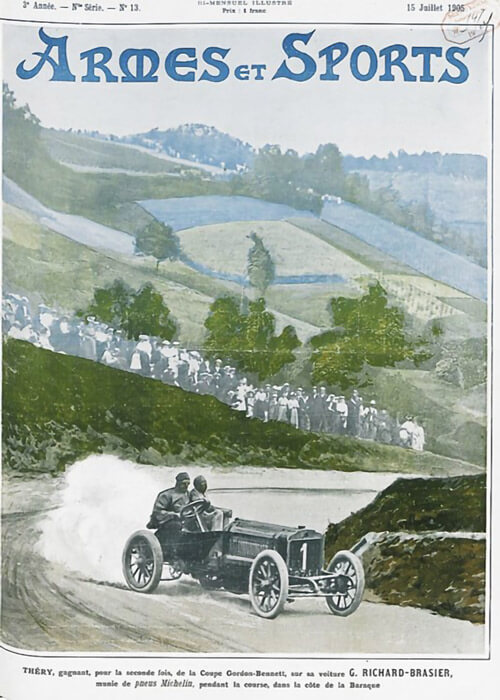
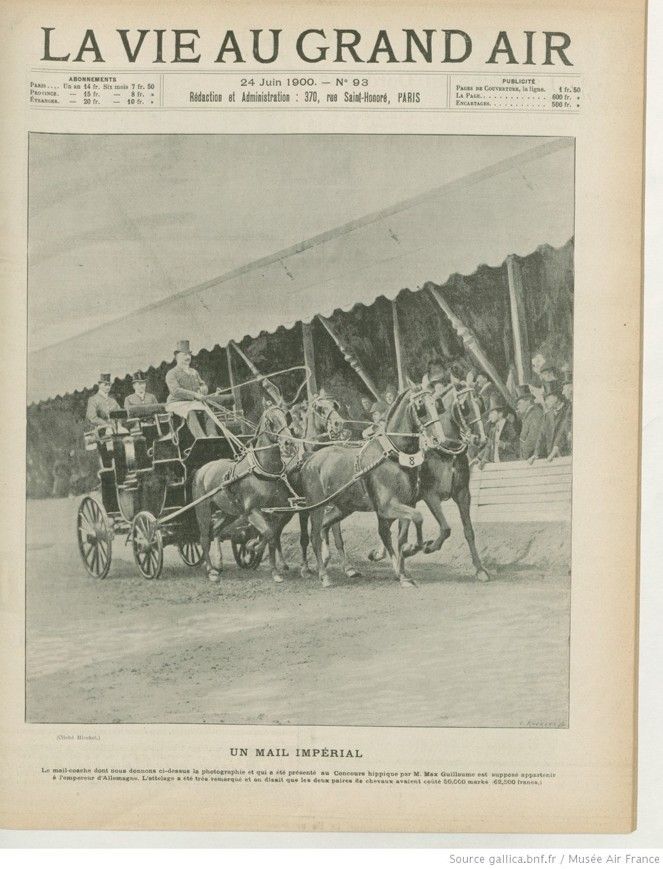
On 24th June 1900, the first Gordon Bennett Cup race became a fact. But a real disappointment at the same time. In this issue it is Geroge Prade, the key editor and contributor to major French sporting magazines like Le Vélo and La Vie au Grand Air, who comments on this huge disappointment. Indeed it was not what JGB had intended. Not only the small number of particpants, also the few that had made the finish, as well as the poor organisation. It’s a miracle at all, that the first Cup race ended with even a winner. Reading this disappointment of the sport press, a question on the organising committee seems justified. (Translation included at the end).
Avec l’autorisation du Bibliothèque national francais – gallica.bnf.fr Texte et photos compilé par motorracinghistory.
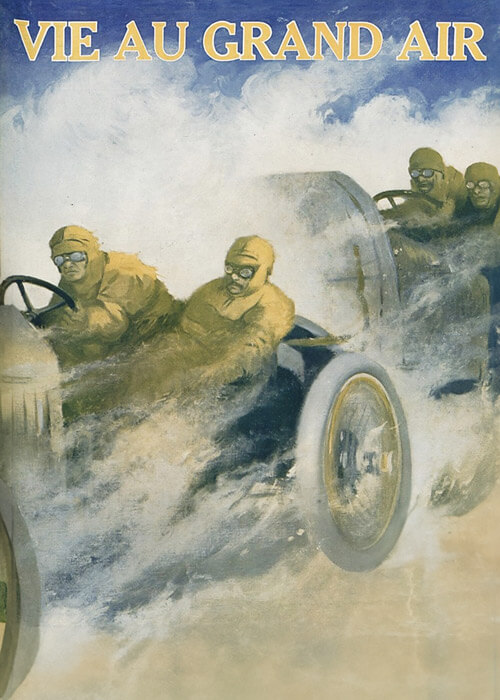
La Vie au Grand Air – No. 93, 24 juin 1900
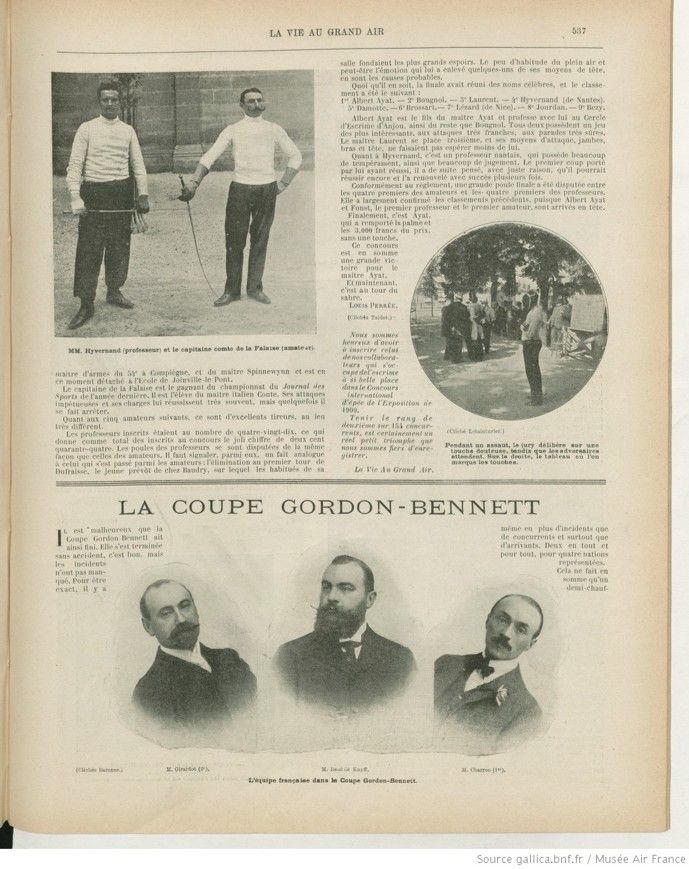
LA COUPE GORDON-BENNETT
Il est malheureux que la Coupe Gordon-Bennett ait ainsi fini. Elle s’est terminée sans accident, c’est bon, mais les incidents n’ont pas manqué. Pour être exact, il y a même eu plus d’incidents que de concurrents et surtout que d’arrivants. Deux en tout et pour tout, pour quatre nations représentées.
Cela ne fait en somme qu’un demi-chauffeur par nation, ce qui est peu, bien peu, avouons-le de bonne grâce.
Si l’on nous avait dit, il y a six mois, dans l’ivresse de joie que nous causa la fondation de la Coupe par le riche et généreux sportsman qu’est Gordon-Bennett, si l’on nous avait dit que cette grande épreuve internationale finirait ainsi en queue de poisson, on nous aurait bien étonnés.
Quoi donc ? On défiait tous les pays du monde à venir se mesurer avec la France. Il devait y avoir un formidable rush d’appétits et de convoitises autour de la Coupe. L’Allemagne, qui guette avec impatience le moment de nous enlever la suprématie dans la belle industrie qu’elle a tant contribué à créer, l’Allemagne n’allait-elle pas profiter de cette splendide occasion d’essayer contre nous les forces de son industrie déjà si en progrès ? Et l’Amérique, encore un pays d’industrie colossale, qu’allait-elle mettre en ligne ? On nous parlait des fameux torpilleurs de Pennington : vous vous rappelez bien Pennington, l’homme aux retentissants défis. Puis il y avait aussi Winton, aux non moins retentissants défis lancés à Charron.
Il est juste de dire que Winton se trouvait au départ. Il serait peut-être exagéré de dire qu’on le vit à l’arrivée, mais enfin cela ne fut pas sa faute s’il n’alla pas plus loin qu’Orléans.
Quant aux Allemands ils ne se mirent pas en ligne et quant aux Belges ils se réduisirent finalement à un Belge, Belge très parisien, d’ailleurs, Jénatzy.
Encore n’avait-il pas sa voiture de course et n’alla-t-il que jusqu’à Moulins.
Bref, ce fut une véritable hécatombe de toutes les voitures en ligne. Pour un peu, il n’en arrivait pas à Lyon, et la Coupe n’eût pas été gagnée. D’où le public simpliste aurait conclu que dans le monde entier, y compris la France, il n’y avait pas une seule, vous entendez bien, pas une seule voiture capable d’aller à Lyon.
Vous voyez commentâtes meilleures intentions peuvent être perverties. Évidemment l’honorable gentleman qu’est M. Gordon-Bennett n’avait pas prévu celle-là.
Il avait créé la Coupe dans d’excellentes intentions, c’est certain, mais le proverbe dit vrai qui dit qu’« il y a loin de la coupe aux lèvres ».
Il y eut d’autant plus loin, cette fois, que l’on put craindre un moment que cette Coupe ne se disputerait jamais.
Et elle ne se disputa, en effet, qu’en dépit de mille entraves, et en dépit du bon sens, il faut l’avouer aussi. Pas un contrôle, pas une affiche ; à peine quelques bénévoles contrôleurs sur les 500 kilométrés de Paris à Lyon.
On se demande comment le vainqueur Charron a pu aller sans accident et dans de telles conditions de Paris à Lyon. Il n’a écrasé que quelques chiens. C’est, mieux encore que toutes les courses d’automobiles organisées avec le plus grand soin, la démonstration péremptoire et définitive que l’automobile n’est pas un sport dangereux puisque Charron a pu aller, sans causer de dégâts, de Paris à Lyon en 9 heures, sans que nul ne frit prévenu de son rapide passage.
Il est vrai que ce n’était pas tout à fait cela qu’on avait cherché ; on avait cherché à déterminer quelle était la première industrie automobile du monde et les places des autres derrière celle-ci.
Or, si la France a répondu à cette question en montrant qu’elle avait toujours la première place, les autres pays n’ont pas répondu.
Et cela n’est pas suffisant. (Clichés Sevestre.)
GEORGES PRADE.
Photos. (Clichés Baronne.)
Page 537: L’équipe française dans le Coupe Gordon-Bennett: M. Girardot (2e). – M. René de Knyff. – M. Charron (1er).
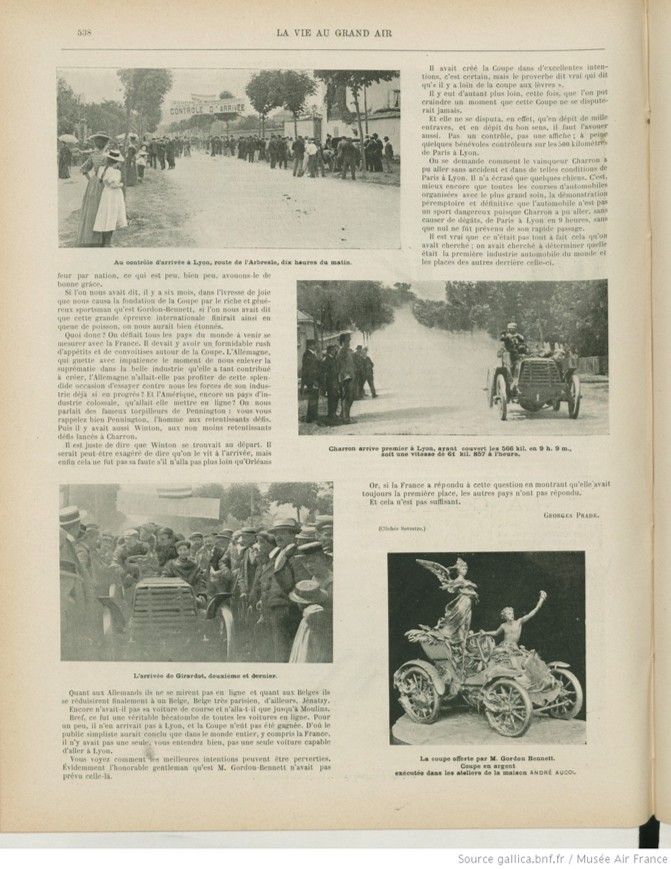
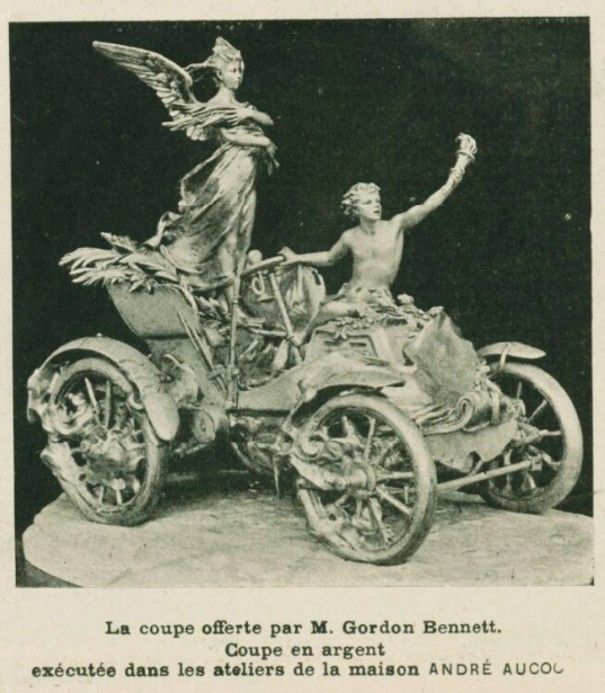
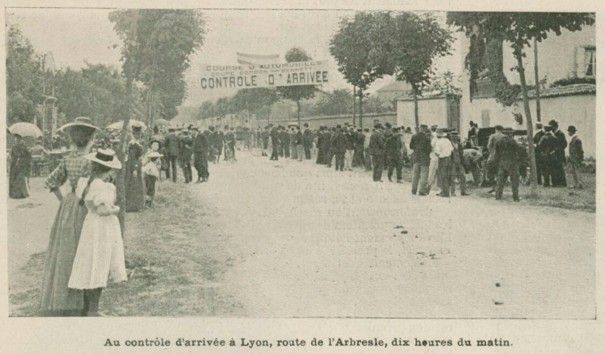
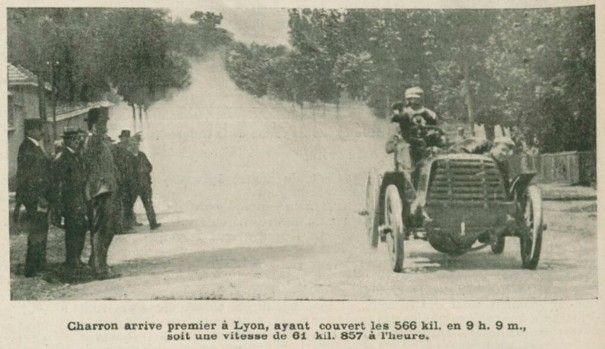
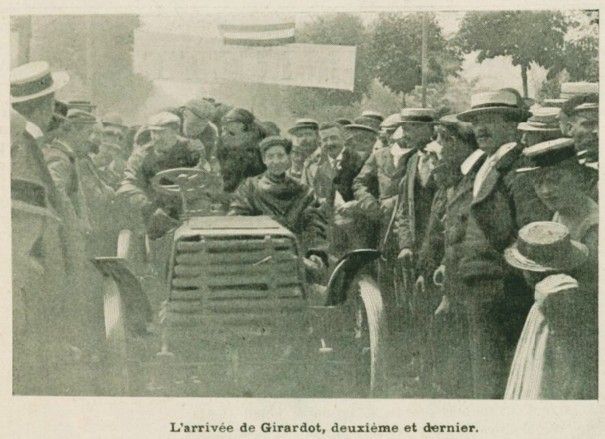
Page 538: Au contrôle d’arrivée à Lyon, route de l’Arbresle, dix heures du matin. – L’arrivée de Girardot, deuxième et dernier. – Charron arrive premier à Lyon, ayant couvert les 566 kil. en 9 h. 9 m., soit une vitesse de 61 kil. 857 à l’heure. – La coupe offerte par M. Gordon Bennett. – Coupe en argent, exécutée dans les ateliers de la maison ANDRÉ AUCOC
L’arrivée de Girardot, deuxième et dernier. —>
Translation by DeepL deepl.com
THE GORDON-BENNETT CUP
It is unfortunate that the Gordon-Bennett Cup ended this way. It concluded without any accidents, which is good, but there was no shortage of incidents. To be exact, there were even more incidents than competitors—and especially more than finishers. Two in all, for four nations represented.
That works out to just half a driver per nation—which is few, very few, let’s admit it in all honesty.
If someone had told us six months ago, in the euphoria brought on by the founding of the Cup by the wealthy and generous sportsman Gordon-Bennett, that this great international event would end in such a anticlimax, we would have been quite surprised.
What was that all about? Every country in the world was challenged to come and compete against France. There was bound to be a tremendous rush of ambition and desire surrounding the Cup. Germany, which eagerly awaits the moment to strip us of our supremacy in the fine industry it has so greatly helped to create—wouldn’t Germany seize this splendid opportunity to pit the strength of its already highly advanced industry against us? And America, another country of colossal industry—what would it field? We’d heard about Pennington’s famous speedboats: you surely remember Pennington, the man of resounding challenges. Then there was also Winton, whose no less resounding challenges were directed at Charron.
It’s fair to say that Winton was at the starting line. It might be an exaggeration to say he made it to the finish line, but then again, it wasn’t his fault that he didn’t get any further than Orléans.
As for the Germans, they didn’t enter the race, and as for the Belgians, they were ultimately reduced to a single Belgian—a very Parisian Belgian, at that—Jénatzy.
Even so, he didn’t have his race car and only made it as far as Moulins.
In short, it was a veritable bloodbath for all the cars on the starting grid. It was a close call—he might not have made it to Lyon, and the Cup might not have been won. Hence, the uninformed public would have concluded that in the entire world, including France, there wasn’t a single—do you hear me?—not a single car capable of making it to Lyon.
You see how even the best intentions can be perverted. Obviously, the honorable gentleman Mr. Gordon-Bennett hadn’t foreseen that one.
He had created the Cup with the best of intentions, to be sure, but there is truth in the proverb that says, “It’s a long way from the cup to the lips.”
The distance was all the greater this time, as there was a moment when it was feared the Cup might never take place.
And indeed, it took place only in spite of a thousand obstacles—and, it must also be admitted, in spite of common sense. Not a single checkpoint, not a single sign; barely a few volunteer marshals along the 500-kilometer route from Paris to Lyon.
One wonders how the winner, Charron, managed to make it from Paris to Lyon without an accident under such conditions. He ran over only a few dogs. This is, even more so than all the automobile races organized with the utmost care, the conclusive and definitive proof that the automobile is not a dangerous sport, since Charron was able to travel, without causing any damage, from Paris to Lyon in 9 hours, without anyone being warned of his rapid passage.
It is true that this was not quite what had been sought; the aim had been to determine which country had the world’s leading automobile industry and the rankings of the others behind it.
However, while France answered this question by demonstrating that it still held first place, the other countries did not respond.
And that is not enough. (Photos by Sevestre.)
GEORGES PRADE.
Photos. (Photos by Baronne.)
Page 537: The French team in the Gordon-Bennett Cup: Mr. Girardot (2nd). – Mr. René de Knyff. – Mr. Charron (1st).
Page 538: At the finish checkpoint in Lyon, Route de l’Arbresle, 10:00 a.m. – Girardot’s arrival, second and last. – Charron arrives first in Lyon, having covered the 566 km in 9 h. 9 m., at a speed of 61 km. 857 per hour. – The cup presented by Mr. Gordon Bennett. Silver cup, crafted in the workshops of the firm ANDRÉ AUCOC