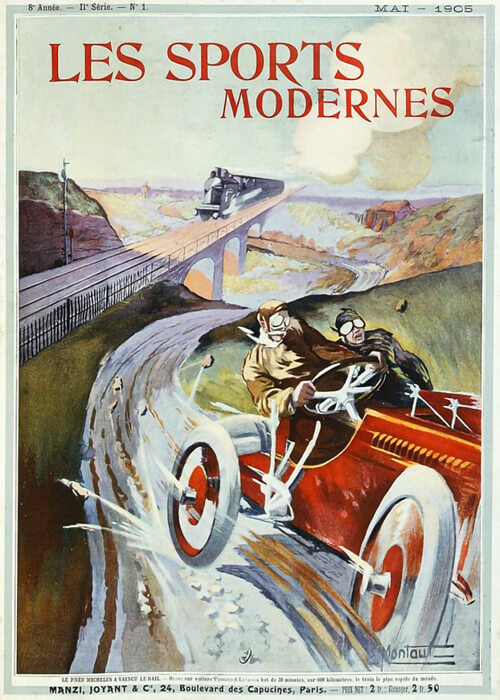
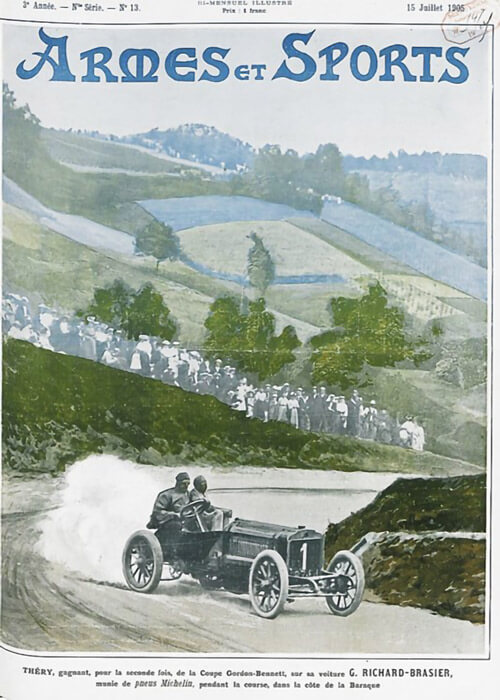
The first official ‘Coppa Florio’ took place on the 167km of roads around Brescia, via Cremona and Mantova. It was to be covered five times; giving a total of 506 km. Twenty-two cars participated: Fiat, Mercedes, Itala, De Dietrich, Darracq, Clément Bayard and Isotta Fraschini. Drivers such as Vincenzo Lancia, Arthur Duray, Felice Nazzaro, Henry Rougier, Louis Wagner, Albert Clément, and even event founder Vincenzo Florio himself were on the scene.
After completing three laps on the circuit, Giovanni Raggio in an Itala became the first winner. Arthur Duray was 2nd and Vincenzo Lancia claimed 3rd. Vincenzo Florio eventually came home 9th. Although this first Coppa Florio was a success, the 1906 edition was cancelled for reasons of safety. Spectator management by the police was hardly possible along the exceptionally long route. So now, count Florio concentrated on bringing the Targa Florio to Sicliy.

By courtesy of hathitrust.org www.hathitrust.org, Text and jpegs compiled by motorracinghistory.
THE AUTOMOBILE Vol. XIII, No. 13, September 28, 1905
Italy’s Great Victory in the Florio Race.
Itala Cars Win Cups for First Place, Fastest Time and Team Regularity – Raggio, the Winner, an Amateur.
Especially Reported from the Stand by Our Own Correspondent.
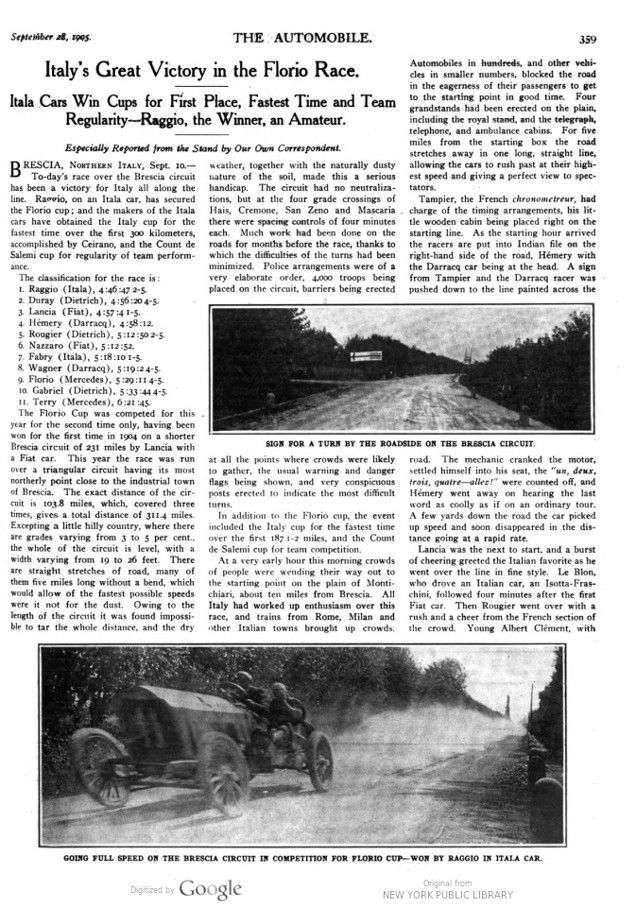
BRESCIA, NORTHERN ITALY, Sept. 10. — To-day’s race over the Brescia circuit has been a victory for Italy all along the line. Raggio, on an Itala car, has secured the Florio cup; and the makers of the Itala cars have obtained the Italy cup for the fastest time over the first 300 kilometers, accomplished by Ceirano, and the Count de Salemi cup for regularity of team performance. The classification for the race is:
1. Raggio (Itala), 4:46:47 2-5.
2. Duray (Dietrich), 4:56:20 4-5.
3. Lancia (Fiat), 4:57:4 1-5.
4. Hémery (Darracq), 4:58:12.
5. Rougier (Dietrich), 5:12:50 2-5.
6. Nazzaro (Fiat), 5:12:52.
7. Fabry (Itala), 5:18:10 1-5.
8. Wagner (Darracq), 5:19:24-5.
9. Florio (Mercedes), 5:29:11 4-5.
10. Gabriel (Dietrich), 5:33:44 4-5.
11. Terry (Mercedes), 6:21:45.
The Florio Cup was competed for this year for the second time only, having been won for the first time in 1904 on a shorter Brescia circuit of 231 miles by Lancia with a Fiat car. This year the race was run over a triangular circuit having its most northerly point close to the industrial town of Brescia. The exact distance of the circuit is 103.8 miles, which, covered three times, gives a total distance of 311.4 miles. Excepting a little hilly country, where there are grades varying from 3 to 5 per cent, the whole of the circuit is level, with a width varying from 19 to 26 feet. There are straight stretches of road, many of them five miles long without a bend, which would allow of the fastest possible speeds were it not for the dust. Owing to the length of the circuit it was found impossible to tar the whole distance, and the dry weather, together with the naturally dusty nature of the soil, made this a serious handicap. The circuit had no neutralizations, but at the four grade crossings of Hais, Cremone, San Zeno and Mascaria there were spacing controls of four minutes each. Much work had been done on the roads for months before the race, thanks to which the difficulties of the turns had been minimized. Police arrangements were of a very elaborate order, 4,000 troops being placed on the circuit, barriers being erected at all the points where crowds were likely to gather, the usual warning and danger flags being shown, and very conspicuous posts erected to indicate the most difficult turns.
In addition to the Florio cup, the event included the Italy cup for the fastest time over the first 187 1-2 miles, and the Count de Salemi cup for team competition.
At a very early hour this morning crowds of people were wending their way out to the starting point on the plain of Montichiari, about ten miles from Brescia. All Italy had worked up enthusiasm over this race, and trains from Rome, Milan and other Italian towns brought up crowds.
Automobiles in hundreds, and other vehicles in smaller numbers, blocked the road in the eagerness of their passengers to get to the starting point in good time. Four grandstands had been erected on the plain, including the royal stand, and the telegraph, telephone, and ambulance cabins. For five miles from the starting box the road stretches away in one long, straight line, allowing the cars to rush past at their highest speed and giving a perfect view to spectators.
Tampier, the French chronometreur, had charge of the timing arrangements, his little wooden cabin being placed right on the starting line. As the starting hour arrived the racers are put into Indian file on the right-hand side of the road, Hémery with the Darracq car being at the head. A sign from Tampier and the Darracq racer was pushed down to the line painted across the road. The mechanic cranked the motor, settled himself into his seat, the “un, deux, trois, quatre – allez!” were counted off, and Hémery went away on hearing the last word as coolly as if on an ordinary tour. A few yards down the road the car picked up speed and soon disappeared in the distance going at a rapid rate.
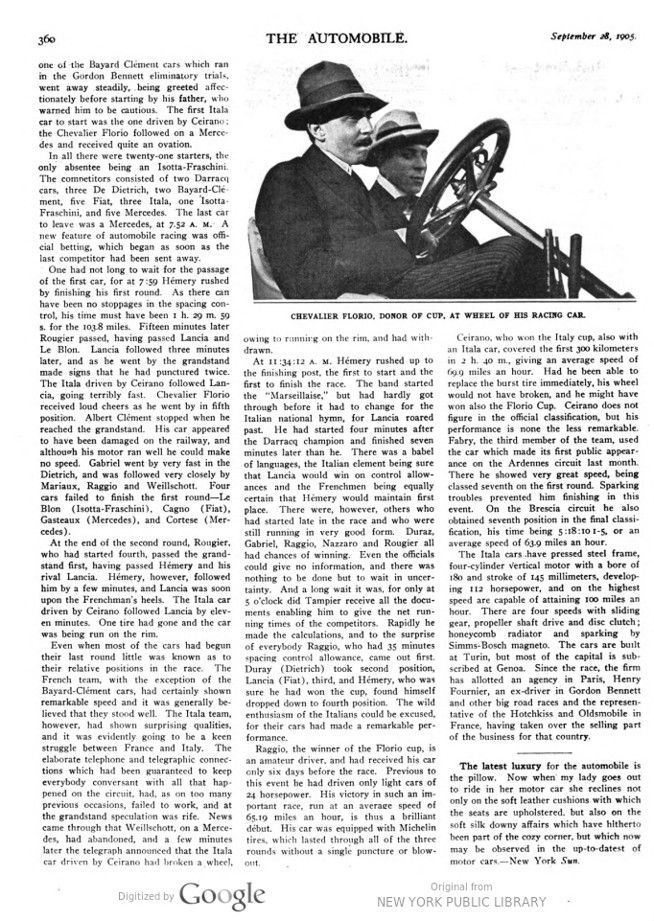
Lancia was the next to start, and a burst of cheering greeted the Italian favorite as he went over the line in fine style. Le Blon, who drove an Italian car, an Isotta-Fraschini, followed four minutes after the first Fiat car. Then Rougier went over with a rush and a cheer from the French section of the crowd. Young Albert Clément, with one of the Bayard Clément cars which ran in the Gordon Bennett eliminatory trials, went away steadily, being greeted affectionately before starting by his father, who warned him to be cautious. The first Itala car to start was the one driven by Ceirano; the Chevalier Florio followed on a Merce- des and received quite an ovation.
In all there were twenty-one starters, the only absentee being an Isotta-Fraschini. The competitors consisted of two Darracq cars, three De Dietrich, two Bayard-Clément, five Fiat, three Itala, one Isotta-Fraschini, and five Mercedes. The last car to leave was a Mercedes, at 7.52 A.M. A new feature of automobile racing was official betting, which began as soon as the last competitor had been sent away.
One had not long to wait for the passage of the first car, for at 7:59 Hémery rushed by finishing his first round. As there can have been no stoppages in the spacing control, his time must have been 1 h. 29 m. 59 s. for the 103.8 miles. Fifteen minutes later Rougier passed, having passed Lancia and Le Blon. Lancia followed three minutes later, and as he went by the grandstand made signs that he had punctured twice. The Itala driven by Ceirano followed Lancia, going terribly fast. Chevalier Florio received loud cheers as he went by in fifth position. Albert Clément stopped when he reached the grandstand. His car appeared to have been damaged on the railway, and although his motor ran well he could make no speed. Gabriel went by very fast in the Dietrich, and was followed very closely by Mariaux, Raggio and Weillschott. Four cars failed to finish the first round – Le Blon (Isotta-Fraschini), Cagno (Fiat), Gasteaux (Mercedes), and Cortese (Mercedes).
At the end of the second round, Rougier, who had started fourth, passed the grandstand first, having passed Hémery and his rival Lancia. Hémery, however, followed him by a few minutes, and Lancia was soon upon the Frenchman’s heels. The Itala car driven by Ceirano followed Lancia by eleven minutes. One tire had gone and the car was being run on the rim.
Even when most of the cars had begun their last round little was known as to their relative positions in the race. The French team, with the exception of the Bayard-Clément cars, had certainly shown remarkable speed and it was generally believed that they stood well. The Itala team, however, had shown surprising qualities, and it was evidently going to be a keen struggle between France and Italy. The elaborate telephone and telegraphic connections which had been guaranteed to keep everybody conversant with all that happened on the circuit, had, as on too many previous occasions, failed to work, and at the grandstand speculation was rife. News came through that Weillschott, on a Merce- des, had abandoned, and a few minutes later the telegraph announced that the Itala car driven by Ceirano had broken a wheel, owing to running on the rim, and had withdrawn.
At 11:34:12 A.M. Hémery rushed up to the finishing post, the first to start and the first to finish the race. The band started the “Marseillaise,” but had hardly got through before it had to change for the Italian national hymn, for Lancia roared past. He had started four minutes after the Darracq champion and finished seven minutes later than he. There was a babel of languages, the Italian element being sure that. Lancia would win on control allowances and the Frenchmen being equally certain that Hémery would maintain first place. There were, however, others who had started late in the race and who were still running in very good form. Duray, Gabriel, Raggio, Nazzaro and Rougier all had chances of winning. Even the officials could give no information, and there was nothing to be done but to wait in uncertainty. And a long wait it was, for only at 5 o’clock did Tampier receive all the documents enabling him to give the net running times of the competitors. Rapidly he made the calculations, and to the surprise of everybody Raggio, who had 35 minutes spacing control allowance, came out first. Duray (Dietrich) took second position, Lancia (Fiat), third, and Hémery, who was sure he had won the cup, found himself dropped down to fourth position. The wild enthusiasm of the Italians could be excused, for their cars had made a remarkable performance.
Raggio, the winner of the Florio cup, is an amateur driver, and had received his car only six days before the race. Previous to this event he had driven only light cars of 24 horsepower. His victory in such an important race, run at an average speed of 65.19 miles an hour, is thus a brilliant début. His car was equipped with Michelin tires, which lasted through all of the three rounds without a single puncture or blow- out.
Ceirano, who won the Italy cup, also with an Itala car, covered the first 300 kilometers in 2 h. 40 m., giving an average speed of 69.9 miles an hour. Had he been able to replace the burst tire immediately, his wheel would not have broken, and he might have won also the Florio Cup. Ceirano does not figure in the official classification, but his performance is none the less remarkable. Fabry, the third member of the team, used the car which made its first public appearance on the Ardennes circuit last month. There he showed very great speed, being classed seventh on the first round. Sparking troubles prevented him finishing in this event. On the Brescia circuit he also obtained seventh position in the final classification, his time being 5:18:10 1-5, or an average speed of 63.9 miles an hour.
The Itala cars have pressed steel frame, four-cylinder vertical motor with a bore of 180 and stroke of 145 millimeters, developing 112 horsepower, and on the highest speed are capable of attaining 100 miles an hour. There are four speeds with sliding gear, propeller shaft drive and disc-clutch; honeycomb radiator and sparking by Simms-Bosch magneto. The cars are built at Turin, but most of the capital is sub- scribed at Genoa. Since the race, the firm has allotted an agency in Paris, Henry Fournier, an ex-driver in Gordon Bennett and other big road races and the representative of the Hotchkiss and Oldsmobile in France, having taken over the selling part of the business for that country.
Photos.
Page 358: SKETCH MAP OF THE BRESCIA CIRCUIT IN ITALY OVER WHICH THE FLORIO AND ITALY CUPS WERE CONTESTED FOR
Page 539: SIGN FOR A TURN BY THE ROADSIDE ON THE BRESCIA CIRCUIT. – GOING FULL SPEED ON THE BRESCIA CIRCUIT IN COMPETITION FOR FLORIO CUP-WON BY RAGGIO IN ITALA CAR
Page 360: CHEVALIER FLORIO, DONOR OF CUP, AT WHEEL OF HIS RACING CAR