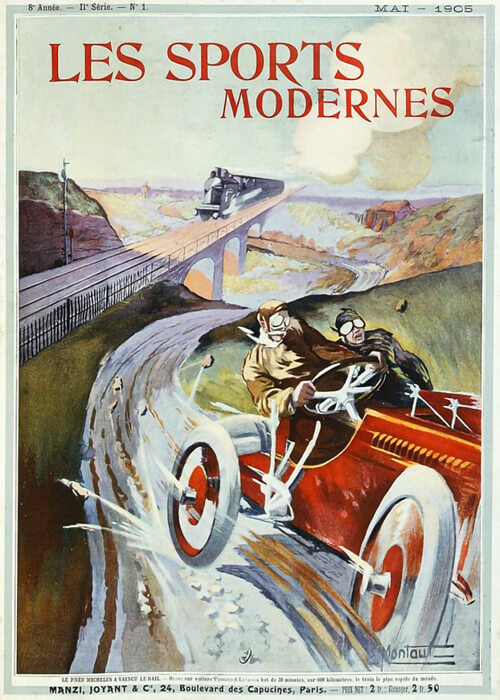
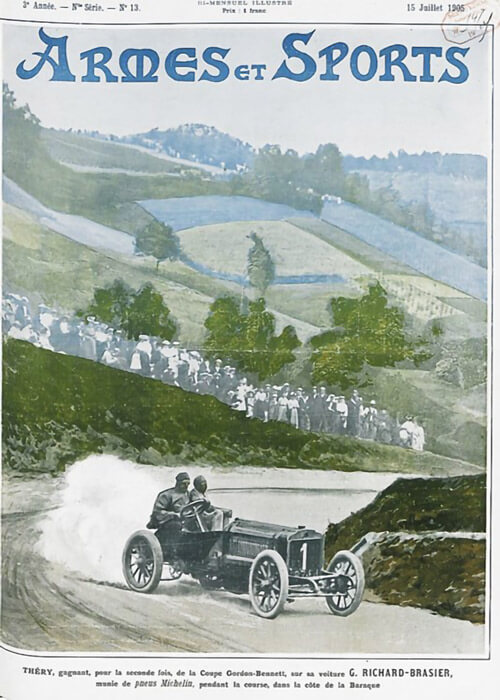
An interesting Italian article; actually the first that I found. It contains a lot of text, but it’s worth while reading! It gives a fair indication, how Italian automobile journalists referred to the first Italian races and victories of Italian cars in those early days. Proud as each nation was on the success of their industry. (Translation.)
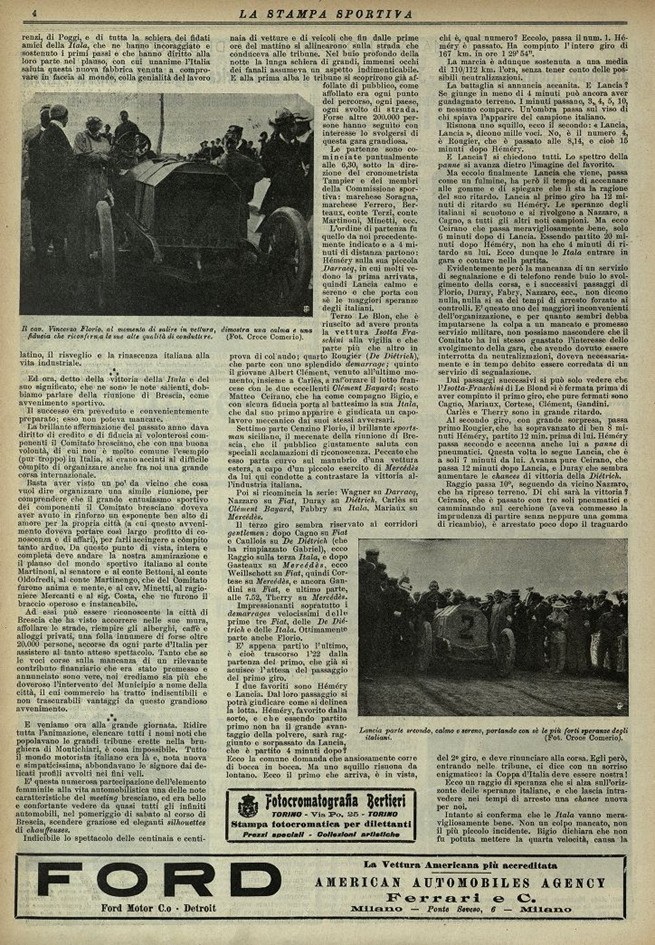
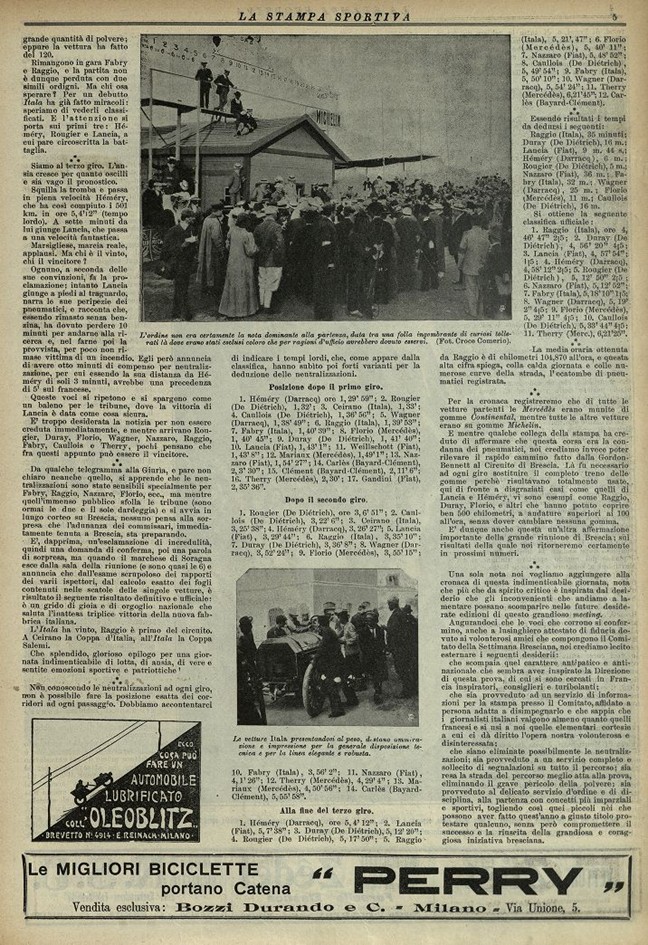
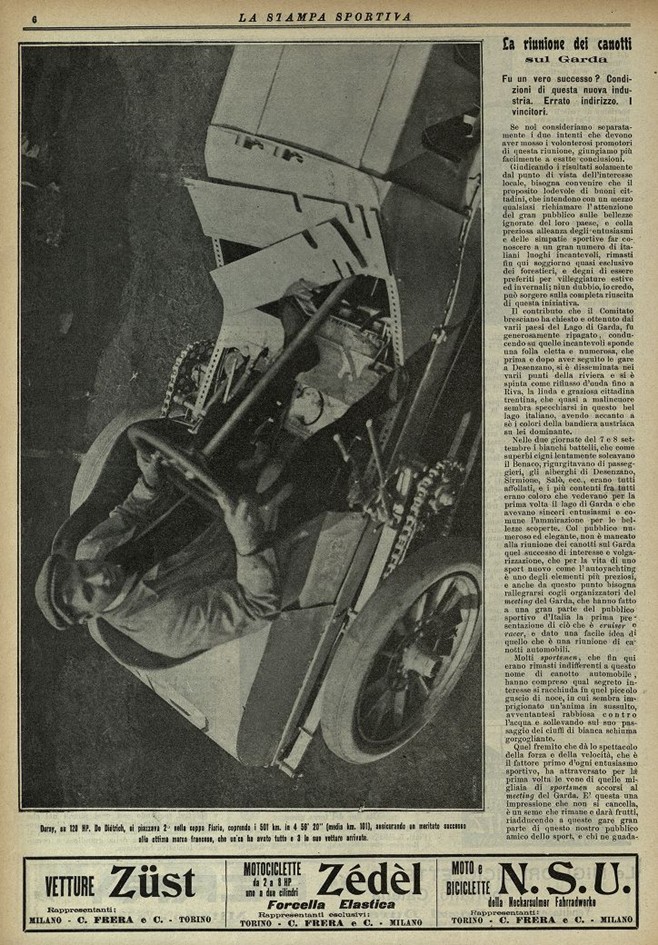
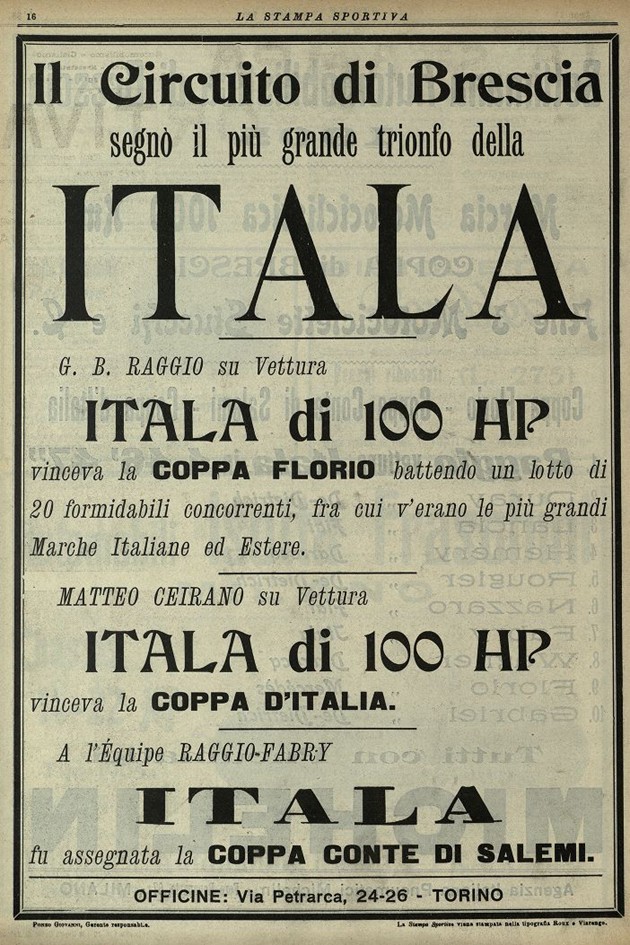
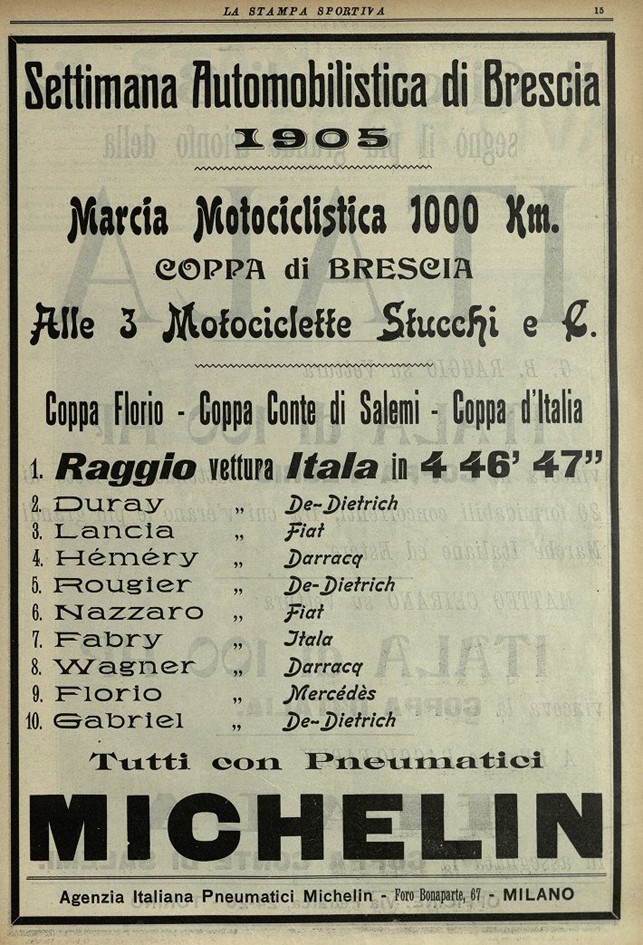
With courtesy of Museo dell’Automobile di Torino, byterfly.eu/
Text and fotos compiled by motorracinghistory.com, Translation by DeepL deepl.com
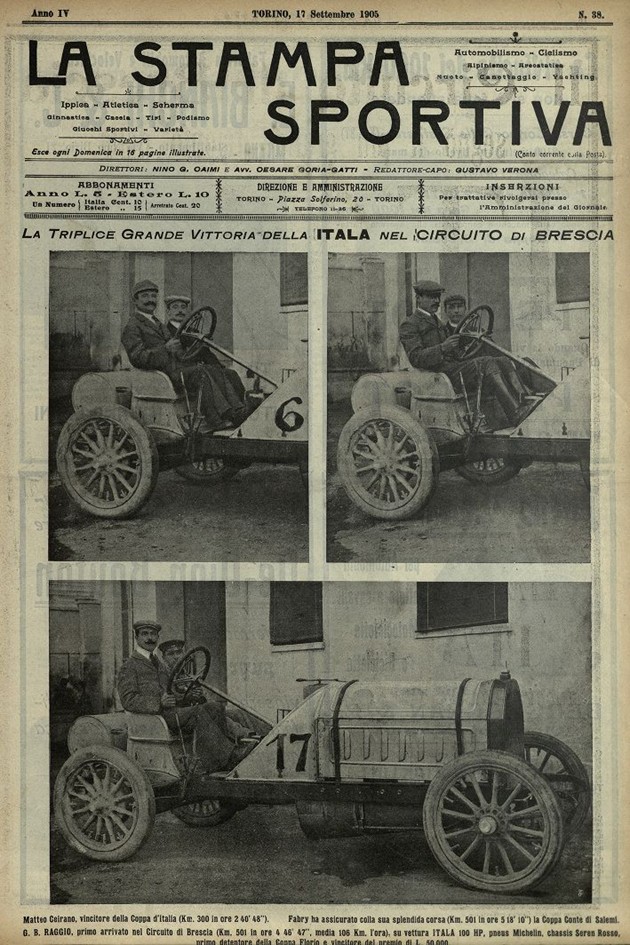
La Stampa Sportiva, Year IV, N. 38, Torino, September 17, 1905
ITALA’s Triple Grand Victory on the Brescia Circuit.
Matteo Ceirano, winner of the Coppa d’Italia (Km. 300 in 2 40′ 48” hours).
Fabry secured the Coppa Conte di Salemi with his splendid ride (Km. 501 in 518′ 10” hours).
G. B. RAGGIO, first to arrive on the Brescia Circuit (Km. 501 in hours 4 46′ 47”, average 106 Km. per hour), in ITALA 100 HP car, Michelin pneus, Seren Rosso chassis, first holder of the Coppa Florio and winner of the L 50,000 prize.
THE BRESCIA AUTOMOBILE WEEK
ITALA’s triple triumph – The journey of a young factory – Significance of its Victory
The sporting success of the Brescian meeting – Praise and notes to the organizing committee – How the Race was run
It was a good run and a great, inspiring success for the Italian industry.
We had gone to Brescia, convinced that we would see a strenuous struggle, which perhaps would prepare surprises, but we could not have wished ourselves a greater and better surprise.
We already knew that we had in Italy an automobile factory, that had been able to impose its value on the entire sporting and industrial world and had earned in the recent Gordon Bennett race admiration and praise for Italian genius and work.
Today in Brescia, a young sister company has come to line up beside him, which has made a marvelous journey in a very short time, and which attests by its brilliant affirmation that we have not only a factory, but also an industry, that, in addition to the name of Fiat, there is that of Itala, and after these two there is a whole seedbed of fervor from which new promises of labor wait to come forth in the sunshine of victories and glory.
And may we forgive our friends at Fiat, on whom fortune has wished to play a capricious trick, if we dare to affirm that the result of the Brescia meeting, with Itala’s triple victory, is for industry and for Italy even more significant and flattering than it could have been with a new Fiat victory, and we who know to what lofty intentions the managers of the great factory in Corso Dante inspire their work, are convinced that they will not begrudge us this affirmation.
A new Fiat victory would have added little or nothing to the glory of this factory, which now has in the world market a name that is no longer in dispute. Itala’s threefold victory at a meeting as important as the one in Brescia and over such a lot of opponents as those who lined up against it, puts this new star at the zenith of the automotive firmament, and while it reaffirms the value of our entire automotive industry, facilitating the way for future victories of other names, other values, and other factories, it is also a just reward to the tenacious and industrious intelligences that have been able to prepare for this day of glory.
One has to remember the early battles in the modest workshop in Via Artisti, when Itala was taking its first steps and its loving and caring fathers were little Bigio, the great Grosso Campana and Matteo Ceirano, the studious technician, the man of few words and many deeds (Non parole ma fatti). One must remember the beautiful and intense faith of those days of preparation to find the secret of today’s success. Those were then the days when the name of Fiat was coming out of the shadows and beginning to clothe itself in the beautiful colors of fame and success, and in the young factory (sprouting from the luxuriant trunk of that Ceirano Firm, which was among the pioneers of motoring), the achievements of others did not generate envy, but admiration, and they were incitement and spur to work. And we will remember those first cars that came out of the fledgling workshop to attempt the Cenisio test, finished on the eve of the start and placed brilliantly, winning in the speed the light car category with Ceirano 1st and Bigio 2nd, and in the tourist category with Raggio, who was making his debut as a driver in the race, getting a second place.
Since last year how far have we come! The move to the grandiose workshops on Via Petrarca, the transformation of Itala into a large joint-stock company with a personality from the financial world at the head, such as Comm. Figari, the brilliant and promising presentation of the Turin Exposition, then the success of the Susa-Moncenisio race and the Ardennes attempt and the great battle and victory at Brescia.
As can be seen, a path marked by very few stages, but of what importance!
And now that to so many efforts, to such sure faith, to such unquestionable valor, victory has arisen, we understand all the righteous exultation that must cheer Matteo Ceirano and Guido Bigio, the two architects of the great success, G. B. Raggio, the fortunate, very skilful conductor, who today sees his name pass before that of the Lancias, the Cagnos, the Nazzarfc of the Héméry, the Dnray, the Rougier, the Florios, that is to say, of all those whom the motoring world hails as great masters, of comm. Figari, of Cattaneo, of Fubini, of Carenzi, of Poggi, and of the whole host of Itala’s trusted friends, who encouraged and supported its first steps and who are entitled to their share in the applause, with which unanimous Italy greets this new factory that has come to prove in the face of the world, with the genius of Latin work, the Italian awakening and rebirth to industrial life.
**
And now, having said something about the victory of the Itala and its significance, what are the salient points, we must talk about the Brescia meeting, as a sporting event.
Success was expected and conveniently prepared; it could not fail.
The brilliant success of last year gave credit and confidence to the willing members of the Brescia Committee, who with a good will, the example of which is not very common (unfortunately) in Italy, had set about the difficult task of organizing a great international race among us too.
One only has to have seen a little of what it means to organize such an event, to understand that the great enthusiasm for sport of the members of the Brescia Committee must have been reinforced by a high level of love for their city (which would benefit greatly from the increased awareness and business that would result from this event), to make them undertake such a difficult task. From this point of view, our admiration and the applause of the Italian sports world must go to Count Martinoni, Senator and Count Bettoni, Count Oldofredi, Count Martinengo, who were the soul and mind of the Committee, and to Cavaliere Minetti, Accountant Mercanti and Mr. Costa, who were its hard-working and tireless arm.
The city of Brescia can be grateful to them, as it saw an innumerable crowd of perhaps over 20,000 people flock to its walls, crowd the streets, fill the hotels, cafes and private lodgings, having come from all over Italy to witness the long-awaited spectacle. So much so that if the rumors about the lack of a significant financial contribution that had been promised and announced are true, we believe it is more than right that the Town Hall should intervene on behalf of the city, whose commerce has drawn indisputable and not insignificant advantages from this grandiose event.
* *
And now we come to the big day. It’s impossible to describe all the excitement, to list all the famous names that populated the grand stands erected on the Montichiari heath. The whole Italian motoring world was there and, a new and very pleasant note, there were lots of ladies with delicate profiles wrapped in fine veils.
This large participation of the female element in automotive life is one of the characteristic features of the Brescia meeting, and it was beautiful and comforting to see the graceful and elegant silhouettes of chauffeuses descending from almost all the endless cars on Saturday afternoon at the Brescia course. The sight of hundreds and hundreds of cars and vehicles lining the road leading to the stands from the early hours of the morning was indescribable. In the deep darkness of the night the long line of huge, immense headlights took on an unforgettable appearance. And at the first light of dawn the stands were already crowded with spectators, as crowded as every point along the route, every town, every bend in the road. Perhaps another 200,000 people followed the progress of this magnificent race with interest.
The race started on time at 6.30 a.m., under the direction of the timekeeper Tampier and the members of the Sports Commission: Marquis Soragna, Marquis Ferrerò, Berteaux, Count Terzi, Count Martinoni, Minetti, etc.
The starting order was the one we indicated previously and 4 minutes later the following started: Héméry in his little Darracq, which many see as the first to arrive, then Lancia calm and collected and who carries with him the greatest hopes of the Italians.
Third is Le Blon, who managed to have his Isotta Fraschini car ready on the eve of the race and who starts more than anything else in the car’s trial; fourth is Rougier (De Diétrich), who starts with a splendid demarrage; fifth is the young Albert Clément, who came at the last moment, together with Carlos, to strengthen the French lot with the two excellent Clément Bayards, sixth Matteo Ceirano, whose partner is Bigio, and with sure confidence brings his Itala to the starting line, which from its first appearance is judged a mechanical masterpiece by his own opponents.
Seventh is Cenzino Florio, the brilliant Sicilian sportsman, the patron of the Brescia meeting, who the public rightly greets with special cheers of gratitude. Too bad he’s leaving leaning on the handlebars of a foreign car, at the head of a small army of Mercedes he’s brought here to thwart the victory of Italian industry.
Then the series starts again: Wagner in the Darracq, Nazzaro in the Fiat, Duiay in the Diétrieh, Carlès in the Clément Bayard, Fabbry in the Itala, Mariaux in the Mercedes.
The third lap seems to be reserved for the gentlemen drivers: after Cagno in the Fiat and Caullois in the De Dietrich (replacing Gabriel), comes Raggio in the third Itala, and after Gasteaux in the Mercedes comes Weillschott in the Fiat, then Cortese in the Mercedes, and again Gandini in the Fiat, and last to start, at 7.52, Thery in the Mercedes.
The very fast demarrages of the first three Fiats, the De Dietrichs and the Italas are particularly impressive. Florio also gets off to a good start.
The last one has just started, that is, 22 laps have passed since the first one started, and the wait for the first lap to pass is already getting tense.
The two favorites are Héméry and Lancia. When they pass by, we’ll be able to judge how the race is shaping up. Héméry, favored by fate, and who, having started first, doesn’t have the great disadvantage of the dust, will be caught up to and overtaken by Lancia, who started 4 minutes later? This is the common question that anxiously runs from mouth to mouth. But a bell rings from afar. Here comes the first one, he’s in sight, who is it, number here? Here he is, number 1 is past. Héméry has passed. He has completed the entire 167 km lap in 1 hour 29 minutes and 54 seconds.
The pace is therefore sustained at an average of 110/112 km per hour, not taking into account possible neutralizations.
The battle promises to be fierce. What about Lancia? If he arrives in less than 4 minutes, he may still have gained ground. The minutes pass, 3, 4, 5, 10, and no one appears. A shadow passes over the face of those who were watching for the appearance of the Italian champion. A bell rings, and then a second: “Lancia, Lancia,” say a thousand voices. No, it’s number 4, it’s Rougier, who arrived at 8:14, 15 minutes after Héméry.
“And Lancia?” everyone wonders. The specter of a breakdown looms behind the image of the favorite.
But finally there he is, Lancia, coming, passing like a flash, but with time to mention the tires and explain that this is the reason for his delay. On the first lap Lancia is 12 minutes behind Héméry. The Italians’ hopes are dashed and they turn to Nazzaro, Cagno, and all the other well-known champions. But here comes Ceirano, who is doing wonderfully well, only 6 minutes behind Lancia. Having started 20 minutes after Héméry, he is only 4 minutes behind him. So here come the Itala cars, joining the race and becoming a factor.
Evidently, however, the lack of a signaling service and telephone makes the progress of the race unclear, and the subsequent passages of Florio, Duray, Fabry, Nazzaro, etc., say nothing; nothing is known about the times of forced stops at the checkpoints. This is one of the major drawbacks of the organization, and although it seems that the blame should be attributed to a lack of promised military service, we cannot hide the fact that the Committee itself spoiled the interest of the race, which, having had to be interrupted by neutralizations, necessarily and in due course had to be accompanied by a signaling service.
From the following passages we can see that Le Blond’s Isotta-Fraschini stopped before completing the first lap, and that Cagno, Mariaux, Cortese, Clément and Gandini also stopped.
Carlès and Therry are very late.
* *
In the second lap, to everyone’s surprise, Rougier takes the lead, having overtaken Héméry by a full 8 minutes, despite having set off 12 minutes before him. Héméry is second and also seems to be suffering from tire problems. This time Lancia is following him, only 7 minutes behind. Ceirano is also making progress, 12 minutes after Lancia, and Duray seems to be increasing Diétrich’s chances of victory.
Raggio is 10th, closely followed by Nazzaro, who has made up ground. Who will win? Ceirano, who had only three tires and was walking on the wheel rim (he had recklessly left without even a spare tire), stopped shortly after the finish line of the second lap and had to give up the race. However, as he entered the stands he told us with an enigmatic smile: the Italian Cup must be ours!
Here’s a ray of hope on the horizon of Italian hopes, and a glimpse that the time we’ve lost gives us a new chance.
Meanwhile, the Itala is doing wonderfully well. Not a single crash, not the slightest accident. Bigio declares that they couldn’t use fourth gear because of the large amount of dust; yet the car did 120 km/h.
With Fabry and Raggio still in the race, the game isn’t lost with two such machines. But who dares to hope? For a debut, Itala has already worked miracles; let’s hope we see them classified. And attention turns to the first three: Héméry, Rougier and Lancia, for whom the battle seems to be limited.
* *
We’re on the third lap. Anxiety grows as the oscillations increase and the prognosis becomes even more vague.
The horn sounds and Héméry passes at full speed, having covered the 501 km in 5 hours, 4 minutes and 2 seconds (gross time). Seven minutes behind him comes Lancia, who is traveling at a fantastic speed.
Marseillaise, royal march, applause. But who is the loser, who is the winner?
Each one, according to his convictions, makes the proclamation; meanwhile Lancia reaches the finish line on foot, tells of his adventures with the tires, and says that, having run out of gas, he lost 10 minutes looking for it and, while refueling, he almost caused a fire. However, he announced that he had eight minutes compensation for neutralization, so since his distance from Héméry was only 3 minutes, he would have a 5′ head start over the Frenchman.
These rumors spread like wildfire through the grandstands, where Lancia’s victory was considered a sure thing.
The news is too eagerly awaited not to be believed immediately, and while Rougier, Duray, Florio, Wagner, Nazzaro, Raggio, Fabry, Caullois and Therry arrive, few think that among these it could be the winner.”
* *
From some telegrams to the Jury, and it seems that even that is not clear, we learn that the neutralizations have been significant, especially for Fabry, Raggio, Nazzaro, Florio, etc., but while that immense audience is leaving the stands (it is now two o’clock and the sun is scorching) and setting off in a long procession for Brescia, no one is thinking about the surprise that the meeting of the commissioners, held immediately in Brescia, is preparing.
First there is an exclamation of disbelief, then a question for confirmation, then a word of surprise, but when the Marquis of Soragna leaves the meeting room (and it is almost 6 o’clock) and announces that from the scrupulous examination of the reports of the various inspectors, from the exact calculation of the sheets contained in the boxes of the individual cars, the following definitive and official result has been reached: it is a cry of joy and national pride that greets the unexpected triple victory of the new Italian factory.
Itala has won, Raggio is first on the circuit. Ceirano has won the Coppa d’Italia, Itala the Coppa Salemi.
What a splendid, glorious epilogue to an unforgettable day of struggle, anxiety, and true and heartfelt sporting and patriotic emotions.
* *
As we don’t know the neutralizations at each lap, it is not possible to determine the exact position of the riders at each passage. We must be content with indicating the gross times, which, as can be seen from the classification, have undergone significant variations due to the deduction of the neutralizations.
Position after the first lap.
1. Héméry (Darracq) 1 hour, 29 minutes, 59 seconds; 2. Rougier (De Diétrich), 1 hour, 32 seconds; 3. Ceirano (Itala), 1.33′; 4. Caullois (De Diétrieh), 1.36’56“; 5. Wagner (Darracq), 1.38’49”; 6. Raggio (Itala), 1.39’53“; 7. Fabry (Itala), 1.40’39”; 8. Florio (Mercédès), 1.40’45“; 9. Duray (De Diétrich), 1.41’40”; 10. Lancia (Fiat), 1.43’1“; 11. Weillschott (Fiat), 1.43‘ 8”; 12. Mariaux (Mercedes), 1.49’1“; 13. Nazzaro (Fiat), 1.54’ 27”; 14. Carlès (Bayard-Clément), 2.330“; 15. Clément (Bayard-Clément), 2.116”; 16. Therry (Mercédès), 2.30“; 17. Gandini (Fìat), 2.3536”.
After the second lap.
1. Rougier (De Dietrich), 3 hours, 6’51“; 2. Caullois (De Dietrich), 3 hours, 22’6”; 3. Ceirano (Itala), 3 hours, 25’38“; 4. Héméry (Darracq), 3 hours, 26’27”; 5. Lancia (Fiat), 3.29’44“; 6. Raggio (Itala), 3.35’10”; 7. Duray (De Diétrich), 3:36:08; 8. Wagner (Darracq), 3:52:24; 9. Florio (Mercédès), 3:55:15; 10. Fabry (Itala), 3:56:02; 11. Nazzaro (Fiat), 4.1’26“; 12. Therry (Mercédès), 4. 29’4”; 13. Mariaux (Mercédès), 4.50′ 56“; 14. Carlès (Bayard-Clément), 5. 55’58”.
At the end of the third lap.
1. Héméry (Darracq), 5 hours, 4 minutes, 12 seconds; 2. Lancia (Fiat), 5 hours, 7 minutes, 38 seconds; 3. Duray (De Diétrich), 5 hours, 12 minutes, 20 seconds; 4. Rougier (De Diétrich), 5 hours, 17 minutes, 50 seconds; 5. Raggio (Itala), 5, 21′, 47“; 6. Florio (Mercédès), 5, 40‘ 11”; 7. Nazzaro (Fiat), 5, 48′ 52“; 8. Caullois (De Diétrich), 5, 49’ 54”; 9. Fabry (Itala), 5. 50′ 10“; 10. Wagner (Darracq), 5, 54′ 24”; 11. Thery (Mercédès), 6.21’45”; 12. Carlès (Bayard-Clément).
**
The following times were deduced:
Raggio (Itala), 35 minutes; Duray (De Diétrich), 16 m.; Lancia (Fiat), 9 m. 44 s.; Héméry (Darracq), 6 m.; Rougier (De Diétrich), 5 m.; Nazzaro (Fiat), 36 m.; Fabry (Itala), 32 m.; Wagner (Darracq), 25 m.; Florio (Mercedes), 11 m.; Caullois (De Diétrich), 16 m.
The official classification is as follows:
1. Raggio (Itala), 4 hours, 46 minutes, 47 seconds 25; 2. Duray (De Diétrich), 4 hours, 56 minutes, 20 seconds 45; 3. Lancia (Fiat), 4 hours, 57 minutes, 54 seconds; 15; 4. Héméry (Darracq), 4, 58′ 12“ 25; 5. Rougier (De Diétrich), 5, 12′ 50” 2/5; 6. Nazzaro (Fiat), 5,12′ 52”; 7. Fabry (Itala), 5, 18′ 10“ 15; 8. Wagner (Darracq), 5, 19′ 2” 4(5; 9. Florio (Mercédès), 5, 29′ 11” 45; 10. Callois (De Diétrich), 5, 33′ 44“ 4/5; 11. Thery (Mercédès.), 6, 21’25”.
* *
The average speed obtained by Raggio was 104.870 kilometers per hour, and this high figure, together with the hot day and the numerous bends in the road, explains the carnage of tires recorded.
**
For the record, we’ll note that of all the cars that started the race, the Mercedes were equipped with Continental tires, while all the other cars were on Michelin tires.
And while some colleagues from the press thought they were stating that this race was the condemnation of tires, we believe instead that we can see the rapid progress made by the Gordon-Bennett at the Brescia Circuit. There it was necessary to replace the entire set of tires after every lap because they were completely worn out. Here, in contrast, in contrast to unfortunate cases such as those of Lancia and Héméry, there are examples such as Raggio, Duray, Florio, and others who were able to cover 500 kilometers at speeds of over 100 kilometers per hour without having to change any tires.
This is therefore another important result of the great meeting in Brescia; we will certainly be discussing the results in future issues.
* *
We would like to add just one note to the report of this unforgettable day, a note that is inspired more by the desire for the inconveniences we are about to complain on disappearing in future editions of this grandiose meeting, than by a critical spirit.
Hoping that the rumors are true, and as a flattering vote of confidence to the willing friends who make up the Committee of Settimana Bresciana, we believe it is legitimate to express the following wishes:
That the unpleasant and anti-national character that seems to have inspired the management of this event, for which they sought inspiration, advice and tribulation in France, disappears.
that an information service for the press be provided at the Committee, entrusted to a suitable person who knows that Italian journalists are worth at least as much as French ones, and that we be shown the basic courtesy to which our willing and disinterested work entitles us;
that neutralizations are eliminated if possible; that a complete and prompt service of reports is provided along the entire route; that the road along the route is made more suitable for the trial, eliminating the serious danger of dust; that the delicate service of order and discipline is provided, at the start with more impartial and sporting concepts, thus removing those small obstacles that may have rightly caused someone to protest this year, without compromising the success and outcome of the grandiose and courageous Brescian initiative.
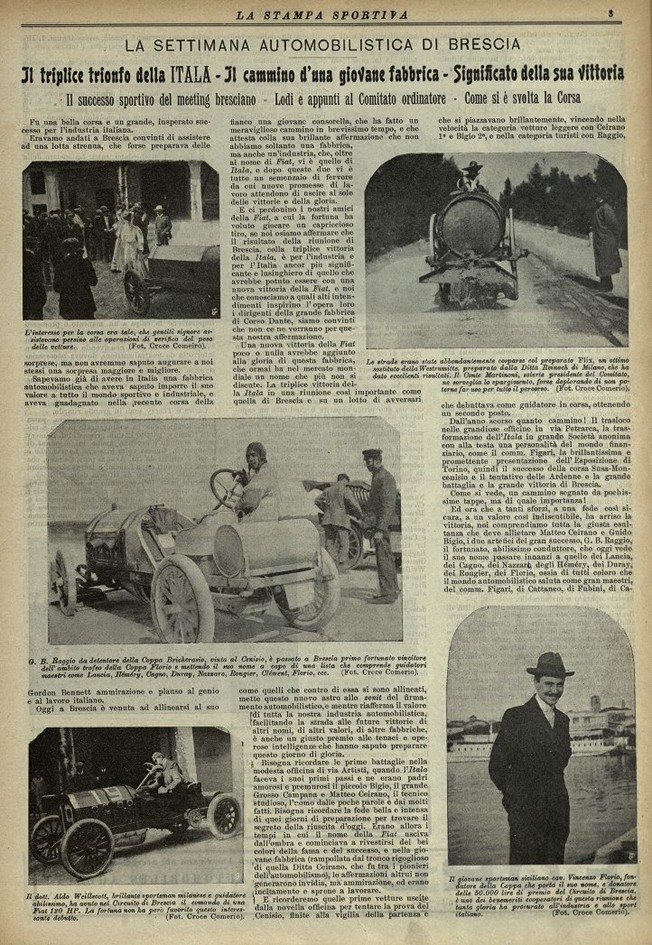
Fotos pages 3 – 6
The interest in the race was such that kind ladies even assisted in the operations of verifying the weight of the cars. (Photo Croce Comeiro).
G. B. Raggio, from being the holder of the Bricherasio Cup, won at Cenisio, went to Brescia as the first lucky winner of the coveted Florio Cup trophy and put his name at the head of a team that included master drivers such as Lancia, Héméry, Cagno, Duray, Nazzaro, Rougier, Clément, Florio, etc. (Photo: Croce Comeno).
Dr. Aldo Weillscott, a brilliant sportsman from Milan and a very skilled driver, was in command of a Fiat 120 HE on the Brescia Circuit. However, luck did not favor this interesting debut. (Photo: Croce Comerio).
The roads had been generously sprinkled with Fiix, an excellent substitute for Westrumitte, prepared by the Reinach Company of Milan, which gave excellent results. And Conte Martinoni, the diligent president of the Committee, supervises the spreading, perhaps regretting that he cannot use it for the whole route. (Photo Croce Comerio).
The young Sicilian sportsman, Vincenzo Florio, founder of the Cup that bears his name, and donor of the 50,000 lire prize for the Brescia Circuit, is one of the worthy collaborators of this meeting that has brought so much glory to Italian industry and sport (Photo: Croce Comerio).
Mr. Vincenzo Florio, as he gets into the car, shows calmness and confidence that reconfirms his high qualities as a driver. (Photo: Croce Cornelio).
Lancia starts second, calm and serene, carrying with him the highest hopes of the Italians. (Photo: Croce Comerio).
Order was certainly not the dominant note at the start, given among a cumbersome crowd of tolerated onlookers where those who, for official reasons, should have been there were excluded. (Photo Croce Comerio).
Durai, on 120 HP. Ds Dietrich, placed 2nd in the Florio cup, covering the 501 kilometers in 4 hours 50 minutes 20 seconds (average speed 63 miles per hour), ensuring a well-deserved success for the excellent French make, which had all 3 of its cars finish. The Itala cars, when presented for weighing, arouse admiration and make an impression due to their general technical arrangement and their elegant and robust lines.
******************