Fred Moskovics was president of the Stutz Company and as such he was involved in and had quite some experience with stock car racing and stock cars. Here’s his opinion on the coming new Indianapolis rules for the 1930’s. He proposed several design issues and as well as some limitations for these racing stock cars.
Text and jpegs by courtesy of hathitrust.org www.hathitrust.org, compiled by motorracinghistory.com
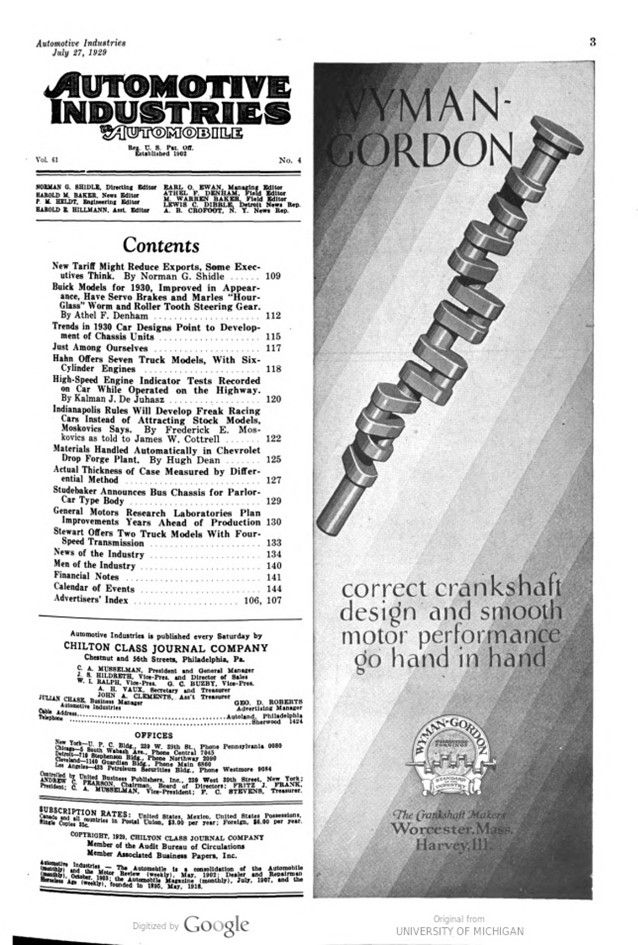
Automotive Industries, Vol. 61, No. 4, July 27, 1929
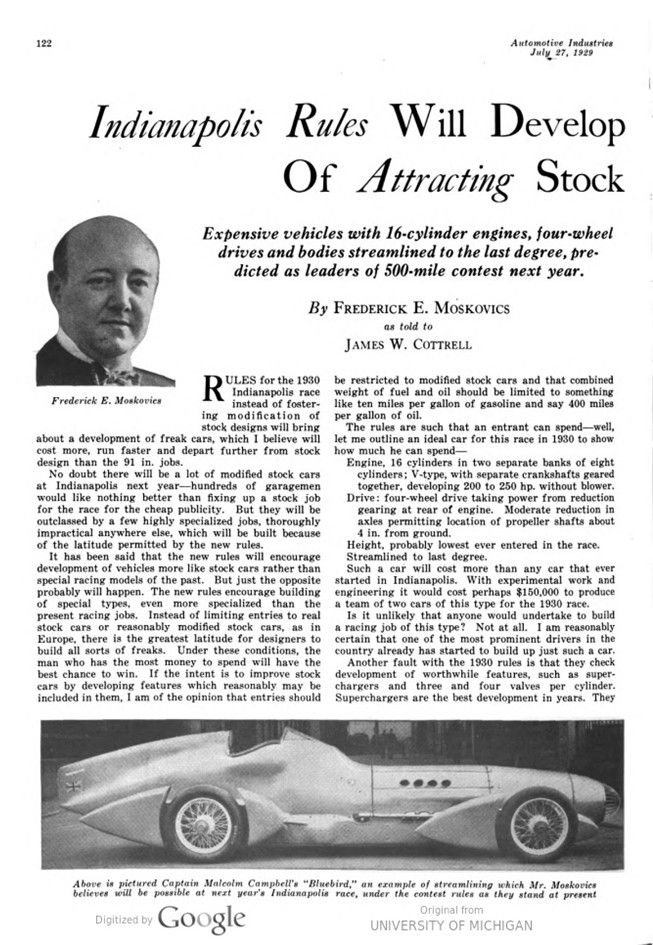
Indianapolis Rules Will Develop Freak Racing Cars Instead Of Attracting Stock Models, Moskovics Says
Expensive vehicles with 16-cylinder engines, four-wheel drives and bodies streamlined to the last degree, predicted as leaders of 500-mile contest next year.
By FREDERICK E. Moskovics as told to JAMES W. COTTRELL
FREDERICK E. MOSKOVICS has taken an active part in automobile contests for the past twenty-five years. Many racing cars were directly or indirectly the result of his activity. His interest in racing continued while he was with Nordyke and Marmon from 1914 to 1924 and with Stutz from 1925 to 1928. While president of Stutz, he organized the stock car racing team which won many championship events in 1927. He was also interested in the sixteen-cylinder special job built by the late Frank Lockhart, for the Daytona Beach record trial in 1928.
RULES for the 1930 Indianapolis race instead of fostering modification of stock designs, will bring about a development of freak cars, which I believe will cost more, run faster and depart further from stock design than the 91 in. jobs.
No doubt there will be a lot of modified stock cars at Indianapolis next year – hundreds of garagemen would like nothing better than fixing up a stock job for the race for the cheap publicity. But they will be outclassed by a few highly specialized jobs, thoroughly impractical anywhere else, which will be built because of the latitude permitted by the new rules.
It has been said that the new rules will encourage development of vehicles more like stock cars rather than special racing models of the past. But just the opposite probably will happen. The new rules encourage building of special types, even more specialized than the present racing jobs. Instead of limiting entries to real stock cars or reasonably modified stock cars, as in Europe, there is the greatest latitude for designers to build all sorts of freaks. Under these conditions, the man who has the most money to spend will have the best chance to win. If the intent is to improve stock cars by developing features which reasonably may be included in them, I am of the opinion that entries should be restricted to modified stock cars and that combined weight of fuel and oil should be limited to something like ten miles per gallon of gasoline and say 400 miles per gallon of oil.
The rules are such that an entrant can spend – well, let me outline an ideal car for this race in 1930 to show how much he can spend –
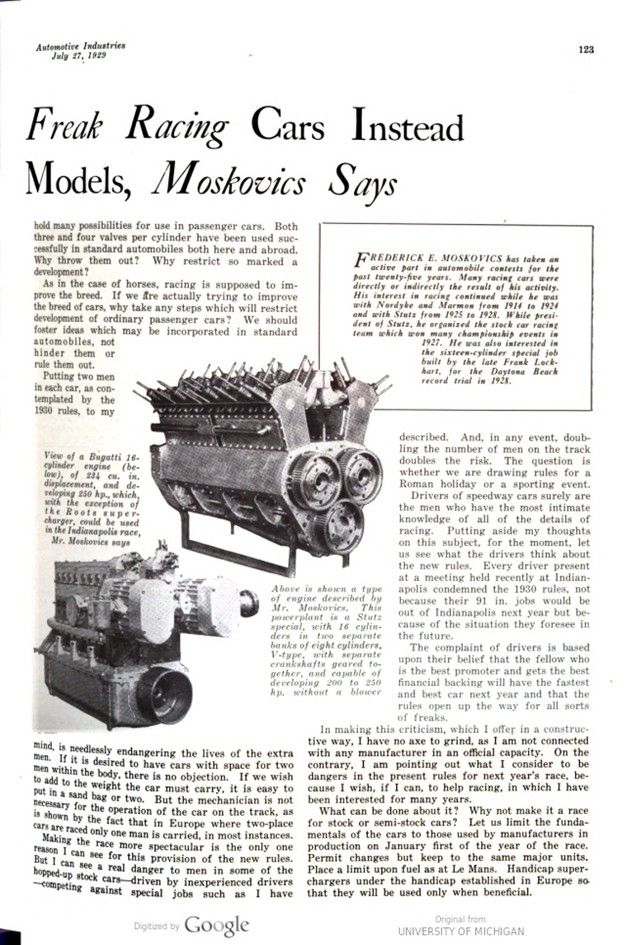
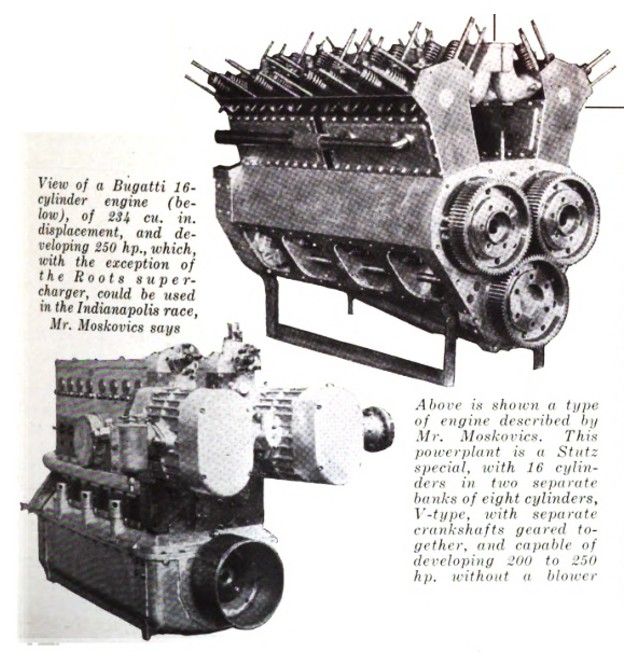
Engine, 16 cylinders in two separate banks of eight cylinders; V-type, with separate crankshafts geared together, developing 200 to 250 hp. without blower.
Drive: four-wheel drive taking power from reduction gearing at rear of engine. Moderate reduction in axles permitting location of propeller shafts about 4 in. from ground.
Height, probably lowest ever entered in the race.
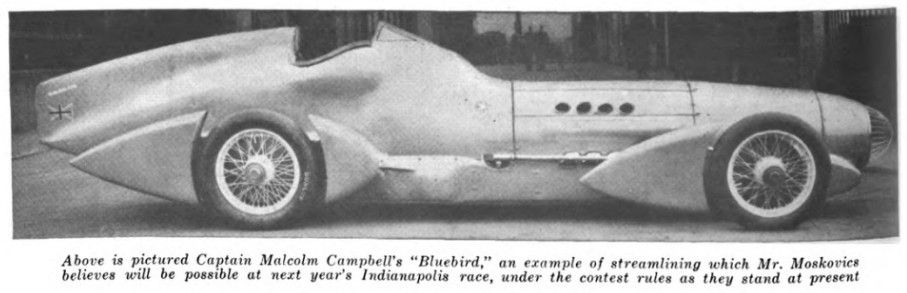
Streamlined to last degree.
Such a car will cost more than any car that ever started in Indianapolis. With experimental work and engineering it would cost perhaps $150,000 to produce a team of two cars of this type for the 1930 race.
Is it unlikely that anyone would undertake to build a racing job of this type? Not at all. I am reasonably certain that one of the most prominent drivers in the country already has started to build up just such a car.
Another fault with the 1930 rules is that they check development of worthwhile features, such as superchargers and three and four valves per cylinder. Superchargers are the best development in years. They hold many possibilities for use in passenger cars. Both three and four valves per cylinder have been used successfully in standard automobiles both here and abroad. Why throw them out? Why restrict so marked a development?
As in the case of horses, racing is supposed to improve the breed. If we are actually trying to improve the breed of cars, why take any steps which will restrict development of ordinary passenger cars? We should foster ideas which may be incorporated in standard automobiles, not hinder them or rule them out.
Putting two men in each car, as contemplated by the 1930 rules, to my mind, is needlessly endangering the lives of the extra men. If it is desired to have cars with space for two men within the body, there is no objection. If we wish to add to the weight the car must carry, it is easy to put in a sandbag or two. But the mechanician is not necessary for the operation of the car on the track, as is shown by the fact that in Europe where two-place cars are raced only one man is carried, in most instances.
Making the race more spectacular is the only one reason I can see for this provision of the new rules. But I can see a real danger to men in some of the hopped-up stock cars – driven by inexperienced drivers – competing against special jobs such as I have described. And, in any event, doubling the number of men on the track doubles the risk. The question is whether we are drawing rules for a Roman holiday or a sporting event.
Drivers of speedway cars surely are the men who have the most intimate knowledge of all of the details of racing. Putting aside my thoughts on this subject, for the moment, let us see what the drivers think about the new rules. Every driver present at a meeting held recently at Indianapolis condemned the 1930 rules, not because their 91 in. jobs would be out of Indianapolis next year but because of the situation they foresee in the future.
The complaint of drivers is based upon their belief that the fellow who is the best promoter and gets the best financial backing will have the fastest and best car next year and that the rules open up the way for all sorts of freaks.
In making this criticism, which I offer in a constructive way, I have no axe to grind, as I am not connected with any manufacturer in an official capacity. On the contrary, I am pointing out what I consider to be dangers in the present rules for next year’s race, because I wish, if I can, to help racing, in which I have been interested for many years.
What can be done about it? Why not make it a race for stock or semi-stock cars? Let us limit the fundamentals of the cars to those used by manufacturers in production on January first of the year of the race. Permit changes but keep to the same major units. Place a limit upon fuel as at Le Mans. Handicap superchargers under the handicap established in Europe so that they will be used only when beneficial.
Racing such cars would give us information of direct value and application to passenger car design. To illustrate, let us require that every car be started by its own electric starter. Every owner is interested in starters. All piping and fittings should be standard throughout. Cutting gas lines and inserting hose to overcome vibration would not be permitted. Neither would taping of lines to prevent breaking be allowed, unless this is standard. Fuel feed should be standard. Ignition and light wiring should be as delivered on stock cars to test these features of stock car design.
Modifications should be permitted to increase speed. Let the entrant set valve and ignition timing any way he wants, change rear axle gearing at will and experiment with springs. The carburetor should be of the same design as that on standard production but could be larger or have different internal specifications. Manifolds also should be of standard pattern, although larger passages could be allowed. Oil coolers should be permitted if desired, because weight of fuel and oil would be limited and stops for fuel would be restricted to one every 150 miles. This would develop large gasoline carrying capacity, a very desirable feature from the owner’s standpoint.
Fuel tanks, motor location, cooling and frames should be standard. Tanks on passenger cars should be large enough to carry a car 150 miles with wide-open throttle. Changes in motor location should not be allowed as this affects balance, which should be a part of the fundamental design of a car. Cooling of a stock car, of proper design, should suffice for a race such as that at Indianapolis, so radiators, both size and location, should be standard.
Limitation of fuel and oil weight for a race not only promotes economy but it adds suspense, which increases public interest. If a car is far in the lead, there is always the question whether it has gas enough to finish. There is uncertainty until the first car crosses the finish line and this keeps the crowd on edge until the last car is given the checkered flag.
I have no suggestion as to the amount of fuel and oil to be allowed for a 500-mile race. It should not be so low that it calls for the use of miniature engines. Possibly 10 miles per gallon would be all right, or it might be more or less than this figure. Some limit should be adopted, as has been done abroad. This too would restrict maximum speed to a reasonable point. Handicapping the supercharger would tend to develop both engines and blowers. Piston displacement would be restricted, as in the new rules, and if a blower is used less piston displacement would be allowed. This would make a designer consider the advantages of blowers against loss in piston displacement under the rules and use blowers only when he is sure of some practical advantage. That is the way we wish to develop superchargers, is it not?
Fuel used in the cars would be any „buyable“ fuel regularly sold at gas stations. This provision would automatically limit compression ratio to something of the order of that practicable for use in passenger cars.
Modified stock cars, such as I have sketched, could be produced for a moderate cost, perhaps not more than $5,000. There would be plenty of competition among the 32 starters at Indianapolis under rules of this kind and entries would not be limited to organizations with limitless capital or the wealthy individual.
Photos.
Page 122. Above is pictured Captain Malcolm Campbell’s „Bluebird,“ an example of streamlining which Mr. Moskovics believes will be possible at next year’s Indianapolis race, under the contest rules as they stand at present.
Page 123. View of a Bugatti 16-cylinder engine (below), of 234 cu. in. displacement, and developing 250 hp., which, with the exception of the Roots supercharger, could be used in the Indianapolis race, Mr. Moskovics says.
Above is shown a type of engine described by Mr. Moskovics. This powerplant is a Stutz special, with 16 cylinders in two separate banks of eight cylinders, V-type, with separate crankshafts geared together, and capable of developing 200 to 250 hp. without blower.