This Friday-Morning issue of the Chicago Times-Herald, is published just after the Thursday 28 November Race. I don’t know the name of the reporter(s), but this real long read is so much interesting not to neglect. It is the most accurate reporting of the race, in a way, as if U were participating yourself or U were one of the spectators along the route and travelling with the vehicles. Just take your time, but going through these „verses“ of the race, you’ll obtain an impression on the technological and human limitations in the heydays of motor racing. What a read!
With permission of hathitrust hathitrust.org == Text and fotos compiled by motorracinghistory
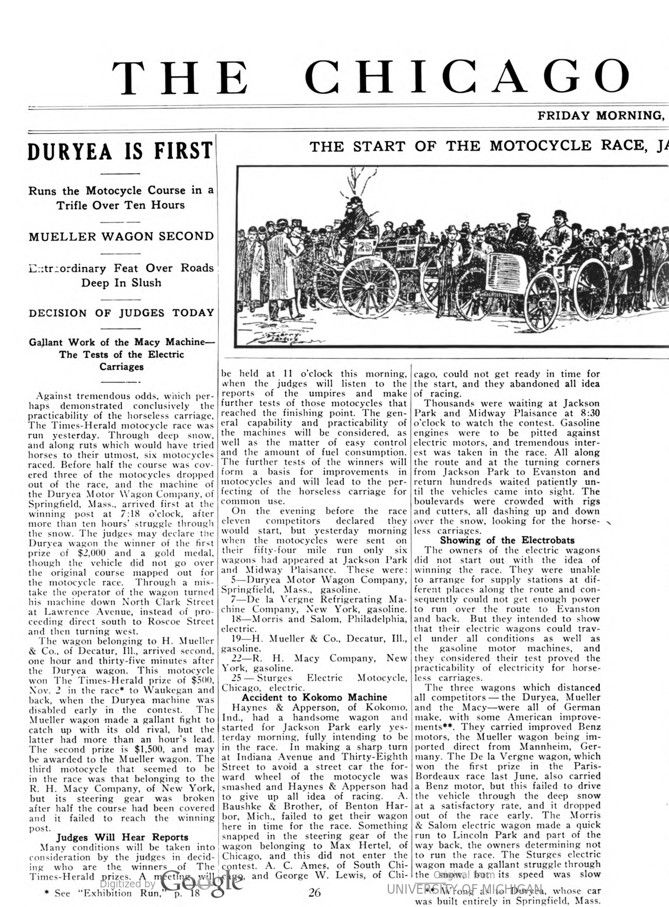
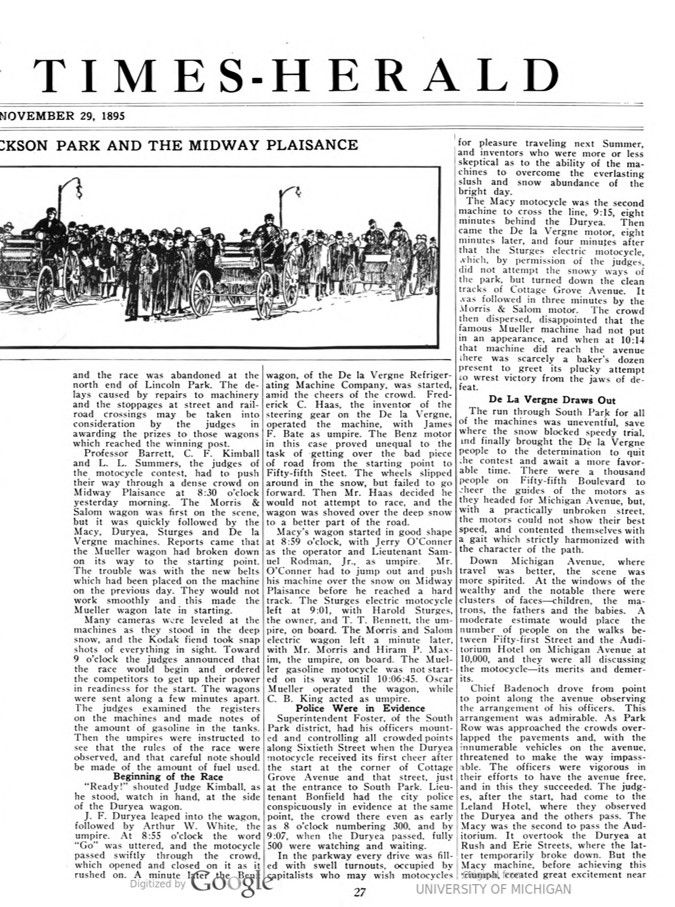
The Chicago Times-Herald — Friday Morning, November 29, 1895, pp. 26 – 30
DURYEA IS FIRST
Runs the Motocycle Course in a Trifle Over Ten Hours
MUELLER WAGON SECOND
Extraordinary Feat Over Roads Deep In Slush
DECISION OF JUDGES TODAY
Gallant Work of the Macy Machine – The Tests of the Electric Carriages
Against tremendous odds, which perhaps demonstrated conclusively the practicability of the horseless carriage, The Times-Herald motocycle race was run yesterday. Through deep snow, and along ruts which would have tried horses to their utmost, six motocycles raced. Before half the course was covered three of the motocycles dropped out of the race, and the machine of the Duryea Motor Wagon Company, of Springfield, Mass., arrived first at the winning post at 7:18 o’clock, after more than ten hours‘ struggle through the snow. The judges may declare the Duryea wagon the winner of the first prize of $2,000 and a gold medal, though the vehicle did not go over the original course mapped out for the motocycle race. Through a mistake the operator of the wagon turned his machine down North Clark Street at Lawrence Avenue, instead of proceeding direct south to Roscoe Street and then turning west.
The wagon belonging to H. Mueller & Co., of Decatur, Ill., arrived second, one hour and thirty-five minutes after the Duryea wagon. This motocycle won The Times-Herald prize of $500, Nov. 2 in the race* to Waukegan and back, when the Duryea machine was disabled early in the contest. The Mueller wagon made a gallant fight to catch up with its old rival, but the latter had more than an hour’s lead.
The second prize is $1,500 and may be awarded to the Mueller wagon. The third motocycle that seemed to be in the race was that belonging to the R. H. Macy Company, of New York, but its steering gear was broken after half the course had been covered and it failed to reach the winning post.
Judges Will Hear Reports
Many conditions will be taken into consideration by the judges in deciding who are the winners of The Times-Herald prizes. A meeting will be held at 11 o’clock this morning, when the judges will listen to the reports of the umpires and make further tests of those motocycles that reached the finishing point. The general capability and practicability of the machines will be considered, as well as the matter of easy control and the amount of fuel consumption. The further tests of the winners will form a basis for improvements in motocycles and will lead to the perfecting of the horseless carriage for common use.
On the evening before the race eleven competitors declared they would start, but yesterday morning when the motocycles were sent on their fifty-four mile run only six wagons had appeared at Jackson Park and Midway Plaisance.
These were:
5 – Duryea Motor Wagon Company, Springfield, Mass., gasoline.
7 – De la Vergne Refrigerating Machine Company, New York, gasoline.
18 – Morris and Salom, Philadelphia, electric.
19 – H. Mueller & Co., Decatur, I11., gasoline.
22 – R. H. Macy Company, New York, gasoline.
25 – Sturges Chicago, Electric Motocycle, electric.
Accident to Kokomo Machine
Haynes & Apperson, of Kokomo, Ind., had a handsome wagon and started for Jackson Park early yesterday morning, fully intending to be in the race. In making a sharp turn at Indiana Avenue and Thirty-Eighth Street to avoid a street car the forward wheel of the motocycle was smashed and Haynes & Apperson had to give up all idea of racing. A. Baushke & Brother, of Benton Harbor, Mich., failed to get their wagon here in time for the race. Something snapped in the steering gear of the wagon belonging to Max Hertel, of Chicago, and this did not enter the contest. A. C. Ames, of South Chicago and George W. Lewis, of Chicago, could not get ready in time for the start, and they abandoned all idea of racing.
Thousands were waiting at Jackson Park and Midway Plaisance at 8:30 o’clock to watch the contest. Gasoline engines were to be pitted against electric motors, and tremendous interest was taken in the race. All along the route and at the turning corners from Jackson Park to Evanston and return, hundreds waited patiently until the vehicles came into sight. The boulevards were crowded with rigs and cutters, all dashing up and down over the snow, looking for the horseless carriages.
Showing of the Electrobats
The owners of the electric wagons did not start out with the idea of winning the race. They were unable to arrange for supply stations at different places along the route and consequently could not get enough power to run over the route to Evanston and back. But they intended to show that their electric wagons could travel under all conditions as well as the gasoline motor machines, and they considered their test proved the practicability of electricity for horseless carriages.
The three wagons which distanced all competitors – the Duryea, Mueller and the Macy – were all of German make. with some American improvements **. (** Wrong as to Duryea, whose car was built entirely in Springfield. Mass.)
They carried improved Benz motors, the Mueller wagon being imported direct from Mannheim, Germany. The De la Vergne wagon, which won the first prize in the Paris-Bordeaux race last June, also carried a Benz motor, but this failed to drive the vehicle through the deep snow at a satisfactory rate, and it dropped out of the race early. The Morris & Salom electric wagon made a quick run to Lincoln Park and part of the way back, the owners determining not to run the race.
The Sturges electric wagon made a gallant struggle through the snow, but its speed was slow, and the race was abandoned at the north end of Lincoln Park. The delays caused by repairs to machinery and the stoppages at street and railroad crossings may be taken into consideration by the judges in awarding the prizes to those wagons which reached the winning post.
Professor Barrett, C. F. Kimball and L. L. Summers, the judges of the motocycle contest, had to push their way through a dense crowd on Midway Plaisance at 8:30 o’clock yesterday morning. The Morris & Salom wagon was first on the scene, but it was quickly followed by the Macy, Duryea, Sturges and De la Vergne machines. Reports came that the Mueller wagon had broken down on its way to the starting point. The trouble was with the new belts which had been placed on the machine on the previous day. They would not work smoothly, and this made the Mueller wagon late in starting.
Many cameras were leveled at the machines as they stood in the deep snow, and the Kodak friend took snap shots of everything in sight. Toward 9 o’clock the judges announced that the race would begin and ordered the competitors to get up their power in readiness for the start. The wagons were sent along a few minutes apart. The judges examined the registers on the machines and made notes of the amount of gasoline in the tanks. Then the umpires were instructed to see that the rules of the race were observed, and that careful note should be made of the amount of fuel used.
Beginning of the Race
„Ready!“ shouted Judge Kimball, as he stood, watch in hand, at the side of the Duryea wagon. J. F. Duryea leaped into the wagon, followed by Arthur W. White, the umpire. At 8:55 o’clock the word „Go“ was uttered, and the motocycle passed swiftly through the crowd, which opened and closed on it as it rushed on. A minute later the Benz wagon, of the De la Vergne Refrigerating Machine Company, was started, amid the cheers of the crowd. Frederick C. Haas, the inventor of the steering gear on the De la Vergne, operated the machine, with James F. Bate as umpire. The Benz motor in this case proved unequal to the task of getting over the bad piece of road from the starting point to Fifty-fifth Steet. The wheels slipped around in the snow, but failed to go forward. Then Mr. Haas decided he would not attempt to race, and the wagon was shoved over the deep snow to a better part of the road.
Macy’s wagon started in good shape at 8:59 o’clock, with Jerry O’Conner as the operator and Lieutenant Samuel Rodman, Jr., as umpire. Mr. O’Conner had to jump out and push his machine over the snow on Midway Plaisance before he reached a hard track. The Sturges electric motocycle left at 9:01, with Harold Sturges, the owner, and T. T. Bennett, the umpire, on board. The Morris and Salom electric wagon left a minute later, with Mr. Morris and Hiram P. Maxim, the umpire, on board. The Mueller gasoline motocycle was not started on its way until 10:06:45. Oscar Mueller operated the wagon, while C. B. King acted as umpire.
Police Were in Evidence
Superintendent Foster, of the South Park district, had his officers mounted and controlling all crowded points along Sixtieth Street when the Duryea motocycle received its first cheer after the start at the corner of Cottage Grove Avenue and that street, just at the entrance to South Park. Lieutenant Bonfield had the city police conspicuously in evidence at the same point, the crowd there even as early as 8 o’clock numbering 300, and by 9:07, when the Duryea passed, fully 500 were watching and waiting.
In the parkway every drive was filled with swell turnouts, occupied by capitalists who may wish motocycles for pleasure traveling next Summer, and inventors who were more or less skeptical as to the ability of the machines to overcome the everlasting slush and snow abundance of the bright day.
The Macy motocycle was the second machine to cross the line, 9:15, eight minutes behind the Duryea. Then came the De la Vergne motor, eight minutes later, and four minutes after that the Sturges electric motocycle, which, by permission of the judges, did not attempt the snowy ways of the park, but turned down the clean tracks of Cottage Grove Avenue. It was followed in three minutes by the Morris & Salom motor. The crowd then dispersed, disappointed that the famous Mueller machine had not put in an appearance, and when at 10:14 that machine did reach the avenue there was scarcely a baker’s dozen present to greet its plucky attempt to wrest victory from the jaws of defeat.
De La Vergne Draws Out
The run through South Park for all of the machines was uneventful, save where the snow blocked speedy trial, and finally brought the De la Vergne people to the determination to quit the contest and await a more favorable time. There were a thousand people on Fifty-fifth Boulevard to cheer the guides of the motors as they headed for Michigan Avenue, but, with a practically unbroken street, the motors could not show their best speed, and contented themselves with a gait which strictly harmonized with the character of the path.
Down Michigan Avenue, where travel was better, the scene was more spirited. At the windows of the wealthy and the notable there were clusters of faces-children, the matrons, the fathers and the babies. A moderate estimate would place the number of people on the walks between Fifty-first Street and the Auditorium Hotel on Michigan Avenue at 10,000, and they were all discussing the motocycle – its merits and demerits.
Chief Badenoch drove from point to point along the avenue observing the arrangement of his officers, This arrangement was admirable. As Park Row was approached the crowds overlapped the pavements and, with the innumerable vehicles on the avenue, threatened to make the way impassable. The officers were vigorous in their efforts to have the avenue free and in this they succeeded. The judges, after the start, had come to the Leland Hotel, where they observed the Duryea and the others pass. The Macy was the second to pass the Auditorium. It overtook the Duryea at Rush and Erie Streets, where the latter temporarily broke down. But the Macy machine, before achieving this triumph, created great excitement near the Art Institute by colliding with an Adams Street horse car from the rear. The machine had taken the rail behind the car, and when the ear stopped, in an effort to stop also, the motor slid on the rail and staved in the rear dashboard of the car. No one was hurt, and the delay was only that of a moment.
When the Sturges motocycle passed the Leland the judges and a crowd of spectators shouted:
„Good boy. Sturges.“
The Mueller machine was also cheered and the excitement was great when at Tower Place it passed the Morris & Salom motor and began its long effort to overtake the Macy, and if possible, conquer the Duryea. A shout came from the Mueller crowd as they passed the north side water tower:
„We are just one hour and sixteen minutes out from Jackson Park.“
Spectators Applaud
The distance was all of nine miles, and the spectators on the pavements and even in the windows of L. Z. Leiter’s mansion applauded back.
The football games were interfered with as to an early attendance on the benches. The street car lines from the west and north and south brought all the „rooters“ to the route of the motocycles. The colors of Michigan and the University of Chicago, of Boston and the Chicago Athletic Association lent brightness, if that were possible, to one of the brightest Thanksgiving mornings Chicago has ever seen. People did not mind standing in the yielding snow. Those on Rush Street, Tower Place and the North Shore Drive waited for all of three hours before they saw the first wheel, They were enthusiastic. Passing through the groups gathered here and there it was surprising to hear the scientific discussion going on as to the merits of motocycles and the eventual good they were to work in urging forward the „good roads“ problem of America.
Some horses shied – a few; some children stared, but thanks to the tremendous agitation in favor of the horseless vehicle started in this country by The Times-Herald few there were that did not have an intelligent conception of the nature of „the beast.“ Even so sedate a man as Lieutenant Hubbard, of police fame, had decided early in the morning that the Duryea machine was certain to win.
Streams of people poured into Lincoln Park to see the big race go by. By 10 o’clock all of the approaches to the Grant Monument were covered and a large crowd had collected on the level ground in front of it. By 10:20 both sides of the driveway were lined with people for a long distance in either direction. A raw wind was blowing, and General Grant sat closer on his horse and seemed to be glad that his left ear was protected by a large patch of snow. At 10:30 No. 22, the R. H. Macy & Co. wagon, came in sight and was loudly applauded. It was going at a conservative gait, about six miles an hour, but looked as though it could have gone faster if there were any occasion for it. It was just forty minutes ahead of No. 5, the Duryea wagon, which was going at seven to eight miles an hour and was evidently trying to overtake No. 22. Not half of the crowd had remained in the cold wind to see the second contestant but had straggled over to the ball grounds to look at a football game. Just thirty-two minutes later, at 11:42, No. 19, the H. Mueller & Co. wagon came into sight and puffed its way slowly and laboriously through the park. Its pneumatic tires* (Error: * Mueller car had solid rubber tires.) had been wrapped with twine to keep them from slipping, and one of the operatives was sanding the belt on the motor for the same reason.
The crowd was chilly, the football players thought of their Thanksgiving dinner, and everybody went home.
At 12:15 the Sturges Electric Motocycle, No, 25, moved slowly through the park. It carried three people. The driver claimed that the battery had been overworked getting through the deep snow of the Midway, and that he had been compelled to make frequent long stops to keep it from burning out. At the north end of the Park the hopelessness of the race was apparent, and the machine was pulled off the course.
After passing through Lincoln Park the Duryea wagon still kept behind the Macy motocycle, but it was making quick time with the determination to overtake its rival. The practically unbeaten roads to the first relay station proved trying to the vehicles, the rubber-tired wheels slipping in the snow.
Many Waited at Grace Street
The scene in the neighborhood of the first relay station, Grace Street and Sheridan drive, was picturesque. Westward, along Grace Street, from the lake shore to Sheffield Avenue, small groups of men, women and children began assembling as early as 9 o’clock. Squads of boys snowballed each other by way of passing the time until the arrival of the first motocycle, Men stopped in front of the guide board and stared at the big letters as if they might give them some information as to the exact time when the first horseless carriage would wheel into sight, and receiving no answer to the interrogation point, looked down the street in the direction of the lake and over the white, cold expanses covering the vacant lots along the converging streets. Sleighs of many shapes and sizes, drawn by steaming horses, passed by the relay station, their occupants drawing rein now and then to ask some pedestrian if any of the steam ** (Error: ** No steam vehicles were present.) race wagons had passed that way yet, and occasionally drawing the fire of the snowball brigade. A good-natured crowd stood in the street and on the pavement at Grace Street and Sheridan drive and stamped the snow with their feet to keep warm.
The first motocycle came into view at this corner at about 11 o’clock. It was the R. H. Macy carriage, No. 22. Operator O’Conner and Umpire Rodman were the occupants.
Several minutes‘ stop was made while the operator looked over his machinery, made a hitch or so in his running gear and took on board a supply of oil and water. Two policemen kept the crowd back from the motocycle while Operator O’Conner was getting things into ship-shape and Lieutenant Rodman was answering good-naturedly the queries of curious bystanders. The wagon had butted into the rear end of a street car it was following too closely, he said, on the south side, and this had thrown the gear out of shape. The heaviest snow had been encountered along the Midway near Washington Park and the north end of Lincoln Park. The Macy vehicle left the relay station, steaming north into Sheridan drive at 11:10:30 A. M.
Just twenty-two minutes and thirty seconds later another motocyele came flying toward the relay station at a clipping gait. the snow flying in miniature showers from its wheels as it moved along. This proved to be the Duryea motocycle. It passed through the crowd and went on its way without stopping or even slacking its speed. The umpire yelled out as this wagon bowled along Sheridan drive going northward: „How far ahead is the other fellow?“ A policeman told him. „Twenty minutes, sor.“
„We’ll overhaul him pretty soon,“ said the man in the wagon, as the latter went bowling along. Nearly an hour elapsed before the appearance of the third racer. It proved to be the Mueller motocycle. The arriving time at the station was 12:25:30. Its leaving time was 12:28:30.
Passed the Macy at Evanston
The Macy wagon was stopped for a short time a few blocks north of the first relay station and this gave the Duryea motocycle a chance to gain on its rival until it finally passed as the two wagons turned south at Evanston on the home journey.
At Evanston great interest was shown in the race. A large number of people gathered near the industrial school at Sheridan Drive and Main Street and received the first comers with cheers. The Macy machine was then slightly in the lead. Two blocks farther on, just after they had turned north on Forest Avenue, the Duryea motocycle was pressing the leader hard, and in accordance with the rules of the contest the Macy drew to one side and allowed its faster competitor to pass. The groups of spectators along Forest Avenue applauded the unusual sight of one horseless carriage forging ahead of a rival. The route north on Forest Avenue and west on Davis Street was lined with interested spectators.
The favorite point of view in Evanston was at the turn at Davis Street and Chicago Avenue. The four corners were packed with people. They began to arrive at 10 o’clock, and held their places until after 1 o’clock. In the office and on the verandas of the Avenue House were gathered many prominent residents of Evanston. As the noon hour arrived, the watchers became expectant. No definite news could be obtained, because of the deranged telephone wires, due to the recent storm. But before the racers turned west on Davis Street the news of their coming had been passed along the street, and the anxious crowd surged toward the middle of the road to catch the first glimpse of the contestants.
Cheers for the Racers
It was a bigger jam than assembled at Main Street and Chicago Avenue on Decoration Day to see the bicycle races make the turn. Up the gentle incline from Forest to Chicago Avenue the motocycles ran easily. Shouts of encouragement from the spectators greeted them along Davis Street, and as they made the turn on Chicago Avenue and started upon the return trip the crowd broke into cheers.
At the turn the Duryea carriage was ahead, but it was followed closely by the Macy vehicle. The pneumatic tires of the former caused it to run more smoothly. The gearing of the latter did not seem to be in the best working order, and thus its engineer was handicapped for speed. The turn was made at 12:50 o’clock.
Following the progress of the motocycles was a cutter containing Frederick C. Haas, who had abandoned the race with the De la Vergne machine on Michigan Boulevard and Sixteenth Street; A. E. Richter and a reporter for The Times-Herald. In crossing the tracks of the Chicago, Milwaukee and St. Paul Road near Calvary Cemetery the cutter was just ahead of the Macy wagon. The sleigh’s runner caught in a frog and the occupants of the cutter were thrown on the tracks. Before they had time to pick themselves up and count bruises the Macy wagon came along. The steering gear of the motocycle had given out, and as the wagon came opposite the overturned sleigh it switched suddenly and smashed into the cutter. No damage was done, however, and the motocycle passed along.
While coming back through Rogers Park the Macy carriage met a hack which did not give the right of way. In trying to turn out the tire of the motocycle slipped, and its left front wheel collided with the rear wheel of the hack. By the collision four spokes were badly chipped, and the steering gear bent so as to be almost useless. Fortunately, the gauge of the vehicle was the same in width as the street car tracks, and by keeping on the car tracks it managed to reach the second relay station a mile farther on.
The second relay station at North Clark Street and Devon Avenue presented a lively scene from 11 until 4 o’clock. The roadhouse of William Bock at that corner was the headquarters for a hundred men who were enthusiastic over the contest. Several watched the race pass the first relay station at Grace Street and Sheridan Drive and then came to the second station by the electric cars. J. A. Lucas of Ravenswood was one of those who stayed till the last carriage had arrived. Two fresh teams, with comfortable rigs, were at the relay station to take the men who were driving along with the contestants. Frank R. Macpherson, manager of the Macy outfit, had a team and brought with him plenty of naphtha to replenish the supply for his motor. H. Wedel was at the relay in readiness to care for the wants of the motocycle entered by the De la Vergne Company, but as his machine did not come that far he had nothing to do. Fred B. Mueller, with his cousin, Adolph Ewers. awaited the Mueller machine with supplies. Various motocycles and different styles of motors were discussed while the crowd waited for the motor wagons to make their appearance.
An excited crowd flocked to the street when the Duryea machine was sighted. It came along at a good pace and crossed Devon Avenue at 1:09:41 o’clock. Two men were in the carriage. It did not even slacken speed at the second relay station, but continued south on Clark Street. In a short time, the Macy carriage came into view. It reached the relay point at 1:16:41 o’clock. In it were Lieutenant Rodman, the umpire, and Engineer Jerry O’Conner. A collision with a hack a little distance back had thrown its steering gear out of order so that it followed the car tracks around the curve, being unable to turn out. A stop of an hour and twenty minutes was made at the relay station for repairs. The machinery was also cleaned. Six gallons of naptha and seven gallons of water were taken on. The machine resumed its journey at 2:37:26 o’clock.
The third and last motocycle to pass the second relay station was the Mueller machine, which arrived at 3:23:16 o’clock. Upon it were Charles G. Reid, Oscar Mueller and Charles B. King. Several stops had been made to oil and to fix the clutch, which had been bent by the rough roads. The right sprocket chain had also given some trouble. After replenishing the fuel, the machine started again at 3:28:40 o’clock, and was working smoothly as it disappeared around a curve in Clark Street.
In the Wrong Street
After passing the second relay station, at Grace and North Clark Streets, the Duryea wagon ran smoothly along the car tracks, going at a high rate of speed. The spectators who stood at the corners of the streets cheered as the motocycle passed swiftly by. A mistake was made at Lawrence Avenue by the operator. He mistook the direction of the hand on the guidepost and went along Clark Street instead of down Ashland Avenue as far as Roscoe Street. He went two miles out of his way, but struck the regular course again by going west on Diversey Street. The observation sleigh, which followed later, followed the indication on the guidepost, but a search was made in vain for the Duryea wagon. None of the hundreds waiting for the motocycles had seen it, and it was at first thought that the wagon had broken down. But it managed to keep ahead of its rivals. The Mueller wagon passed the Macy at the second relay station, where the New York machine was delayed for repairs. Swift runs were made to the next relay station.
The run out Roscoe Street and Belmont Avenue, and then southeast on Milwaukee Avenue and through Humboldt and Garfield parks, was fairly uneventful, but slow. Western Avenue Boulevard was not very gay with sleighs and foot passengers, but in the vicinity of Brighton Park, on Twenty-sixth Street, and at California and Ogden Avenues, about Douglas Park, and on to Fortieth Street, the crowds blocked the sidewalk. They skated, coasted. ran on a dozen false alarms that the first motor was in sight and finally, grown weary of waiting, resolved themselves into snowball parties. At Douglas Park this form of amusement became so serious that the park and city police sought to make arrests. Then the crowd turned loose on them with their white missiles and completely drove them for a time from the street. Two hundred small boys charged one officer, knocked his hat from his head, covered him with snow and made him retreat. An attempt to call for the patrol wagon revealed the fact that not a telephone nor police alarm box in that district has been working since the storm of Monday night.
Duryea Reaches Douglas Park
Wet and cold, darkness already coming on, and not a motocycle in sight, the small boys and the little girls and the older folks went home. Consequently, when, a few minutes before 6 o’clock, the Duryea motor came through Douglas Park laboring with a very bad roadway. there was no one to greet it on California Avenue but a representative of The Times-Herald. Ahead of the machine drove the umpire, and after the good wheeling on California Avenue was found he had a lively time keeping ahead of the vehicle. On Thirty-fourth Street and the first approaches to Western Avenue the roadbed was comparatively hard, and the motor made magnificent time, traveling one pace at the rate of eight miles an hour with case. Lacking spectators, except here and there a solitary workman on his way home, or the belated watchman of one of the ill smelling soap factories of the district hastening to his odorous place of duty, the men on the motor gave vent to war-hoops, cheers, catcalls and other manifestations of joy over the victory they were winning.
Western Avenue Boulevard was not so easy going. The path was poorly broken and the underbed rough. Progress to Fifty-fifth Street was slow and tedious, but the motor held to her work without a break. As the boulevard was turned onto and the final run on the home stretch begun, the cry rang out: „This is 5:5:55.“
To Ashland Avenue but one sleigh was passed. The darkness was on, and, hidden behind two horse-moving rigs, the motocyele was comparatively unnoticed. But at Halstead a woman crossing the street with an escort caught sight of the strange rig and jumped back from the crossing frightened. On the opposite corner at a drug store a crowd of men cheered. Young boys began to chase the motocycle and shout, but they could not keep up.
No delays were met with but a stoppage for gasoline and the holding of the motor at the crossing of the Fort Wayne Road by passing trains for four minutes. After this the run to South Park and then to the Harting line of the morning was uneventful. Not fifty people saw the last stages of the finish or knew that the Duryea had established a world’s record in the capacity of a motocycle to conquer even King Winter himself. It was just 7:18 when Frank Duryea threw himself out of the seat of the motor and announced the end. His hand was grasped by the few who saw him cross the line. The congratulations were hearty. The crowd of travelers were hungry. The Duryea was wheeled about and started for her quarters on Sixteenth Street.
At 8:53, with John Lundy, one of the judges, holding the watch, the Mueller motor crossed the line, second in the race, and, considering the lateness of the hour at which she started, really only twenty-four or twenty-five minutes behind the Duryea. Her journey through the parks and boulevards of the city proper was even more lonesome than that of the Duryea to the spectators. An enthusiast might be found at some point who had waited all the afternoon for the sight, but these were few. The gayeties of the evening had called away the large and jolly crowds of the morning, and only the officials of the race and the reporters saw the end of the great battle against the snow and a too kindly sun.
Lieutenant Samuel Rodman, umpire for the Macy motocycle, reported last night shortly after 12 o’clock that the Macy had been compelled to quit the race at California and Ogden Avenues at 6:15 P. M. At that time they were only twenty-five minutes behind the Duryea machine and were ahead of the Mueller motocycle. Their motor gave out at that point, and although they labored with it for five hours or until 11:30, they were unable to make it run satisfactorily again. They consequently abandoned the race. The Mueller machine passed them while they were trying to repair the defects of the motor, but they could not follow it.
Lieutenant Rodman was convinced that the collision which the Macy had on Evanston Avenue early in the day with an ignorant and obstinate coachman and which injured the steering apparatus, so destroyed the adjustment of that important mechanism that after that time the motor could not be run at its full capacity and eventually broke down altogether. Still, at California and Ogden Avenues, where it quit, the Macy was second in the race, with a fair show of overtaking the Duryea and producing a neck-and-neck finish. (Errors: * Mueller car had solid rubber tires. ** No steam vehicles were present).
THE MISFORTUNES OF O’CONNER
Hard-luck driver of the Race was the jolly and tireless Jerry O’Conner whose Macy-Benz, No. 22 established a memorable record of antipathy for horse-drawn vehicles. This car, under the guiding hand of O’Conner, with Lt. Samuel Rodman as Umpire, made its start at one-minute-before nine, and upon reaching the Art Institute, due to snow or other conditions, it „staved in“ the rear platform of a horse-drawn streetcar, shaking up the passengers and damaging the steering-gear of the Macy. Jerry O’Conner then drove on, with this uncertain steering gear, until reaching Clark Street near Calvary Cemetery where he collided with an overturned horse-drawn cutter on the C. M. and St. P. R. R. tracks, which had spilled Frederick Haas and A. E. Richter, a Times-Herald reporter. Haas had been in charge of the De La Vergne entry, car No 7, which he earlier withdrew from the Race. The Macy- Benz then continued on with its damaged steering-gear, but on entering Rogers Park the front wheel collided with the rear wheel of a hack, badly damaging four spokes and further bending its own steering-gear so as to be almost useless, until it finally broke down in Douglas Park at 6:15 P. M. and there abandoned the Race. There is no doubt that Jerry O’Conner created an amusing background in this Race, for we have the horse-car incident, the R. R. crossing, and finally his smashing into a hack. As to the R. R. crossing, the scenario writer would naturally include an approaching „flyer“ with its warning whistle and further feature nearby Calvary Cemetery. C.B.K. (Charles B. King)
Photo. THE START OF THE MOTOCYCLE RACE, JACKSON PARK AND THE MIDWAY PLAISANCE