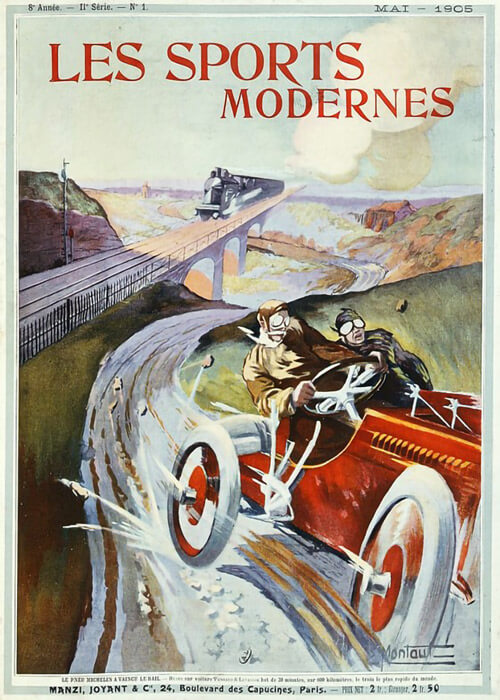
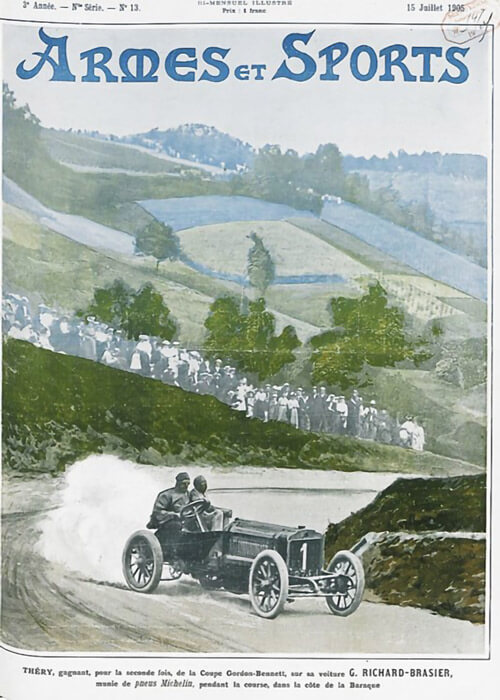
Introduction on the title is on it’s way..
With permission of hathitrust hathitrust.org == Text and fotos compiled by motorracinghistory motorracinghistory.com
THE AUTOMOBILE — Volume XXVII 27, No. 14, October 3 19, 1912, pages 655 – 659
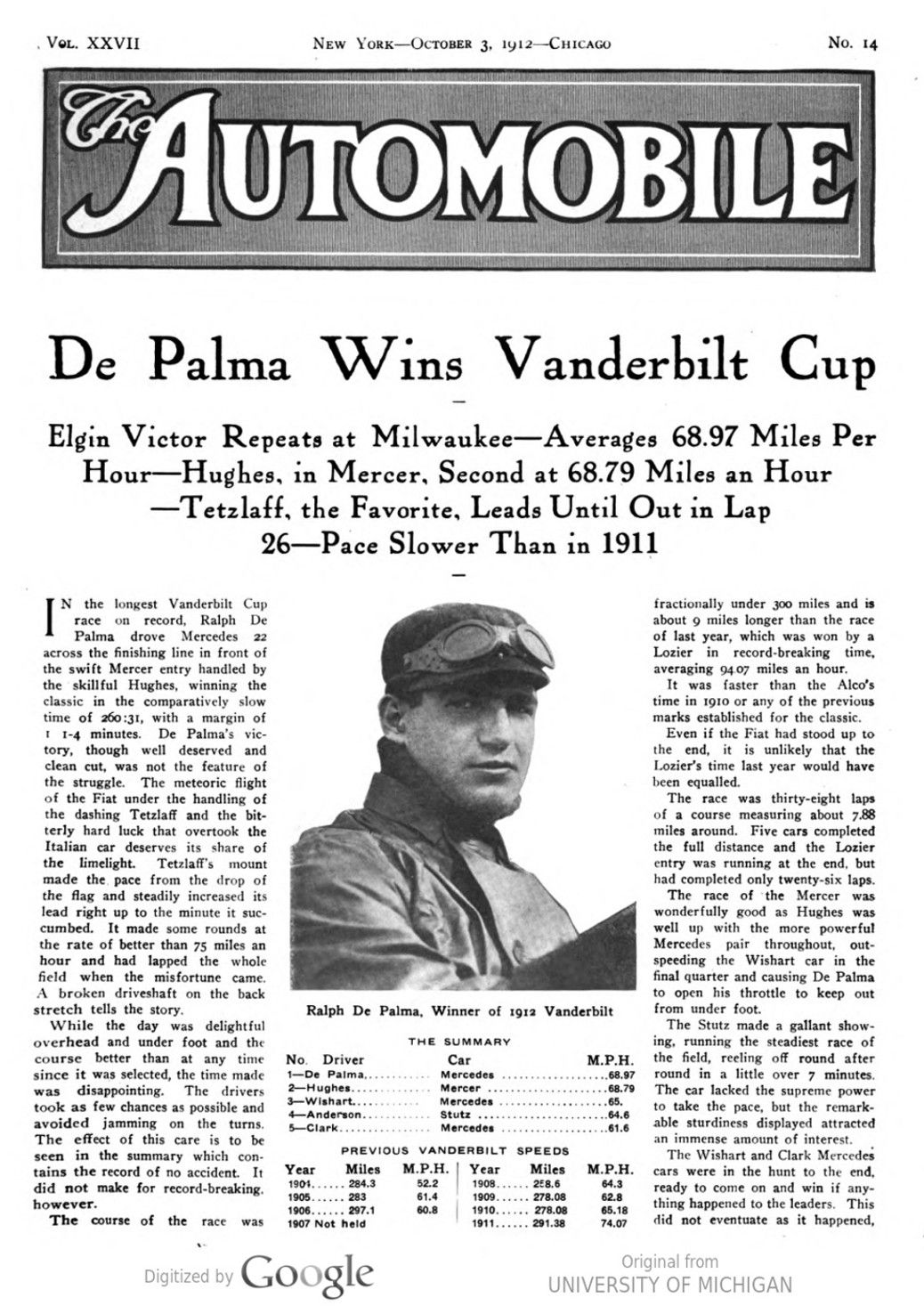
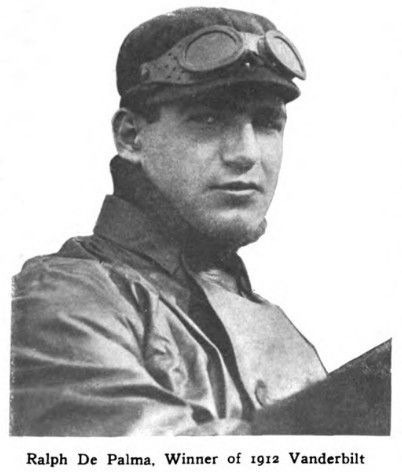
De Palma Wins Vanderbilt Cup
Elgin Victor Repeats at Milwaukee-Averages 68.97 Miles Per Hour – Hughes, in Mercer, Second at 68.79 Miles an Hour – Tetzlaff, the Favorite, Leads Until Out in Lap 26 – Pace Slower Than in 1911
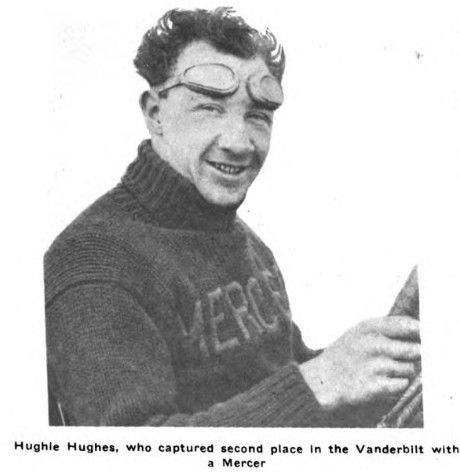
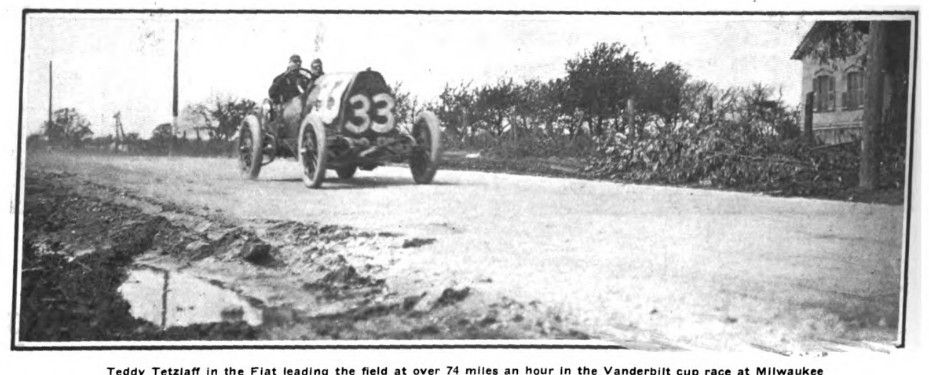
IN the longest Vanderbilt Cup race on record, Ralph De Palma drove Mercedes 22 across the finishing line in front of the swift Mercer entry handled by the skillful Hughes, winning the classic in the comparatively slow time of 260:31, with a margin of 1 1-4 minutes. De Palma’s victory, though well-deserved and clean cut, was not the feature of the struggle. The meteoric flight of the Fiat under the handling of the dashing Tetzlaff and the bitterly hard luck that overtook the Italian car deserves its share of the limelight. Tetzlaff’s mount made the pace from the drop of the flag and steadily increased its lead right up to the minute it succumbed. It made some rounds at the rate of better than 75 miles an hour and had lapped the whole field when the misfortune came. A broken driveshaft on the back stretch tells the story.
While the day was delightful overhead and under foot and the course better than at any time since it was selected, the time made was disappointing. The drivers took as few chances as possible and avoided jamming on the turns. The effect of this care is to be seen in the summary which contains the record of no accident. It did not make for record-breaking, however.
The course of the race was fractionally under 300 miles and is about 9 miles longer than the race of last year, which was won by a Lozier in record-breaking time, averaging 94.07 miles an hour.
It was faster than the Alco’s time in 1910 or any of the previous marks established for the classic. Even if the Fiat had stood up to the end, it is unlikely that the Lozier’s time last year would have been equaled.
The race was thirty-eight laps of a course measuring about 7.88 miles around. Five cars completed the full distance and the Lozier entry was running at the end, but had completed only twenty-six laps. The race of the Mercer was wonderfully good as Hughes was well up with the more powerful Mercedes pair throughout, out-speeding the Wishart car in the final quarter and causing De Palma to open his throttle to keep out from under foot.
The Stutz made a gallant showing, running the steadiest race of the field, reeling off round after round in a little over 7 minutes. The car lacked the supreme power to take the pace, but the remarkable sturdiness displayed attracted an immense amount of interest.
The Wishart and Clark Mercedes cars were in the hunt to the end, ready to come on and win if anything happened to the leaders. This did not eventuate as it happened, but they performed with credit to themselves and the drivers.
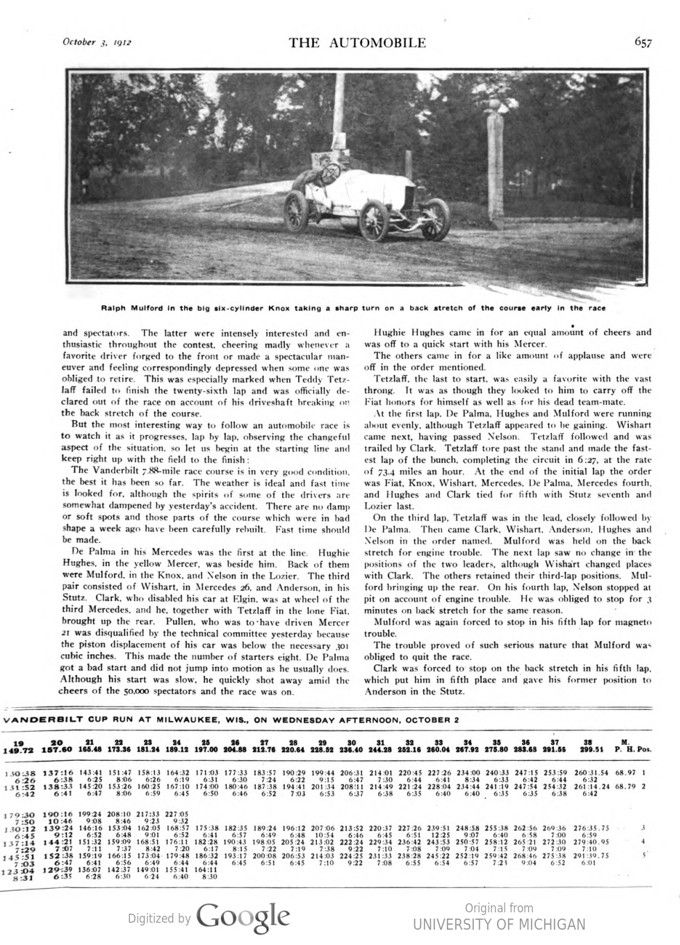
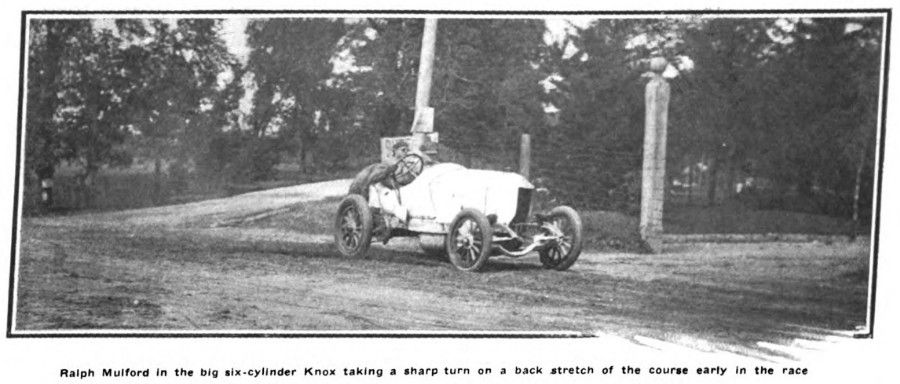
The Knox had a short airing, succumbing in lap 5, after encountering trouble in two of the earlier rounds. It did well while it was going, but it did not go far. Magneto trouble was announced as the cause of the failure of the Knox.
A magnificent crowd witnessed the running of the race, it being estimated that the stands and points of vantage contained at least 50,000 enthusiastic spectators.
The sentiment of the crowd was with Tetzlaff’s Fiat, and as the big car took the pace and whisked away from its competitors in the early stages of the race the Californian was cheered repeatedly by the assembly. He kept shooting the car along under this encouragement and as events proved out his pace was too fast. He was fortunate with his tires and was obliged to draw up at the pits only once. This came in lap 19 and for the first time thus far in the race the Fiat failed to gain on the average time of the contenders. The round was made in about 8 1-2 minutes. and when he started away once more the lead of nearly 10 minutes was not materially reduced.
At this point in the contest the majority of the crowd was willing to concede victory to the Fiat, but the contending drivers, notably the cool, crafty Hughes and the mercurial De Palma, maintained their slower pace in anticipation of just what did happen to the flying leader.
It was a magnificent bit of generalship which was largely overlooked by the crowd, but it paid dividends in the final result. This pair could not be persuaded to sprint with Tetzlaff, but they hung on each other’s skirts for 100 miles, waiting. waiting. like a pair of hawks. They nursed their cars carefully, changing tires together and taking supplies as nearly as possible at the same time.
To those who were motorwise in the crowd, this duel was the most beautiful thing about the contest. They both seemed to realize that the Fiat could not survive such a terrific beating as she was getting from the Californian and that the final test would be between them.
The big German car and the little yellow Jerseyite proved to be well matched and the finish, while not so close as some of those developed in Vanderbilt Cup races, was close enough to keep the crowd on tiptoe.
That the Mercedes won was due to the extra power of its motor and the handling it received from a great driver. As to the Mercer, it can be said that considering its size it made the most wonderful showing ever displayed in a Vanderbilt Cup race.
Although only five cars finished, their performance was consistent throughout and there was plenty of excitement for the 50,000 spectators who lined the course, mostly at the grandstand. Although no records were broken, the time was much faster than was anticipated by the officials of the meet and it looks good for the balance of the race to be run during the week.
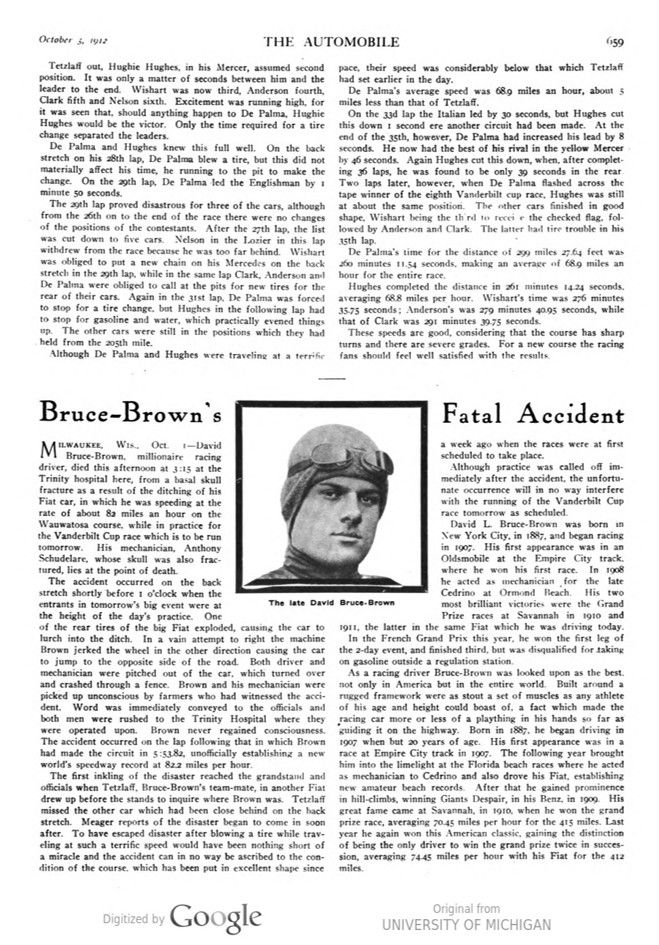
De Palma, who crossed the tape well in the lead of most of his competitors, was wildly cheered by the spectators when he strolled back to the grandstand after putting his faithful Mercedes in its camp. It was easily seen that the big crowd was with the plucky driver, although they were sorry for the misfortune that befell Teddy Tetzlaff, who had driven at a dare-devil pace until misfortune overtook him. De Palma drove a consistent race and the victory was deserved, coming as it did for the second time this year.
Considering the fact that the race was over a new course, the time which was made may well be regarded as remarkable. Everyone rejoiced at the propitious weather conditions as well as at the state of the course which permitted the race to be run off in such good order from the viewpoint of both participants and spectators. The latter were intensely interested and enthusiastic throughout the contest, cheering madly whenever a favorite driver forged to the front or made a spectacular maneuver and feeling correspondingly depressed when some one was obliged to retire. This was especially marked when Teddy Tetzlaff failed to finish the twenty-sixth lap and was officially declared out of the race on account of his driveshaft breaking on the back stretch of the course.
But the most interesting way to follow an automobile race is to watch it as it progresses, lap by lap, observing the changeful aspect of the situation, so let us begin at the starting line and keep right up with the field to the finish:
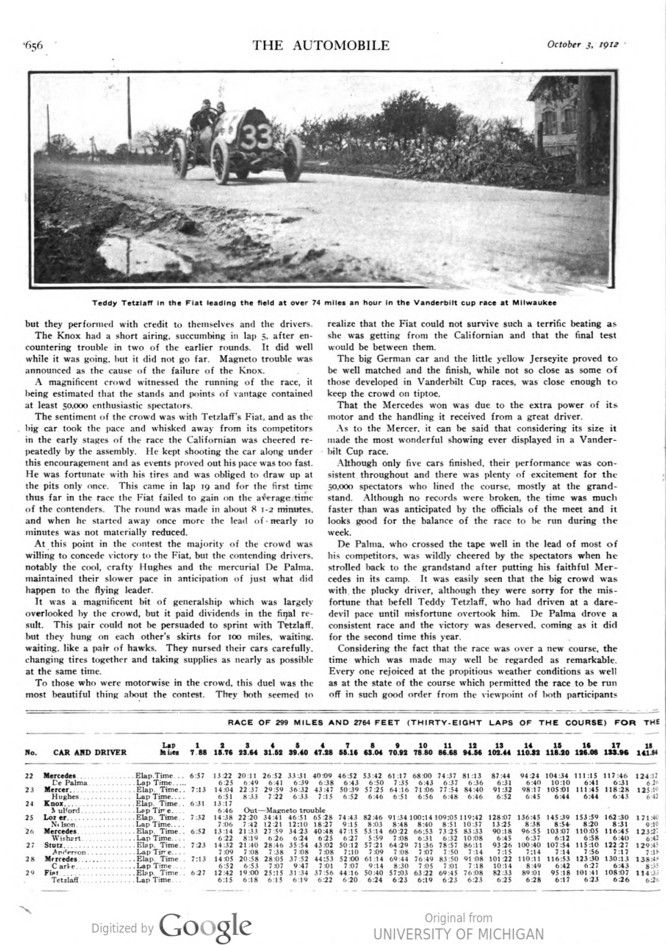
– RACE OF 299 MILES AND 2764 FEET (THIRTY-EIGHT LAPS OF THE COURSE) FOR THE VANDERBILT CUP RUN AT MILWAUKEE, WIS., ON WEDNESDAY AFTERNOON, OCTOBER (table)
The Vanderbilt 7.88-mile racecourse is in very good condition, the best it has been so far. The weather is ideal and fast time is looked for, although the spirits of some of the drivers are somewhat dampened by yesterday’s accident. There are no damp or soft spots and those parts of the course which were in bad shape a week ago have been carefully rebuilt. Fast time should be made.
De Palma in his Mercedes was the first at the line. Hughie Hughes, in the yellow Mercer, was beside him. Back of them were Mulford, in the Knox, and Nelson in the Lozier. The third pair consisted of Wishart, in Mercedes 26, and Anderson, in his Stutz. Clark, who disabled his car at Elgin, was at wheel of the third Mercedes, and he, together with Tetzlaff in the lone Fiat. brought up the rear. Pullen, who was to have driven Mercer 21 was disqualified by the technical committee yesterday because the piston displacement of his car was below the necessary 301 cubic inches. This made the number of starters eight. De Palma got a bad start and did not jump into motion as he usually does. Although his start was slow, he quickly shot away amid the cheers of the 50,000 spectators and the race was on.
Hughie Hughes came in for an equal amount of cheers and was off to a quick start with his Mercer. The others came in for a like amount of applause and were off in the order mentioned. Tetzlaff, the last to start, was easily a favorite with the vast throng. It was as though they looked to him to carry off the Fiat honors for himself as well as for his dead team-mate.
On the third lap, Tetzlaff was in the lead, closely followed by De Palma. Then came Clark, Wishart. Anderson, Hughes and Nelson in the order named. Mulford was held on the back stretch for engine trouble. The next lap saw no change in the positions of the two leaders, although Wishart changed places with Clark. The others retained their third-lap positions. Mulford bringing up the rear. On his fourth lap, Nelson stopped at pit on account of engine trouble. He was obliged to stop for 3 minutes on back stretch for the same reason. Mulford was again forced to stop in his fifth lap for magneto trouble. The trouble proved of such serious nature that Mulford was obliged to quit the race. Clark was forced to stop on the back stretch in his fifth lap. which put him in fifth place and gave his former position to Anderson in the Stutz.
On his sixth lap, Nelson’s Lozier developed brake trouble which put him out of the running, although on the stretches he appeared to be going well.
On the ninth lap, Tetzlaff was still way ahead, his average for the nine laps being 74.9 miles an hour. De Palma still second in the seventh lap, had covered a distance of 55 miles at an average speed of 70 miles.
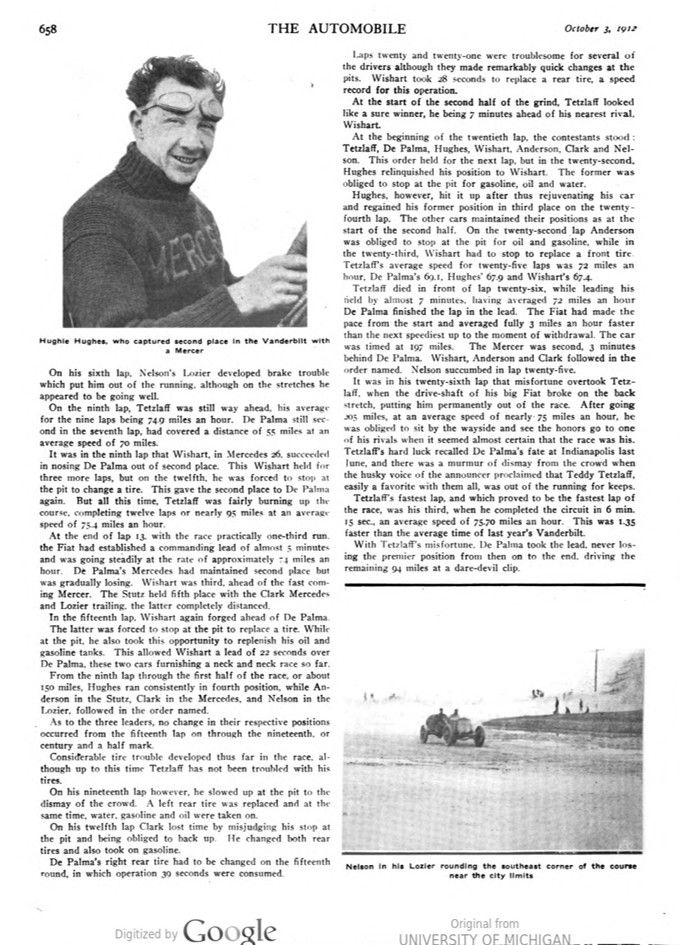
It was in the ninth lap that Wishart, in Mercedes 26, succeeded in nosing De Palma out of second place. This Wishart held for three more laps, but on the twelfth, he was forced to stop at the pit to change a tire. This gave the second place to De Palma again. But all this time, Tetzlaff was fairly burning up the course, completing twelve laps or nearly 95 miles at an average speed of 75.4 miles an hour.
At the end of lap 13, with the race practically one-third run, the Fiat had established a commanding lead of almost 5 minutes and was going steadily at the rate of approximately 74 miles an hour. De Palma’s Mercedes had maintained second place but was gradually losing. Wishart was third, ahead of the fast coming Mercer. The Stutz held fifth place with the Clark Mercedes and Lozier trailing, the latter completely distanced.
In the fifteenth lap, Wishart again forged ahead of De Palma. The latter was forced to stop at the pit to replace a tire. While at the pit, he also took this opportunity to replenish his oil and gasoline tanks. This allowed Wishart a lead of 22 seconds over De Palma, these two cars furnishing a neck and neck race so far.
From the ninth lap through the first half of the race, or about 150 miles, Hughes ran consistently in fourth position, while Anderson in the Stutz, Clark in the Mercedes, and Nelson in the Lozier, followed in the order named.
As to the three leaders, no change in their respective positions occurred from the fifteenth lap on through the nineteenth, or century and a half mark.
Considerable tire trouble developed thus far in the race, although up to this time Tetzlaff has not been troubled with his tires.
On his nineteenth lap however, he slowed up at the pit to the dismay of the crowd. A left rear tire was replaced and at the same time, water, gasoline and oil were taken on.
On his twelfth lap Clark lost time by misjudging his stop at the pit and being obliged to back up. He changed both rear tires and also took on gasoline.
De Palma’s right rear tire had to be changed on the fifteenth round, in which operation 39 seconds were consumed.
Laps twenty and twenty-one were troublesome for several of the drivers although they made remarkably quick changes at the pits. Wishart took 28 seconds to replace a rear tire, a speed record for this operation.
At the start of the second half of the grind, Tetzlaff looked like a sure winner, he being 7 minutes ahead of his nearest rival, Wishart.
At the beginning of the twentieth lap, the contestants stood: Tetzlaff, De Palma, Hughes, Wishart, Anderson, Clark and Nelson. This order held for the next lap, but in the twenty-second, Hughes relinquished his position to Wishart. The former was obliged to stop at the pit for gasoline, oil and water.
Hughes, however, hit it up after thus rejuvenating his car and regained his former position in third place on the twenty-fourth lap. The other cars maintained their positions as at the start of the second half. On the twenty-second lap Anderson was obliged to stop at the pit for oil and gasoline, while in the twenty-third, Wishart had to stop to replace a front tire. Tetzlaff’s average speed for twenty-five laps was 72 miles an hour, De Palma’s 69.1, Hughes’ 67.9 and Wishart’s 67.4.
Tetzlaff died in front of lap twenty-six, while leading his field by almost 7 minutes, having averaged 72 miles an hour De Palma finished the lap in the lead. The Fiat had made the pace from the start and averaged fully 3 miles an hour faster than the next speediest up to the moment of withdrawal. The car was timed at 197 miles. The Mercer was second, 3 minutes behind De Palma. Wishart, Anderson and Clark followed in the order named. Nelson succumbed in lap twenty-five.
It was in his twenty-sixth lap that misfortune overtook Tetzlaff, when the driveshaft of his big Fiat broke on the back stretch, putting him permanently out of the race. After going 205 miles, at an average speed of nearly 75 miles an hour, he was obliged to sit by the wayside and see the honors go to one of his rivals when it seemed almost certain that the race was his. Tetzlaff’s hard luck recalled De Palma’s fate at Indianapolis last June, and there was a murmur of dismay from the crowd when the husky voice of the announcer proclaimed that Teddy Tetzlaff, easily a favorite with them all, was out of the running for keeps.
Tetzlaff’s fastest lap, and which proved to be the fastest lap of the race, was his third, when he completed the circuit in 6 min. 15 sec., an average speed of 75.70 miles an hour. This was 1.35 faster than the average time of last year’s Vanderbilt. With Tetzlaff’s misfortune, De Palma took the lead, never losing the premier position from then on to the end, driving the remaining 94 miles at a dare-devil clip.
Tetzlaff out, Hughie Hughes, in his Mercer, assumed second position. It was only a matter of seconds between him and the leader to the end. Wishart was now third, Anderson fourth, Clark fifth and Nelson sixth. Excitement was running high, for it was seen that, should anything happen to De Palma, Hughie Hughes would be the victor. Only the time required for a tire change separated the leaders.
De Palma and Hughes knew this full well. On the back stretch on his 28th lap, De Palma blew a tire, but this did not materially affect his time, he running to the pit to make the change. On the 29th lap, De Palma led the Englishman by 1 minute 50 seconds.
The 29th lap proved disastrous for three of the cars, although from the 26th on to the end of the race there were no changes of the positions of the contestants. After the 27th lap, the list was cut down to five cars. Nelson in the Lozier in this lap withdrew from the race because he was too far behind. Wishart was obliged to put a new chain on his Mercedes on the back stretch in the 29th lap, while in the same lap Clark, Anderson and De Palma were obliged to call at the pits for new tires for the rear of their cars. Again in the 31st lap, De Palma was forced to stop for a tire change, but Hughes in the following lap had to stop for gasoline and water, which practically evened things up. The other cars were still in the positions which they had held from the 205th mile.
Although De Palma and Hughes were traveling at a terrific pace, their speed was considerably below that which Tetzlaff had set earlier in the day. De Palma’s average speed was 68.9 miles an hour, about 5 miles less than that of Tetzlaff.
On the 33d lap the Italian led by 30 seconds, but Hughes cut this down I second ere another circuit had been made. At the end of the 35th, however, De Palma had increased his lead by 8 seconds. He now had the best of his rival in the yellow Mercer by 46 seconds. Again Hughes cut this down, when, after completing 36 laps, he was found to be only 39 seconds in the rear. Two laps later, however, when De Palma flashed across the tape winner of the eighth Vanderbilt cup race, Hughes was still at about the same position. The other cars finished in good shape, Wishart being the third to receive the checked flag, followed by Anderson and Clark. The latter had tire trouble in his 35th lap.
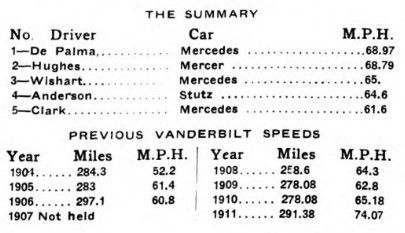
De Palma’s time for the distance of 299 miles 27.64 feet was 260 minutes 11.54 seconds, making an average of 68.9 miles an hour for the entire race.
Hughes completed the distance in 261 minutes 14.24 seconds. averaging 68.8 miles per hour. Wishart’s time was 276 minutes 35.75 seconds; Anderson’s was 279 minutes 40.95 seconds, while that of Clark was 291 minutes 39.75 seconds. These speeds are good, considering that the course has sharp turns and there are severe grades. For a new course the racing fans should feel well satisfied with the results.
Photos.
Page 655. Ralph De Palma, Winner of 1912 Vanderbilt – THE SUMMARY – PREVIOUS VANDERBILT SPEEDS
Page 656. Teddy Tetzlaff in the Fiat leading the field at over 74 miles an hour in the Vanderbilt cup race at Milwaukee – RACE OF 299 MILES AND 2764 FEET (THIRTY-EIGHT LAPS OF THE COURSE) FOR THE VANDERBILT CUP RUN AT MILWAUKEE, WIS., ON WEDNESDAY AFTERNOON, OCTOBER
Page 657. Ralph Mulford in the big six-cylinder Knox taking a sharp turn on a back stretch of the course early in the race
Page 658. Hughie Hughes, who captured second place in the Vanderbilt with a Mercer – Nelson in his Lozier rounding the southeast corner of the course near the city limits