Introduction on the title is on it’s way.

With permission of hathitrust hathitrust.org == Text and fotos compiled by motorracinghistory motorracinghistory.com
THE AUTOMOBILE — Volume XXVII 27, No. 12, September 19, 1912, pages 592 – 593
All Eyes On Milwaukee
Despite Postponement of Grand Prize Until Monday –
Races Center Attention of Motordom –
Promoters Display Much Energy in Belated Effort to Get Course in Shape for Speed Trials
MILWAUKEE, Sept. 17 — (Special Telegram) — Rain during the last 72 hours interfered with practice on the course today to such an extent that De Palma, in his Mercedes, was the only one to make an effort for time. He accomplished the fastest time so far recorded in the practice; covering the 7.8 miles in 7 minutes and 15.03 seconds, averaging 64.7 miles an hour. During the 2 hours of practice today the best laps made were as follows:
Car – Driver – Time min. sec. – Average speed miles per hour
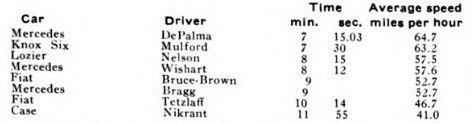
De Palma’s lap was the only one timed by the Warner electric timing instrument which was not ready during the earlier laps. There was but 2 hours‘ practice, the time being extended to 4 hours for Wednesday.
A new entry, a Bergdoll car, has been entered. The lists will not close until Thursday. The driver of this car has not been named. By fast work the promotors hope to have the track fully restored to condition by the opening race.
Milwaukee’s big road racing carnival will open on Friday noon with the first running of the races for the Pabst Blue Ribbon trophy and the Wisconsin Challenge trophy, the big event scheduled as the curtain-raiser, the fourth contest for the Grand Prix of the Automobile Club of America having been changed to the wind-up, which will take place on Monday, September 23, following the Vanderbilt on Saturday, September 21.
The necessity of a change in the program so that the first events would be set back to give the Milwaukee Automobile Dealers‘ Association the better part of an additional week to get their course in shape, was anticipated by the inner circle for some days in advance of Thursday, September 12.
The action temporarily staggered the promoters, but all realized the absolute necessity of the change, and then started out to make good. The road construction contractor and his assistants were fired on the spot and some new and fresh blood infused into the thing. Friday morning the dealers cast off their blue spectacles when they saw a half dozen gangs of workmen driven at top speed by the new bosses, actually accomplishing something worth while. The course fairly grew while one looked and the fast work was carried on throughout the night by the light of torches and headlights focused to the best advantage. Monday night, the last drop of oil was on the roads and the final coating of sand was being applied. Starter Wagner announced that official practice would positively start at 11 o’clock Tuesday morning – which, by the way, is the hour at which the Grand Prix was to have been started on that day.
The new arrangement gives the light car drivers two full days of practice; the Vanderbilt contestants four days, and the competitors in the Grand Prix six whole days in which to tune up their cars and make that close acquaintance with the roads which is so necessary to make the best speed possible. Only an insane driver would attempt to start a race of the importance of the Grand Prix or the Vanderbilt without having an intimate knowledge of every inch of the course.
The change in the program carried over the closing of entries for the Grand Prix to Wednesday night. Twelve cars have already been nominated, and it is possible that two or three more will come in, as it is planned to give any entrant in the other three events a chance to be booked for the final race up to Sunday morning. A few of the Vanderbilters have held off because they desire to get through the Saturday race before taking a chance on the Monday race.

The Pabst and Wisconsin Challenge races show only a fair-sized entry list, but both will bring out classy fields. In the Pabst, for 231 to 300 cubic inch cars, there are three Mercers, one Mason, two Falcars and a Case. Judging from past performance, the calibre of the men behind the wheels should make this a most interesting race, for Hughey Hughes and Spencer Wishart will pit themselves against Mortimer Roberts, Hastings and Trussel, Ed Pullen of their own camp, and Joe Jagersberger, who intends to „come back“ after being out of the speed game for nearly a year, and with one good leg, at that. The other limb he lost at Columbia, S. C. last November in a bad spill on a dirt track only a short time before the international races at Savannah. If the „Flying Dutchman“ cannot stand the 220-mile gaff, Louis Disbrow or Joe Nikrent will help him out, with „Farmer Bill“ Endicott as a third substitute.
The Wisconsin Challenge, a 173-mile contest for the little fellows of 161 to 300 cubic inches, will be a three-cornered fight between the Ford, E-M-F and Mason. It is likely this event will be a duel between Frank Kulick and Harry Endicott, as the other three drivers, Cramer and Roy Snyder, of the Mason team and John Heber of the E-M-F, are lesser lights. Heber is a Milwaukee man and will drive a Milwaukee-owned car, an E-M-F of the type used by Frank Witt in all of his races, the property of Dr. Irving H. Fowle, of Milwaukee. The doctor bought the car only a few days ago and after looking high and low for a competent driver, he found Heber, who has done a lot of track work in Buicks but is new on the road.
The line-up in the Vanderbilt will be similar to that in the Elgin National, although there will be seen at Milwaukee such stars as Teddy Tetzlaff, holder of the world’s road racing record for average speed, and Louis Disbrow of the Case team.
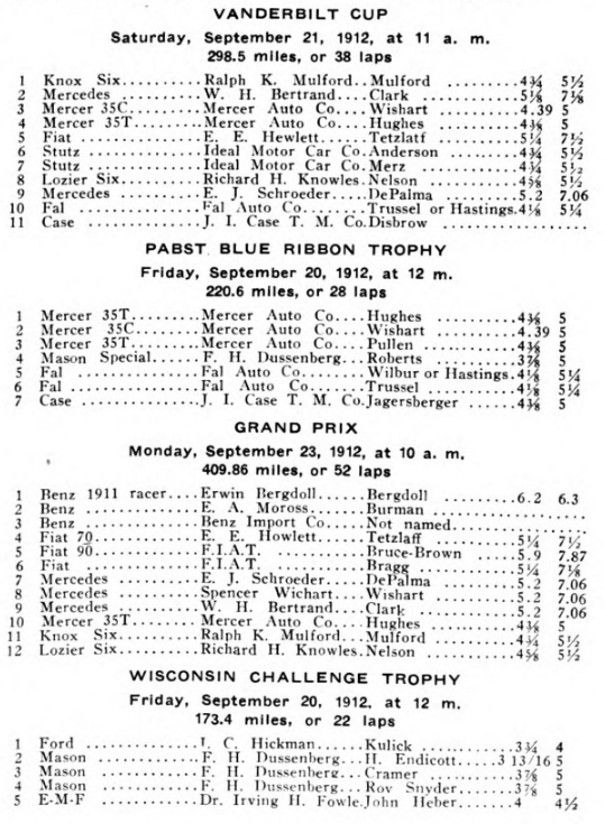
VANDERBILT CUP Saturday, September 21, 1912, at 11 a. m. 298.5 miles, or 38 laps
PABST BLUE RIBBON TROPHY Friday, September 20, 1912, at 12 m. 220.6 miles, or 28 laps
GRAND PRIX Monday, September 23, 1912, at 10 a. m. 409.86 miles, or 52 laps
WISCONSIN CHALLENGE TROPHY Friday, September 20, 1912, at 12 m. 173.4 miles,
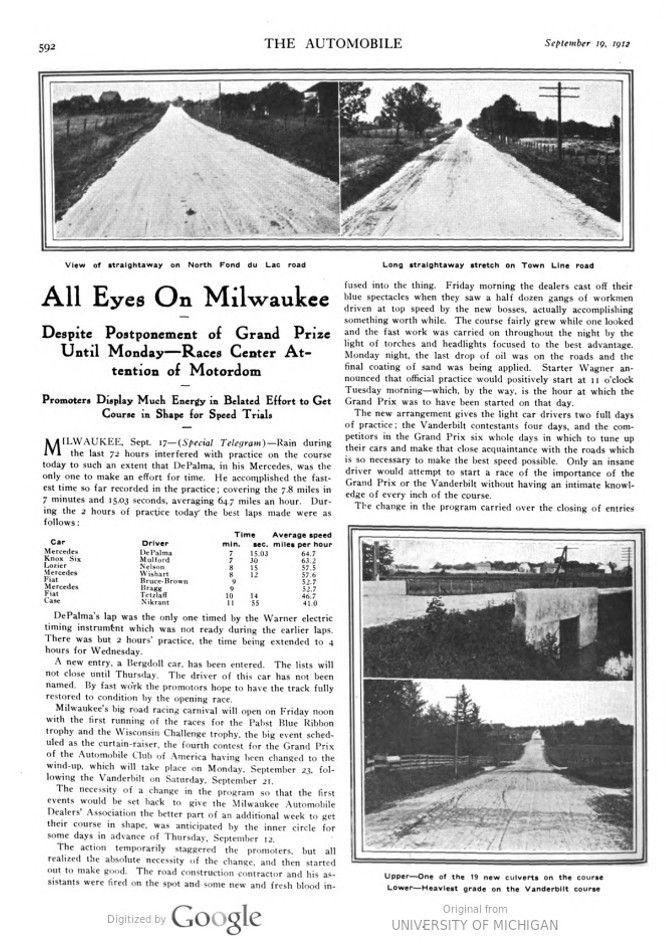
Photos.
Page 592.
View of straightaway on North Fond du Lac road
Long straightaway stretch on Town Line road
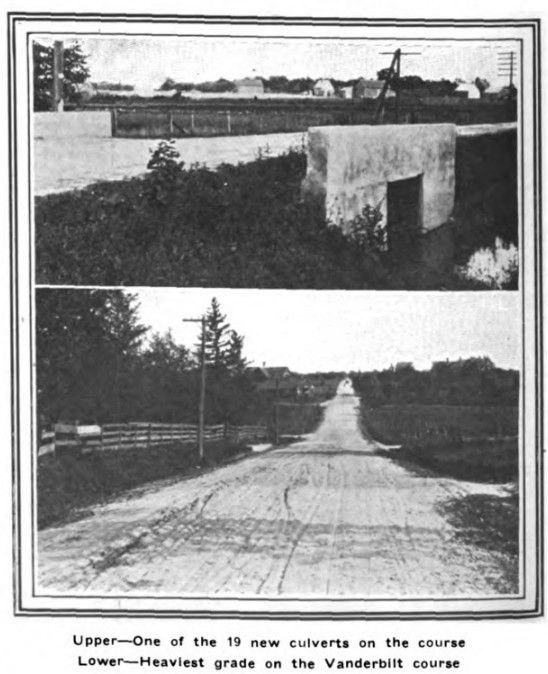
Upper – One of the 19 new culverts on the course
Lower – Heaviest grade on the Vanderbilt course
Page 593.
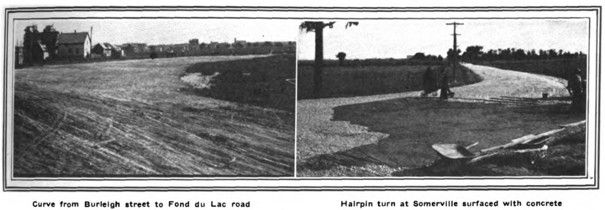
Curve from Burleigh street to Fond du Lac road
Hairpin turn at Somerville surfaced with concrete
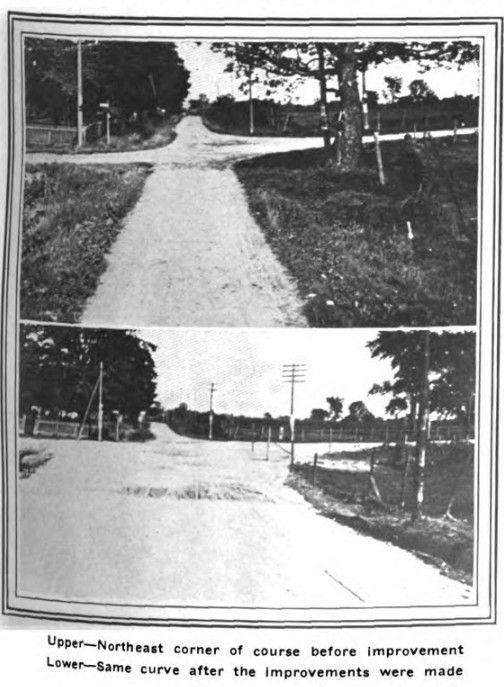
Upper – Northeast corner of course before improvement
Lower – Same curve after the improvements were made