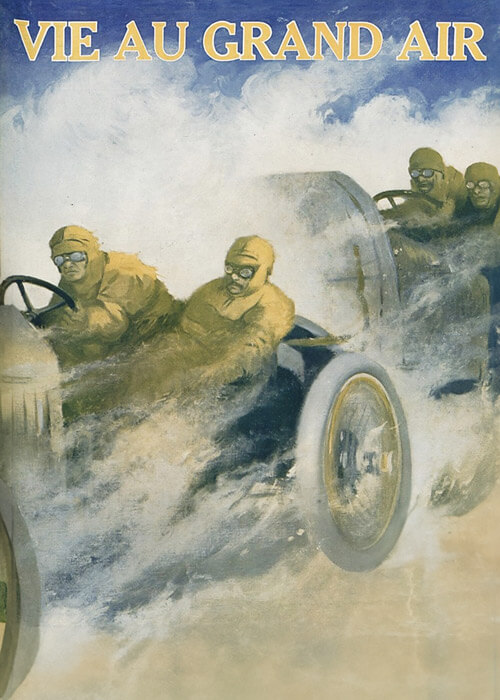
This last report by Georges Prade of La Vie au Grand Air on the 1902 Paris-Vienna race is this magazine’s summary. First, the so-called compartive race between rail-and-car is dicsussed. Most important feature of this Paris-Vienna race hiowever, is the fact that out of 137 cars, 80 could finish in Vienna; this was considered to be a significant progression in the automotive industry. It is mentioned here, that failures due to driver’s errors were even much more than technical related features. Technology has beaten man? Anyhow, it is concluded that this race was the very first prove of significant technical evolution in automotive indistry.
Text and jpegs by courtesy of Bibliotheque national francais, gallica.bnf.fr; compiled by motorracinghistory, Translation by DeepL.com
La Vie au Grand Air, Vol. 8, No. 2019, July 19, 1902
After Paris – Vienna
The Paris–Vienna race is over, and the painstaking process of tabulating the results has finally been completed. The time has come to take a look back at this great event together, which is exactly what our correspondent Georges Prade will do, having followed it from start to finish and very closely.
THERE you have it: the third major international race is over. In 1898 we had Paris-Amsterdam, in 1901 we had Paris-Berlin, and this year will certainly be remembered as the year of Paris-Vienna. It is worth noting that each time we went further and dreamed bigger. Amsterdam is still just a few hours from Paris. Leave at 8 a.m. from one of the two cities and you’ll be in the other by 6 p.m.
Berlin is already farther away. No matter how fast it goes, the Nord-Express, leaving Paris before 2 p.m., doesn’t arrive in the German capital until 9 a.m., and the journey from Paris to Vienna takes 24 hours on the Orient-Express — and even if you want to go through Switzerland and the Arlberg as the race did, you have to count on 36 hours — 36 long, endless hours from which you return worn out, exhausted, and broken.
The winner, Marcel Renault, took about 24 hours, not including the crossing of Switzerland; we’ll readily concede that he could easily have covered those 312 kilometers in 6 hours at a leisurely pace, bringing us to a rough total of 32 hours — a time with which, despite the speed bumps, gutters, hills, and hairpin turns, he nevertheless once again indulges in the luxury of beating the Arlberg Express, which departs Paris at 8:35 3:35 p.m. to arrive the day after tomorrow in Vienna at 6:45 a.m., for a total journey time of 34 hours and 10 minutes. Let no one object that the train-made stops along the way; it is far from having made as many as the unfortunate driver, who, from Paris to Vienna, was made to pass through even the smallest villages at slow speed
Let us readily admit, moreover, that if once again the road train has beaten the other, and if the road has once again triumphed over the rail, it is because the rail has not been very brilliant itself. The high-speed trains do not reach 50 km/h over there, and there are 90 kilometers from Bluckenz to Landeich that the excellent train takes 3 hours to cover, which allows it to stay under the 30-mph limit dear to Mr. Lépine, and could, if necessary, spare the locomotive from having to display some large, unsightly number like automobiles do.
It remains nonetheless true that once again this peaceful cohort of progress, this army of peace and industry — which nevertheless partly satisfies our combative instincts and our need for struggle — has set out from Paris toward a new city. Never before, from a general perspective, has such a brilliant result been achieved.
In the past, we counted those who arrived; now we are beginning to count those who no longer arrive. Of the 137 cars that left Paris, 80 arrived in Vienna — nearly three out of four, and in any case three out of five — an unprecedented and marvelous result that is indeed the main point of the race. I have no hesitation in saying that, given the difference in road conditions between the Paris-Berlin and Paris-Vienna routes, if the vehicles from Paris to Berlin had been in the race, barely one in five would have finished, and in the Paris-Berlin race, there had been only one in three.
Progress is therefore undeniable, and we can no longer even count the teams whose every vehicle, without exception, reached the finish line. Should we mention the Georges Richards (5 out of 5), the Serpollets (5 out of 5), the Déchamps (4 out of 4), the Gobrons (2 out of 2), or the admirable little Werner motorcycles, which, with two entrants, took the top two spots? A marvelous feat and an indisputable demonstration of the practicality of this little machine, which we hope to see become popular very soon.
And how many others left a few vehicles in their wake simply because of a driver’s mistake, which, we must admit, has nothing to do with the quality of the vehicle’s construction: the Darracqs first and foremost, whose race was splendid, the Gobron-Brilliés, the Renault brothers — already winners — the Decauvilles, and the Peugeots.
From this perspective, the race was prepared with a seriousness and dedication worthy of all praise, and while it may not have achieved the resounding brilliance of the clarion call that was Paris-Berlin, the first major race of its kind, and which was further highlighted by a host of factors entirely unrelated to the automobile, this Paris-Vienna race was undoubtedly the finest practical result we have yet recorded. And what lessons were learned on the road, in that school that is always hard, but here harder than ever. There is not a single manufacturer who, despite his success, does not return from it with new ideas and an experience — if not entirely new, then at least stronger and more precise — of the conditions of endurance to which he must henceforth submit.
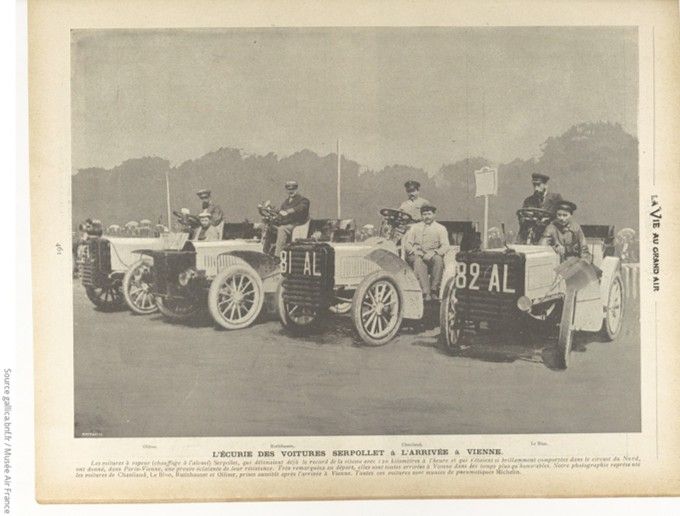
The Serpollet steam-powered (alcohol-heated) cars, which already held the speed record at 120 kilometers per hour and had performed so brilliantly on the Northern Circuit, provided striking proof of their endurance on the Paris-Vienna route. Highly noted at the start, they all arrived in Vienna in more than respectable times. Our photograph shows the cars of Chanliaud, Le Blon, Rutishauser, and Olliver, taken immediately after their arrival in Vienna. All these cars are equipped with Michelin tires. Bibliothèque national francais, gallica.bnf.fr
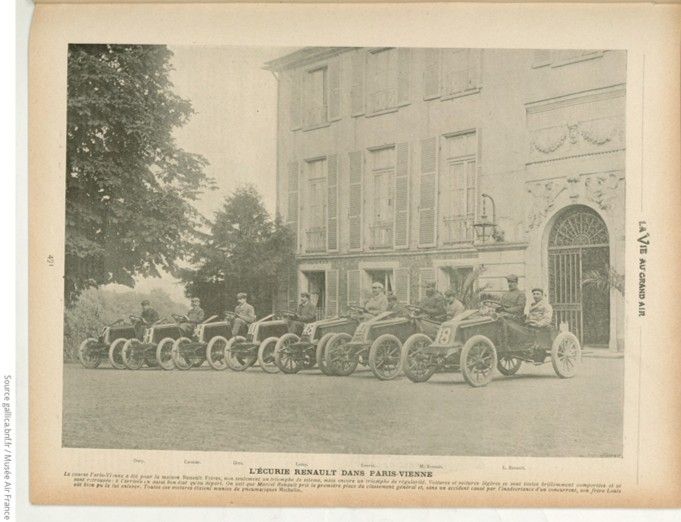
Ouvy – Cornier – Gras – Lamy – Louvet – M. Renault – L. Renault.
The Paris-Vienna race was for Renault Frères not only a triumph of speed, but also a triumph of consistency. Both standard and light cars performed brilliantly and arrived at the finish line in as good a condition as when they started. It is known that Marcel Renault took first place in the overall standings, and had it not been for an accident caused by a competitor’s carelessness, his brother Louis might well have taken it from him. All these cars were equipped with Michelin tires. Bibliothèque national francais, gallica.bnf.fr
Ah! Yes, no doubt, and seen from afar, the race appears to us above all as a splendid epic of human energy and will, but in our minds as on the road, let us allow the whirlwind of dust rising in its wake to settle, and, behind the poetry, let us rediscover science and work — the solid and beautiful framework of this fine body, and the eternal foundations of all work and all reality.
Let us take a quick and highly imperfect glance at the imposing procession of vehicles that have arrived there.
In the front row of the cars, we see the Panhards and Levassors and the Mercedes alongside the Mors. The latter were unlucky, and a series of racing incidents prevented them from performing as the triumphant brand of 1901 should have.
But they gave us the impression that their speed was equal to that of the Panhard cars, which are certainly, at present, the queens of speed. This formidable fleet of large cars arrived in Vienna with almost no breakdowns, and it took sheer bad luck for the fatal breakdown to strike precisely the car representing our colors in the Bennett Cup, allowing the Englishman Edge to snatch victory from us in his Napier. Edge deserves high praise, by the way. After his second 2,000-kilogram Napier, he brought us this time a vehicle that was perhaps a little too light — 800 kilograms — but robust and reliable.
The Mercedes achieved in this race the undeniable success of the serious car which, having not sacrificed everything to the god of speed, nevertheless manages to maintain the highest speed on rough terrain. For them, it was one of their best, if not their best day. The Peugeots and Dietrichs, though slower, had the advantage of their undeniable consistency.
In the lightweight class, Renault enjoyed great success, with Marcel Renault as the official winner and his brother Louis as the unofficial one. The new four-cylinder vehicle was undoubtedly the big sensation of the event. It embodies the economy and elegance of line and power that are classic hallmarks of Renault.
It was also a major success for the Darracqs. Their tightly packed contingent took all the top spots, triumphing in both the alcohol and gasoline classes, and in short, set a record for consistency following their speed records. The same was true for the sturdy Cléments, a true commercial car, as well as the G. Richards, the Decauvilles, and the Déchamps, and the Gobrons confirmed their success from the Circuit du Nord. In the small cars, the victory went to Darracq and Renault, who swapped places from the lightweight car category, and behind them, Corre and Georges Richard, who brought all their vehicles.
In the motorcycle class, the de Dion company pulled off the feat of bringing two machines along this route, which one might have thought was closed to motorcycles, and in the moped class, a great triumph for the Werners, who definitively established themselves as the queens of the road. These few notes may seem dry but let us examine them by looking at what lies beneath: energy and intelligence, effort and money skillfully allocated.
There is no finer test of human energy than this industrial struggle, of which Paris-Vienna was the final, toughest, and most comprehensive trial.
Here, to support what we said above, is an interesting little table showing the progressive and parallel progress of the Arlberg express and Marcel Renault, including both all the train’s stops and all the driver’s stops.
—————-The train. — Marcel Renault.
Paris———- 0 h.——— 0 h.
Belfort ——– 6 h. 48.—- 8 h. 23.
Feldkirch—– 16 h. 48.—- 14 h. 23.
Salzbourg—- 27 h. 57.—- 22 h. 30.
Vienne——- 33 h. 45.—- 21 h. 39.
After 29 hours and 30 minutes, the train had only just reached Vocklabruck, where it passed at 2:10 a.m.—29 hours and 35 minutes after its departure from Paris—and was at that moment 250 kilometers from Vienna. It is therefore 250 kilometers behind, including stops.
With Paris-Vienna, we will no doubt have seen the end of races with neutralized sections, which turn the race into a series of arithmetic operations and delay the announcement of the winner by 15 days. Also likely over are these trips to foreign countries, whose costs run into the hundreds of thousands of francs for the racing teams.
In the meantime, we will have, in Belgium, on a closed circuit, a race of 50 kilometers and a few kilometers, without neutralizations, without stops. It will be a true speed race with no respite for the engines, no cooling for the tires. And, from these two perspectives, it will be of paramount interest.
GEORGES PRADE.
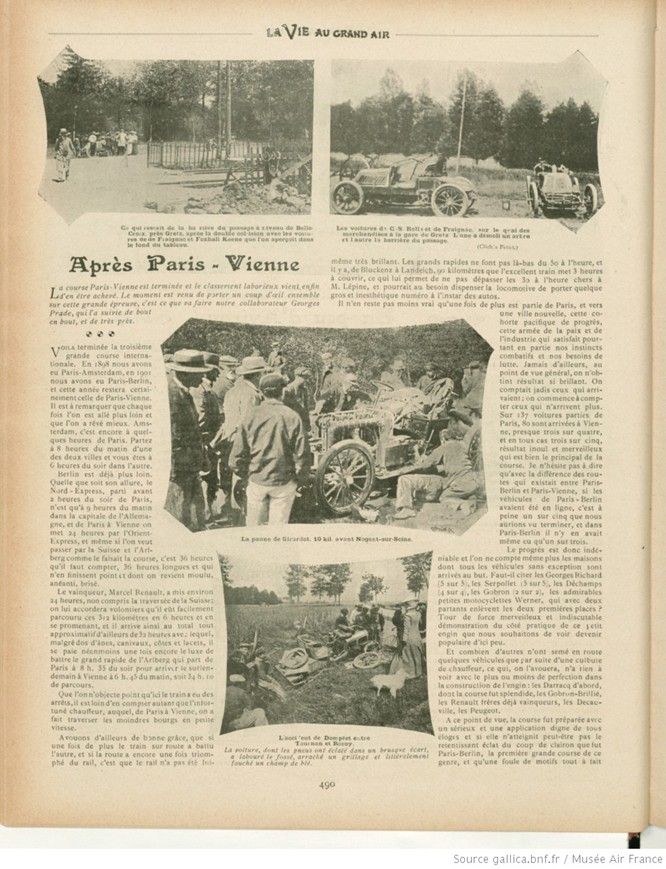
Photos.
Page 490.
What remained of the Belle-Croix railroad crossing barrier, near Gretz, after the double collision with the cars of de Fraignac and Foxhall Keene, which can be seen in the background of the picture.
The cars of C.-S. Rolls and de Fraignac, on the freight platform at the Gretz station. One demolished a tree and the other the crossing barrier. (Petiet photos.)
Girardot’s breakdown, 10 kilometers before Nogent-sur-Seine.
The Domptet accident between Tournan and Rozoy. The car, whose tires burst during a sudden swerve, plowed into the ditch, tore down a fence, and literally mowed down a wheat field.
Page 491.
THE RENAULT TEAM IN THE PARIS-VIENNA RACE
Ouvy – Cornier – Gras – Lamy – Louvet – M. Renault – L. Renault.
The Paris-Vienna race was for Renault Frères not only a triumph of speed, but also a triumph of consistency. Both standard and light cars performed brilliantly and arrived at the finish line in as good a condition as when they started. It is known that Marcel Renault took first place in the overall standings, and had it not been for an accident caused by a competitor’s carelessness, his brother Louis might well have taken it from him. All these cars were equipped with Michelin tires.
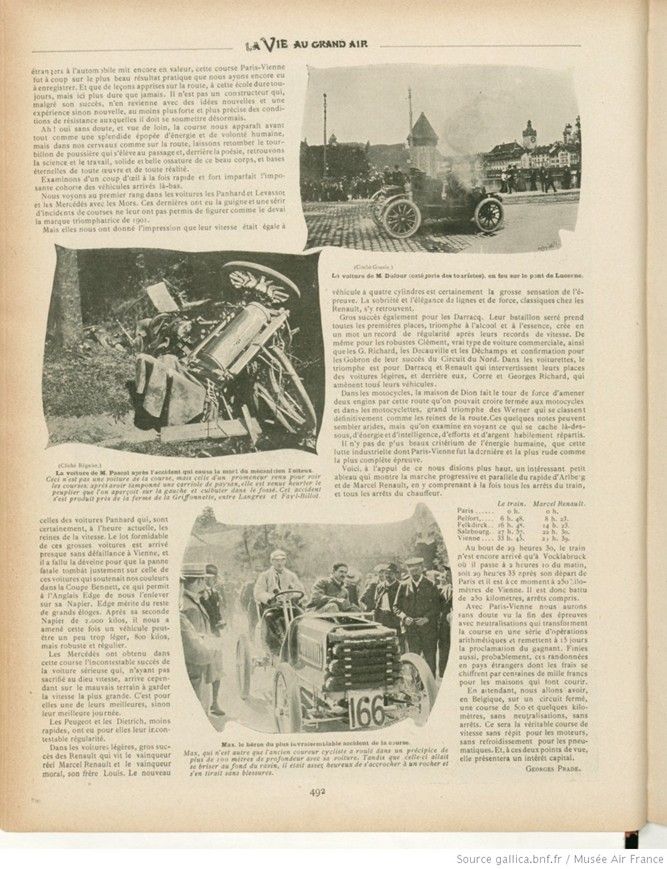
Page 492.
Mr. Pascal’s car after the accident that caused the death of the lame mechanic.
This is not a race car, but that of a spectator who came to watch the races; after rear-ending a farmer’s cart, it struck the poplar tree visible on the left and overturned into the ditch. This accident occurred near the Griffonnette farm, between Langres and Fayl-Billot. (Photo by Régnier.)
Mr. Dufour’s car (tourists category), on fire on the Lucerne bridge. (Photo by Gossin)
Max, the hero of the race’s most incredible accident. Max, who is none other than the former cyclist, drove his car off a cliff over 100 meters deep. Just as the car was about to crash at the bottom of the ravine, he was lucky enough to grab hold of a rock and escaped unharmed.
La Vie au Grand Air of july 12, 1902.
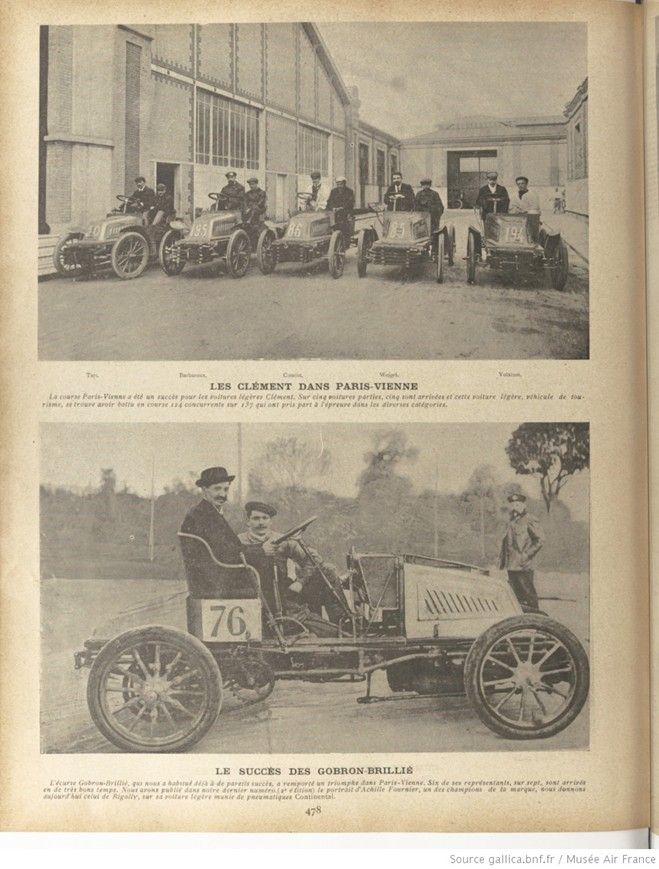
THE CLÉMENTS IN THE PARIS-VIENNA RACE
Tart. Barbaroux. Comiot. Weigel. Volatum.
The Paris-Vienna race was a success for the Clément light cars. Of the five cars that started, all five finished, and this light car, a passenger vehicle, managed to beat 124 of the 137 competitors who took part in the event across the various categories.
THE SUCCESS OF GOBRON-BRILLIÉ
The Gobron-Brillié team, which has already accustomed us to such successes, triumphed in the Paris-Vienna race. Six of its seven entrants finished with very good times. In our last issue (2nd edition), we published a profile of Achille Fournier, one of the brand’s champions; today we present that of Rigolly, in his lightweight car equipped with Continental tires.
(Translated with DeepL.com)