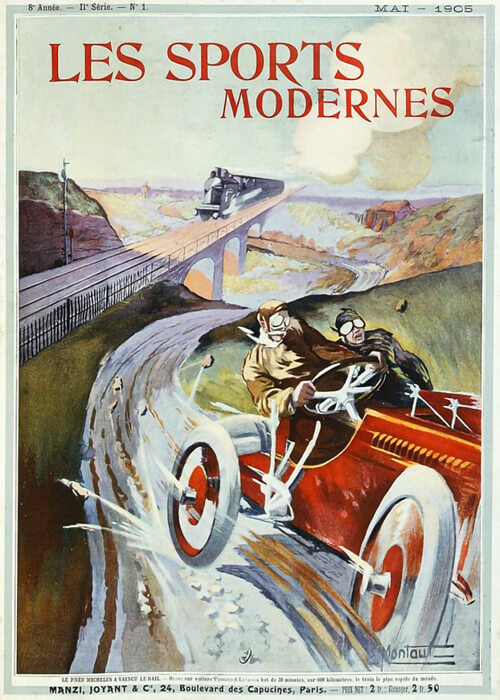
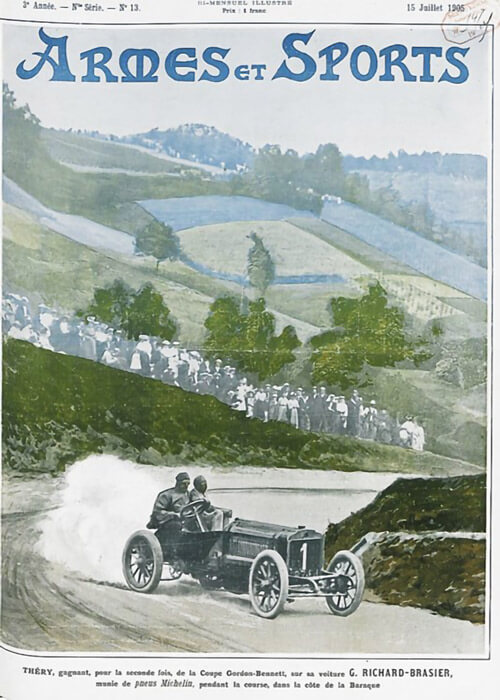
Introduction on the title is on it’s way.
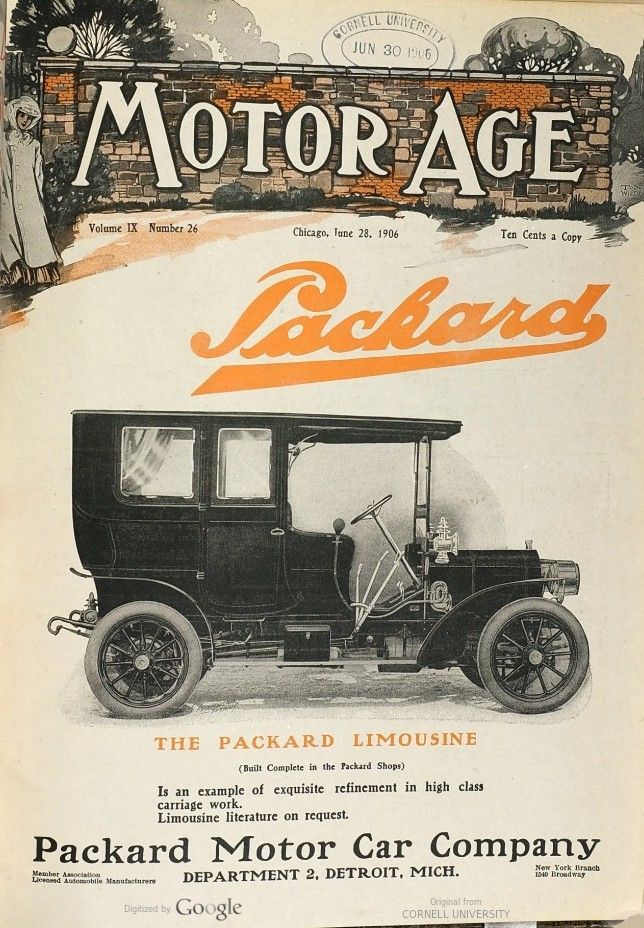
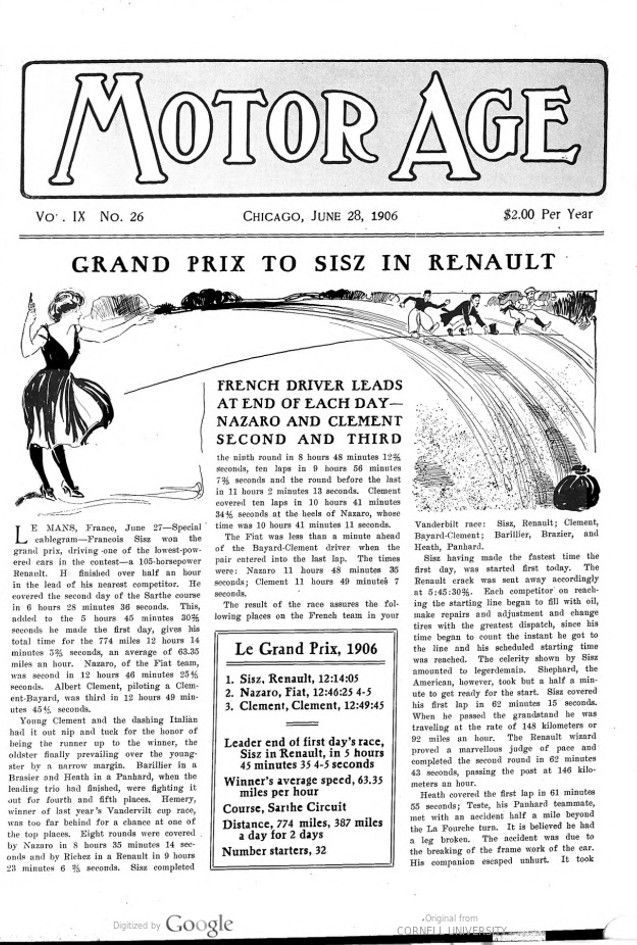
With permission of hathitrust hathitrust.org == Text and fotos compiled by motorracinghistory
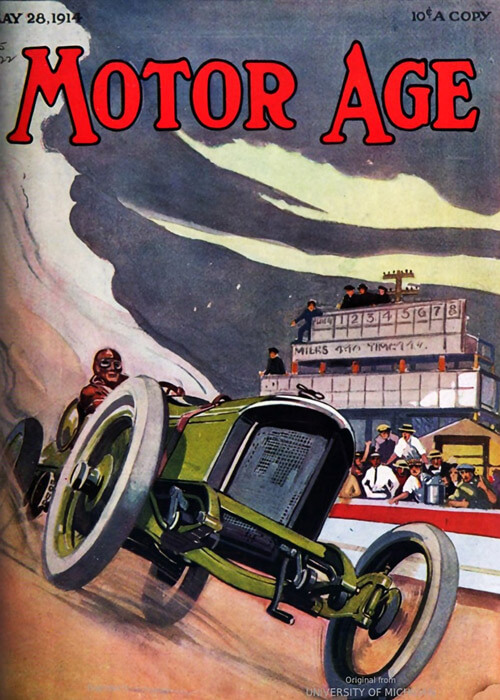
Motor Age — Volume IX, No. 24, June 14, 1906
GRAND PRIX TO SISZ IN RENAULT
FRENCH DRIVER LEADS AT END OF EACH DAY- NAZARO AND CLEMENT SECOND AND THIRD
(Note: the name of Szisz is here wrongly spelled with Sisz -GrocerJack)
LE MANS, France, June 27 – Special cablegram – Francois Sisz grand prix, driving one of the lowest-powered cars in the contest–a 105-horsepower Renault. He finished over half an hour in the lead of his nearest competitor. He covered the second day of the Sarthe course in 6 hours 28 minutes 36 seconds. This, added to the 5 hours 45 minutes 30 2/5 seconds he made the first day, gives his total time for the 774 miles 12 hours 14 minutes 5 2/5 seconds, an average of 63.35 miles an hour. Nazaro, of the Fiat team, was second in 12 hours 46 minutes 25 4/5 seconds. Albert Clement, piloting a Clement-Bayard, was third in 12 hours 49 minutes 45 4/5 seconds.
Young Clement and the dashing Italian had it out nip and tuck for the honor of being the runner up to the winner, the oldster finally prevailing over the youngster by a narrow margin. Barillier in a Brasier and Heath in a Panhard, when the leading trio had finished, were fighting it out for fourth and fifth places. Hemery, winner of last year’s Vanderbilt cup race, was too far behind for a chance at one of the top places. Eight rounds were covered by Nazaro in 8 hours 35 minutes 14 seconds and by Richez in a Renault in 9 hours 23 minutes 6 2/5 seconds. Sisz completed the ninth round in 8 hours 48 minutes 12 2/5 seconds, ten laps in 9 hours 56 minutes 7 2/5 seconds and the round before the last in 11 hours 2 minutes 13 seconds. Clement covered ten laps in 10 hours 41 minutes 34 4/5 seconds at the heels of Nazaro, whose time was 10 hours 41 minutes 11 seconds.
The Fiat was less than a minute ahead of the Bayard-Clement driver when the pair entered into the last lap. The times were: Nazaro 11 hours 48 minutes 35 seconds; Clement 11 hours 49 minutes 7 seconds. The result of the race assures the following places on the French team in your Vanderbilt race: Sisz, Renault; Clement, Bayard-Clement; Barillier, Brazier, and Heath, Panhard.
Le Grand Prix, 1906
1. Sisz, Renault, 12:14:05
2. Nazaro, Fiat, 12:46:25 4-5
3. Clement, Clement, 12:49:45
Leader end of first day’s race, Sisz in Renault, in 5 hours 45 minutes 35 4-5 seconds
Winner’s average speed, 63.35 miles per hour
Course, Sarthe Circuit
Distance, 774 miles, 387 miles a day for 2 days
Number starters, 32
Sisz having made the fastest time the first day, was started first today. The Renault crack was sent away accordingly at 5:45:30%. Each competitor on reaching the starting line began to fill with oil, make repairs and adjustment and change tires with the greatest dispatch, since his time began to count the instant he got to the line and his scheduled starting time was reached. The celerity shown by Sisz amounted to legerdemain. Shephard, the American, however, took but a half a minute to get ready for the start. Sisz covered his first lap in 62 minutes 15 seconds. When he passed the grandstand he was traveling at the rate of 148 kilometers or 92 miles an hour. The Renault wizard proved a marvelous judge of pace and completed the second round in 62 minutes 43 seconds, passing the post at 146 kilometers an hour.
Heath covered the first lap in 61 minutes 55 seconds; Teste, his Panhard teammate, met with an accident half a mile beyond the La Fourche turn. It is believed he had a leg broken. The accident was due to the breaking of the framework of the car. His companion escaped unhurt. It took Shepherd 1 hour 40 minutes 32 seconds to cover his first round. Sisz quickened his pace and covered the third lap in 58 minutes 44 seconds.
The weather was again exceedingly hot today. The crowd was as big as yesterday’s. The competitors were greatly ex- cited at the start under the eyes of the watching crowds and worked feverishly at their preparations in front of the grand stand. Nazaro was the only one who did not have to do any work. Heath took 15 minutes to make his adjustments. He was slow and methodical in this work, realizing that the more haste, the less speed. That these precautionary measures well repaid the Panhard man was shown at the finish, when he was easily within the first five and assured of a chance to again cross the Atlantic and try to repeat his 1904 performance in the Vanderbilt.
Sisz changed two tires, fueled up and regulated his lubricator within 10 minutes.
Lancia was so excited at the start that he stalled the engine of his Fiat. His mechanic went in front of the car and started the motor, but Lancia did not allow time for the man to get out of the way, and the latter had to cling to the radiator from the start to the repair station.
Clement completed seven rounds in 7 hours 14 minutes 45 seconds from the start yesterday. Nazarro completed the same distance in 7 hours 29 minutes 11% seconds.
Clement’s time for eight rounds was 8 hours 12 minutes 12 seconds.
Tarte’s Panhard overturned near Champagne.
STORY OF THE FIRST DAY – SISZ THE LEADER
Le Mans, France, June 26 – Special cablegram – Sisz, of France, in a Renault, led at the end of the first day, having covered the 387 miles in 5 hours 45 minutes 30% seconds. Clement, in a Clement, was second in 6 hours 10 minutes 40 seconds.
The official standing at the end of the day was as follows: Sisz, Clement, Nazarro, Shephard, Barillier, Richez, Weilschott, Teste, Lancia, Mariaux, Baras, Duray, Pierry, Jenatzy and Rougier.
Baron de Caters was upset, but escaped with slight injuries.
Sisz was evolved as the winner of the first stage of the grand prix, run over the Sarthe course. The man with the seltzer syphon name drove his 105-horsepower Renault six times over the 65-mile triangle, covering the 387 miles of splendid going in 5 hours 45 minutes 30 4/5 seconds, an average of 65.4 miles an hour. Dashing young Albert Clement, who barked at the heels of Heath in the first Vanderbilt race, was second. Nazarro, of the Fiat team, was third. Two Americans – young Elliot F. Shephard, of New York, in a Hotchkiss, and George Heath, now a Parisian boulevardier, in a Panhard – completed the leading quintet, running fourth and fifth respectively. All but Shephard have been competitors in the Vanderbilt cup contests. Fifteen of the thirty-two starters failed to qualify for the second stage by finishing within 4 hours of the winner.
The finish was as follows:
Pos. Driver and Car Time
1-Sisz, Renault 5:45:30 2-Clement, Clement 6:11:40 3-Nazaro, Fiat .6:26:53 5-Barillier, Brasier 4-Shephard, Hotchkiss 6:30:45 6:31:48 6-Richez, Renault .6:35:47 7-Heath, Panhard .6:48:13 S-Teste, Panhard 7:01:53 9-Lancia, Fiat .7:12:00 10-Hemery, Darracq 7:26:13 11-Rigoly, Gobron 7:36:08 12-Mariaux, Mercedes 7:39:31 13-Baras, Brasier .7:41:43 14-Duray, de Dietrich 7:58:46 15-Pierry, Brasier 7:59:05 16-Jenatzy, Mercedes S:07:20 17-Rougier, de Dietrich .8:16:55.
The first day’s results justify the predictions that the outcome will depend mainly upon the tires. The day was fearfully hot and hard on tires and spectators alike. Sisz had wonderful luck with his tires. He also made remarkably even runs, varying between 53 and 63 minutes with four successive rounds, covering in close to 57 minutes. His car was equipped with movable rims, which enabled him to make a change in 4 minutes as against 35 minutes required to replace two tires in one of his former races.
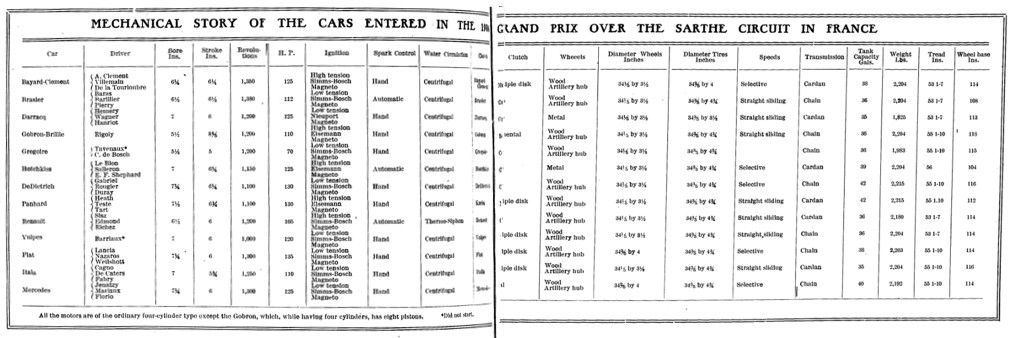
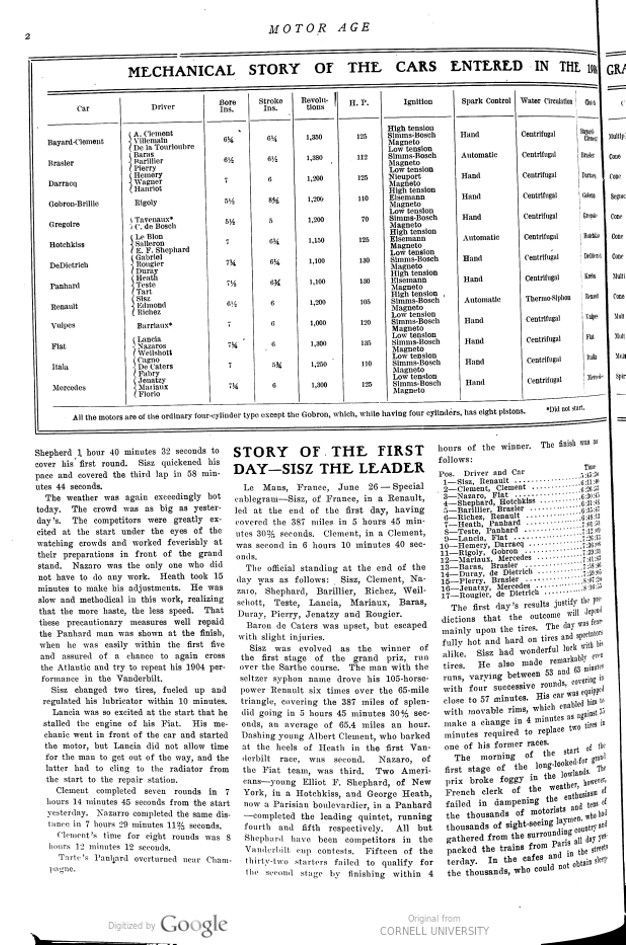
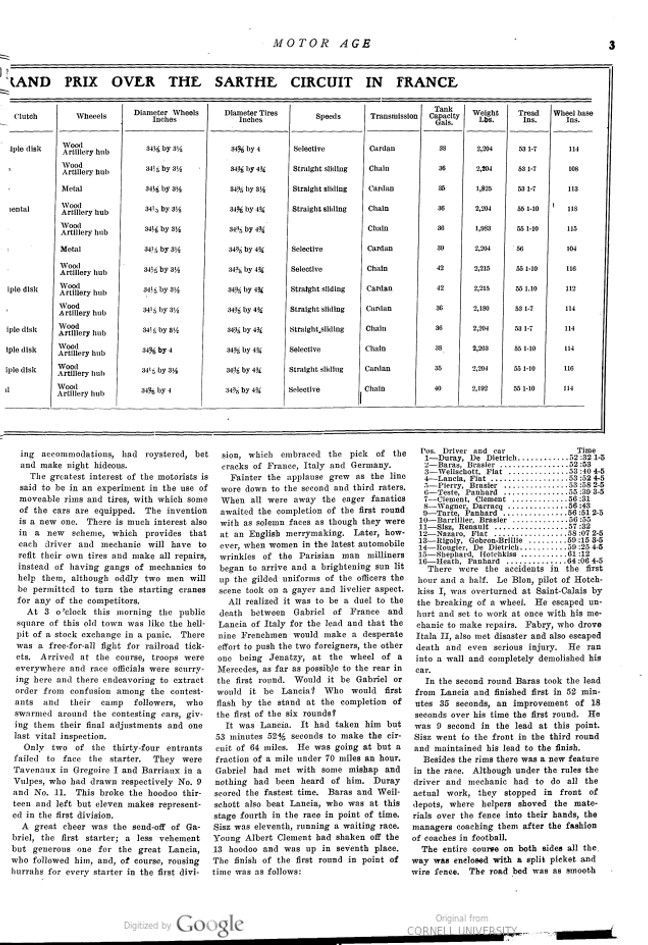
MECHANICAL STORY OF THE CARS ENTERED IN THE 1906 GRAND PRIX OVER THE SARTHE CIRCUIT IN FRANCE
Car – Driver – Bore Ins. – Stroke Ins. – Revolutions H. P. – Ignition – Spark Control – Water Circulation – Clutch
All the motors are of the ordinary four-cylinder type except the Gobron, which, while having four cylinders, has eight pistons. *Did not start.
The morning of the start of the first stage of the long-looked-for grand prix broke foggy in the lowlands. The French clerk of the weather, however, failed in dampening the enthusiasm of the thousands of motorists and tens of thousands of sight-seeing laymen, who had gathered from the surrounding country and packed the trains from Paris all day yesterday. In the cafes and in the streets the thousands, who could not obtain sleeping accommodations, had roistered, bet and make night hideous.
The greatest interest of the motorists is said to be in an experiment in the use of moveable rims and tires, with which some of the cars are equipped. The invention is a new one. There is much interest also in a new scheme, which provides that each driver and mechanic will have to refit their own tires and make all repairs, instead of having gangs of mechanics to help them, although oddly two men will be permitted to turn the starting cranes for any of the competitors.
At 3 o’clock this morning the public square of this old town was like the hellpit of a stock exchange in a panic. There was a free-for-all fight for railroad tickets. Arrived at the course, troops were everywhere and race officials were scurrying here and there endeavoring to extract order from confusion among the contestants and their camp followers, who swarmed around the contesting cars, giving them their final adjustments and one last vital inspection.
Only two of the thirty-four entrants failed to face the starter. They were Tavenaux in Gregoire I and Barriaux in a Vulpes, who had drawn respectively No. 9 and No. 11. This broke the hoodoo thirteen and left but eleven makes represented in the first division.
A great cheer was the send-off of Gabriel, the first starter; a less vehement but generous one for the great Lancia, who followed him, and, of course, rousing hurrahs for every starter in the first division, which embraced the pick of the cracks of France, Italy and Germany.
Fainter the applause grew as the line wore down to the second and third raters. When all were away the eager fanatics awaited the completion of the first round with as solemn faces as though they were at an English merrymaking. Later, however, when women in the latest automobile wrinkles of the Parisian man milliners began to arrive and a brightening sun lit up the gilded uniforms of the officers the scene took on a gayer and livelier aspect.
All realized it was to be a duel to the death between Gabriel of France and Lancia of Italy for the lead and that the nine Frenchmen would make a desperate effort to push the two foreigners, the other one being Jenatzy, at the wheel of a Mercedes, as far as possible to the rear in the first round. Would it be Gabriel or would it be Lancia? Who would first flash by the stand at the completion of the first of the six rounds?
It was Lancia. It had taken him but 53 minutes 5 4/5 seconds to make the circuit of 64 miles. He was going at but a fraction of a mile under 70 miles an hour. Gabriel had met with some mishap and nothing had been heard of him. Duray scored the fastest time. Baras and Weilschott also beat Lancia, who was at this stage fourth in the race in point of time. Sisz was eleventh, running a waiting race. Young Albert Clement had shaken off the 13 hoodoo and was up in seventh place. The finish of the first round in point of time was as follows:
Pos. Driver and car Time
1-Duray, De Dietrich 52:32 1-5
2-Baras, Brasier 52:53
3-Weilschott, Fiat 53:40 4-5
4-Lancia, Fiat 53:52 4-5
5-Pierry, Brasier 53:58 2-5
6-Teste, Panhard 55:39 3-5
7-Clement, Clement 56:31
8-Wagner, Darracq 56:43
9-Tarte, Panhard 56:51 2-5
10-Barrillier, Brasier 56:55
11-Sisz, Renault 57:32
12-Nazaro, Fiat 58:07 2-5
13-Rigoly, Gobron-Brillie 59:15 3-5
14-Rougier, De Dietrich 59:25 4-5
15-Shephard, Hotchkiss 61:12
16-Heath, Panhard 64:06 4-5
There were the accidents in the first hour and a half. Le Blon, pilot of Hotchkiss I, was overturned at Saint-Calais by the breaking of a wheel. He escaped unhurt and set to work at once with his mechanic to make repairs. Fabry, who drove Itala II, also met disaster and also escaped death and even serious injury. He ran into a wall and completely demolished his car.
In the second round, Baras took the lead from Lancia and finished first in 52 minutes 35 seconds, an improvement of 18 seconds over his time the first round. He was 9 second in the lead at this point. Sisz went to the front in the third round and maintained his lead to the finish.
Besides the rims there was a new feature in the race. Although under the rules the driver and mechanic had to do all the actual work, they stopped in front of depots, where helpers shoved the materials over the fence into their hands, the managers coaching them after the fashion of coaches in football.
The entire course on both sides all the way was enclosed with a split picket and wire fence. The road bed was as smooth …… (Note: I couldn’t find the text, that was to follow – GroderJack)