Comment is on the way. (Translation separately.)
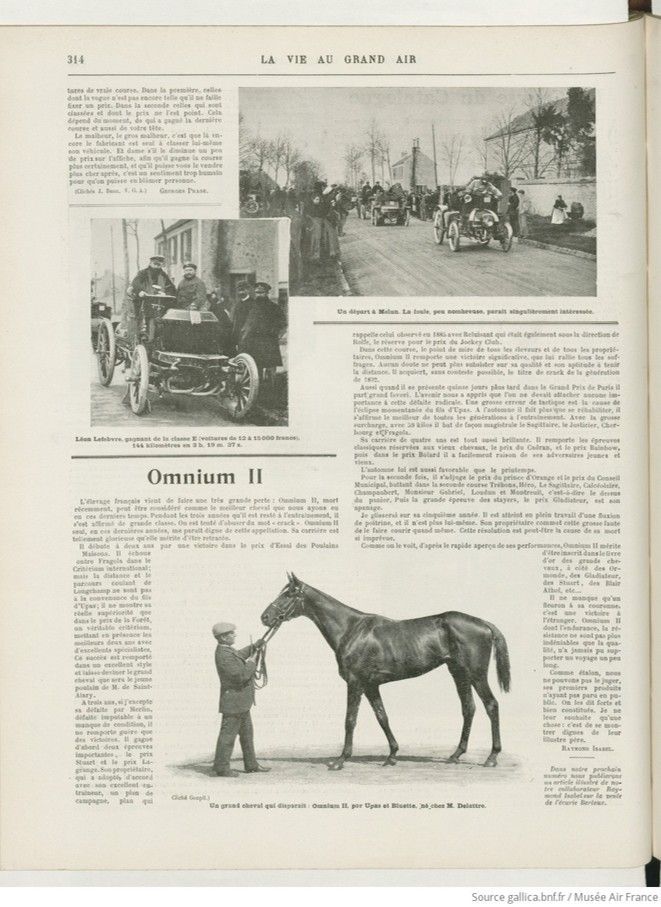
With permission of the Bibliothèque national francais gallica.bnf.fr
Text and photos compiled by motorracinghistory.com, Translation by DeepL deepl.com
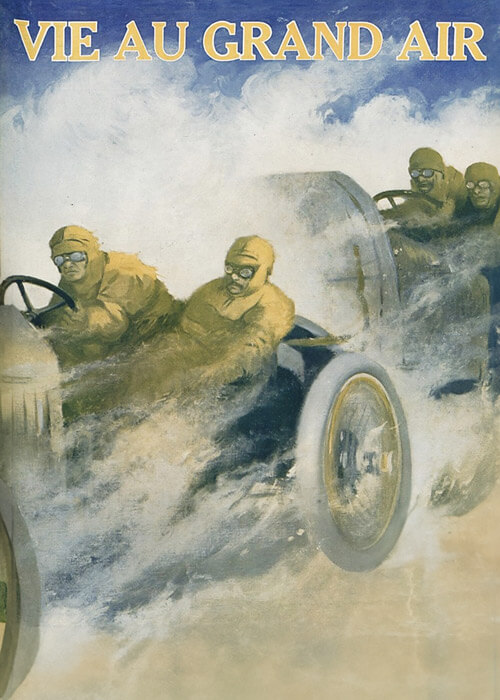
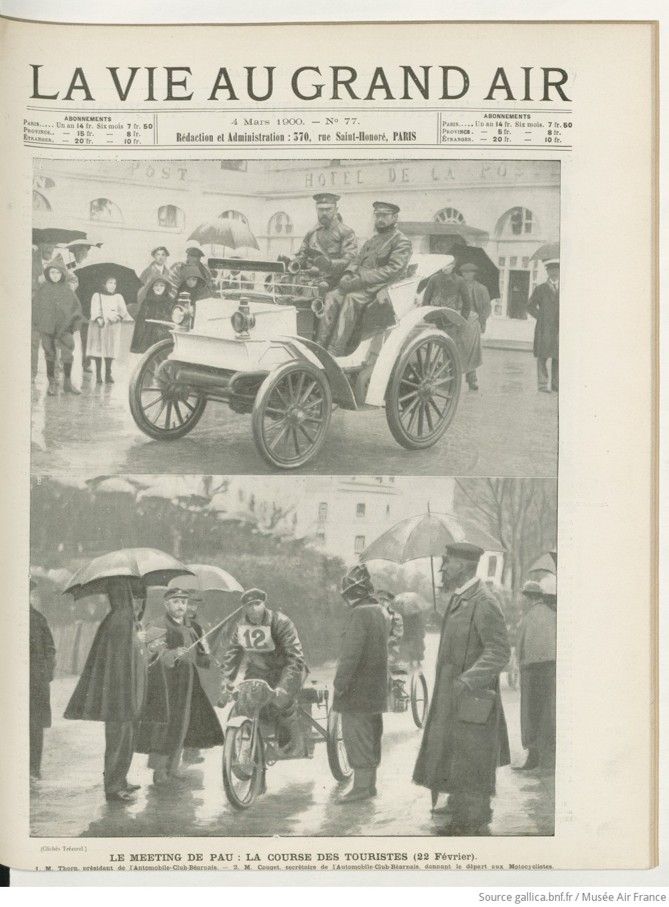
La Vie au Grand Air – No. 77, March 4, 1900
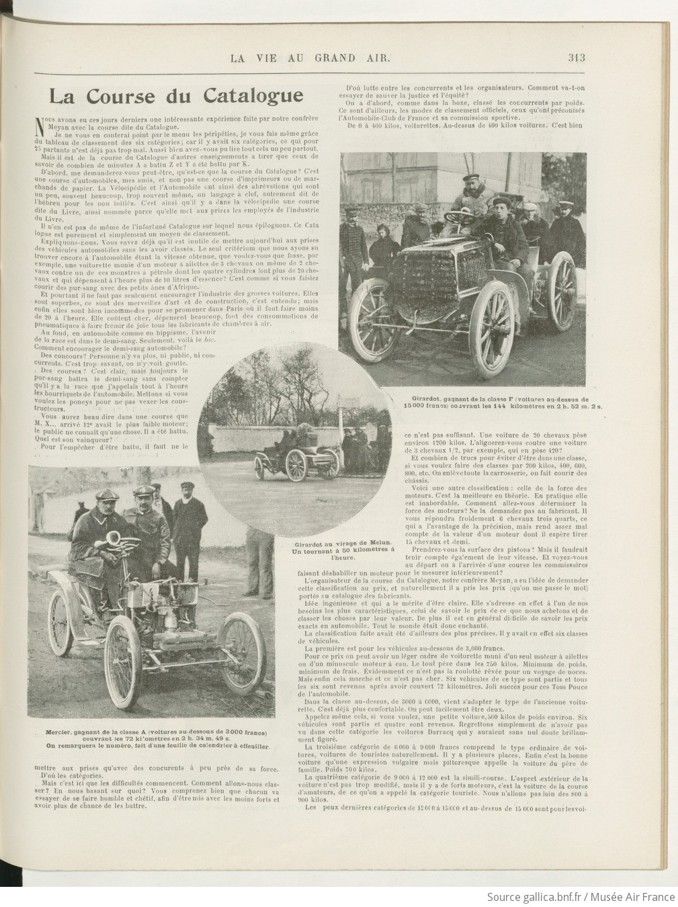
The Catalogue Race
Over the past few days, we’ve had an interesting experience with our colleague Meyan regarding the so-called Catalogue Race.
I won’t go into the details of the twists and turns, nor will I bore you with the standings for the six categories; after all, there were six categories, which—for the number of entrants—isn’t too shabby. Besides, you’ve probably read all about it elsewhere.
But there are other lessons to be learned from the “Catalog Race” besides simply knowing by how many minutes A beat Z and Y was beaten by K.
First of all, you might ask, what is the “Catalog Race”? It is a car race, my friends, and not a race for printers or paper merchants. Thus, “Velo-pedia” and “Automobile” have abbreviations that are somewhat—often, even all too often—a kind of code language, in other words, gibberish to the uninitiated. For example, in “Velo-pedia” there is a race called the “Book Race,” so named because it pits employees of the book industry against one another. The same cannot be said of the unfortunate Catalog we are discussing. This Catalog is purely and simply a means of classification.
Let’s explain. You already know that it is pointless today to pit motor vehicles against one another without first classifying them. Since the only criterion we’ve yet been able to identify for automobiles is the speed they achieve, what do you expect, for example, a small car equipped with a 3-horsepower or even a 2-horsepower fin-cooled engine to do against one of those gasoline-guzzling monsters whose four cylinders produce more than 20 horsepower and consume more than 10 liters of gasoline per hour? It’s as if you were racing thoroughbreds against little African donkeys.
And yet we shouldn’t just encourage the industry of large cars. They’re superb—they’re marvels of art and engineering, to be sure—but they’re really inconvenient for getting around Paris, where you have to drive under 20 per hour. They’re expensive, guzzle fuel, and wear out tires at a rate that would make every inner-tube manufacturer jump for joy.
Deep down, in the automotive world as in horse racing, the future of the breed lies in the half-blood. But here’s the catch. How do we encourage the automotive half-blood?
Car shows? Nobody goes to them anymore—neither the public nor the competitors. It’s too technical; no one understands a thing.
Races? Sure, but the thoroughbred will always beat the half-breed—not to mention the category I referred to earlier as the “donkey-mongers” of the automotive world. Let’s call them “ponies,” if you will, so as not to offend the manufacturers.
You can say all you want in a race that Mr. X… who finished 12th had the weakest engine; the public cares about only one thing. He was beaten. Who is his winner?
To prevent him from being beaten, he must be pitted against competitors who are roughly his equal in strength.
Hence the categories.
But this is where the difficulties begin. How are we going to classify them? Based on what? You can well understand that everyone will try to make themselves seem humble and weak, in order to be placed with the weaker competitors and have a better chance of beating them.
Hence the conflict between competitors and organizers. How can we try to ensure fairness and equity?
First, as in boxing, competitors were classified by weight. These are, in fact, the official classification methods recommended by the Automobile Club of France and its sports commission.
From 0 to 400 kilograms: microcars. Above 400 kilograms: cars. That’s fine, but it’s not enough. A 20-horsepower car weighs about 1,200 kilograms. Would you pit it against a 3½-horsepower car, for example, that weighs 420 kilograms? And how many ways are there to avoid being placed in a class, if you want to divide classes into 200-kilo, 400-kilo, 600-kilo, 800-kilo, and so on? You remove all the bodywork and race just the chassis.
Here’s another classification: engine power. In theory, it’s the best. In practice, it’s impractical. How are you going to determine engine power? Don’t ask the manufacturer. He’ll coldly reply, “6 and three-quarters horsepower,” which has the advantage of precision but doesn’t really reflect the value of an engine from which he hopes to extract 15 and a half horsepower.
Will you use the surface area of the pistons? But you’d also have to take their speed into account. And do you ever see race officials at the start or finish of a race having an engine taken apart to measure its internal dimensions?
The organizer of the “Catalog” race, our colleague Meyan, had the idea of basing this classification on price, and naturally he used the prices (please pass me the note) listed in the manufacturers’ catalogs.
An ingenious idea that has the merit of being clear. It addresses one of our most fundamental needs: knowing the price of what we buy and classifying things by their value. Moreover, it’s generally difficult to know the exact prices of automobiles. So everyone was delighted.
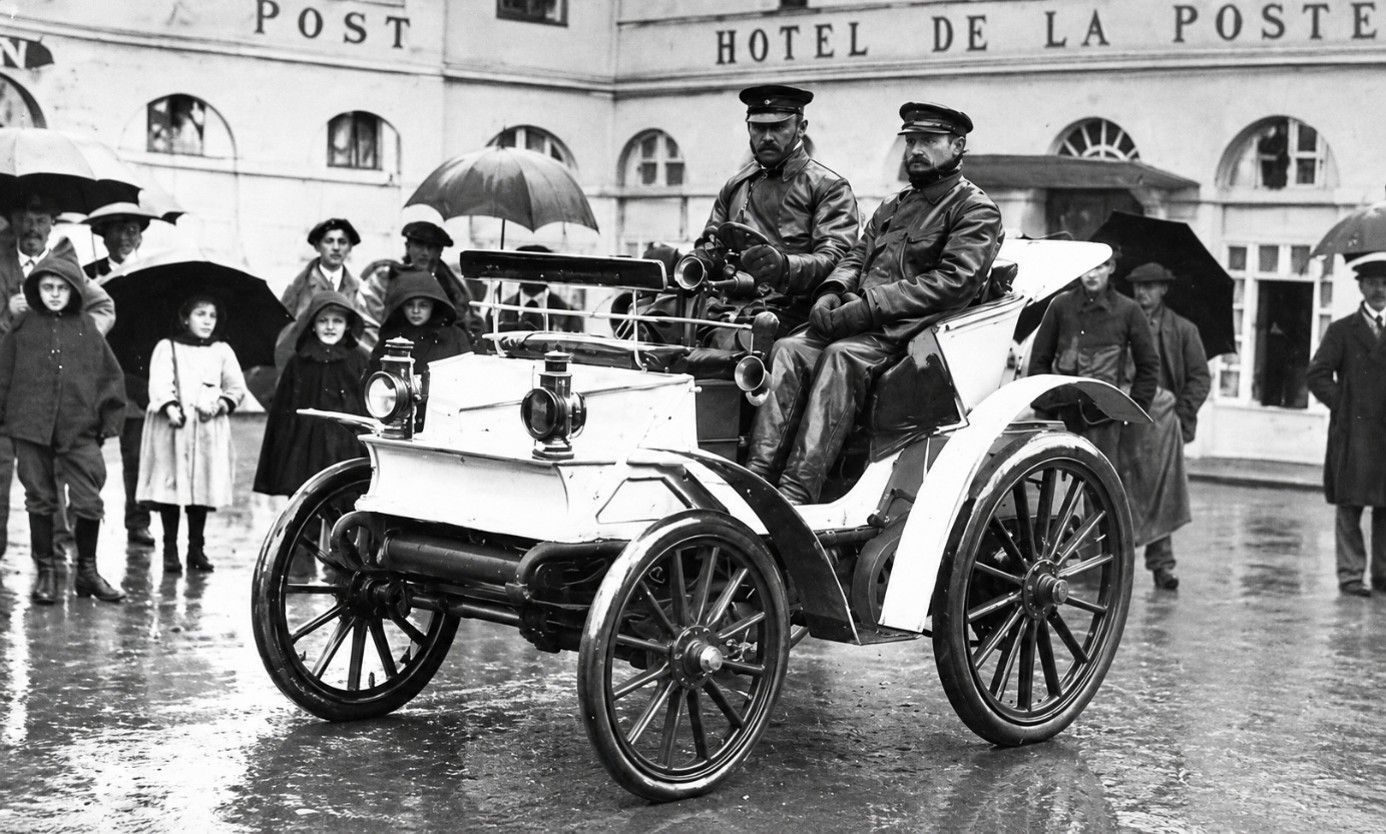
gallica.bnf.fr, photo modified by AI
The classification system was, in fact, extremely precise. There were six vehicle classes.
The first is for vehicles under 3,000 francs.
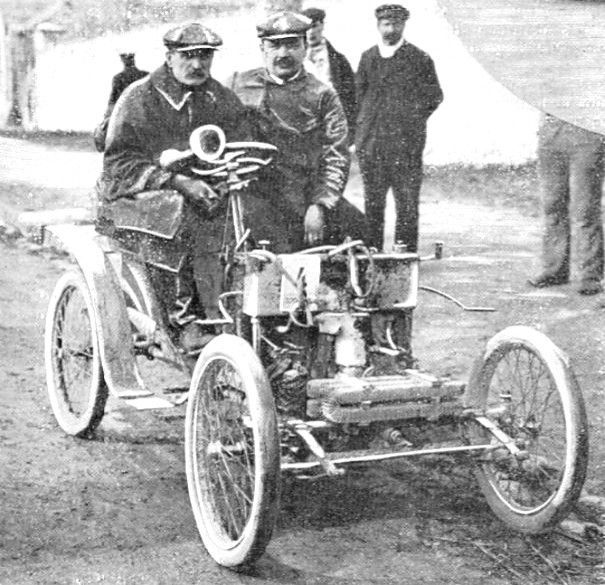
For that price, you can get a light-weight go-kart frame equipped with a single fin-cooled engine or a tiny water-cooled engine. The whole thing weighs around 250 kilos. Minimal weight, minimal cost. Obviously, this isn’t the ideal vehicle for a honeymoon. But still, it runs and it’s inexpensive. Six vehicles of this type set out, and all six returned after covering 72 kilometers. A nice success for these “Tom Thumb” cars.
In the next class up, from 3,000 to 3,000 francs, we find the classic microcar. It’s already more comfortable. It easily seats two.
You could even call it, if you like, a small car, weighing about 500 kilos. Six vehicles set out, and four returned. We simply regret not having seen Darracq cars in this category, which would undoubtedly have performed brilliantly.
The third category, from 6,000 to 9,000 francs, includes ordinary cars, touring cars, naturally. They have several seats. In short, this is the kind of car that a colloquial but colorful expression calls the “family car.” Weight: 700 kilograms.
The fourth category, ranging from 9,000 to 12,000 francs, is the semi-racing class. The car’s exterior has not been significantly modified, but it is equipped with powerful engines; this is the car for amateur racing, what has been called the “touring” category. We’re not far off from 800 to 900 kilos.
The very last categories from 12,000 to 15,000 and above 15,000 are for true race cars. In the first category are those whose popularity hasn’t yet reached the point where a price needs to be set. In the second are those that are classified but for which no price has been set. It depends for the moment, on who won the last race, and also your judgment.
gallica.bnf.fr, photo modified by AI
gallica.bnf.fr, photo modified by AI
The trouble, the real trouble is that here again, the manufacturer is the sole judge in classifying his own vehicle. And, well, if he lowers the price a bit on the poster so that it’s more likely to win the race and he can sell it to you for a higher price afterward, that’s a feeling too human for anyone to be blamed for.
GEORGES PRADE
(Photos J. Beau, V. G. A.)
Photos.
Page 313.
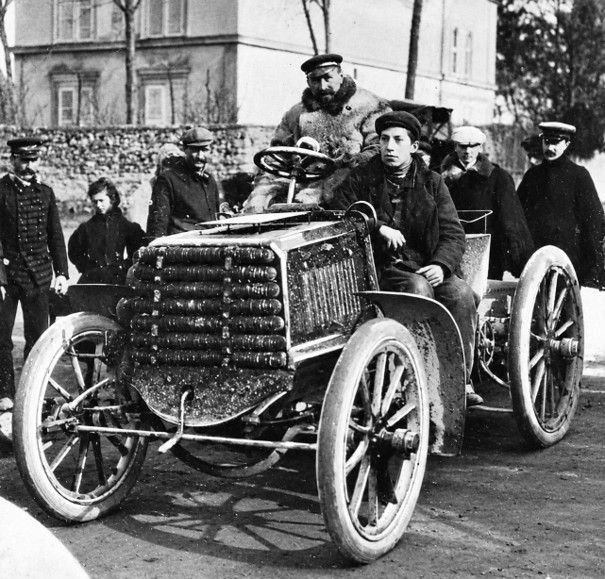
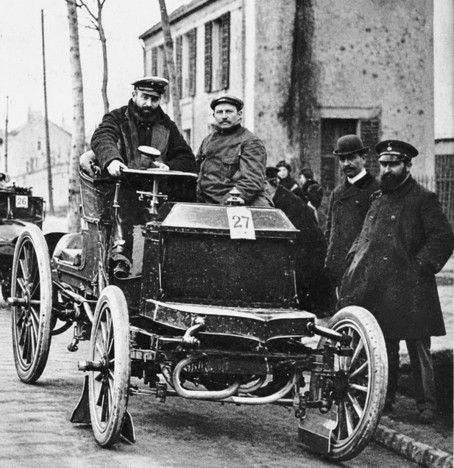
Girardot, winner of Class F (cars over 15,000 francs), covering the 144 kilometers in 2 h. 52 m. 2 s.
Girardot at the Melun turn. A turn taken at 50 kilometers per hour.
Mercier, winner of Class A (cars under 3,000 francs), covering the 72 kilometers in 2 hours, 34 minutes, and 49 seconds. Note the number, made from a page of a tear-off calendar.
Page 314.
Léon Lefebvre, winner of Class E (cars priced from 12 to 15,000 francs), covered 144 kilometers in 3 hours, 19 minutes, and 37 seconds.
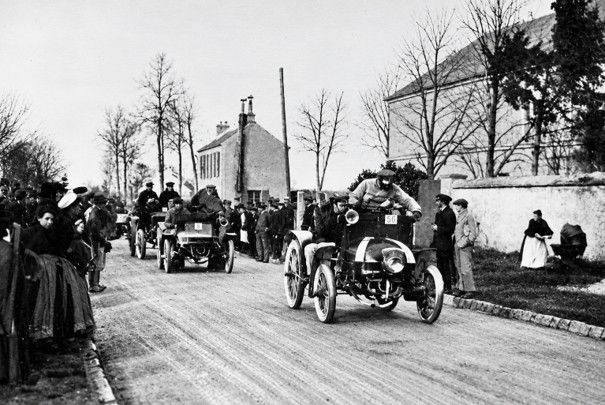
The start in Melun. The small crowd seems remarkably interested.
(Photos by J. Beau, V. G. A.)