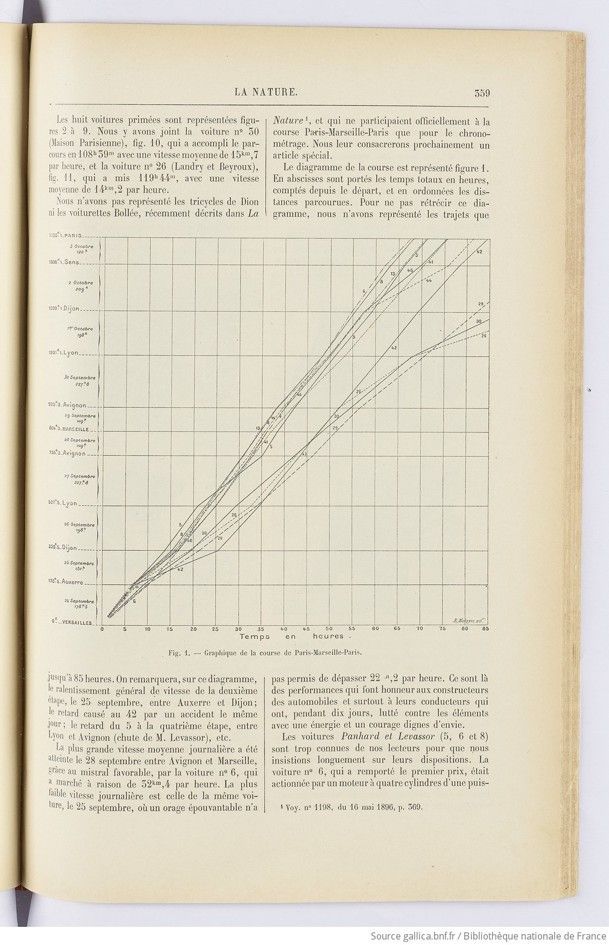
La Nature here brings more information on the Paris-Marseille-Paris race. Results for both A classes. The winner averaged just over 25 kmh on the entire distance. Most interesting is the diagram showing the times of arrivel over the complete distance., showing car # 6 and 8 were quickest. The first separation already took plave after about 15 hours of the whole 67, being after about 22% of the winners time. Then the first four inishing vehicles are described. Further discussion on technical items of the cars in terms of durabilty is finally given. Interesting for those early days of motoring!
With permission of the Bibliothèque national francais gallica.bnf.fr
Text and photos compiled by motorracinghistory, Translation by DeepL deepl.com
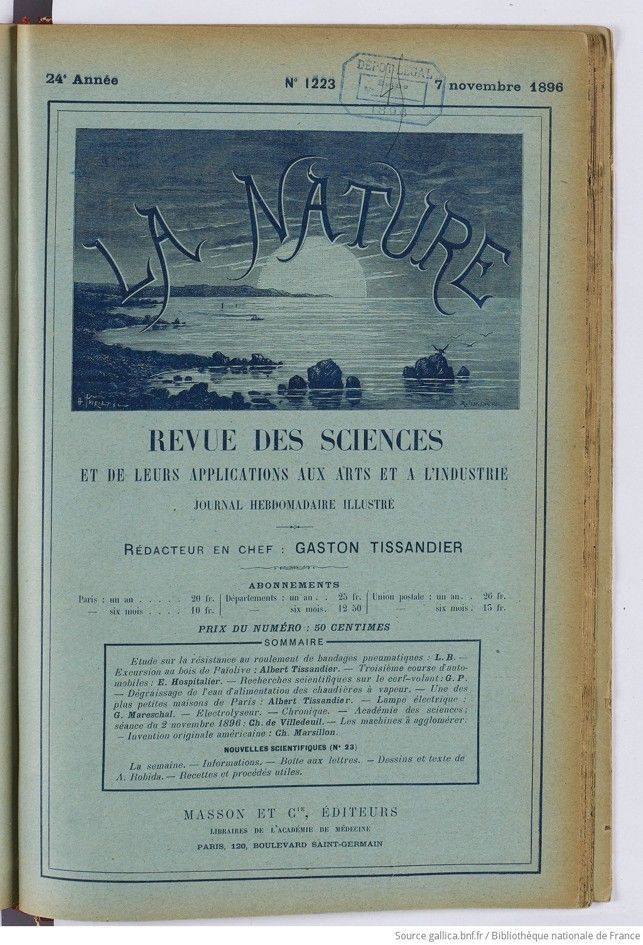
LA NATURE — 24th Year, No. 1223, November 7, 1896
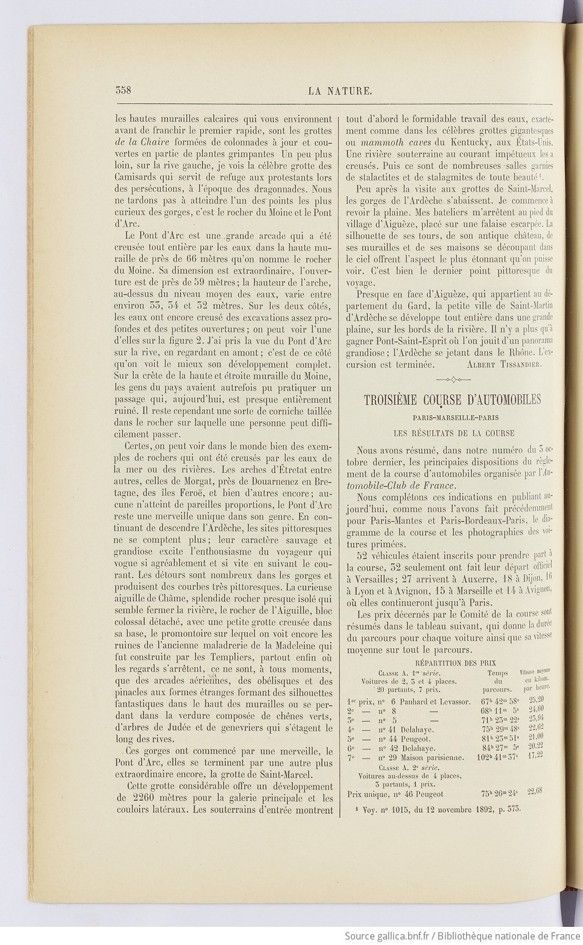
THIRD AUTOMOBILE RACE – PARIS-MARSEILLE-PARIS
RACE RESULTS
In our issue of October 5, we summarized the main provisions of the rules for the automobile race organized by the Automobile Club de France.
We are supplementing this information by publishing today—as we did previously for the Paris-Mantes and Paris-Bordeaux-Paris races—the race route map and photographs of the winning cars.
Fifty-two vehicles were registered to take part in the race; only 52 made their official start in Versailles. Twenty-seven arrived in Auxerre, 18 in Dijon, 16 in Lyon and Avignon, 15 in Marseille, and 14 in Avignon, where they will continue on to Paris.
The prizes awarded by the Race Committee are summarized in the following table, which lists the travel time for each car as well as its average speed over the entire route.
PRIZE DISTRIBUTION
Class A. 1st series. 2-, 3-, and 4-seater cars. 20 starters, 7 prizes.
Travel Time – Average Speed in kilometers per hour
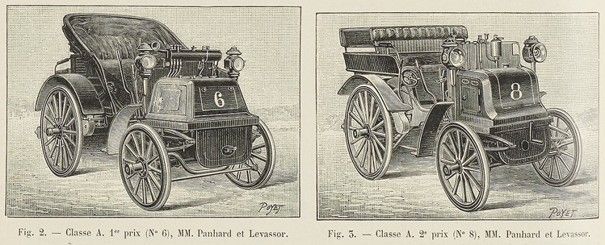
1st prize, No. 6 Panhard & Levassor. 67h 42“ 58s — 25.20
2nd — No. 8 Panhard & Levassor. 68h 11“ 5s ——— 24.60
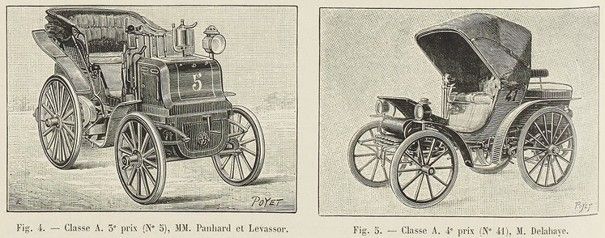
3rd — No. 5 Panhard & Levassor. 71h 25“ 22s ——- 23.94
4th — No. 41 Delahaye. 75h 29“ 48s——————— 22.62
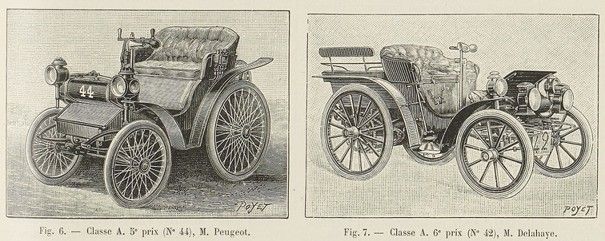
5th — No. 44 Peugeot. 81h 25“ 51s ———————- 21.00
6th — No. 42 Delahaye. 84h 27“ 5s ———————- 20.22
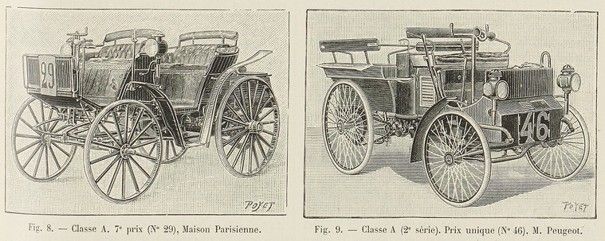
7th — No. 29 Maison Parisienne. 102h 41” 37s —— 17.22
Class A. 2nd series. Cars with more than 4 seats. 3 entrants, 1 prize.
Single prize, No. 46 Peugeot 75h 26“ 24s ————- 22.68
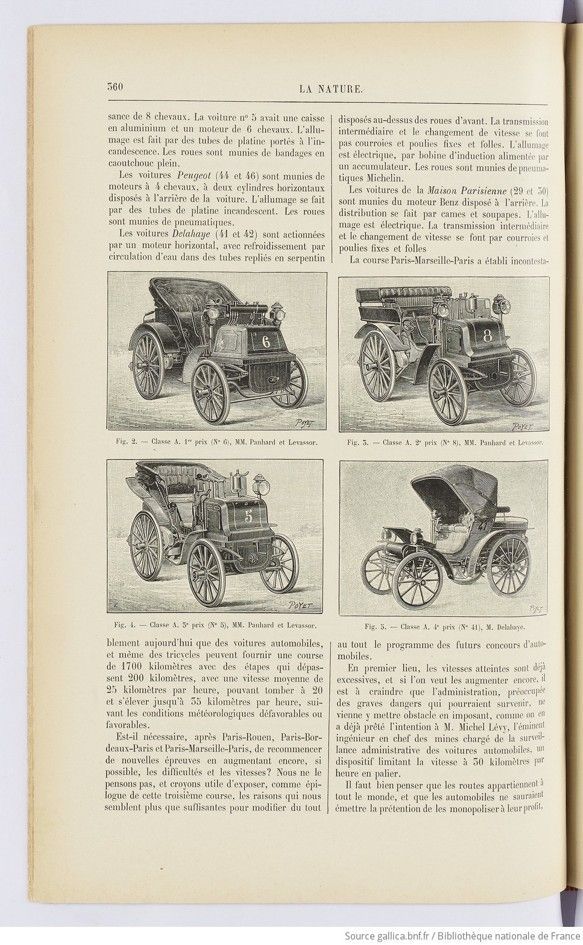
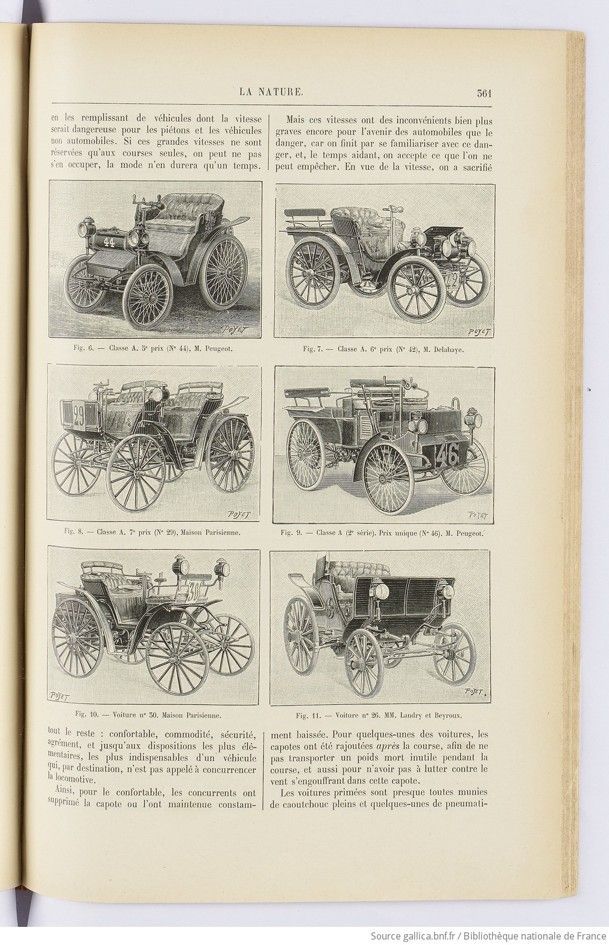
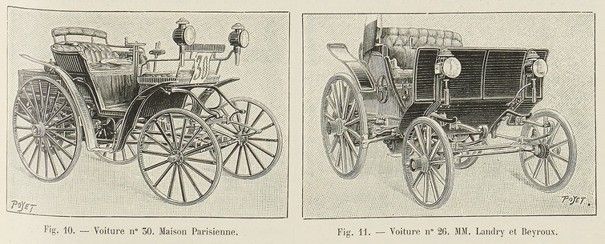
The eight prize-winning cars are shown in Figures 2 through 9. We have included car No. 50 (Maison Parisienne), Fig. 10, which completed the course in 108h 59ni at an average speed of 15.7 km per hour, and car No. 26 (Landry and Beyroux), Fig. 11, which took 119 hours 44 minutes, with an average speed of 14.2 km per hour.
We have not included Pion’s tricycles or the Bollée motorcars, recently described in La Nature (Vol. 1, No. 1198, May 16, 1896, p. 369) and which were officially participating in the Paris-Marseille-Paris race solely for timing purposes. We will devote a special article to them shortly. Fig. 1.
The race diagram is shown in Figure 1. The x-axis shows the total times in hours, counted from the start, and the y-axis shows the distances traveled. To keep this chart from becoming too narrow, we have only plotted the routes up to 85 hours. Note, on this diagram, the general slowdown in speed during the second stage on September 25, between Auxerre and Dijon; the delay suffered by Car No. 42 due to an accident on the same day; the delay of Car No. 5 during the fourth stage, between Lyon and Avignon (Mr. Levassor’s fall), etc.
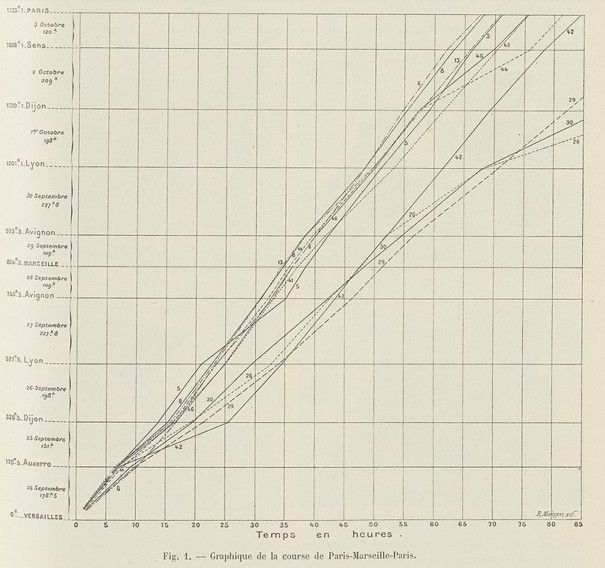
The highest average daily speed was achieved on September 28 between Avignon and Marseille, thanks to a favorable mistral wind, by car No. 6, which traveled at a rate of 52.4 km per hour. The lowest daily speed was recorded by the same car on September 25, when a terrible storm prevented it from exceeding 22.2 km per hour. These are achievements that do credit to the automobile manufacturers and, above all, to their drivers, who, for ten days, battled the elements with energy and courage worthy of admiration.
The Panhard and Levassor cars (Nos. 5, 6, and 8) are too well known to our readers for us to dwell at length on their specifications. Car No. 6, which won first prize, was powered by a four-cylinder engine with an output of 8 chevaux. Car No. 5 had an aluminum body and a 0 chevaux engine. Ignition is provided by platinum tubes heated to incandescence. The wheels are fitted with solid rubber tires.
The Peugeot cars (44 and 46) are equipped with 4-horsepower engines, featuring two horizontal cylinders located at the rear of the car. Ignition is provided by incandescent platinum tubes. The wheels are fitted with pneumatic tires.
The Delahaye cars (41 and 42) are powered by a horizontal engine, cooled by water circulating through coiled tubes positioned above the front wheels. The intermediate transmission and gear shifting are accomplished via belts and fixed and idler pulleys. Ignition is electric, via an induction coil powered by a battery. The wheels are fitted with Michelin tires.
The cars from Maison Parisienne (29 and 50) are equipped with a rear-mounted Renz engine. The valve train consists of cams and valves. Ignition is electric. Power is transmitted via fixed and idler pulleys and belts.
The Paris-Marseille-Paris race has now indisputably demonstrated that automobiles—and even tricycles—can complete a 1,700-kilometer course with stages exceeding 200 kilometers, at an average speed of 25 kilometers per hour, which can drop to 20 and rise to 55 kilometers per hour, depending on whether weather conditions are favorable or unfavorable.
Is it necessary, after Paris–Rouen, Paris–Bordeaux–Paris, and Paris–Marseille–Paris, to launch new races by further increasing—if possible—the difficulties and speeds? We do not think so, and believe it is useful to set forth, as an epilogue to this third race, the reasons that seem to us more than sufficient to completely overhaul the program for future automobile races.
First of all, the speeds reached are already excessive, and if one wishes to increase them further, it is to be feared that the authorities, concerned about the serious dangers that could arise, will intervene to prevent it by imposing—as has already been attributed to Mr. Michel Lévy, the eminent chief mining engineer responsible for the administrative oversight of automobiles—a device limiting speed to 50 kilometers per hour on level ground.
We must remember that the roads belong to everyone, and that automobiles cannot claim the right to monopolize them for their own benefit, by filling them with vehicles traveling at speeds that are dangerous to pedestrians and non-motorized vehicles. If these high speeds are reserved solely for races, we need not be concerned with them; the fad will only last for a while.
But these speeds have drawbacks far more serious for the future of automobiles than the danger itself, for one eventually becomes accustomed to that danger, and, with time, accepts what cannot be prevented. In the pursuit of speed, everything else has been sacrificed: comfort, convenience, safety, enjoyment, and even the most basic, indispensable features of a vehicle that, by its very nature, is not meant to compete with a locomotive.
Thus, in the name of comfort, competitors have removed the soft top or kept it constantly lowered. For some of the cars, the soft tops were reattached after the race, so as not to carry unnecessary dead weight during the race, and also to avoid having to contend with the wind rushing into the soft top.
Almost all of the award-winning cars are equipped with solid rubber tires, and a few with pneumatic tires. These pneumatic tires, which provide the car with a particularly comfortable ride, cannot yet withstand excessive speeds once the car becomes even slightly heavy. In an effort to increase speeds, one is then led to remove the pneumatic tires—which, however, perform perfectly well at moderate speeds—at the expense of comfort.
Good steering at high speeds requires that the front-end load be sufficiently heavy so that the car does not swerve at the slightest pebble encountered on the road. From this perspective, Panhard and Levassor cars, with their front-mounted engines, are rationally designed; however, it can be advantageous—and is above all more pleasant—to have the engine in the rear in terms of odor, acceleration, and so on. High speeds therefore also necessitate significant changes to the weight distribution.
High speeds necessitate the use of powerful, heavy, and bulky engines; they require active cooling systems and considerable reserves of gasoline, especially on long journeys: in short, there is no longer room in the car for anything but the mechanical components; passengers become a negligible factor, which should be almost the opposite in a vehicle designed primarily for tourism and leisure.
We could cite many more examples and provide numerous additional arguments in support of the thesis that the pursuit of ever-higher speeds is a step backward on the path of progress and the practical development of automobiles. There must be as much difference between a road bicycle and a racing bicycle as there is between a road car and most of the racing cars whose successes we have been recording for the past three years.
Now that the result is established and well established, and the proof of the endurance, sturdiness, and speed of today’s race cars has been thoroughly demonstrated, we ask that more attention be given to the tourist car—comfortable, lightweight, equipped with pneumatic tires, and never exceeding 25 kilometers per hour.
This program is certainly less sensational than the previous ones, but it better meets practical needs, as not all of our tourists are as hardy as Mr. Levassor, Mr. Archdeacon, and the rest who drove their cars to victory… or to the precipice.
When will we see a true tourist car competition with an appropriate program?
E. Hospitalier.
Photos.
Page 359: Fig. 1. — Chart of the Paris-Marseille-Paris race.
Page 360:
Fig. 2. — Class A. 1st prize (No. 6), Messrs. Panhard and Levassor.
Fig. 3. — Class A. 2nd prize (No. 8), Messrs. Panhard and Levassor.
Fig. 4. — Class A. 3rd prize (No. 5), Messrs. Panhard and Levassor.
Fig. 5. — Class A. 4th prize (No. 41), Mr. Delahaye.
Page 361:
Fig. 6. — Class A. 5th prize (No. 44), Mr. Peugeot.
Fig. 7. — Class A. 6th prize (No. 42), Mr. Delahaye.
Fig. 8. — Class A. 7th prize (No. 29), Maison Parisienne.
Fig. 9. — Class A (2nd series). Single prize (No. 46), Mr. Peugeot.
Fig. 10. — Car No. 30. Maison Parisienne.
Fig. 11. — Car No. 26. Messrs. Landry and Beyroux.