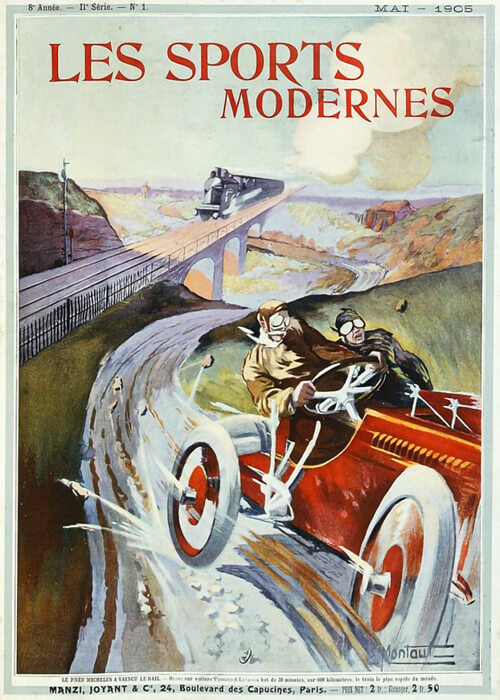
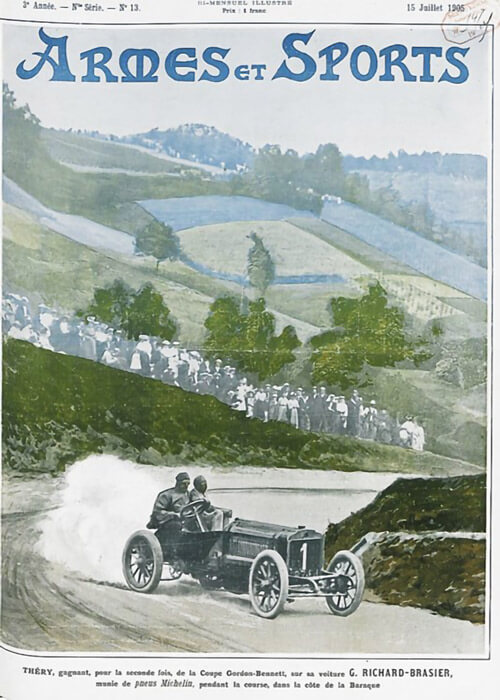
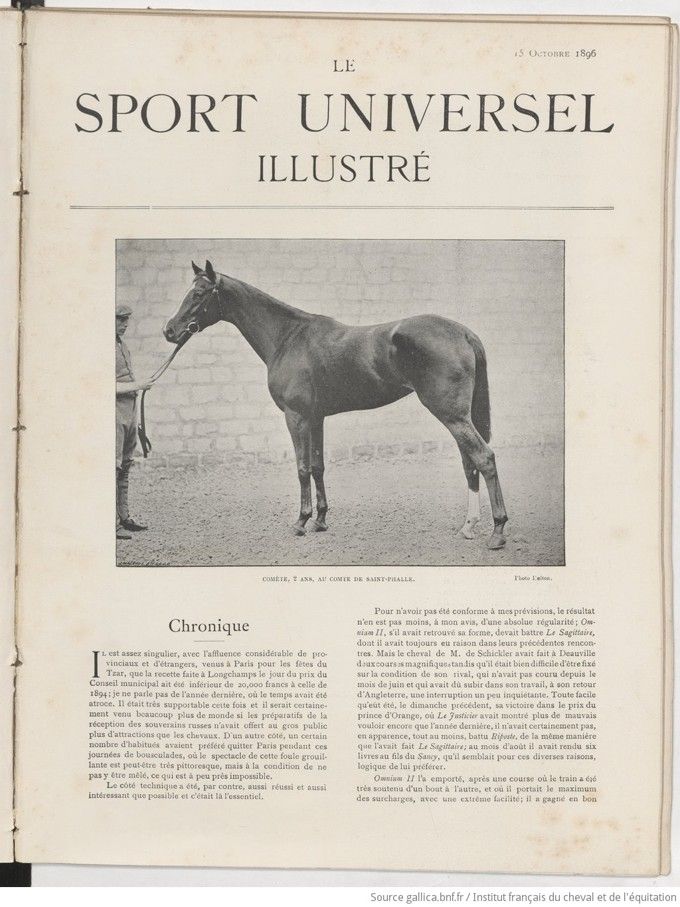
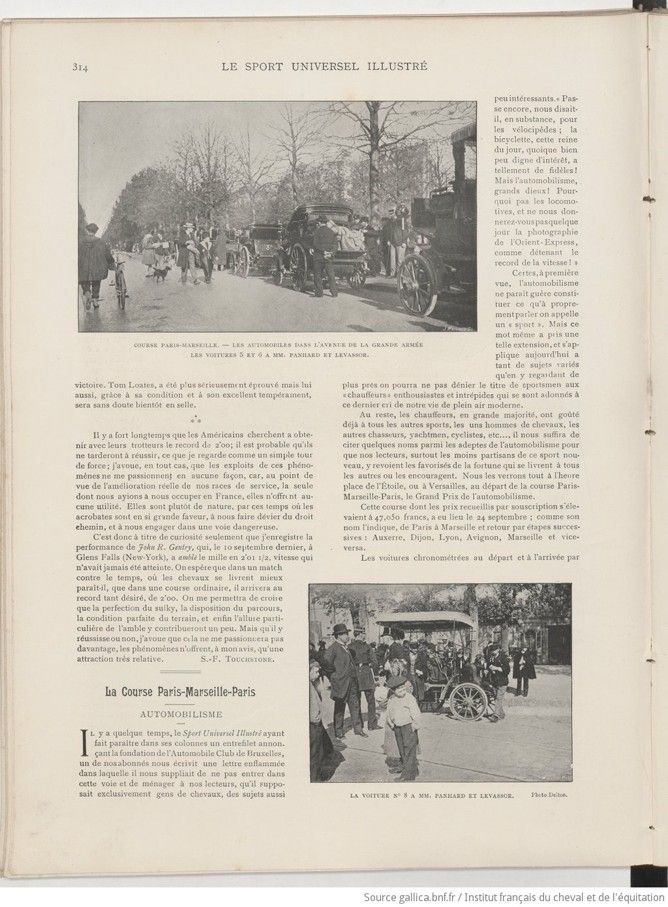
Le Sport Universel Illustré was a sport magazine that principally wrote about equestrial events. Logical, as in those days, the only real motive power was the horse. In the issue, the Paris-Marseille-Paris race of September 1896, organised by the young Automobile Club de France is highlighted. It started in Versailles, took about four days and it even had a first kind of “parc fermé” for the participating vehicles. The article first describes briefly two of the best-known vehicles of that time. Then, even more briefly, the days of the event are mentioned, followed by the final standings. The accompanying pictures show that the public was very interested in such events.
With permission of the Bibliothèque national français, gallica.bnf.fr
Text and photos compiled by motorracinghistory.com, Translation by DeepL deepl.com
LE SPORT UNIVERSEL ILLUSTRÉ, deuxième Année, 15 octobre 1896
THE PARIS-MARSEILLE-PARIS RACE – AUTOMOBILE RACING
Some time ago, after “Sport Universel Illustré” published a brief article announcing the founding of the Automobile Club of Brussels, one of our subscribers wrote us a passionate letter in which he begged us not to go down that path and to spare our readers — whom he assumed were exclusively horse enthusiasts — such uninteresting topics. “That’s one thing,” he told us, in essence, “when it comes to velocipedes; the bicycle, that queen of the day, though hardly worthy of interest, has so many devotees! But automobiles, for heaven’s sake! Why not locomotives? Won’t you one day publish a photograph of the Orient Express, as the holder of the speed record!”
Admittedly, at first glance, auto racing hardly seems to constitute what is strictly speaking called a “sport.” But this very word has taken on such a broad meaning, and is applied today to so many varied subjects, that upon closer inspection one cannot deny the title of “sportsmen” to the enthusiastic and intrepid “drivers” who have devoted themselves to this latest craze of our modern outdoor life.
——–
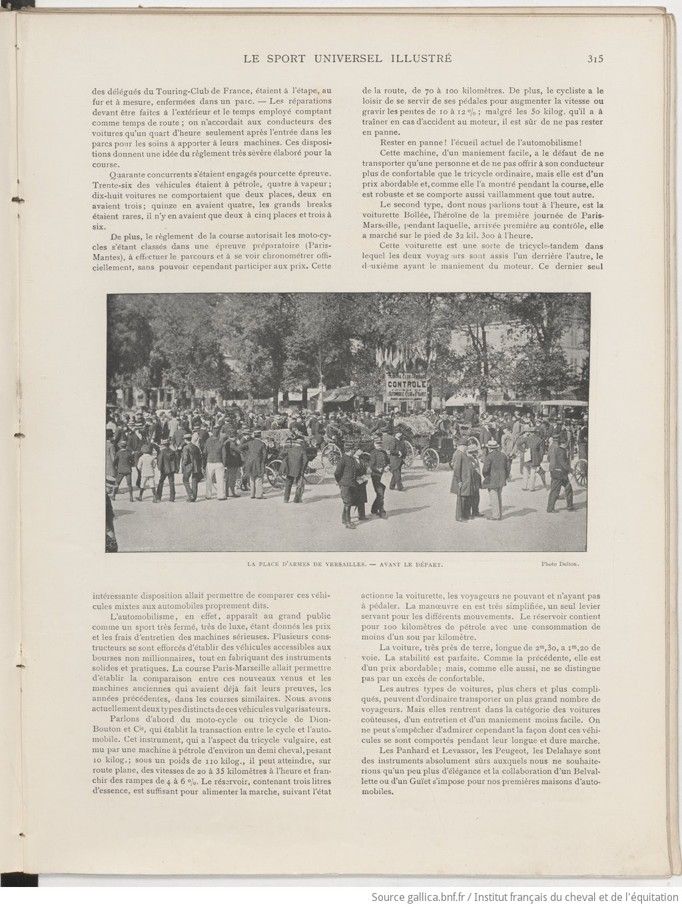
Moreover, the vast majority of drivers have already tried their hand at all other sports—some as horsemen, others as hunters, yachtsmen, cyclists, and so on. We need only mention a few names among the enthusiasts of motor racing for our readers, especially those least enthusiastic about this new sport, to recognize in them the fortunate few who engage in or support all the other sports. We’ll see them shortly at Place de l’Étoile, or in Versailles, at the start of the Paris-Marseille-Paris race, the Grand Prix of auto racing. This race, for which the prize money raised through subscriptions totaled 47,050 francs, took place on September 24; as its name suggests, it ran from Paris to Marseille and back in successive stages: Auxerre, Dijon, Lyon, Avignon, Marseille, and back.
The cars, timed at the start and finish by representatives of the Touring-Club de France, were secured in a parc fermé at each stage as they arrived. — Since repairs had to be made outside the parking areas and the time spent on them counted as driving time, drivers were allowed only a quarter of an hour after entering the parking areas to tend to their vehicles. These provisions give an idea of the very strict rules established for the race.
Forty competitors had entered this event. Thirty-six of the vehicles were gasoline-powered, four were steam-powered; eighteen cars had only two seats, two had three; fifteen had four; large station wagons were rare — there were only two with five seats and three with six.
Furthermore, the race regulations allowed motorcycles that had placed in a preliminary race (Paris–Mantes) to complete the course and be officially timed, though they were not eligible for prizes. This interesting provision made it possible to compare these mixed-vehicle entries with, strictly speaking, automobiles.
——–
To the general public, in fact, auto racing appears to be a very exclusive, very luxurious sport, given the prices and maintenance costs of high-performance cars. Several manufacturers have strived to produce vehicles affordable to those without millions, while still building sturdy and practical machines. The Paris-Marseille race would provide an opportunity to compare these newcomers with the older models that had already proven themselves in similar races in previous years.
We currently have two distinct types of these mass-market vehicles. Let’s first discuss the motorcycle or tricycle from Dion-Bouton & Co., which bridges the gap between the bicycle and the automobile. This vehicle, which resembles an ordinary tricycle, is powered by a gasoline engine producing about half a horsepower and weighing 10 kilograms; with a total weight of 110 kilograms, it can reach speeds of 20 to 35 kilometers per hour on flat roads and climb gradients of 4 to 6 percent. The fuel tank, holding three liters of gasoline, is sufficient to cover a distance of 70 to 100 kilometers, depending on road conditions. Furthermore, the rider is free to use the pedals to increase speed or climb slopes of 10 to 12 percent; despite the 50 kilograms he has to carry in the event of engine failure, he is sure not to break down. Breaking down! The current pitfall of motoring!
This machine, which is easy to handle, has the drawback of carrying only one person and offering its driver no more comfort than an ordinary tricycle, but it is affordable and, as it demonstrated during the race, it is sturdy and performs just as valiantly as any other.
——–
The second type, which we mentioned earlier, is the Bollée voiturette, the star of the first day of the Paris-Marseille race, during which—having arrived first at the checkpoint—it reached a speed of 32.3 kilometers per hour.
This vehicle is a sort of tandem tricycle in which the two passengers sit one behind the other, with the second passenger operating the engine. The engine alone powers the vehicle; the passengers cannot and do not need to pedal. Operation is greatly simplified, with a single lever controlling all movements. The fuel tank holds enough gasoline for 100 kilometers, with fuel consumption of no less than one sou per kilometer.
The vehicle, which sits very close to the ground, is 2.30 meters long and has a track width of 1.20 meters. Its stability is perfect. Like the previous model, it is affordable; however, like that one as well, it is not particularly comfortable.
Other types of cars, which are more expensive and more complicated, can usually carry a larger number of passengers. But they fall into the category of expensive cars, which are less easy to maintain and handle. One cannot help but admire, however, the way these vehicles performed during their long and arduous journey.
The Panhard and Levassor, the Peugeot, and the Delahaye are absolutely reliable vehicles; we would only wish for a little more elegance, and the collaboration of a Belvallette or a Guïet is essential for our leading automobile manufacturers.
* * *
Twenty-seven cars took part in the start at Versailles. Many dignitaries were in attendance: Baron de Zuylen, Sir David Salomons, Jeantaud, Giffard, the Prince of Sagan, Memer, Robert Lebaudy, Halbroun, and others.
The first leg from Paris to Auxerre (178 kilometers) was completed without any accidents other than the traditional mishaps inherent in motor racing—which are to this sport what street nails or broken glass are to a rider whose horse steps on them, a loose horseshoe, or even an unexpected injury the animal sustains mid-ride. Cycling, too, has its drawbacks: we’ve all experienced them; who hasn’t lost a pedal, bent their handlebars, or even… gotten a flat tire?
And so, right from the start, No. 5, one of the frontrunners, lost the rubber on his wheels; a little further on, the drive shaft of another car seized up; one competitor, after running over a dog, damages his engine, and another, who—to stretch his legs—walks alongside his car up a steep hill, forgets that it will start moving on its own once it reaches level ground, and watches as it careens out of control and crashes into a ditch.
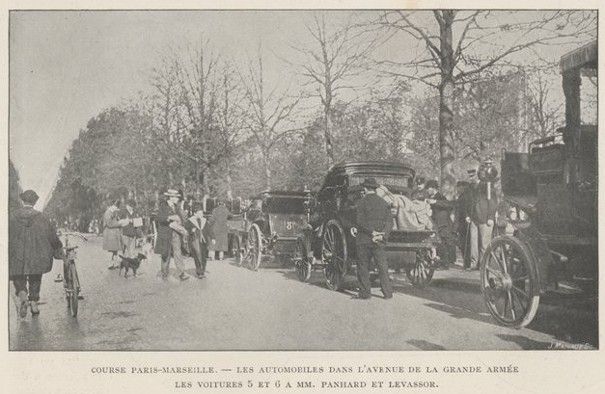
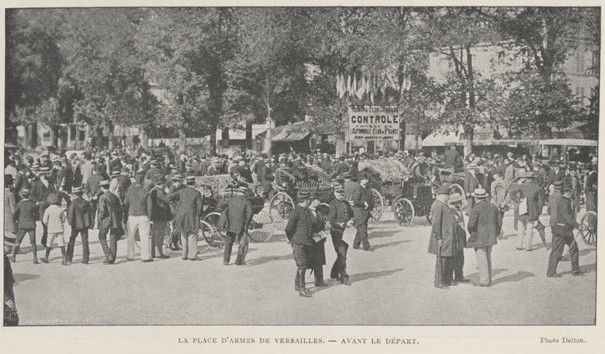
This first stage, however, was a triumph: the winner, a Bollée, traveled at 32 kilometers per hour. Only seven cars required repairs, and of the thirty-two that set out from Versailles, twenty-seven were present at the checkpoint. But the next day, the beautiful weather took a turn for the worse: a storm raged, with rain and wind ganging up on the drivers, and even the most skeptical could not deny that this “pastime”—which demanded truly heroic efforts from its devotees, just as the competitors had to make to withstand the combined forces of nature—deserved to be called a sport. A Bollée open-top car was wrecked, its passengers thrown into the fields; a Panhard had its roof torn off by the wind.
Several competitors found their path blocked by trees that had fallen across the road; they had to either saw them through or attempt a steeplechase that the manufacturers had not anticipated. Only sixteen cars made it to Dijon, and yet No. 6 (Panhard) still covered the stage’s 151 kilometers at a pace of 22 per hour.
The third day, from Dijon to Lyon (198 kilometers) completed the route of the steam-powered vehicles that had begun the day before. “Petroleum, forever!” arrived first in Lyon, once again in the form of No. 6, with an average speed of 30 kilometers.
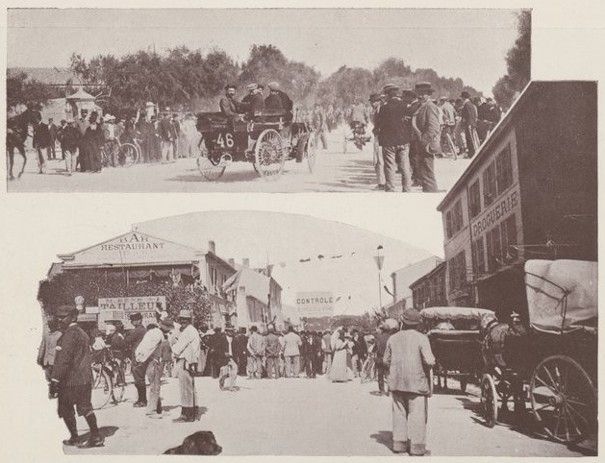
Fourth day, from Lyon to Avignon (227 kilometers). An accident involving Mr. Levassor, the driver of the Panhard, reversed the order in favor of No. 46, the Peugeot, which finished first, having traveled at 29.200 kilometers per hour. However, on the fifth day, No. 6 regained first place on the route from Avignon to Marseille, with the highest average speed: 35.100 kilometers per hour.
FINAL STANDINGS
Here are the final results for the automobiles that completed yesterday’s long journey from Paris to Marseille and back (1,728 kilometers 100 meters):
1st, No. 6, Panhard and Levassor, in 67 h. 42 m. 58 s.;
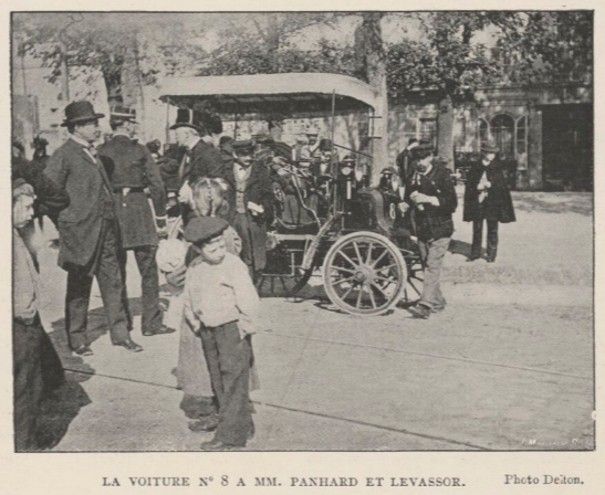
2nd, No. 8, Panhard and Levassor, in 68 h. 11 m. 5 s.;
3rd, No. 13, Dion Tricycle, in 71 h. 1 m.;
4th, No. 5, Panhard and Levassor, in 71 h. 23 m. 22 s.;
5th, No. 51, Michelin Tricycle, in 73 h. 30 min. 12 sec.;
6th, No. 46, Peugeot, in 75 h. 26 min. 24 sec.;
7th, No. 41, Delahaye, in 75 h. 29 min. 48 sec.;
8th, No. 44, Peugeot, in 81 h. 23 min. 51 sec.;
9th, No. 15, Tricycle de Dion, in 83 h. 6 m. 16 s.;
10th, No. 42, Delahaye, in 84 h. 27 m. 5 s.;
11th, No. 29, Maison Parisienne, in 100 h. 41 m. 37 s.;
12th, No. 30, Maison Parisienne, in 108 hours, 39 minutes, 48 seconds;
13th, No. 26, Landry and Beyroux, in 137 hours, 11 minutes, 17 seconds.
Average speed of the first car for the entire round trip from Paris to Marseille: 25 kilometers, 525 meters per hour.
Photos.
Page 314: PARIS-MARSEILLE RACE. — THE AUTOMOBILES ON AVENUE DE LA GRANDE ARMÉE.
CARS 5 AND 6 BELONGING TO MM. PANHARD AND LEVASSOR.
CAR NO. 8 BELONGING TO MM. PANHARD AND LEVASSOR. Photo by Delton.
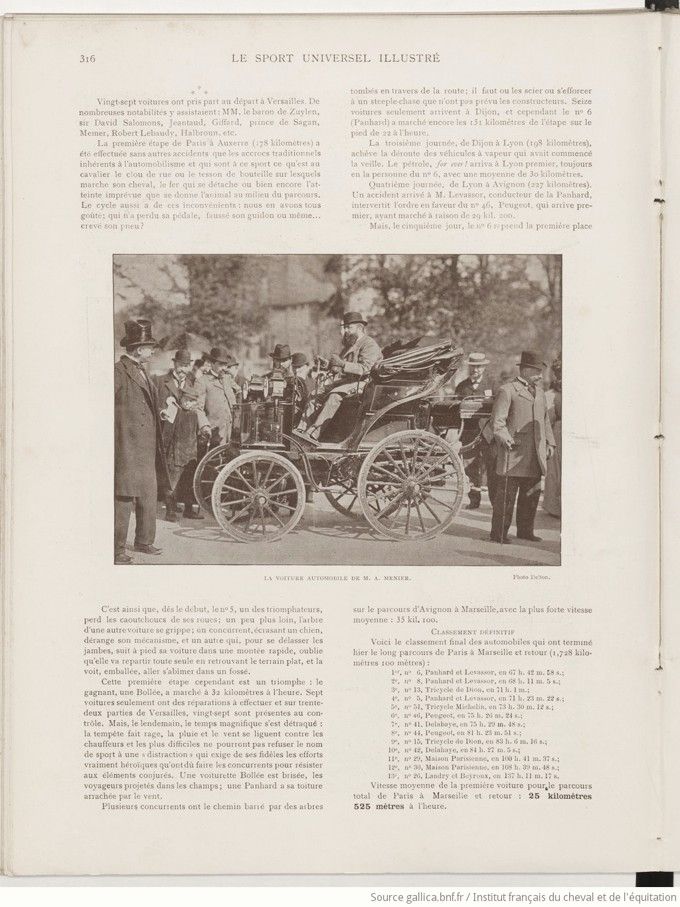
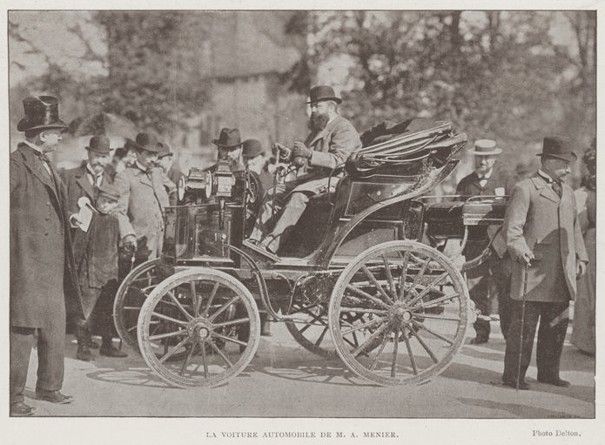
Page 315: MR. A. MENIER’S CAR. Photo by Delton.
THE PARADE GROUND AT VERSAILLES. — BEFORE THE START. Photo by Delton.
Page 316: MR. A. MENIER’S CAR. Photo by Delton.
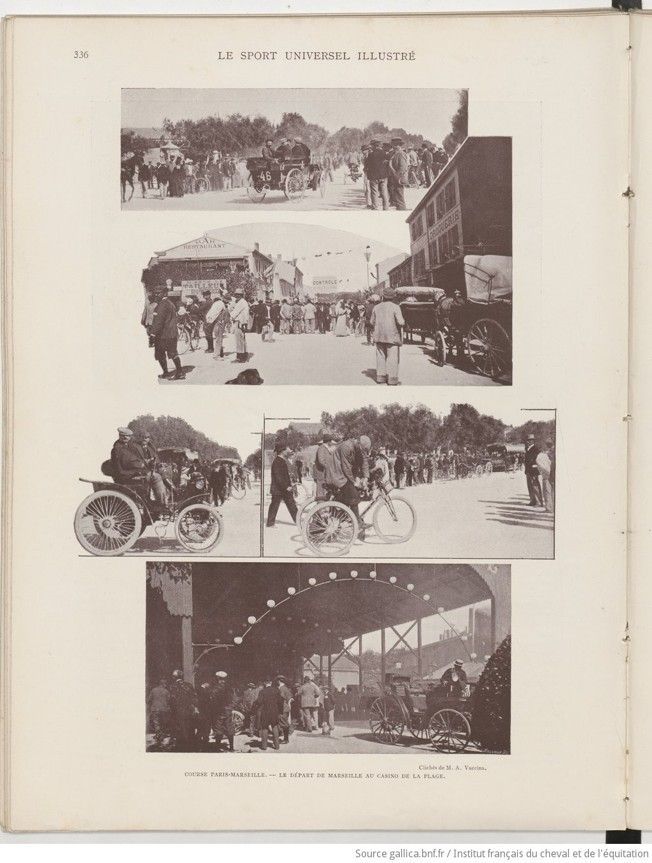
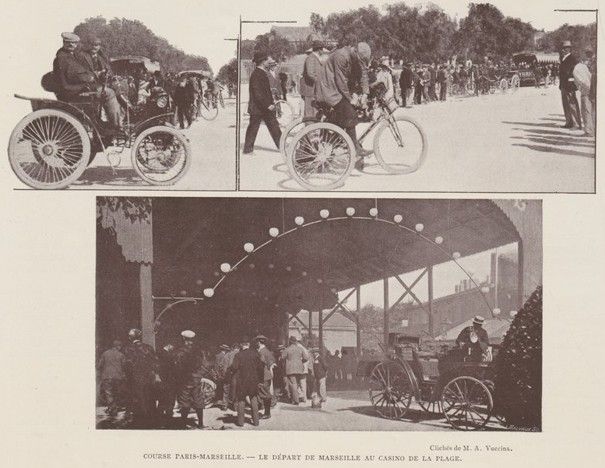
Page 336 (of 1st November 1896): PARIS-MARSEILLE RACE. — THE START IN MARSEILLE AT THE CASINO DE LA PLAGE. (Photographs by M. A. Vuccina).