Here, the results of the second elimination trial are briefly discussed. Although some twelve carriages applied for the trial, only six participants went along in this elimination. After the trial of this second day, all six were admitted to participate in the concours. For tomorrow Saturday, the last elimination day, seven vehicles have applied. (Translation included at the end).
Avec l’autorisation du Bibliothèque national français, gallica.bnf.fr/ https://www.bnf.fr/fr
Texte et photos compilé par motorracinghistory.com
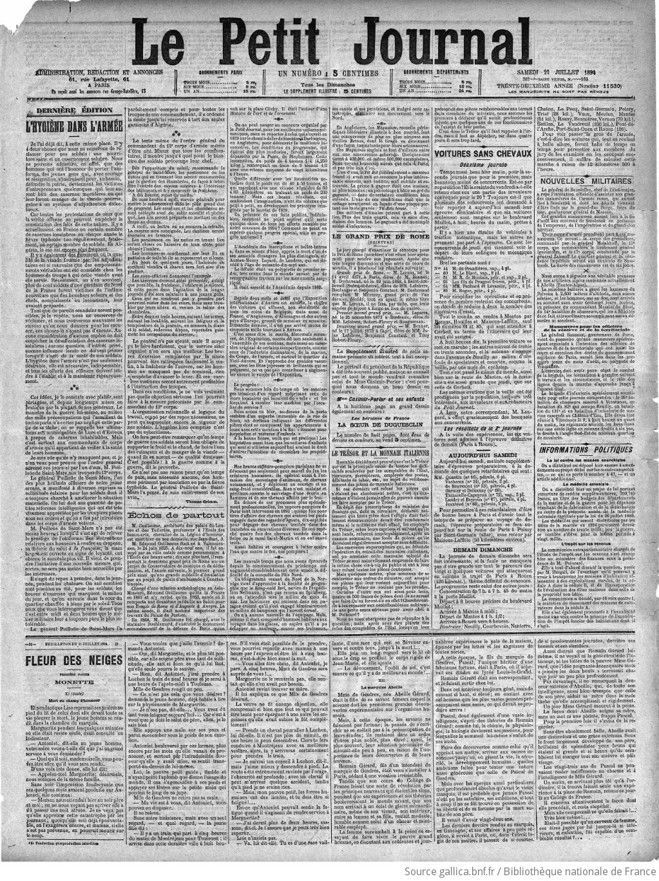
Le Petit Journal, Vol. 32, No. 11530, Samedi, 21 juillet 1894
VOITURES SANS CHEVAUX – Deuxième Journée
Temps aussi, beau hier matin, pour la seconde journée que; pour la première, mais beaucoup moins de concurrents. Est-ce par superstition ? Et la crainte dii vendredi a-t-elle retenu chez eux une partie des inventeurs convoqués pour le 20 ? Toujours est-il que plusieurs, des concurrents ont demandé à voir reporter à aujourd’hui samedi, leur épreuve éliminatoire, et que six voitures seulement sont rangées sur le boulevard Maillot, à huit heures du matin, prêtes à partir.
Il y a bien une dizaine de véhicules à traction mécanique, mais les autres ne prennent pas part à l’épreuve. Ce sont les concurrents de jeudi qui viennent voir le départ de leurs collègues ès mécanique routière.
Bref les partants sont :
Nos 44 M. de Prandières, vap., 4 pl.
—- 60. M. Le Blant, vap., 8 pl.
—- 61 M. R. de Montais, pétr. et vap., 2 pi.
—- 65 Les fils de Peugeot frères, pétr., 4 pl.
—- 64 MM. Panhard et Levassor, pétr., 4 pl.
—- 85 M. Roger, pétr., 4 pl.
Pour simplifier les opérations et en présence du nombre restreint des concurrents, on décide de réduire à deux le nombre des itinéraires d’essai.
Tout le rnonde se rendra à Mantes par Bezons, Houilles et Maisons-Laffitte, sauf les numéros 61 et 85, qui sont attendus à Corbeil, au terme de l’itinéraire, qui leur avait été assigné.
A huit heures dix, la première voiture se met en marche ; les autres suivent de trente en trente secondes, et la colonne, s’engage dans l’avenue de Neuilly au milieu d’une foule de spectateurs et escortée, comme la veille, par une nuée de cyclistes.
Tout s’est passé le mieux du monde, aussi bien sur la route de Mantes, où la curiosité a été aussi grande que jeudi, que sur celle de Corbeil.
Les mêmes ovations que la veille ont été prodiguées par la population, toujours très intéressée, aux inventeurs et aux rédacteurs du Petit Journal.
A Igny, notre correspondant, M. Langard, a offert gracieusement des bouquets aux concurrents.
Les résultats de la 2* Journée
A la suite des expériences, les six voitures sont admises à l’épreuve définitive de demain (Paris à Rouen).
——————–
AUJOURD’HUI SAMEDI
Aujourd’hui samedi, matinée supplémentaire d’épreuves préparatoires ; à la demande des quelques retardataires qui sont :
MM. Quantin (n° 16), pétrole, 6 pl.
—– Vacheron (n° 24), pétrole, 2 pl.
—– de Bourmont (n° 53), pétrole, 4 pl.
—– Garnier et Delannoy (n° 68).
—– Tamarelle-Capeyron (n° 72), vap., 5 pl.
—– Landry et Beyroux (n° 87), pétrole, 4 pl.
—– Jeantaud (n° 88), pétrole, 4 pl.
Pour permettre à ces retardataires d’étre de bonne heure à Paris et d’avoir tout le temps de se préparer au voyage de demain, l’épreuve préparatoire se fera aujourd’hui sur la route de Paris à Poissy par Saint-Germain (aller), avec retour par Maisons-Laffitte (50 kilomètres environ).
——————–
DEMAIN DIMANCHE
La journée de demain dimanche sera fort-intéressante, et la foule ne manquera pas d’être grande sur tout, le parcours des vingt et quelques voitures qui attaqueront en colonne le trajet de Paris, à Rouen (126 kilomètres), thème définitif du concours.
Le programme reste celui des autres jours :
Concentration de 7 h. à 7 h. 45 du matin à la porte Maillot.
Départ à 8 heures précises du boulevard Maillot ;
Arrivée à Mantes à midi ;
Départ de Mantes à 1 h. ½ ;
Arrivée à-Rouen vers 8 heures
Itinéraire : Neuilly, Courbevoie, Nanterre, Chatou, Le, Pecq, Saint-Germain, Poissy,
Triel (28 kil.), Vaux, Meulan, Mantes (51 kil.), Rosny, Bonnières, Vernon (70 kil.),
Gaillon, Le Vaudreuil (100 kil.), Pont-de-l’Arche, Port-Saint-Ouen et Rouen (126).
Pour voir passer le gros de l’armée, c’est-à-dire les voitures qui, tout en roulant à belle allure, feront halte de temps en temps pour permettre aux membres du jury de les examiner en les occupant successivement, il suffira de calculer cette marche à raison de 12 kilomètres 500 à l’heure.
——————————————————————–
Translation by Deepl deepl.com
32nd YEAR (Issue 11530), SATURDAY, JULY 21, 1894
HORSELESS CARRIAGES – Day Two
The weather was just as nice yesterday morning for the second day as it was for the first, but there were far fewer competitors. Was it superstition? And did the fear of Friday keep some of the inventors—who had been summoned for the 20th—at home? In any case, several competitors asked to have their qualifying round postponed to today, Saturday, and only six cars were lined up on Maillot Boulevard at eight o’clock in the morning, ready to go.
There are indeed about ten mechanically powered vehicles, but the others are not taking part in the race. These are Thursday’s competitors who have come to watch the start of their colleagues in the field of road mechanics.
In short, the starters are:
No. 44 Mr. de Prandières, steam, 4-seater.
—- No. 60 Mr. Le Blant, steam, 8-seater.
—- 61 Mr. R. de Montais, gasoline and steam, 2-passenger
—- 65 The sons of Peugeot frères, gasoline, 4-passenger
—- 64 Messrs. Panhard and Levassor, gasoline, 4-passenger
—- 85 Mr. Roger, gasoline, 4-passenger.
To simplify operations and given the limited number of competitors, it was decided to reduce the number of test routes to two.
Everyone will travel to Mantes via Bezons, Houilles, and Maisons-Laffitte, except for numbers 61 and 85, which are expected in Corbeil at the end of the route assigned to them.
At 8:10 a.m., the first car set off; the others followed at thirty-second intervals, and the convoy entered Avenue de Neuilly amid a crowd of spectators and escorted, as on the previous day, by a swarm of cyclists.
Everything went perfectly, both on the road to Mantes—where curiosity was just as great as on Thursday—and on the road to Corbeil.
The same ovations as the previous day were lavished by the public, who remained very interested, upon the inventors and the editors of the Petit Journal. In Igny, our correspondent, Mr. Langard, graciously presented bouquets to the competitors.
Results of the 2nd Day
Following the trials, the six cars have been admitted to tomorrow’s final race (Paris to Rouen).
——————–
TODAY, SATURDAY
Today, Saturday, an additional morning of preliminary trials; at the request of the few latecomers, who are:
Messrs. Quantin (No. 16), gasoline, 6-seater.
—– Vacheron (No. 24), gasoline, 2-seater.
—– de Bourmont (No. 53), gasoline, 4-seater.
—– Garnier and Delannoy (No. 68).
—– Tamarelle-Capeyron (No. 72), steamship, 5 seats.
—– Landry and Beyroux (No. 87), oil-fired, 4 seats.
—- – Jeantaud (No. 88), gasoline, 4-seater.
To allow these latecomers to arrive in Paris early and have plenty of time to prepare for tomorrow’s journey, the preliminary trial will take place today on the route from Paris to Poissy via Saint-Germain (one way), with the return trip via Maisons-Laffitte (approximately 50 kilometers).
——————–
TOMORROW, SUNDAY
Tomorrow, Sunday, will be a very interesting day, and there is sure to be a large crowd along the entire route as the twenty-odd cars set out in column from Paris to Rouen (126 kilometers), the final stage of the competition.
The schedule remains the same as on other days:
Gathering from 7:00 a.m. to 7:45 a.m. at Porte Maillot.
Departure at 8:00 a.m. sharp from Boulevard Maillot;
Arrival in Mantes at noon;
Departure from Mantes at 1:30 p.m.;
Arrival in Rouen around 8:00 p.m.
Route: Neuilly, Courbevoie, Nanterre, Chatou, Le Pecq, Saint-Germain, Poissy, Triel (28 km), Vaux, Meulan, Mantes (51 km), Rosny, Bonnières, Vernon (70 km), Gaillon, Le Vaudreuil (100 km), Pont-de-l’Arche, Port-Saint-Ouen, and Rouen (126).
To watch the bulk of the “army” pass by—that is, the cars that, while traveling at a brisk pace, will stop from time to time to allow jury members to examine them by taking turns riding in them—simply calculate the journey at a rate of 12.5 kilometers per hour.