Introduction on its way. (Translation separately).
With permission of Bibliothèque national francais gallica.bnf.fr
Text and photos compiled by motorracinghistory, Translation by DeepL deepl.com
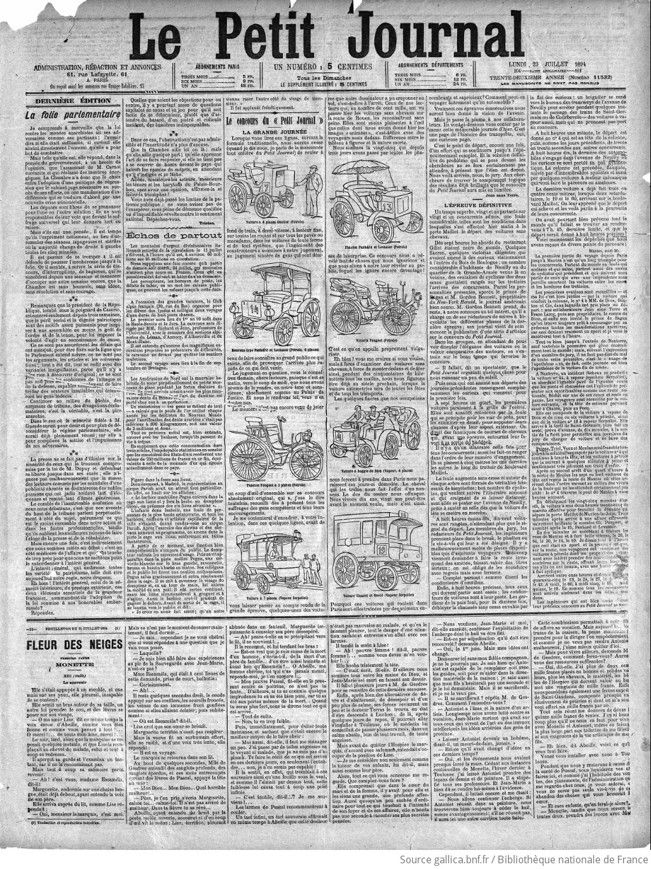
Le Petit Journal, Vol. 32, No. 11532, July 23, 1894
The „Petit Journal“ Contest
THE GREAT DAY
By the time you read these lines, as the saying goes, we—and when I say “we,” I mean the entire “Petit Journal” staff—will have stopped driving at full speed, at half speed; at a steady, slow pace, on all roads and on all cobblestones or macadam surfaces, in vehicles of every shape and design that the ingenuity of manufacturers has submitted to our judgment—the sincere judgment of people eager to inform the general public of what currently exists, in order to hasten the arrival of what is yet to come.
You will learn of this judgment tomorrow, dear readers, since it was this morning, around noon, that we promised to render it, in good faith, just as we would in the Palace of Justice. And we will render it as such—of that you may be certain.
The time has not yet come to take a comprehensive look at this utterly original competition, which, I dare say, has already garnered the unanimous approval and encouragement of all those in the know.
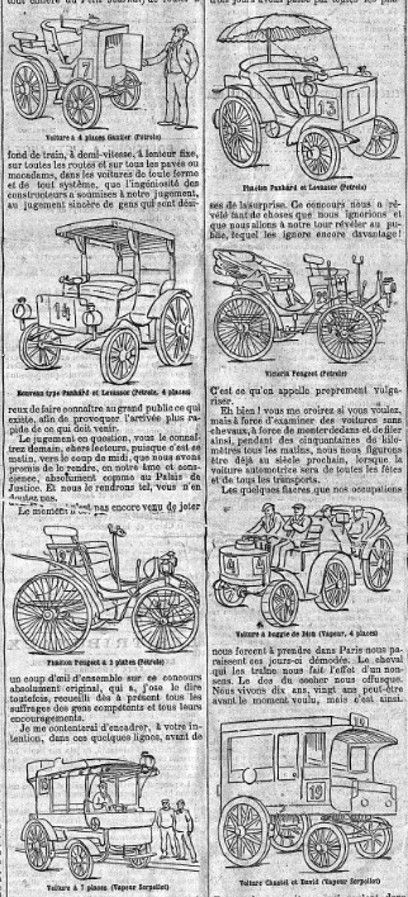
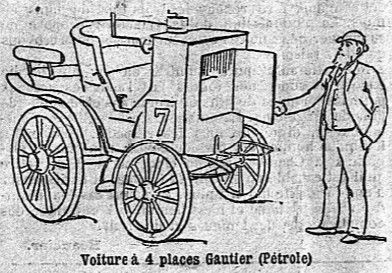
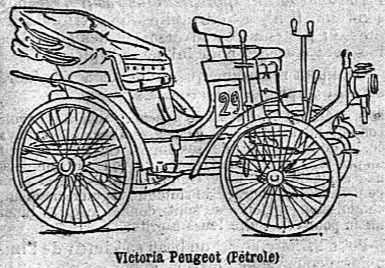
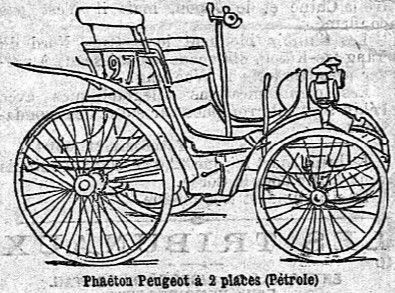
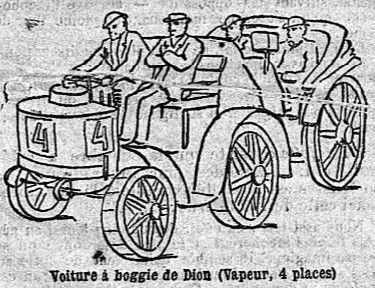
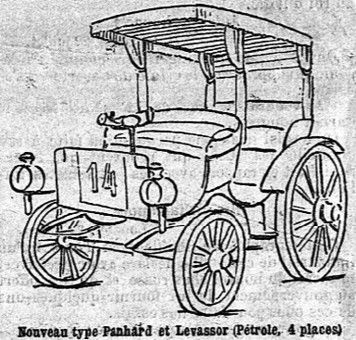
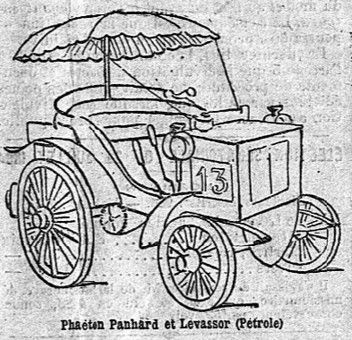
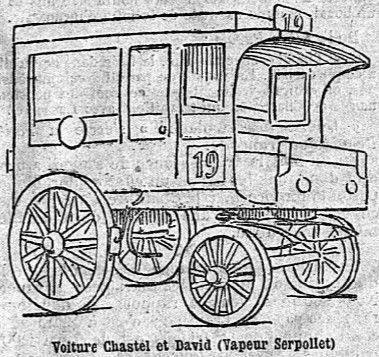
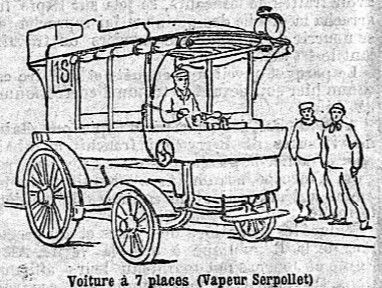
I shall content myself with providing, for your benefit, in these few lines—before letting you move on to the report on the grand event—a few sketches of the carriages that our illustrator was able to sketch on the fly, that is, while they were stopped. Those of our 100,000 readers who saw the horseless carriages pass by yesterday on the road to Rouen will recognize them easily. They are less pleasing to the eye than those whose “animated” images we published yesterday—that is, with passengers seated inside. It is the difference between a figure study and a still life.
There are twenty-five of us here who, over the past three days, have gone through all the stages of surprise. This experience has revealed so many things to us that we were previously unaware of—and which we, in turn, will reveal to the public, who are even more in the dark about them! This is what is properly called popularizing.
Well! Believe it or not, but after examining so many horseless carriages, after getting into them and zooming off like that for fifty kilometers every morning, we feel as though we’re already in the next century, when the self-propelled carriage will be a fixture at every celebration and for all forms of transportation.
The few horse-drawn carriages that our duties force us to take in Paris seem outdated to us these days. The horse pulling them strikes us as utter nonsense. The coachman’s back offends us. We’re living ten years—perhaps twenty—ahead of our time, but that’s just how it is.
Why are these carriages rolling through Paris pulled by cumbersome and capricious animals? How can one travel any other way than by automobile?
Truly, these successive trials have given us a clear vision of the future.
But I’ll hand the pen over to our contributors. Below, they’ll recount for you, in detail, yesterday’s memorable day. It’s a page in the history of transportation—yes, a curious page.
It is, once again, the starting point of an effort that will continue until it reaches its full potential. And the definitive solution to the problem facing researchers will certainly not be long in coming, now that the momentum has been set in motion.
Here we are, the jury. It is up to the researchers to find the logical next step following the already brilliant results that the Petit Journal contest has brought to light.
Jean sans Terre.
THE FINAL TEST
Splendid weather, twenty-one starters out of twenty-one eligible competitors; a considerable crowd—such were the conditions under which the race for horseless carriages began yesterday morning at the Porte Maillot.
By seven o’clock, the area around the Gillet restaurant was teeming with people. A few fiacres and elegant victorias that had brought onlookers there were parked at the entrance to the Bois de Boulogne; a considerable number of residents from Neuilly or the Grande-Armée neighborhood, who had come as neighbors, and hundreds of cyclists of both sexes were lined up on the sidewalks, waiting for the competitors’ arrival. Among the dignitaries present were the Prince of Sagan and Mr. Gordon Bennett, owner of the New-York Herald, the well-known American newspaper. Mr. Gordon Bennett, in fact, takes such an interest in our competition that he has tasked one of his editors with following the various stages of the final race by bicycle; his newspaper has just begun publishing a series of articles on the Petit Journal competition.
In small groups, while waiting to discuss the elegance of the cars or the comparative performance of the engines, people are raving about the beautiful weather that is making the race a success.
“The Petit Journal had to organize something to bring us back a little sunshine,” said one spectator.
Then those who attended the starts on previous days helpfully provide information to the curious first-time visitors.
At a quarter past seven, the first cars appear at the tollgate. They are immediately surrounded by the crowd, which rushes to see them up close, to examine them in detail, and to gauge their chances based on their outward appearance. They look like horse-racing fanatics who, before a race, surround their favorite as it leaves the paddock.
There is only one route this time for all the competitors; so they are lined up in the order of their entry numbers. They position themselves five meters behind one another along the sidewalk of Boulevard Maillot.
The crowd is growing steadily, and clusters of bicycles have formed around every tree; quite a few cyclists, wanting to follow the announced route and afraid of falling behind, have taken up positions on Avenue de Neuilly, ready to jump on their bikes as soon as the lead car starts moving.
At ten to eight, nineteen cars are lined up, waiting only for the starting signal. The jury members, the editors of the Petit Journal, and the engineers take their seats in the station wagon, phaeton, or vis-à-vis assigned to them. Unfortunately, there are fewer seats available than there are aspiring travelers; many come asking to join the trip, citing friendships or presenting impressive credentials; we are forced to turn them away with regret but firmly. — “Fully booked everywhere!” as the omnibus drivers say.
Finally, at eight o’clock sharp, everyone who is supposed to leave has been accommodated; the carriage drivers are at their posts.
The police, for the tenth time, clear the roadway, which is constantly being overrun by the flood of onlookers; a sergeant heads toward the streetcar office on Avenue de Neuilly to halt for a few moments the passage of trains from Saint-Germain or Courbevoie—including steam-powered cars, though these are not participating in the race.
At one minute past eight, the starting signal is given to No. 4, which is at the head of the column; then, as on previous days, the other competitors follow at thirty-second intervals.
At ten past eight, the last of the automobiles enters Avenue de Neuilly, where onlookers have gathered at a brisk pace. The column is preceded, flanked, and followed by countless cyclists and also by a few mechanically powered cars that are completing the course as amateurs.
The last car had already traveled three or four hundred meters when two stragglers, numbers 19 and 60, arrived on Boulevard Maillot. They were informed that the start had already taken place, and off they went in pursuit of their competitors.
Yet everyone had been clearly warned that they had to be at the meeting point by 7:45 a.m.—the absolute latest—and that the start would be given at eight o’clock sharp!
Here are the dispatches we have received from various points along the route:
Mantes, 12:50 p.m.
The first leg of the journey from Paris to Mantes was nothing but a triumph for the competitors. Everywhere, crowds cheered and waved; everywhere, too, swarms of cyclists rode ahead and behind—not to mention those who, with unparalleled recklessness, escorted the cars between the wheels and the curbs.
The first ovations were received—and, in my opinion, quite rightly so—by the car leading the column, No. 4 belonging to Messrs. de Dion, Bouton & Co., in which the following had taken their seats at the start: our colleagues Jean sans Terre and Franc Lamy, then its owner, the Count de Dion, and finally his guest, the Prince de Sagan, who is always ready to lend his support to sporting events through his presence, for this is truly becoming a sport, as I will show you shortly.
Everything goes smoothly until the entrance to Nanterre, except for the dust, which greatly hinders everyone; but, as one jury member put it, one must not speak ill of all this dust—it is the “cloud of apotheosis”—and, in fact, this day is indeed the apotheosis of the fin-de-siècle automobile.
In Nanterre, an unfortunate incident occurs: Car No. 44, a steam-powered vehicle (Serpollet system), upon hitting the wretched cobblestones of the wretched road—which the Department of Public Works has the audacity to present to taxpayers as a national highway—bends one of its wheels and breaks down. The passengers were picked up by the next car, and the lead vehicle thus reached Chatou, then Le Pecq.
It consisted of the Dion steam-powered car and five or six gasoline-powered cars, as well as the No. 18 Serpollet steam-powered car. It arrived at the Forest of Saint-Germain, then made a prearranged ten-minute stop at the forest’s exit to allow the jury members to switch cars and make comparisons.
Poissy, Triel, Vaux, and Meulan were passed at the same rapid pace by Car No. 4, which continued to lead, while the gasoline-powered cars following close behind—barely a few minutes behind—kept up with its breakneck speed very admirably.
After a second 15-minute stop just outside Meulan, the seven or eight leading cars resumed their journey toward Mantes, where they arrived in the following order amid the cheers of the crowd, which certainly hadn’t expected them so soon: No. 4 crossed the Mantes Bridge at the stroke of eleven o’clock.
Excluding the twenty-five-minute stop, the car took two hours and thirty-five minutes of actual driving time to cover the distance between Porte Maillot and Mantes-la-Jolie. Three minutes later, No. 65, a Peugeot, arrived at an extraordinarily brilliant pace, followed immediately by No. 15, a Panhard & Levassor.
Within ten minutes, cars No. 28, No. 64, No. 30, No. 14, and No. 10 passed one after another through the streets of Mantes at a very brisk pace. I mentioned earlier that this was a sport, and the proof is that along the way, our travelers encountered gasoline-powered cars whose owners eagerly stopped to check in on their fellow drivers on the road, offering their best wishes if needed, with a sense of camaraderie that felt like a cycling race.
Arriving between 11:30 and 11:45 were cars No. 13, 24, 27, ***, and 42. At noon, No. 60; at 12:05, No. 85; and at 12:15, No. 19. In short, all competitors arrived easily within the time limit except for two.
The engineers who kindly provided their valuable assistance to the Petit Journal are delighted with their trip and this interesting event.
Mantes, 1:30 p.m.
The No. 61 just arrived at 12:30 p.m. at Mr. Roger de Montais’s; at 12:44 p.m. on the 7th, and at 1:16 p.m. on the 19th.
A fact that was widely noted by everyone in the cars: the horses’ perfect calm. None of them were startled at the sight of the vehicles without their fellow horses.
A farmer, fearing the opposite, had wrapped his horse’s head; the poor animal was completely covered and remained bundled up like that the entire time the competitors passed by.
The weather is absolutely superb and just as one could wish for—no rain and not too hot.
Needless to say, photographers have spread out in droves along the road.
Vernon, July 22, 3:00 p.m.
The route from Mantes to Vernon is being followed with mathematical precision. A few minutes before 1:30 p.m. (military time), a bugle will sound the assembly call in the streets of Mantes.
At exactly 1:30 p.m., under ideal overcast skies—despite the dust—all the cars set off at high speed to reach Vernon, 22 kilometers away, the agreed-upon checkpoint between the competitors.
Car No. 4, which started last, continues to race like the devil; it arrives in Vernon, in front of the Hôtel du Soleil d’Or, at 2:25. Following it, car No. 28 (Peugeot) arrives one minute later, running admirably and seemingly proving that, when it comes to speed, gasoline no longer fears steam.
Along the route, a few pleasant incidents:
First, the owner of a garden in Triel, just before Mantes, who offered apricots to everyone; then the mayors of various towns who had cannons fired; and finally, the distributor of the Petit Journal in Bonnières, who presented the first car in the convoy with a magnificent bouquet.
I note, as they arrive in excellent condition—like the turn-of-the-century racehorses that they are—the following numbers arriving between 2:30 and 2:45: 13, 64, and 31.
3:30 p.m.
Arriving one after another with intervals of barely a few minutes: 65, 42, 13, 63, 30, 24, 18, 14, 27, 60, 10, amid an increasingly enthusiastic crowd. An accident nearly occurred: a horse, startled by one of the carriages, bolted and charged at full speed into the crowd gathered in the Place de Paris. By an incredible stroke of luck, one of the attendants managed to stop the animal, preventing any accident from occurring.
At 3:10 p.m., the nearly complete lot had passed by.
IN ROUEN
Rouen, 11 p.m.,
It has been four days since we began traveling the highways in horseless carriages of all shapes and designs. But it was really today that we fully grasped the significance of the event organized by the Petit Journal and the incalculable implications it will have for the future.
During the first three days, we had only made relatively short trips—no more than fifty kilometers—but today was the big test.
We were no longer addressing the residents of the towns near Paris; we were about to encounter populations less familiar with the modes of rapid transportation that we intended to parade before their eyes.
I would like to note right away that the impact was considerable, enormous, and in some ways similar to that which the passage of the first trains must have produced on this very same route from Paris to Rouen.
Everyone who took part in today’s journey will cherish an unforgettable memory of it. How could we forget, indeed, that unbroken line of people along a route stretching over 100 kilometers; those residents of small towns rushing out to meet the automobiles and greeting them with warm applause?
Flowers were thrown at us in heaps, along with sheaves of wheat and even fruit, which provided a pleasant distraction from the dust we were swallowing. The bouquets were tossed to us very skillfully, I must say, by young and pretty women; the fruit was offered to us by kind farmers who held it up for us to see from a distance, so that we could slow down our vehicles and catch it as we passed.
At windows and doors, elderly people waved with a certain emotion at these vehicles of the future—a future that is certainly imminent. Schoolteachers and nuns had lined up their students on the sidewalks so they could witness a spectacle that will undoubtedly go down in the annals of this country.
Need we mention the cyclists who followed us by the hundreds, some all the way from Paris, many from one city to another? They, too, competed in enthusiasm and good cheer to facilitate the competitors’ passage, as always.
With incomparable endurance, they performed a very useful service as scouts and couriers. Motor vehicles and cyclists—they all work together, and one could hardly imagine one without the other. Among these zealous cyclists, we owe a special mention to a graceful female cyclist whom we had the sorrow of seeing take what, in cycling terms, is called a spectacular tumble; the unfortunate woman, who was racing down a steep hill, had no doubt struck a rock or some other obstacle and had fallen heavily.
She had remained unconscious for a moment, and we feared she might have been seriously injured. This was not the case, and half an hour later, we found her energetically climbing the steepest hills.
The vehicles produced very different effects depending on their nature. When onlookers saw, for example, Dion’s steam-powered car passing by at an unprecedented speed, they felt a sort of dread; but when it was a light passenger car powered by a gasoline engine, everyone seemed more at ease.
However, applause was directed at both types of vehicles.
I spent most of today’s trip in Dion’s car, and I noticed that whenever we were spotted by groups standing at a distance—onlookers, mostly women—who were on the left side of the road, they would cross a few meters in front of the car and pass on the right.
I was quite intrigued by this for a while, but eventually figured out the explanation. The passenger seat on the right side of our car was occupied by Captain de Place, a brilliant officer and distinguished scholar; and since he was in uniform, the onlookers who spotted the red of his kepi from a distance tended to move to his side to get a better look at the brave officer. Not to mention that he rendered great service to Mr. de Dion—first, shortly before reaching Pont-de-l’Arche, when we encountered a gravel bed stretching for several hundred meters, a gravel bed that had been most inopportune placed there by the Department of Public Works.
It was extremely difficult to navigate over those sharp stones. With timely efficiency, Captain de Place and Mr. de Dion called upon the help of some brave farmers who were witnessing our predicament, and in no time at all, the car, lifted off the ground, made it through that treacherous stretch.
Further on, another scare. Due to a wrong turn, our vehicle began climbing a steep incline that was not the correct road, and just as the driver realized his mistake and tried to turn around, a sudden jolt sent us careening into a potato field.
Once again, the car was steered back onto the right path thanks to the energy of Captain de Place, and we were able to make a triumphant entrance into Rouen at 5:30 p.m. on the Champ-de-Mars, where the crowd welcomed us with prolonged cheers.
The vehicles that followed were also celebrated, and thus, amid applause, this day—which had begun with cheers on the Avenue de Neuilly—came to a close.
In short, everyone has every right to be satisfied. Both steam- and gasoline-powered vehicles proved their worth, and the reception they received from the public must have shown their owners and inventors just how much interest the general public has in the subject to which they have devoted themselves.
All those who attended this competition of such a novel kind had, in a way, a premonition that a new era was about to dawn in the field of transportation.
“The Petit Journal’s competition will have an incalculable impact,” a man from Rouen who had come to meet us on his bicycle told me just a few moments ago.
“We’ll see this clearly at the 1900 Exposition. Once again, the Petit Journal will have set the movement in motion, and this movement will be fruitful.”
Roland.
Rouen, midnight.
The arrival in Rouen took place amid a huge crowd. In fact, one could say that the crowd has been continuous ever since Pont-de-l’Arche, where the first cars were cheered on by thousands of onlookers gathered on both sides of the road. Everywhere there were swarms of cyclists.
In Gailon, an accident occurred due to a broken pipe. An explosion took place in Mr. Scotte’s car. Unfortunately, in this explosion—which caused severe damage to the car—the driver sustained minor injuries.
Here is the list of cars, in order of arrival and by time:
No’s Messrs.
4 de Dion, 4-seater, steam, 5:40 a.m.
65 Peugeot, 4-seater, gasoline, 5:45 a.m.
28 Peugeot, 4-seater, gasoline, 5:50 a.m.
13 Panhard & Levassor, 4-seater, gasoline, 6:03 a.m.
31 Peugeot, 5-seater, gasoline, 6:07 a.m.
42 Le Brun, 4-seater, gasoline. 6 24
15 Panhard and Levassor, 2-seater, gasoline. 6 30
64 Panhard and Levassor, 4-seater, gasoline. 6 49
53 de Bourmont, 4-seater, gasoline; 7 1
30 Peugeot, 3-seater, gasoline. 7 2
24 Vacheron, 2-seater, gasoline. 7 3
27 Peugeot, 2-seater, gasoline. 7 5
14. Panhard and Levassor, 4-seater, gasoline. 7 10
85. Roger, 4-seater, gasoline. 8 9
60 Le Blant, 8-seater, steam. 8 50