With permission of hathitrust hathitrust.org == Text and fotos compiled by motorracinghistory
Automotive Topics — Volume XVII (17), No. 8, November 28, 1908
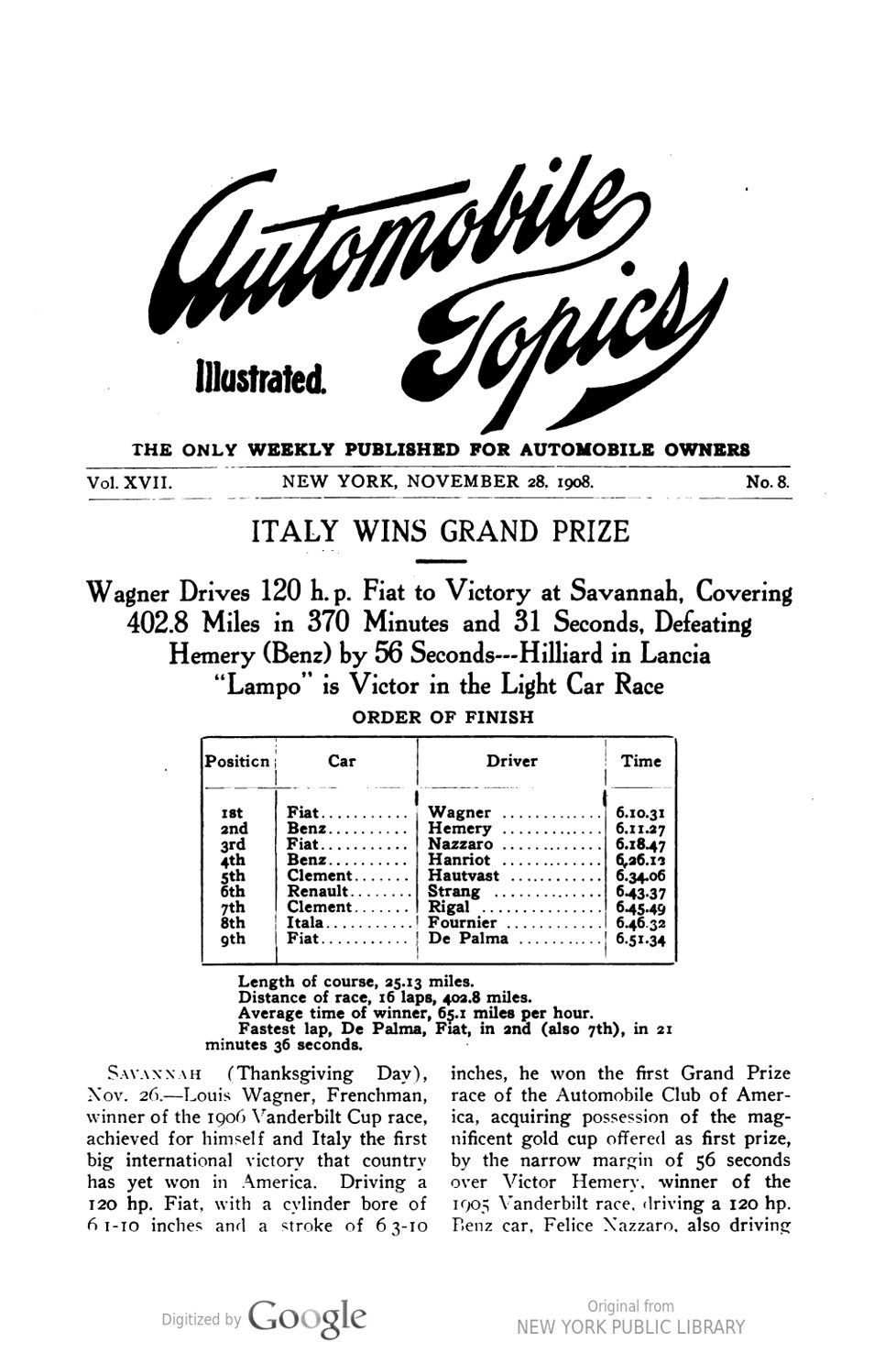
ITALY WINS GRAND PRIZE
Wagner Drives 120 h. p. Fiat to Victory at Savannah, Covering 402.8 Miles in 370 Minutes and 31 Seconds, Defeating Hemery (Benz) by 56 Seconds – Hilliard in Lancia „Lampo“ is Victor in the Light Car Race
————————
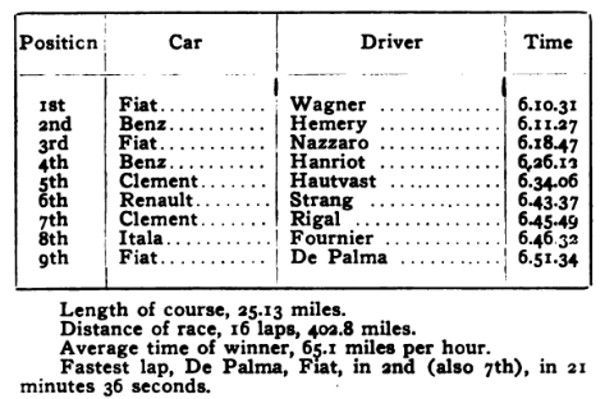
ORDER OF FINISH
Position Car Driver Time
1st Fiat — Wagner 6.10.31
2nd Benz — Hemery 6.11.27
3rd Fiat — Nazzaro 6.18.47
4th Benz — Hanriot 6,26.12
5th Clement — Hautvast 6.34.06
6th Renault — Strang 6.43.37
7th Clement — Rigal 6.45.49
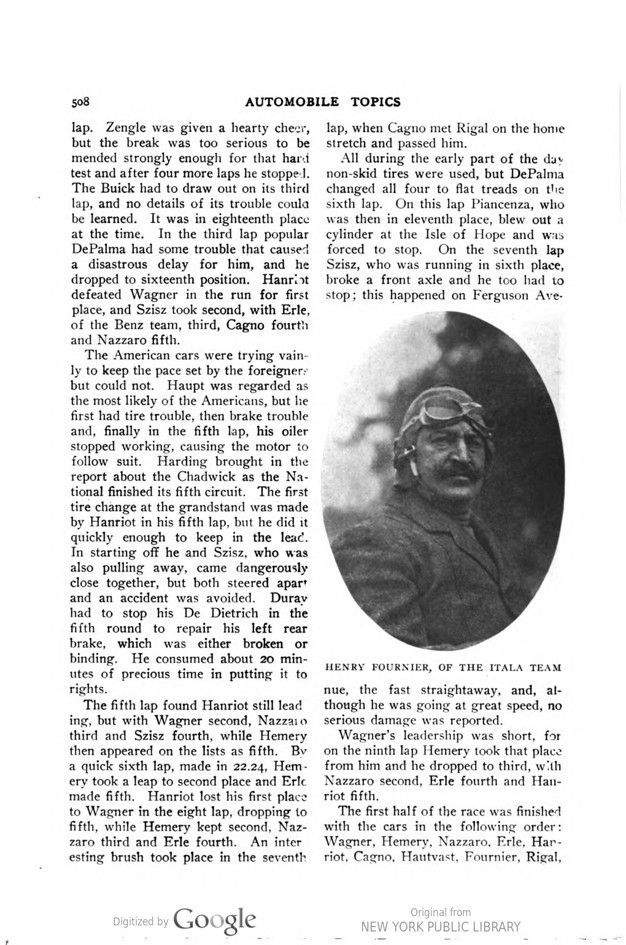
8th Itala — Fournier 6.46.32
9th Fiat — De Palma 6.51.34
————————
Length of course, 25.13 miles.
Distance of race, 16 laps, 402.8 miles.
Average time of winner, 65.1 miles per hour. Fastest lap, De Palma, Fiat, in 2nd (also 7th), in 21 minutes 36 seconds.
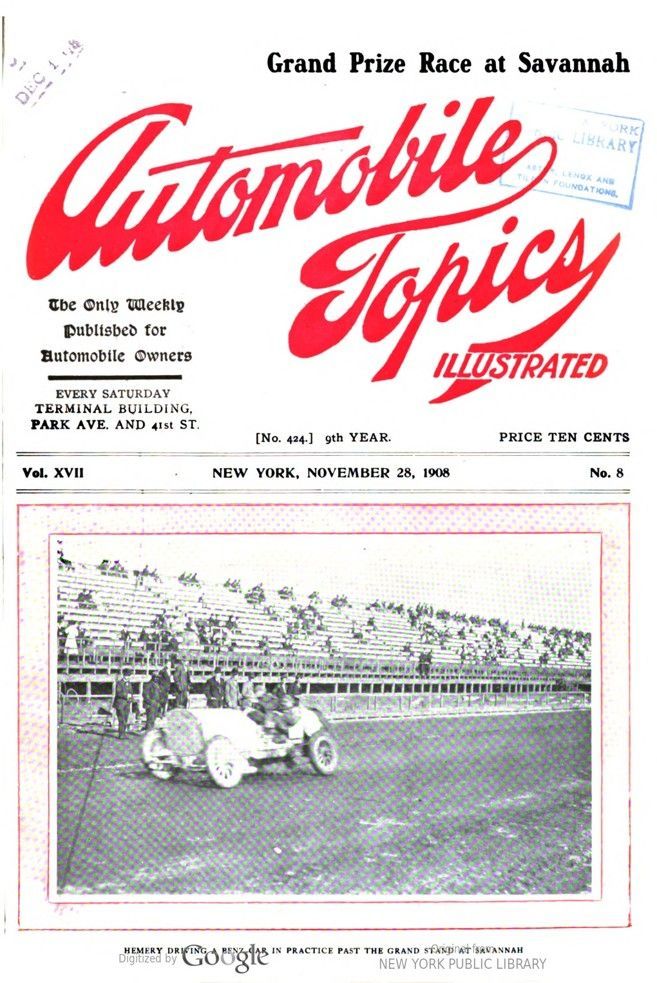
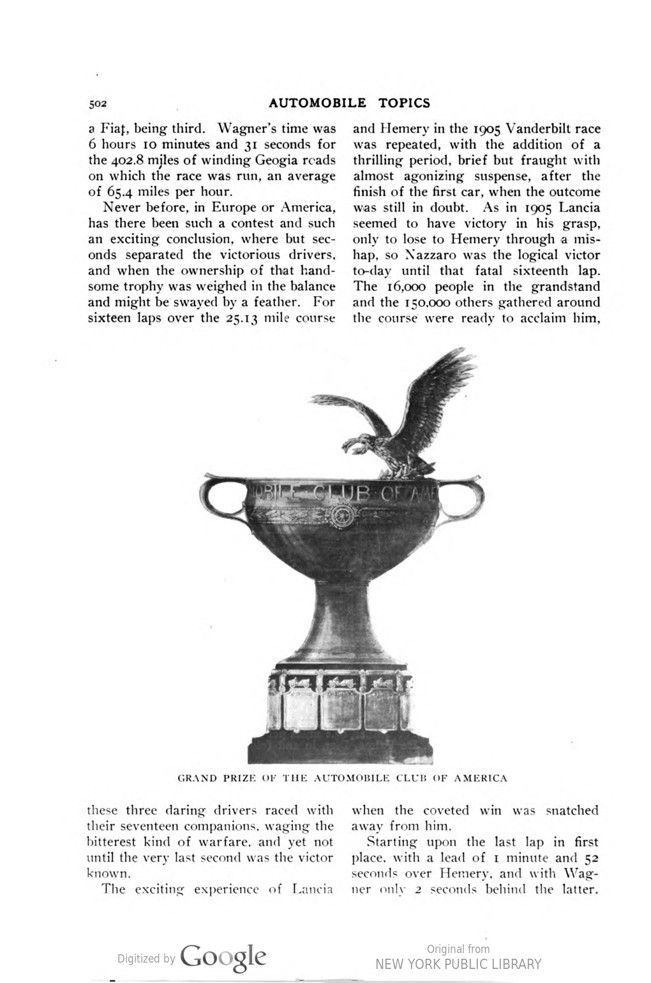
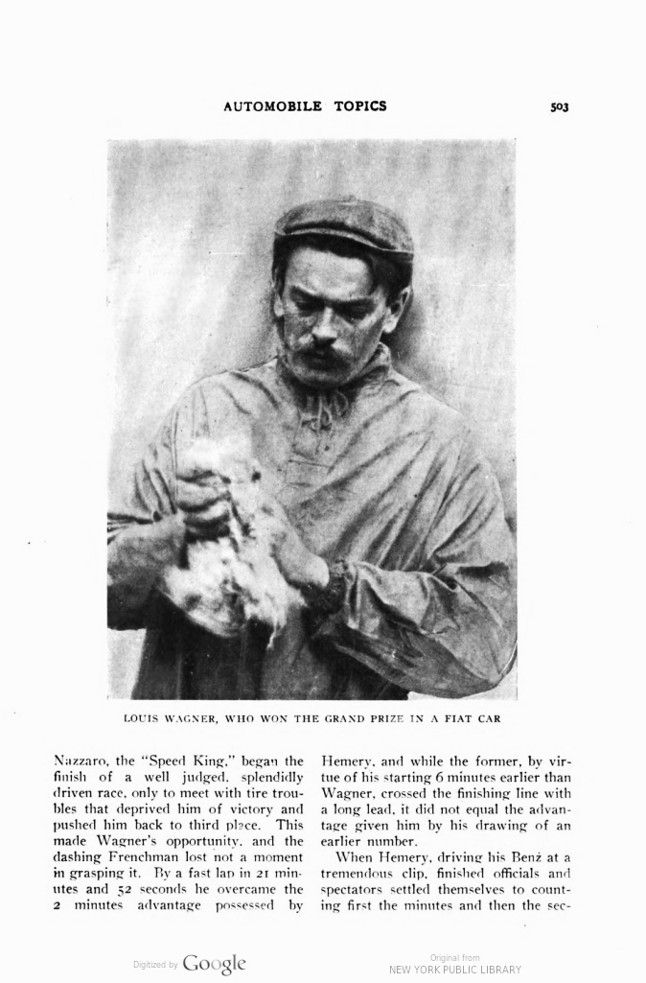
SAVANNAH (Thanksgiving Day), Nov. 26. – Louis Wagner, Frenchman, winner of the 1906 Vanderbilt Cup race, achieved for himself and Italy the first big international victory that country has yet won in America. Driving a 120 hp. Fiat, with a cylinder bore of 61-10 inches and a stroke of 6 3-10 inches, he won the first Grand Prize. race of the Automobile Club of America, acquiring possession of the magnificent gold cup offered as first prize, by the narrow margin of 56 seconds over Victor Hemery, winner of the 1905 Vanderbilt race, driving a 120 hp. Benz car, Felice Nazzaro, also driving a Fiat, being third. Wagner’s time was 6 hours 10 minutes and 31 seconds for the 402.8 miles of winding Geogia reads on which the race was run, an average of 65.4 miles per hour.
Never before, in Europe or America, has there been such a contest and such an exciting conclusion, where but seconds separated the victorious drivers, and when the ownership of that hand- some trophy was weighed in the balance and might be swayed by a feather. For sixteen laps over the 25.13 mile course these three daring drivers raced with their seventeen companions, waging the bitterest kind of warfare, and yet not until the very last second was the victor known.
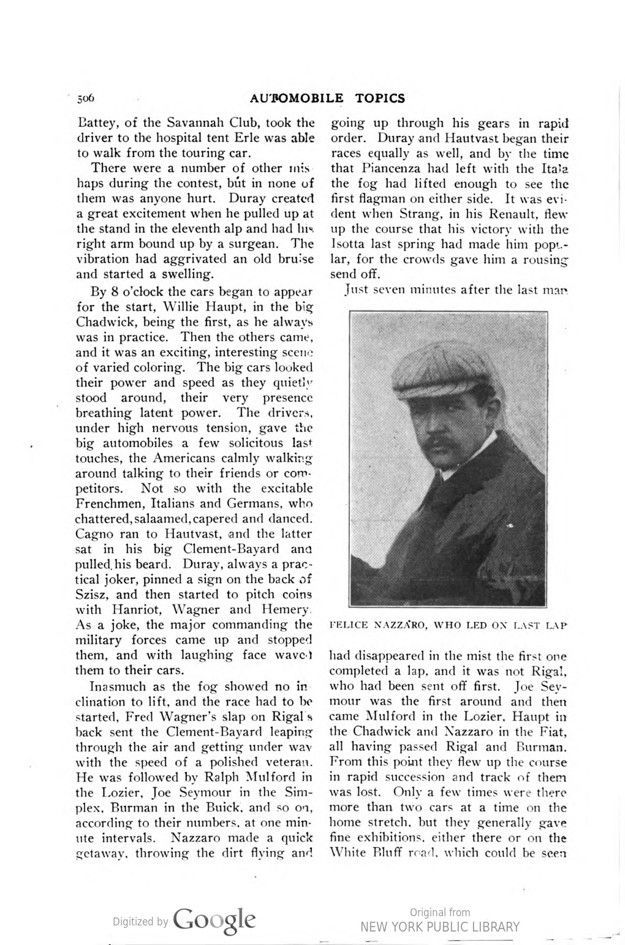
The exciting experience of Lancia and Hemery in the 1905 Vanderbilt race was repeated, with the addition of a thrilling period, brief but fraught with almost agonizing suspense, after the finish of the first car, when the outcome was still in doubt. As in 1905 Lancia seemed to have victory in his grasp, only to lose to Hemery through a mishap, so Nazzaro was the logical victor to-day until that fatal sixteenth lap. The 16,000 people in the grandstand and the 150,000 others gathered around the course were ready to acclaim him, when the coveted win was snatched away from him. Starting upon the last lap in first place, with a lead of 1 minute and 52 seconds over Hemery, and with Wagner only 2 seconds behind the latter,
Nazzaro, the „Speed King,“ began the finish of a well judged, splendidly driven race, only to meet with tire troubles that deprived him of victory and pushed him back to third place. This made Wagner’s opportunity, and the dashing Frenchman lost not a moment in grasping it. By a fast lap in 21 minutes and 52 seconds he overcame the minutes advantage possessed by Hemery, and while the former, by virtue of his starting 6 minutes earlier than Wagner, crossed the finishing line with a long lead, it did not equal the advantage given him by his drawing of an earlier number.
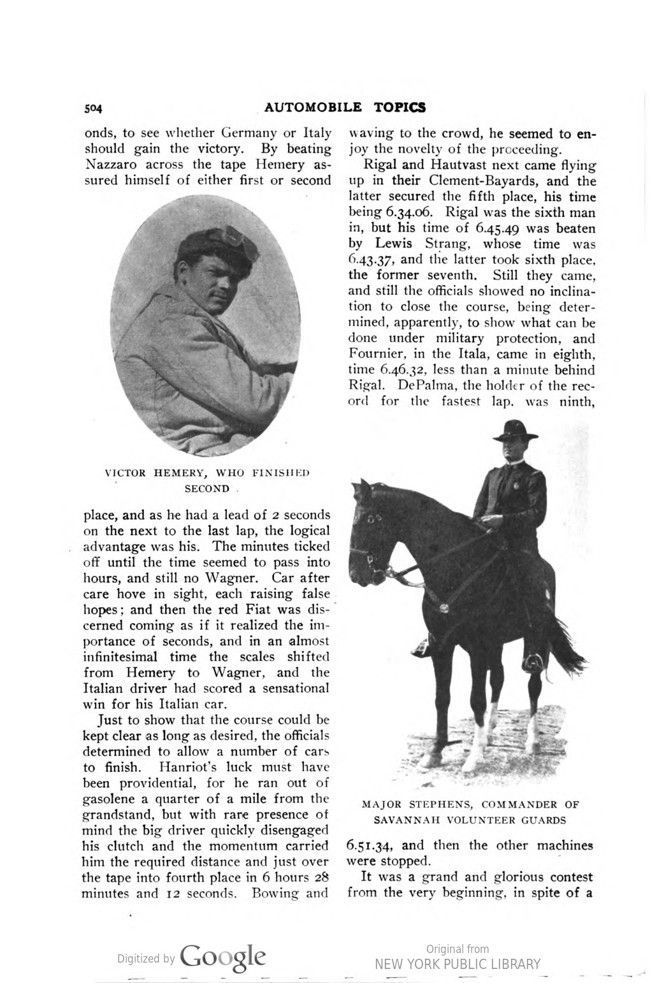
When Hemery, driving his Benz at a tremendous clip, finished officials and spectators settled themselves to counting first the minutes and then the seconds, to see whether Germany or Italy should gain the victory. By beating Nazzaro across the tape Hemery assured himself of either first or second place, and as he had a lead of 2 seconds on the next to the last lap, the logical advantage was his. The minutes ticked off until the time seemed to pass into hours, and still no Wagner. Car after care hove in sight, each raising false hopes; and then the red Fiat was discerned coming as if it realized the importance of seconds, and in an almost infinitesimal time the scales shifted from Hemery to Wagner, and the Italian driver had scored a sensational win for his Italian car.
Just to show that the course could be kept clear as long as desired, the officials determined to allow a number of cars to finish. Hanriot’s luck must have been providential, for he ran out of gasolene a quarter of a mile from the grandstand, but with rare presence of mind the big driver quickly disengaged his clutch and the momentum carried him the required distance and just over the tape into fourth place in 6 hours 28 minutes and 12 seconds. Bowing and waving to the crowd, he seemed to enjoy the novelty of the proceeding.
Rigal and Hautvast next came flying up in their Clement-Bayards, and the latter secured the fifth place, his time being 6.34.06. Rigal was the sixth man in, but his time of 6.45.49 was beaten by Lewis Strang, whose time was 6.43.37, and the latter took sixth place, the former seventh. Still they came, and still the officials showed no inclination to close the course, being determined, apparently, to show what can be done under military protection, and Fournier, in the Itala, came in eighth, time 6.46.32, less than a minute behind Rigal. De Palma, the holder of the record for the fastest lap, was ninth, 6.51.34, and then the other machines were stopped. It was a grand and glorious contest from the very beginning, in spite of a very heavy fog that delayed the start from 9 o’clock to 9.45. To all the thousands of northerners the great feature of the race, almost surpassing that of the sensational finish, and making the latter possible, was the management and policing. Six hundred militiamen and 100 policemen, all with loaded arms, did the work, and so enthusiastic were the foreign drivers after the race that their mouths were speechless and their hands expressed their joy.
Imagine a home stretch in any part of the world where, as far as the eye could see, there were only four men on the road, one policeman and three flagmen. And in front of the supply pits there were ten men, the announcer, two military officials and the rest judges, whose duty required them to be there. So strict was the management that very few passes were given to the officials, the supply pit employees and photographers, and these men then had to sign a release to the Savannah Automobile Club for any personal injuries received.
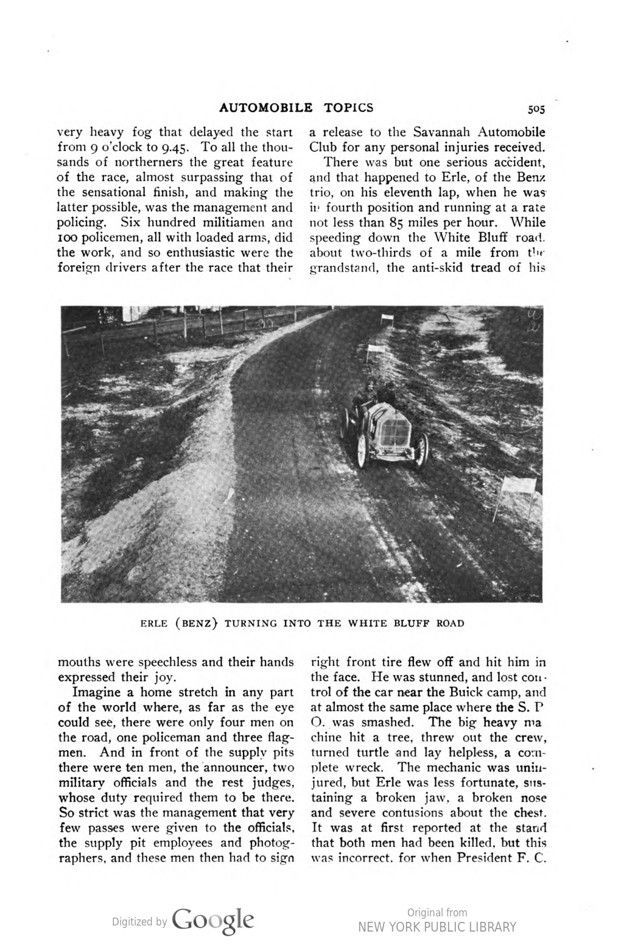
There was but one serious accident, and that happened to Erle, of the Benz trio, on his eleventh lap, when he was in fourth position and running at a rate not less than 85 miles per hour. While speeding down the White Bluff Road. about two-thirds of a mile from the grandstand, the anti-skid tread of his right front tire flew off and hit him in the face. He was stunned, and lost control of the car near the Buick camp, and at almost the same place where the S. P O. was smashed. The big heavy ma chine hit a tree, threw out the crew, turned turtle and lay helpless, a complete wreck. The mechanic was uninjured, but Erle was less fortunate, sustaining a broken jaw, a broken nose and severe contusions about the chest. It was at first reported at the stand that both men had been killed, but this was incorrect, for when President F. C. Battey, of the Savannah Club, took the driver to the hospital tent Erle was able to walk from the touring car.
There were a number of other mis haps during the contest, but in none of them was anyone hurt. Duray created a great excitement when he pulled up at the stand in the eleventh alp and had his right arm bound up by a surgeon. The vibration had aggravated an old bruise and started a swelling.
By 8 o’clock the cars began to appear for the start, Willie Haupt, in the big Chadwick, being the first, as he always was in practice. Then the others came, and it was an exciting, interesting scene of varied coloring. The big cars looked their power and speed as they quietly stood around, their very presence breathing latent power. The drivers, under high nervous tension, gave the big automobiles a few solicitous last touches, the Americans calmly walking around talking to their friends or com- petitors. Not so with the excitable Frenchmen, Italians and Germans, who chattered, salaamed, capered and danced. Cagno ran to Hautvast, and the latter sat in his big Clement-Bayard and pulled his beard. Duray, always a practical joker, pinned a sign on the back of Szisz, and then started to pitch coins. with Hanriot, Wagner and Hemery. As a joke, the major commanding the military forces came up and stopped them, and with laughing face waved them to their cars.
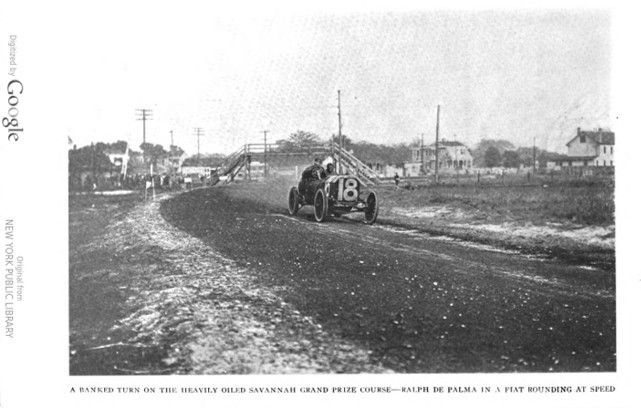
Inasmuch as the fog showed no inclination to lift, and the race had to be started, Fred Wagner’s slap on Rigal’s back sent the Clement-Bayard leaping through the air and getting under way with the speed of a polished veteran. He was followed by Ralph Mulford in the Lozier, Joe Seymour in the Simplex, Burman in the Buick, and so on, according to their numbers, at one minute intervals. Nazzaro made a quick getaway, throwing the dirt flying and going up through his gears in rapid order. Duray and Hautvast began their races equally as well, and by the time that Piacenza had left with the Itala the fog had lifted enough to see the first flagman on either side. It was evident when Strang, in his Renault, flew up the course that his victory with the Isotta last spring had made him popular, for the crowds gave him a rousing send off. Just seven minutes after the last man had disappeared in the mist the first one. completed a lap, and it was not Rigal, who had been sent off first. Joe Seymour was the first around and then came Mulford in the Lozier, Haupt in the Chadwick and Nazzaro in the Fiat, all having passed Rigal and Burman. From this point they flew up the course in rapid succession and track of them was lost. Only a few times were there more than two cars at a time on the home stretch, but they generally gave fine exhibitions, either there or on the White Bluff Road, which could be seen from the stands. It was evident from the first that some fast laps were being made, but some surprise, coupled with pleasure, was shown when it was seen that Ralph DePalma led Wagner by 12 seconds; Hanriot was third, and Szisz fourth. Rigal, the first to start, was eighth around.
Tire troubles commenced at once, and fear was expressed lest there be a repetition of the fatal incidents of the last Grand Prix race in France, when the speed attained by these monsters was more than tires could stand. It was a tire blowout that lost the race for Nazzaro, for the one he used in replacing the flat one was found to be soft and a second change was necessary.
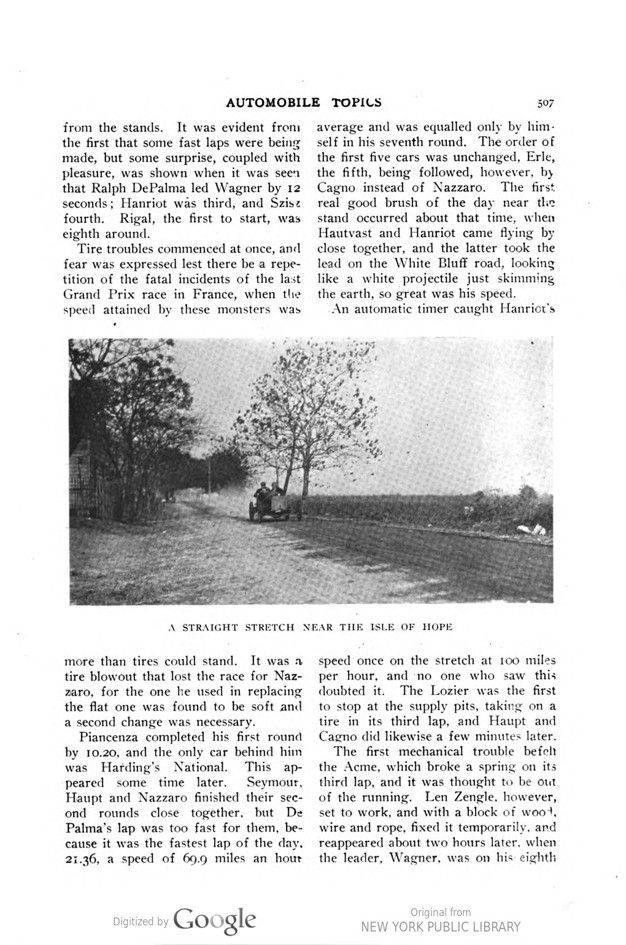
Piacenza completed his first round by 10.20, and the only car behind him was Harding’s National. This appeared some time later. Seymour, Haupt and Nazzaro finished their second rounds close together, but De Palma’s lap was too fast for them, because it was the fastest lap of the day. 21.36, a speed of 69.9 miles an hour average and was equalled only by himself in his seventh round. The order of the first five cars was unchanged, Erle, the fifth, being followed, however, by Cagno instead of Nazzaro. The first real good brush of the day near the stand occurred about that time, when Hautvast and Hanriot came flying by close together, and the latter took the lead on the White Bluff Road, looking like a white projectile just skimming the earth, so great was his speed.
An automatic timer caught Hanriot’s speed once on the stretch at 100 miles per hour, and no one who saw this doubted it. The Lozier was the first to stop at the supply pits, taking on a tire in its third lap, and Haupt and Cagno did likewise a few minutes later. The first mechanical trouble befell the Acme, which broke a spring on its third lap, and it was thought to be out of the running. Len Zengle, however, set to work, and with a block of wool, wire and rope, fixed it temporarily, and reappeared about two hours later, when the leader, Wagner, was on his eighth lap. Zengle was given a hearty cheer, but the break was too serious to be mended strongly enough for that hard test and after four more laps he stopped. The Buick had to draw out on its third lap, and no details of its trouble could be learned. It was in eighteenth place at the time. In the third lap popular DePalma had some trouble that caused a disastrous delay for him, and he dropped to sixteenth position. Hanriot defeated Wagner in the run for first place, and Szisz took second, with Erle, of the Benz team, third, Cagno fourth and Nazzaro fifth.
The American cars were trying vainly to keep the pace set by the foreigners but could not. Haupt was regarded as the most likely of the Americans, but he first had tire trouble, then brake trouble and, finally in the fifth lap, his oiler stopped working, causing the motor to follow suit. Harding brought in the report about the Chadwick as the National finished its fifth circuit. The first tire change at the grandstand was made by Hanriot in his fifth lap, but he did it quickly enough to keep in the lead. In starting off he and Szisz, who was also pulling away, came dangerously close together, but both steered apart and an accident was avoided. Duray had to stop his De Dietrich in the fifth round to repair his left rear brake, which was either broken or binding. He consumed about 20 minutes of precious time in putting it to rights.
The fifth lap found Hanriot still leading, but with Wagner second, Nazzaro third and Szisz fourth, while Hemery then appeared on the lists as fifth. By a quick sixth lap, made in 22.24, Hemery took a leap to second place and Erle made fifth. Hanriot lost his first place to Wagner in the eight lap, dropping to fifth, while Hemery kept second, Nazzaro third and Erle fourth. An interesting brush took place in the seventh lap, when Cagno met Rigal on the home stretch and passed him.
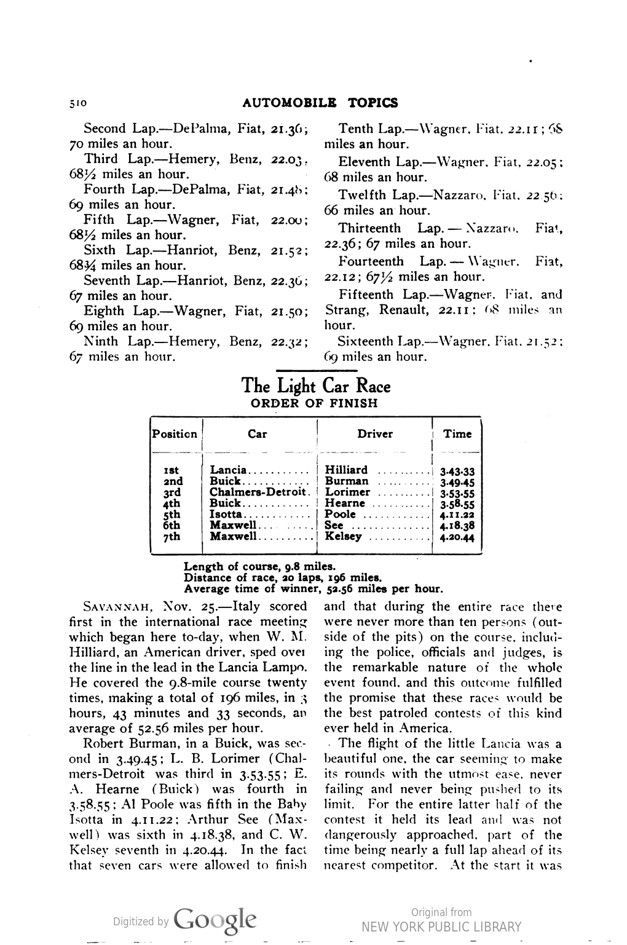
All during the early part of the day non-skid tires were used, but DePalma changed all four to flat treads on the sixth lap. On this lap Piacenza, who was then in eleventh place, blew out a cylinder at the Isle of Hope and was forced to stop. On the seventh lap Szisz, who was running in sixth place, broke a front axle and he too had to stop; this happened on Ferguson Avenue, the fast straightaway, and, although he was going at great speed, no serious damage was reported.
Wagner’s leadership was short, for on the ninth lap Hemery took that place from him and he dropped to third, with Nazzaro second, Erle fourth and Hanriot fifth.
The first half of the race was finished with the cars in the following order: Wagner, Hemery, Nazzaro, Erle, Hanrriot, Cagno, Hautvast, Fournier, Rigal, Strang, DePalma, Duray, Seymour, Harding and Mulford. Cagno retired in the eleventh lap with a broken rear spring, which might have thrown his rear construction out of line. Wagner led again in the eleventh lap, with Hemery second, Nazzaro third and Hanriot fourth (which place he held straight through to the finish) and Hautvast fifth. Ralph Mulford made a long stop somewhere on the course, but when he did come around, nearly an hour later, his car was running splendidly and better than at the start.
Felice Nazzaro took the lead in the twelfth lap and was never headed until the last, whereas Wagner, the winner, was third and Hemery second, so that Wagner really took Nazzaro’s place from him to win.
All during the time that the crowd was watching the big cars of the foreigners, two Americans, the Simplex and National, were having a beautiful race of their own for the thirteenth position, the former leading by a slight margin. When the race was called there were still running the Lozier on its eleventh lap, the Simplex on its fifteenth and Duray (De Dietrich) on his fifteenth. Harding did not continue after the twelfth lap.
When De Palma crossed the line and the race was called off, he was the ninth of the twenty starters to finish. Six other cars were still running, while five had dropped out.
The American cars started out well, although, of course, unable, except Haupt in the Chadwick, to keep up with the foreign racing machines. The Sin- plex, with Seymour driving, was the only American car to exceed twelve laps. It had finished fourteen of the sixteen laps; the National with Hugh Harding at the wheel had made eleven circuits of the course, and the Lozier, handled by Ralph Mulford, had made ten; the Acme six, the Chadwick four and the Buick but two when various troubles took them out of the running.
The drivers making the fastest time in each lap were as follows:
First Lap. — De Palma, Fiat, 22.18; 67 miles an hour.
Second Lap. — De Palma, Fiat, 21.30; 70 miles an hour.
Third Lap. — Hemery, Benz, 22.03. 68½ miles an hour.
Fourth Lap. — DePalma, Fiat, 21.46; 69 miles an hour.
Fifth Lap. — Wagner, Fiat, 22.00; 68½ miles an hour.
Sixth Lap. — Hanriot, Benz, 21.52; 6834 miles an hour.
Seventh Lap. — Hanriot, Benz, 22.30; 67 miles an hour.
Eighth Lap. — Wagner, Fiat, 21.50; 69 miles an hour.
Ninth Lap. — Hemery, Benz, 22.32; 67 miles an hour.
Tenth Lap. — Wagner, Fiat, 22.11; 58 miles an hour.
Eleventh Lap. — Wagner, Fiat, 22.05: 68 miles an hour.
Twelfth Lap. — Nazzaro, Fiat, 22.56: 66 miles an hour.
Thirteenth Lap. — Nazzaro, Fiat, 22.36; 67 miles an hour.
Fourteenth Lap. — Wagner, Fiat, 22.12; 67½ miles an hour.
Fifteenth Lap. — Wagner, Fiat, and Strang, Renault, 22.11; 68 miles an hour.
Sixteenth Lap. — Wagner, Fiat, 21.52: 69 miles an hour.