The 1902 Gordon Bennett race was projected from Paris to Innsbruck and was part of the Paris-Vienna race. Only six vehicles participated: France with a Mors, a Panhard and a C.G.V. versus Great Britain with a Napier and two Wolseleys. This report of The Horseless Age deals with the Paris-Vienna race and here too, the Gordon Bennett race is only a monir part of the report. After three year, the Gordon Bennet Cup seemed to slither into mere oblivian; for the press too.
With permission of hathitrust hathitrust.org == Text and fotos compiled by motorracinghistory motorracinghistory.com
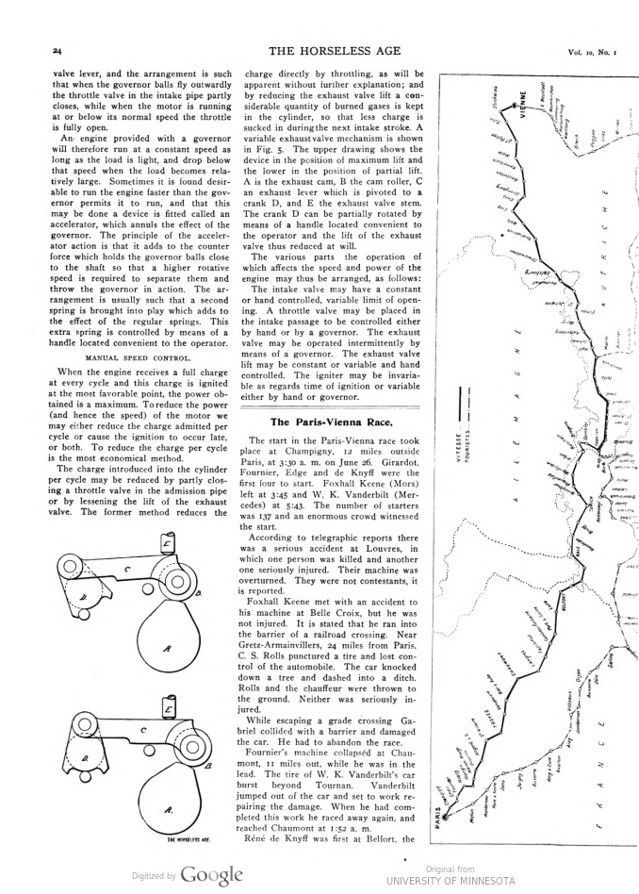
THE HORSELESS AGE — Volume 10, No. 1, July 2, 1902
The Paris-Vienna Race.
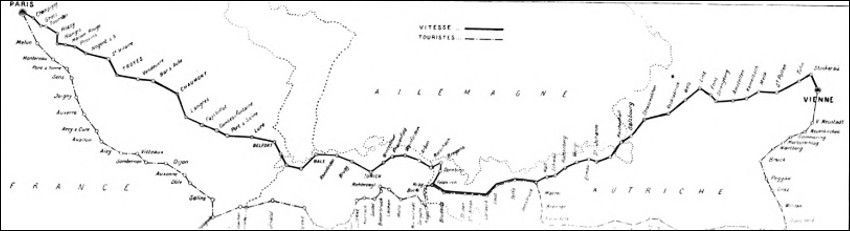
The start in the Paris-Vienna race took place at Champigny, 12 miles outside Paris, at 3:30 a. m. on June 26. Girardot, Fournier, Edge and de Knyff were the first four to start. Foxhall Keene (Mors) left at 3:45 and W. K. Vanderbilt (Mercedes) at 5:43. The number of starters was 137 and an enormous crowd witnessed the start.
According to telegraphic reports there was a serious accident at Louvres, in which one person was killed and another one seriously injured. Their machine was overturned. They were not contestants, it is reported.
Foxhall Keene met with an accident to his machine at Belle Croix, but he was not injured. It is stated that he ran into the barrier of a railroad crossing. Near Gretz-Armainvillers, 24 miles from Paris, C. S. Rolls punctured a tire and lost control of the automobile. The car knocked down a tree and dashed into a ditch. Rolls and the chauffeur were thrown to the ground. Neither was seriously injured.
While escaping a grade crossing Gabriel collided with a barrier and damaged the car. He had to abandon the race.
Fournier’s machine collapsed at Chaumont, II miles out, while he was in the lead. The tire of W. K. Vanderbilt’s car burst beyond Tournan. Vanderbilt jumped out of the car and set to work repairing the damage. When he had completed this work he raced away again, and reached Chaumont at 1:52 a. m.
Réné de Knyff was first at Belfort, the end of the first day’s race, arriving at 10:47 a. m. The distance is 408 kilometres (255 miles). His net time was 4h. 6m., indicating an average speed of 100 kilometres (62½ miles) per hour.
The first six machines were Panhards. Then followed Count Zborowski in a Mercedes, de Crawhez in a Panhard, Giraud in a Charron, Girardot and Voigt, Decaters in a Mors and Edge in a Napier. Girardot was also put hors de combat by an accident. Vanderbilt arrived at Belfort at 4:21 p. m., being the fifty-fifth to arrive.
The winner for this stage in the light automobile category was M. Edmond, with a Darracq machine, his net time being 4h. 47m. M. Oury won in the voiturette cate- gory with a Renault in 6h. 19m.
Of the 137 starters from Paris 106 arrived at Belfort and 105 started on the second stage on the 27th.
The first four starters from Paris – Girardot, Fournier, Edge and de Knyff – competed for the Gordon-Bennett cup, the race for which was run in conjunction with the Paris-Vienna race and was to be from Paris to Innsbruck, a distance of approximately 500 miles, plus neutralized territory. At Belfort the first two were out already and only the last two – Edge and de Knyff – remained to compete for the cup.
The Swiss authorities had refused to sanction racing on their territory, and on the second day the racers therefore proceeded at a moderated gait from Belfort to Bregenz in Austria on the Swiss frontier.
On Saturday the third stage, Bregenz to Salzburg, was run. De Knyff was far ahead of all other competitors when 25 miles before Innsbruck his machine broke down and he had to quit. Edge was therefore the only one to finish in the International or Gordon-Bennett cup race, and he is regarded as the winner. His actual time from Paris to Belfort and from Bregenz to Innsbruck was 10 h. 41m. 58s. It is asserted that Edge will be disqualified on account of having received help from some peasants in extricating his machine from a bad place on the road. Edge, on his part, says that when his machine fell into a ditch a number of peasants ran to assist him in getting it out, but he drove them away and got the car out himself. He protested against being disqualified.
Baron de Forest (Mercedes) was the first to reach Salzburg, at 1:34 p. m., his average speed up to that point having been 44½ miles. Henry Farman arrived second, at 2:18, and he was said to be the winner up to that point.
Many automobiles were damaged, owing to the poor condition of the roads. A number of accidents occurred in crossing the Arlberg. One of the competing vehicles is said to have run off a bridge and dropped into the River Sena, 300 (?) feet below, being smashed to pieces. The occupants escaped with slight injury.
The race came to an end on Sunday at the Vienna trotting track. It was an unusually hot day, but an immense crowd of people had gathered on the grand stands and promenades.
The first to arrive was Marcel Renault (Renault, light carriage class), and, as is usual on such occasions, he was received with vociferous applause. It is possible that he may be disqualified, as he failed to have his pass signed at the last controlling station. He states that the omission was unintentional.
The second to arrive, and the first in the heavy vehicle class, was Count Zborowski (Mercedes), who presumed that he was the winner. He was followed after a considerable time by Maurice Farman (Panhard). Zborowski accounted for his good‘ showing partly by the fact that he had never had to renew his water supply.
The actual running time of Marcel Renault was 15 hours 22 minutes, which gives him an average speed of 82 kilometres (51 miles) per hour. After Farman came Baras (fourth), Edmond (fifth) and Hemery (sixth). At the time of going to press the winner is not known. The credit of being winner in the Paris-Vienna race is claimed by Renault, Zborowski and Farman, and that of winning the Gordon Bennett cup race by Edge. Protests have been filed against Edge and Renault, however.
In the evening a banquet was held, which was attended by the French ambassador, the president of the Austrian Automobile Club and others.