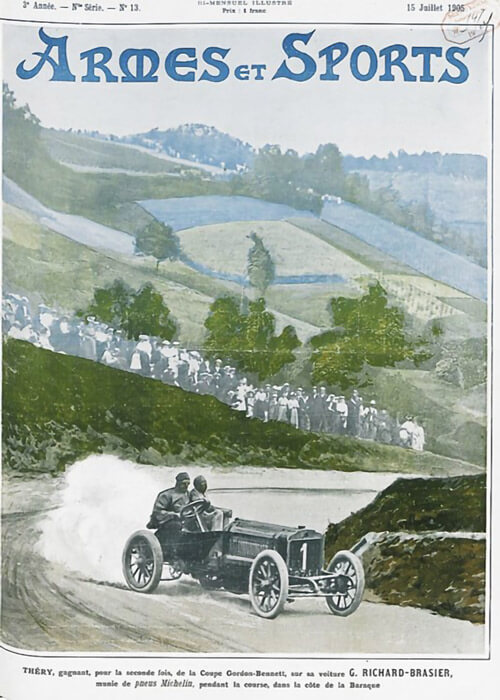
An all-encompassing summary of the first Gordon Bennett Cup race Paris-Lyon. The most important conclusions: „—– that the race was very badly organized, that insufficient preparations had been made for it and that it must be looked upon as a failure.“ Here you have it, the American view on an European motor racing event, initiated by an American.
With permission of hathitrust hathitrust.org == Text and fotos compiled by motorracinghistory
THE HORSELESS AGE — Volume 6, No. 14, July 4, 1900
THE GORDON BENNETT INTERNATIONAL CUP RACE.
BY P. M. HELDT.
The results of this race are, of course, known in America, but a few observations made at short range might be of interest to the readers of THE HORSELESS AGE.
The race was less international than its name would imply, three of the five participants starting being French, so that, granting equal value to each of the racers, and applying the theory of probability, we should have reached the conclusion that France had greater chance of winning than of loosing the cup race. The internationality soon vanished entirely, on account of accidents sustained by the vehicles of the two foreigners, and the race finished as a match between two business partners-Charron and Girardot.
The race was run between Paris and Lyons, and the club whose representative arrived at Lyons first was to retain the cup. One of the conditions laid down by the donor of the cup was that the distance covered should not be less than 550 h. m. (344 miles). As the distance between Paris and Lyons is less than this, a roundabout way was taken.
The start was given at the Parc St. Cloud, on the road to Versailles, at 3 o’clock in the morning. A couple of hundred of spectators were present. Eight racers had been entered for the course, three French, three Belgian, one American and one German. None of the Belgian vehicles had arrived on the day of the race, and the only participant of the Belgian contingent, M. Jenatzy, who will be remembered in connection with the kilometre championship and his torpedo-shaped vehicle, the „Jamais Content,“ started with “ any which“ vehicle, as he said. Objection was at once made, it being claimed that the tires of M. Jenatzy’s vehicle were of French make, while the conditions of the race stipulated that the vehicles should be entirely the product of the country, which they represented. Nevertheless M. Jenatzy started.
Herr Engen, who was to represent Germany with a Benz vehicle, withdrew at the last moment. The Benz Co. had expected to have a 30 h. p. racer ready for this race, but it was not completed in time. Herr Engen intended to take part with a 15 h. p. vehicle which last year won the race Berlin-Leipsic. He withdrew, giving as an excuse insufficient time for preparation. The official authorization was obtained only three days before the race took place. Before this time, it was extremely questionable whether the race would be run. M. Jenatzy and a number of other Belgian present also talked of addressing a formal protest to the Automobile Club against the too short time allowed for preparation.
The three French participants, Charron, Girardot and de Knyff, all had exactly the same vehicle, Panhard racers of 27 h. p. The double cylinder vertical engine is placed in front, and the construction follows the same general lines as that of the ordinary Panhard vehicles. The cases are entirely of partinium, an aluminum alloy. (*See THE HORSELESS AGE, June 20).
The engines are governed on the hit-and-miss principle, and when the vehicle stands still and the engine is runing, an explosion, occurring every three or four seconds, will set every sheet of partinium of the body vibrating, thus producing a strong metallic ring, which gradually dies out only to be reinforced by another explosion.
Mr. Winton employed the vehicle illustrated in THE HORSELESS AGE Some time ago. It has a single cylinder engine, of his own type, of 6½-inch bore and 6¾-inch stroke. The weight of his vehicle with supplies is nearly 2,000 lbs. Before covering 75 miles of the course Mr. Winton had a rear tire punctured and a front wheel damaged, which retarded him considerably. A little farther on, René de Knyff broke his high-speed gear, which put him „hors de combat.“ Girardot broke a wheel at Orleans in running against a walk, trying to evade a horse team. Charron bent his rear axle running against a milestone; and Jenatzy also had an accident. Charron and Girardot finished, however, the former in 9 hrs. 9 m., and the latter in 10 hrs. 36m. The actual distance is 354 miles, giving a mean for the winner of nearly 39 miles an hour. This is more than the average made by the express train running between Paris and Lyon.
As is usual on such occasions, a large number of dogs were sacrificed to the cause of science (or to the cause of sport). Jenatzy claims to have five or six on his conscience, and if the other contestants killed each as many this was certainly an unlucky day for the dogs of France. Many flocks of sheep were also encountered by the racers, and it is just short of a miracle that no serious accident happened to anyone of the participants.
In general, it is the impression here that the race was very badly organized, that insufficient preparations had been made for it and that it must be looked upon as a failure.
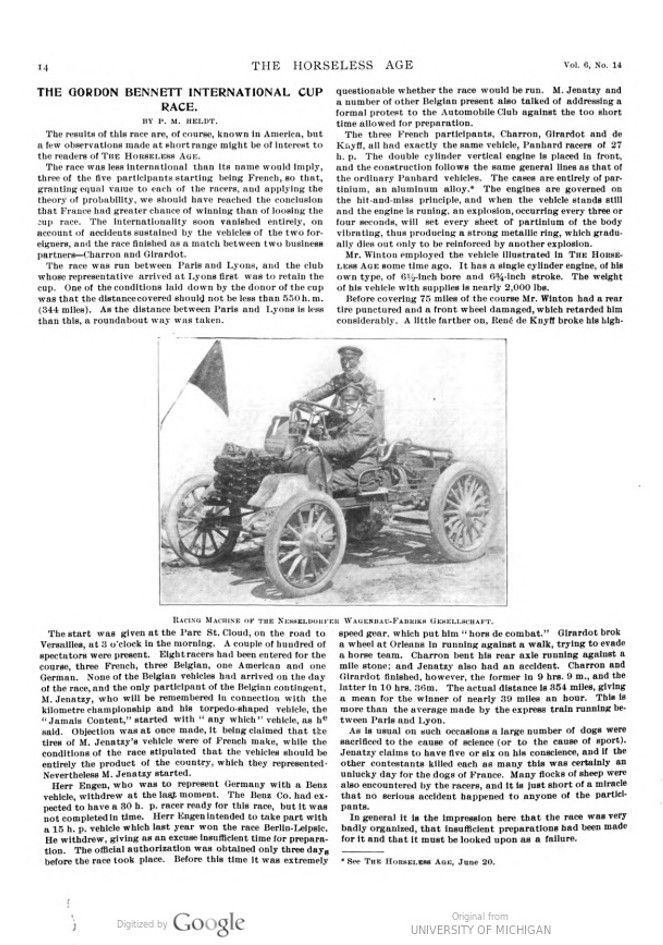
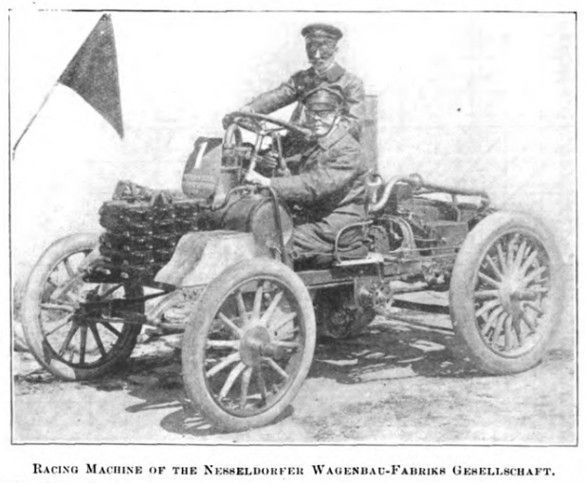
Photo page 1: RACING MACHINE OF THE NESSELDORFER WAGENBAU-FABRIKS GESELLSCHAFT.
MORE ABOUT THE RACE.
The correspondent of The Motor-Car Journal, describing the Gordon Bennett Cup Race, writes in part as follows:
Away out into the country I tramped (from Orleans), and had reached and rested a good 40 minutes at the tiny halmet of Le Moulin Choix before away in the distance was heard the Maxim-like sound of a big racing machine. I looked at my watch, which showed 5:7, and inwardly remarked, „By Jove, they are traveling in spite of all the local regulations,“ for to cover some 163 kilometres in 2 hrs. 7 min. means fast going. The noise continued for perhaps a minute, then ceased as the car ran behind an intervening hill, only to break forth with redoubled vigor as the racer’s nose showed above the crest of the hill and dashed down towards us.
The local enthusiasts sent up a howl of despair. The car was red! America’s color! But as she whizzed past us I recognized the grim countenance of M. Levegh, and was able to reassure the group of villagers that it was no American invader who was leading the way, but merely a French automobilist whose car the „A. C. F.“ had not considered good enough to represent „la belle France.“
As Levegh was traveling at some 90 kilometres an hour the effect of my explanation was that the good people of Le Moulin Choix fully anticipated seeing the actual representatives of their fatherland fly rather than drive past, and when 35 minutes later M. Girardot hove in sight they were visibly disappointed at his moderate gait of about 56 miles per hour. It was near to Le Grand Orme that Girardot passed us, for we had walked back a couple of kilometres, and five minutes after he had disappeared down the long, level stretch of road, Charron arrived at express speed.
Never have I seen a car travel so fast on level ground as did that of Charron’s last Thursday morning at Le Grand Orme, and I have seen some few races too. She simply flew along, and then at St. Jean de la Ruelle she struck the caniveau (block pavement) traversing the route close to the Mairie and was pulled up with a back axle bent almost double and a pump badly wrecked.
By the time I reached the scene of the mishap Charron had roughly effected repairs and set out again, but very slowly, and no one anticipated that he would finish the race. We then procured and hoisted a green flag some 30 yards before the caniveau, and this, aided by plenty of shouting, had the effect of reducing De Knyff’s speed to walking pace where he reached the dangerous spot. A wave of the hand from De Knyff, and off he went again, but not at the pace at which he usually races, and it was obvious from that and the grinding sound made by his car that something was amiss. Jenatzy was the next comer, and he also was not traveling well, while the car of Mr. Winton, the whipper-in, presented a woe-begone appearance, with a buckled front wheel and a collapsed tire.
A long tramp brought me back to Orleans, where I heard of Girardot’s accident as he was leaving the town by the Porte de Bourgogne. A frightened horse, a sudden swerve, and the back wheel broken against a curbstone, such briefly the story of Girardot’s mishaps. This resulted in a loss of some 80 minutes to him, but for which he would doubtless have made a desperately close finish with Charron. It was here, too, that Mr. Winton decided to abandon the con- test, and it is quite possible that had not the Comte de Chasseloup-Laubat been at Orleans and told Charron how matters stood, he, too, would have discontinued. The official returns at this point, 173 kilometres from the start, were as follows:
Name. Time. Average.
1. Girardot 5:53 60.0 kilometres
2. Charron 6:10 58.9 “
3. De Knyff 6:49 48.2 “
4. Jenatzy 6:52 47.6 “
5. Winton 8:30 –
Between Orleans and Glen there are 63 kilometres, and at the latter place Charron arrived at 7:15 a. m., followed by Jenatzy at 8:25 a. m., and Girardot at 8:45 a. m., their respective average speeds per hour being 58.70, 45.00 and 42.70 kilometres. Here de Knyff, who had, previous to reaching Orleans, decided to abandon the race, actually quitted the route and returned to Paris with MM. Krebs and Chasseloup-Laubat. At Nevers, 322 kilometres from the start, Charron was a long way ahead of Girardot, and his average speed per hour was 59.69 kilometres as compared with the latter’s 47. Jenatzy had dropped into the last place of the three remaining competitors -tire, gear and ignition troubles worrying him incessantly. Fifty-four kilometres further on, at Moulins, Charron found Huillier and Levegh awaiting him, and they lent a willing hand in refilling his petrol tanks. At that point the ultimate winner’s average speed had advanced to 60 kilometres per hour. Girardot arrived an hour and a half later, and after rapidly replenishing his petrol tanks he also made haste for Lyons. As for Jenatzy, he was hopelessly en panne some few kilometres outside the town. At La Palisse Charron passed through the town at 10:9 a. m., and Girardot at 11:44, while at Roanne, 49 kilometres further on (476 kilometres from the start), the former arrived at 10:56 a. m. and the latter at 12:34. From La Palisse onward the route became very hilly, with numerous nasty turnings, until the last 12 or 15 kilometres into Lyons had to be negotiated, where the road was excellent. It was here that Charron met with an extraordinary accident. When traveling at nearly 100 kilometres an hour a large dog ran right in the way of the car and became wedged between the steering gear and the springs. The vehicle swerved violently to the left, passed between two of the trees bordering the route, descended into the ditch, mounted again, and continued its course down the road. And the dog was dead! And so was the pump pretty nearly; for Fournier, who was with Charron, had to hold it in place for the remainder of the journey.
From 10 o’clock in the morning a crowd of automobile enthusiasts had congregated before the hospitable doors of the „Delices de la Demi-Lune,“ that restaurant situated on the Arbrecle route, and so well known to all the chauffeurs and cyclists of Lyons. The members of the local automobile club had turned out in great force, and they were supported by many well-known motor men from all parts of France. Had the melancholy finish of the race been anticipated, I doubt whether the attendance would have been so large, for while recognizing the superiority of the French cars, still a semblance of a struggle was expected. But not a bit of it. The race was but a race in name, and not a particle of excitement could be worked up over the arrival of but two competitors, and these two representing the same country, and separated by the trifle of an hour and a half. Charron reached the control at 12:23 in a considerably exhausted condition, while his mechanician Fournier, was even more done up, having been required to hold in place a damaged pump during the last 12 kilometres of the course. Girardot arrived at 2 o’clock, and after that, although anxiously awaited, no other competitor put in an appearance. What a tame conclusion to what promised to be a terrific race! But there it is; and we must wait a twelvemonth ere we again have an opportunity of seeing a contest for the Gordon Bennett Cup.
Will France again retain it so easily? Time will show.