In this last of five articles on the 1900 Gordon Bennett Cup race, a summary is given on some specific feats during and around the event.
With permission of the Bibliothèque national francais, gallica.bnf.fr Text and fotos compiled by motorracinghistory
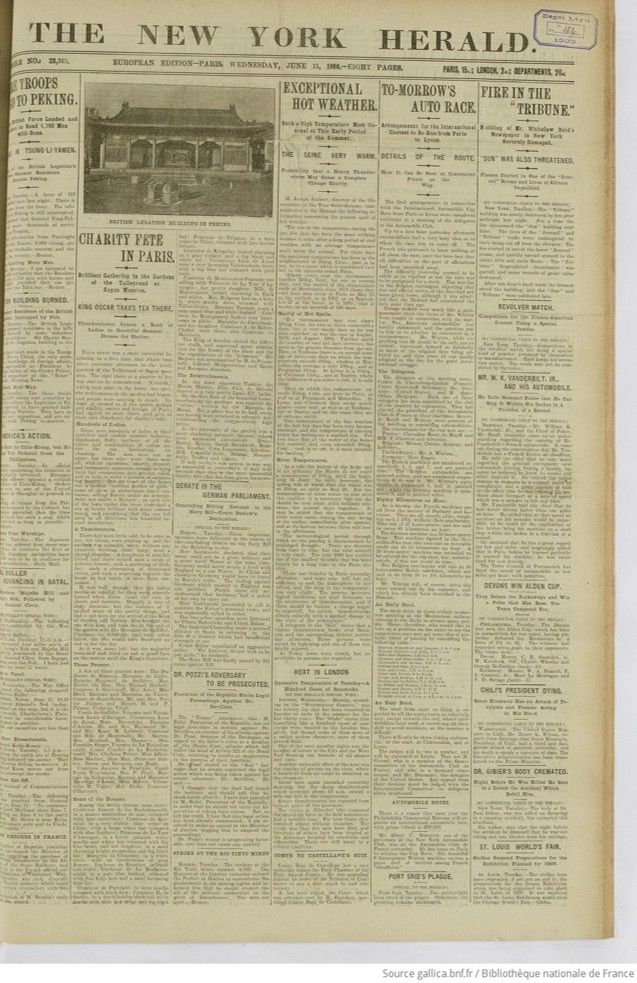
THE NEW YORK HERALD, European Edition — No. 23,308, Saturday, June 16, 1900, page 1.
LESSONS OF AUTO RACE.
American Machine Has Demonstrated the Utility of the Single Cylinder Motor.
WHAT M. CHARRON HAS TO SAY.
Contests Must Be Shorter to Avoid Accidents — M. Levegh’s Performance.
Now that the International Cup has been run for and won, the question is, what are the lessons of this important automobile struggle?
Two names stand out prominently in this connection — Charron and Winton.
The former because he represents a French victory, and the latter because he represents an American defeat.
Mr. Winton arrived in Paris late on Thursday night, and proceeded to London at an early hour yesterday morning. Mr. Shanks, who is associated with him, however, stated to a HERALD correspondent that Mr. Winton bore his defeat very well. The difficulty which the American automobilist experienced in the contest, was that his machine had skidded in going round a corner, and bumped into an embankment.
The effect of this was that, although the wheel was left intact, the steering-head, made of forged steel, was bent to an angle of forty-five degrees. And yet Mr. Winton continued to race. It was only when one of the tires of a rear wheel collapsed that the American automobilist was forced to abandon the race.
“The machine,” said Mr. Shanks, ” developed twenty-three horsepower. It weighed 1,4501b. It has too much power, and was too light to successfully compete with the high speed of the French machines. But the fact was demonstrated beyond question that the single cylinder motor of our peculiar type is practical, and does not limit power to a minimum degree, as is the case in other machines which have been constructed with a single cylinder.”
M. Charron.
M. Charron, who arrived in Paris last night by train, was met at the station by a number of friends. After receiving congratulations from all present, he said to a HERALD correspondent:
“In future races of this kind must be made much shorter. It is impossible to race at the high speed attained in the recent contest without risking one’s life. If this kind of thing continues the result will be that someday there will be for each competing automobile, two “chauffeurs” less in the world. Now, the ‘Course du Trefle’ is much more reasonable in this respect.
“I left my automobile to be brought back to Paris by train. M. Girardot, however, is returning to Paris on his racing machine.
“My automobile requires some adjustment. You remember that near Orleans, I ran over a dog. The animal’s body became entangled in the wheels and springs and caused my automobile to bound along in rather a strange fashion. I was going at the time at 90 kilometres an hour. Had M. de Knyff been able to continue, I should have been very much inclined to give up the contest.
Best Speed.
“The springs of my automobile were started, and the pump carried away by the accident I have described. The speed I obtained was perhaps the best I have ever officially accomplished, the maximum being at the rate of about 100 kilometres an hour. This was just before entering Lyons.
“But I am prepared to bet that I can do the distance from Paris to Lyons in about eight hours, providing I take the direct route.
“The road was, taking it as a whole, not bad.; but after leaving La Pallsse, it was impossible to make more than forty-eight kilometres an hour. This was due to the sharp turnings and gradients.
“This race proves that the Panhard and Levassor machines must be pretty solid to stand the wear and tear of such a speed on such a road.
“The race also shows that the higher the speed the more frequent the accidents, and hence the fewer to arrive at the winning post.”
In regard to M. Levegh’s trip, M. Charron remarked that it was an easy matter to race when not entered officially, since failure to win did not entail criticism.
As to M. Jenatzy’s performance, M. Charron was rather sarcastic so far as the machine was concerned. It “was not a machine selected at late hazard, as reported, but one originally intended for the race. M. Charron values the automobile in which he won the race at 75,000fr.
AUTOMOBILE NOTE.
The Rallye-Auto has arranged an excursion to the Forest of Marly for to-morrow.
Each “chauffeur” is requested to bring his own lunch, and a pleasant picnic is anticipated. — Figaro.
—————
The second Criterium for electric motors will be run on Monday from Paris to Melun and back. Start from the Pont de Neuilly at 7 a.m., arrival at the Pont de Suresnes about 11 a an. The following have entered: 1, Garcin; 2, H. O. Berg; 3, Bruel; 4, Heinz; 5, Cuvelier; 6, d’Espeugnes. — Figaro.
—————
The conductors of the automobiles which took part in the race from Paris to Lyons for the International Cup have, says the “Temps,” been charged with two breaches of the police regulations in the town of Versailles. The one is based on the excessive speed of the vehicles, and the other that they traversed the town at an hour other than that which had already been fixed.
—————
M. Auguste Bourtier, a mechanic, aged forty-two years, was on Wednesday afternoon testing an automobile on the road to Suresnes, when a sudden lurch of the vehicle caused him to lose his balance and fill under the wheels of his vehicle, which passed over his abdomen. The. unfortunate man, says the “Temps,” was admitted to the Beaujon Hospital in a very serious date!
———