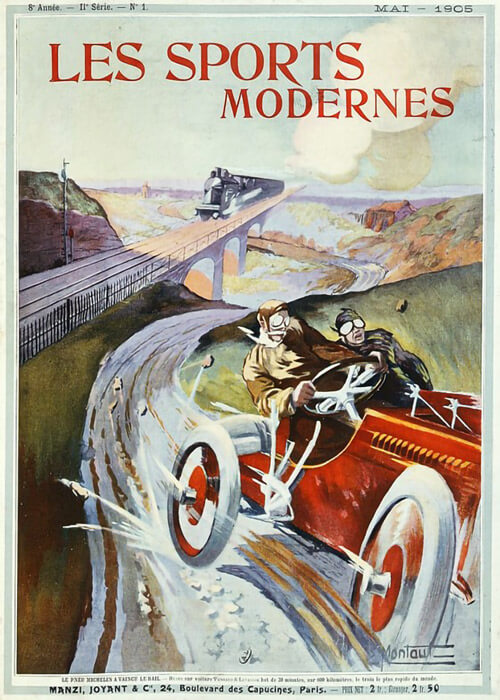
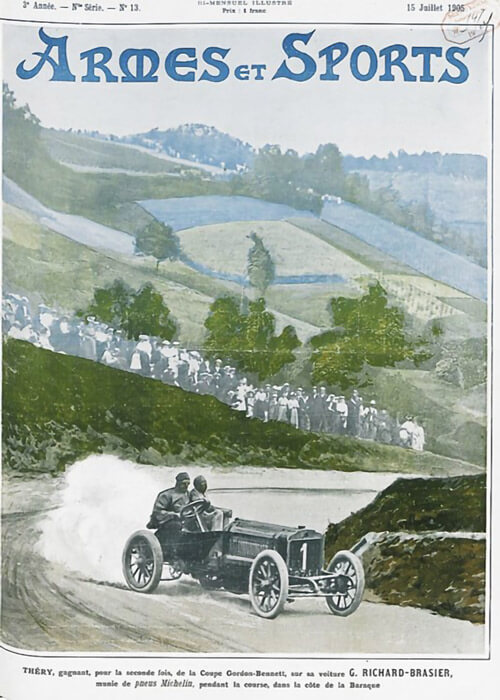
For the first Gordon Bennett Cup race in 1900, Paris-Lyon, the European edition of The New York Herald dedicated no less that five articles on that race. Logically, as this was the Cup initiator’s own newspaper. But one significant item comes up, going through the differenct issues. The name of James Gordon Bennett was never allowed to appear in this newspaper; such were the strict rules of the owner himself! Instead, one could only read titles such as “auto race” or “Coupe Internationale” in the Paris edition of The New York Herald. This one is the first of five.
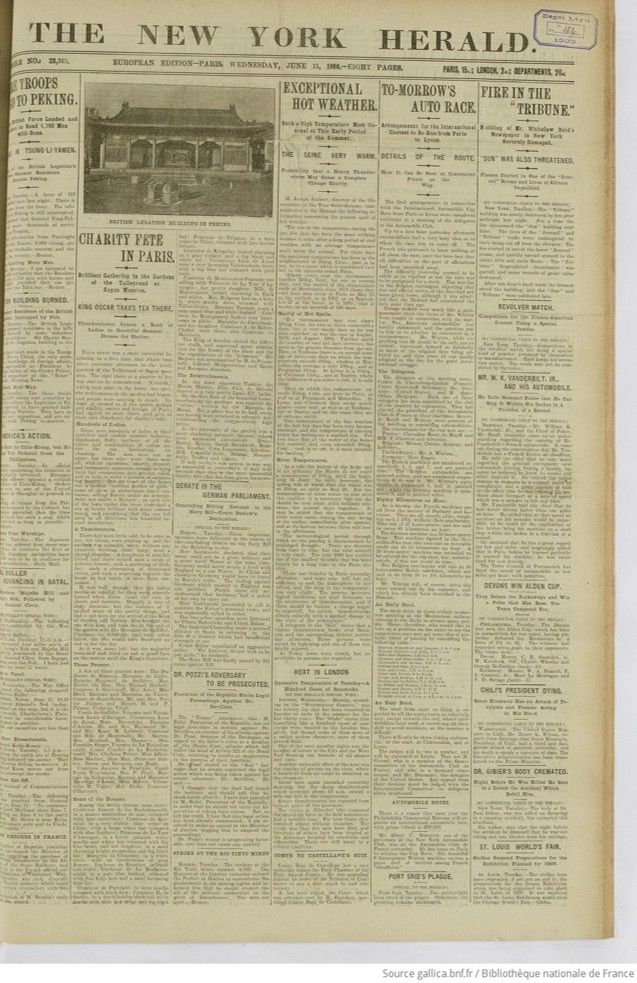
With permission of the Bibliothèque national francais, gallica.bnf.fr Text and fotos compiled by motorracinghistory
THE NEW YORK HERALD, European Edition — No. 23,305, Wednesday, June 13, 1900, page 1.
TO-MORROW’S AUTO RACE.
Arrangements for the International Contest to Be Run from Paris to Lyons.
DETAILS OF THE ROUTE.
How It Can Be Seen at Convenient Points on the Way.
The final arrangements in connection with the International Automobile Cup Race from Paris to Lyons were completed yesterday at a meeting of the delegates at the Automobile Club.
Up to a late hour yesterday afternoon, automobilists had a very hazy idea as to when the race was to come off. The French trio professed to know nothing at all about the race, save the bare fact that all difficulties on the part of officialdom had been smoothed away.
The difficulty yesterday seemed to be solely as to whether or not the race was to be postponed for a week. This was due to the Belgian contingent objecting that due and official notice of the date had not been given them, although it was admitted that the HERALD had announced the date some time ago.
Things looked very much like a postponement when the views of Mr. Winton were sought in connection with the matter. The American automobilist was hastily summoned, and the question put to him as to whether he concurred in a postponement. Mr. Winton, while regretting that he should be the only one to dissent, expressed himself as decidedly in favor of the original date being adhered to, and thus June 14 was finally adopted as the day for the great international struggle.
The Delegates.
The delegates at this meeting were :
Comte de Chasseloup-Laubat (France), Count Sierstorpff (Germany), Mr. Dinsmore (United States), and M. Ruys-Orban (Belgium). Each one of these delegates has been appointed by the club of the country he represents. They had elected the president of the Automobile Club de France as their chairman. Messrs. de Knyff and Winton were present at the meeting as consulting automobilists.
The contestants for the cup now are : —
France: Chevalier René de Knyff and MM. F. Charron and Girardot.
Belgium: Messrs. Caters, Jenatzy, and Lefebre.
United States: Mr. A. Winton.
Germany: Herr Eugen.
The French machines are numbered respectively 1, 5, and 7, and are painted blue. The Belgian automobiles are painted yellow, and are numbered respectively 2, 6, and 8. Mr. Winton’s automobile is numbered 4, and is painted red: while the German machine. is numbered 6, and is painted white.
Eighty Kilometres an Hour:
As is known, the French machines are all from the factory of Panhard and Levassor. They are all exactly alike, weighing each 1,100k. without their conductors.
They are of 27 horse-power, and are said to cover 80 kilometres an hour.
The German machine is a 15 horse-power Benz. This machine figured in the Marseilles-Nice race this year and on favorable loads can do 58 kilometres an hour. A 30 horse-power machine was intended to be entered for the cup race, but, unfortunately, it was not ready in time.
The Belgian contingent will ride in 30 horse-power Bolide machines, which are said to do from 90 to 105 kilometres an hour.
Mr. Winton will, of course, drive the racer turned out by his company, and which has already been described in the HERALD.
An Early Start.
The early start, at three o’clock tomorrow morning at the Montretout railway crossing is not likely to attract many people. Those, therefore, who would like to take up a position on the route to see the competitors pass may get some idea of probable times of passing by consulting the following table: —
Between Montretout and Limours, 3 to 4 a.m.
Between Limours and Ablis, 3 to 5 a.m.
Ablis and Chartres, 3.30. to 5 a.m.
Chartres and Châteaudum, 4 to 5.30 a.m.
Châteaudum and Orleans, 4.30 to 6 a.m.
Orleans and Gien, 5 to 7 a.m.
Gien and Cosne, 5.30 to 8 a.m.
Cosne and Nevers, 6 to 9 a.m.
Nevers and Moulins, 6.30 to 10 a.m.
Moulins and La Palisse, 7 to 10.30 a.m.
La Palisse and Roanne. 7.30 to 11 a.m.
Roanne and Tarare, 8.30 to 12.30.
Tarare and Lyon, 9 a.m. to 1 p.m.
Probable arrival at Lyon at 9.30 a.m. to 2 p.m.
An Easy Road.
The road from start to finish is regarded by all the contestants as relatively easy, except towards the end, where automobilists have need of exercising all their skill to avoid accidents, as the country is difficult.
There will only be three timing stations, viz., at the start, at Chateaudun, and at Lyons.
The judges will be two in number, and will be stationed at Lyons. They are M. Giraud, who is a member of the Sports committee of the Automobile Club de France, and who is a licensed timekeeper, and Mr. Dinsmore, the delegate of the United States. Any appeal from their decision must be lodged with the International Committee or delegates above mentioned.
———