Already after three years since its introduction, the Sweepstakes coud enjoy a huge publical interest. That must have been one of the reasons for The Horseless Age to write such an extensive preview for the 1914 Indianapolis Sweepstakes, Therefore, it’s best to post the article here in two parts. Here now is part 1 of the preview, introducing the foreign and the American cars and drivers, as well as race and racetrack specifics, prizes for drivers and, not to forget, for spectators.
Text and jpegs by courtesy of hathitrust.org www.hathitrust.org, compiled by motorracinghistory.com
THE HORSELESS AGE Vol. XXXIII (33), No. 20, May 20, 1914
Tuning Up for the Fourth 500 Mile Race. (Part 2)
THE STAGE FOR THE GREAT RACE.
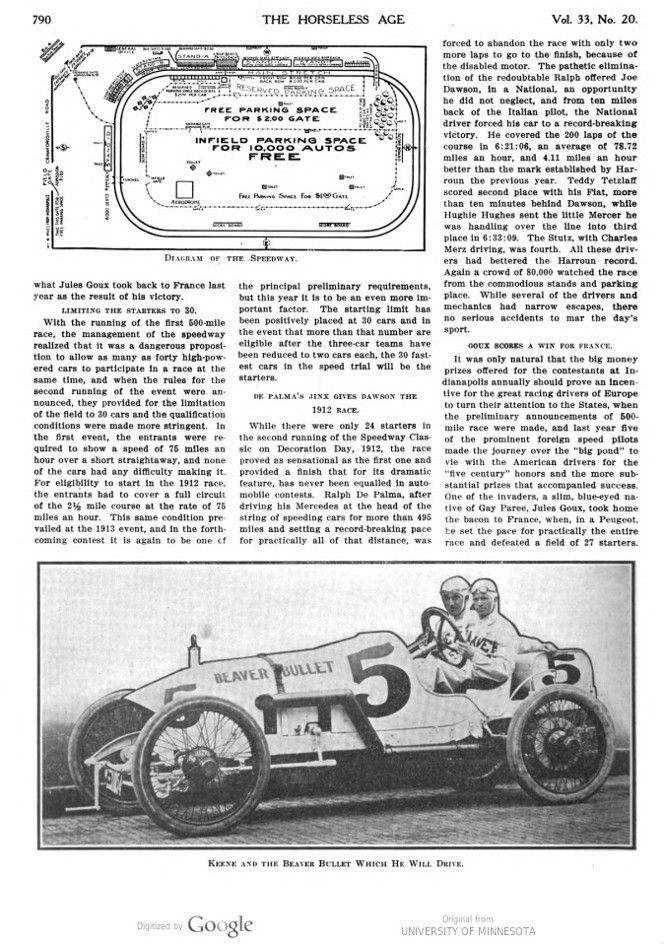
There is hardly a motorist in the country who is not familiar, to some extent, with the description of the Indianapolis Motor Speedway, the arena upon which these annual battles of cylinders are fought, but at this time, just before the gun is fired that will set the score and ten of drivers on their long and strenuous chase for gold and glory, it is appropriate that the Speedway again be briefly described. While several improvements of a minor nature have been made since the race of last May the course is practically the same and will present the same gigantic appearance that it did to those attending previous five century grinds.
The motorist on his first visit to the Indianapolis Motor Speedway will be impressed by its size and the completeness of the details for the handling of an event of the nature of the 500-mile race. A good sized fortune is invested in the speedway, which is a 2½ mile oval with a vitrified brick surface. No less than 328 acres of ground are covered by the speedway and the forty or more buildings that go to make it complete. These buildings include garages, aerodromes, aviation hangars, club houses, cafes, restaurants, office structures, oil houses and machine shops. Grandstands have a seating capacity of over 60,000 persons, and the infield and other sections of the ground can accommodate close to 200,000 people. Parking space is provided for more than 10,000 automobiles.
The turns on the oval are banked more than 16 feet and have a radius of 1,500 feet. The course of cement covered with vitrified brick, no less than 3,500,000 brick being required to pave it. A cement retaining wall 3 feet in height and 11 inches in thickness extends around the outer edge of the track at each turn. The foresight of the management in constructing these retaining walls was forcibly demonstrated on a number of occasions during the practice for previous races and in the contests themselves when the wall pre- vented what might have been serious accidents.
FASTEST CARS TO SET PACE AT START.
The starting of the 500-mile race is a gigantic task in itself and calls for the display of a cool head and fine judgment on the part of the drivers. As has been the practice since the first of these races was run, the cars will be lined up at the starting point and promptly at 10 o’clock will be sent away to follow the pace set by an official in a non-contesting car for one lap of the course. At the completion of the circuit, the latter part of which will be made at high speed, the official’s car will draw off the course and the con- test will be on in earnest. Positions during the flying start in the next race will be determined not according to the old lot system, as heretofore, but by the speed of the cars in the elimination trials, thus putting the fastest machines in front, where they will not have to thread their way through the slower members of the field and get away. In times past there has been considerable danger of accident, *** to the congestion caused by the thirty cars jockeying for place at the stand-off, and the new arrangement is expected to eliminate the possibility of a smash up.
CARS LIMITED TO 450 CUBIC INCHES DISPLACEMENT.
As was the case last year, the race is open to all cars of 450 cubic inches piston displacement or less and with a mini mum weight of 1,600 pounds. This practice of restricting starters to cars of 450 cubic inches piston displacement or less was first adopted last year, and the results obtained then have done much to encourage its continuation. In the first two 500-mile races the limit was placed at 600 cubic inches, which made it possible for the entry of specially constructed and freak racing cars to the detriment of the chances of the more generally used small displacement machines. It was with the idea of encouraging the entry of cars coming closer to the size of ordinary stock cars that the limit was reduced to the 450 cubic inch mark.
There have been several changes in the conditions governing the coming race which it is believed will meet with the general approval of entrants. The entry fee has been reduced from $500 to $200, with the stipulation that fifty per cent of this fee will be refunded for all cars that start on May 30. To further insure the safety of the drivers it has also been ordained that all steering knuckles and tie rods must be replaced with new ones two days before the starting of the race, while aluminum steering wheels will not be permitted. Frame hangers and steering mechanism are subject to the approval of the Indianapolis Motor Speedway mechanical engineer, and cars failing to meet approval will not be allowed to start. All drivers, including relief drivers, must furnish the referee with a certificate from the Speedway surgeon, Dr. H. R. Allen, proving that they are physically fit to engage in such a contest and that they are entirely free from any serious nervous manifestations or other disorders which might prove a handicap. Physical conditions justifying the refusal of such a certificate will disbar drivers from the race.
A COMPARISON OF THE DISPLACEMENTS.
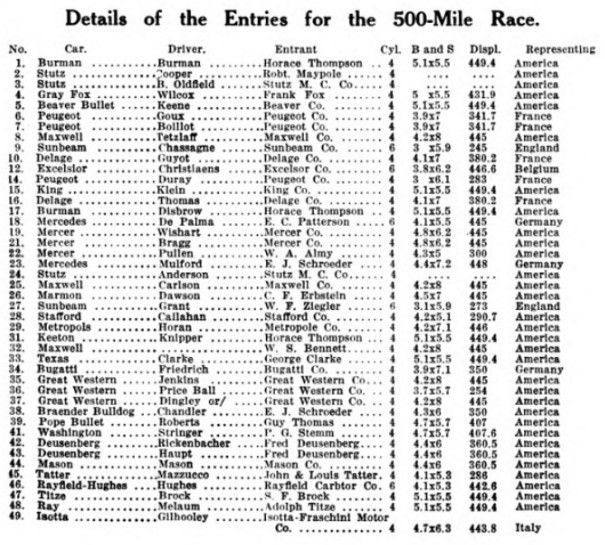
Of the forty-five cars nominated for the race twenty-five have piston displacements exceeding 400 cubic inches, while six are below 300 cubic inches. There are eight cars whose displacements are only a fraction below the maximum of 450 cubic inches, these being the Burman (2), Beaver Bullet, King, Keeton, Titze, Texas and Ray, all of which show a piston displacement of 449.4 cubic inches. Twelve other cars are within five inches of the limit as follows: Mercedes (Mulford) 448; Mercedes (De Palma) 447; Excelsior, 446. 6; Metropol, 446; Maxwell (3), 445; Great Western (2), 445; Mercer (2), 445, and Marmon, 445. other cars above 400 inches are the Isotta, 443.8; Rayfield, 442.6; Gray Fox, 431.9; Washington, 407.6, and Pope Bullet, 407. There are ten cars in the 300-400 cubic inch class as follows: Delage (2), 380.2; Duesenberg (2), 360.5; Mason, 360.5; Braender Bull Dog, 350; Bugatti, 350; Peugeot (2), 341.7; Mercer (Pullen), 300.
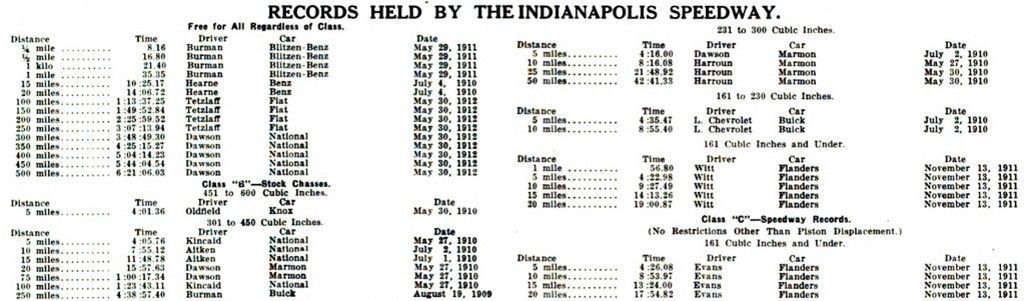
Arthur Duray, the Frenchman, will have the distinction of piloting the smallest car in the race. The private entry, Peugeot, which will be handled by this driver, has a piston displacement of only 183 cubic inches, but it is reported capable of remarkable speed. One of the Sunbeam cars comes second to the Duray Peugeot in this respect, having a displacement of 245 cubic inches. His machine is also to be driven by a foreigner, Chassagne, one of the most prominent of the French land pilots. Chassagne and the Sunbeam is a combination that has been most successful in speedway work, being the holder of numerous records established during the last year on the famous Brooklands track in England, the home of the Sunbeam. Another Sunbeam, which will be driven by our own Harry Grant, of two time Vanderbilt Cup winning fame, is also in the small car class, this machine having a piston displacement of 273 cubic inches. One of the trio of Great Western cars, that to be handled by Price, has a piston displacement even lower than that of Grant’s Sunbeam, the four cylinder American ma- chine’s bore and stroke, of 3.7 and 5.7 inches respectively, giving a displacement of 254 cubic inches. The Tatter, to be handled by Mazzucco, and Callahan’s Stafford are the other two small vehicles in the race, their piston displacement being 286 and 290.7 cubic inches respectively.
LONG STROKE MOTORS PREDOMINATE.
There is a strong predominance of long stroke motors among the cars nominated for the contest, particularly among the foreign machines. Two of the Peugeots have cylinder dimensions of 3.9×7 inches, while the other, that to be driven by Duray, is 3×6.2. One of the six-cylinder Sunbeams has 3×5.9-inch cylinder while the other is 3.1×5.9. The Excelsior, also a six-cylinder vehicle, has a cylinder dimension of 3.8×6.2, while the two Delage cars are 4.1×7. Of the American cars the three Maxwells and two of the Great Western machines are conspicuous because of their long stroke, their cylinder dimensions being 4.2×8. The two large Mercers have 4.8×6.2-inch cylinders, while the 300 cubic inch car has 4.3×5 inch cylinders. The eight 449.4 cubic inch piston displacement cars-Burman (3), Keeton, Beaver Bullet, King, Texas and Titze -are the closest approaches to the square type of motor, each having cylinder dimensions of 5.1×5.5 inches. The Gray Fox is another in this class, its cylinders being 5×5.5 inch.
THE MARMON THE 1911 VICTOR.
The initial 500-mile race was held at the Indianapolis Motor Speedway on Memorial Day, 1911, and it proved to be by far the most stirring motoring event held in this country up to that time. There was no restriction on the number of entries, and of 46 cars nominated, an even 40 went to the post. It was a great race, hard fought and crowded with exciting incidents. It attracted the attention of the entire American motoring world because of its novelty, and though the prize awards were not as large as they are for the forthcoming event, the race drew an entry list of unusual size. The speedway had been opened since August, 1909, but it remained for the 500-mile race to place it conspicuously before the motoring public of the world. Some 80,000 people sat in the stands or parking spaces on May 30 and watched forty cars circle the course, guided by men who were encouraged to get the most out of their mounts by the $40,000 in prizes that were to be distributed among the winners.
Practically every race driver of any importance in the country was entered in the long grind, and the field of cars was the largest ever gotten together for an automobile track meet. There were all sorts of wild prophecies of disaster resulting from the racing of so many high-powered cars on the track at the same time, and many of the pessimists predicted that the contest, instead of accelerating the sport of automobile racing, would be detrimental to it. However, it proved to be the most interesting and exciting sporting event ever held, and the tremendous crowd that had watched the cars in their close to seven-hour grind, left the speedway much pleased with their day’s entertainment. While there were several thrilling and almost serious accidents, only one fatality marred the race.
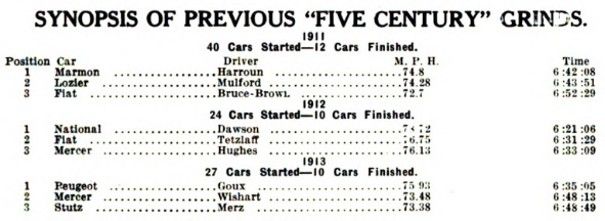
Ray Harroun, at the wheel of the Marmon „Wasp,“ was the winner of the race, finishing the long grind in 6:42:08, which was just one minute, and forty-three seconds better than the time made by Ralph Mulford in a Lozier, who finished second. The late David Bruce-Brown, piloting a Fiat, finished in third place, in 6:52:57. Of the forty starters, twelve finished the 500 miles, while fourteen more were running when the race was declared finished. For his victory, Harroun was awarded $14,250, which was just about half of what Joe Dawson got the following year and of what Jules Goux took back to France last year as the result of his victory.
LIMITING THE STARTERS TO 30.
With the running of the first 500-mile race, the management of the speedway realized that it was a dangerous proposition to allow as many as forty high-powered cars to participate in a race at the same time, and when the rules for the second running of the event were announced, they provided for the limitation of the field to 30 cars and the qualification conditions were made more stringent. In the first event, the entrants were required to show a speed of 75 miles an hour over a short straightaway, and none of the cars had any difficulty making it. For eligibility to start in the 1912 race, the entrants had to cover a full circuit of the 2½ mile course at the rate of 75 miles an hour. This same condition pre- vailed at the 1913 event, and in the forthcoming contest it is again to be one of the principal preliminary requirements, but this year it is to be an even more important factor. The starting limit has been positively placed at 30 cars and in the event that more than that number are eligible after the three-car teams have been reduced to two cars each, the 30 fastest cars in the speed trial will be the starters.
DE PALMA’S JINX GIVES DAWSON THE 1912 RACE.
While there were only 24 starters in the second running of the Speedway Classic on Decoration Day, 1912, the race proved as sensational as the first one and provided a finish that for its dramatic feature, has never been equaled in automobile contests. Ralph De Palma, after driving his Mercedes at the head of the string of speeding cars for more than 495 miles and setting a record-breaking pace for practically all of that distance, was forced to abandon the race with only two more laps to go to the finish, because of the disabled motor. The pathetic elimination of the redoubtable Ralph offered Joe Dawson, in a National, an opportunity he did not neglect, and from ten miles back of the Italian pilot, the National driver forced his car to a record-breaking victory. He covered the 200 laps of the course in 6:21:06, an average of 78.72 miles an hour, and 4.11 miles an hour better than the mark established by Harroun the previous year. Teddy Tetzlaff scored second place with his Fiat, more than ten minutes behind Dawson, while Hughie Hughes sent the little Mercer, he was handling over the line into third place in 6:33:09. The Stutz, with Charles Merz driving, was fourth. All these drivers had bettered the Harroun record. Again, a crowd of 80,000 watched the race from the commodious stands and parking place. While several of the drivers and mechanics had narrow escapes, there no serious accidents to mar the day’s sport.
GOUX SCORES A WIN FOR FRANCE.
It was only natural that the big money prizes offered for the contestants at Indianapolis annually should prove an incentive for the great racing drivers of Europe to turn their attention to the States, when the preliminary announcements of 500- mile race were made, and last year five of the prominent foreign speed pilots made the journey over the „big pond“ to vie with the American drivers for the „five century“ honors and the more substantial prizes that accompanied success. One of the invaders, a slim, blue-eyed native of Gay Paree, Jules Goux, took home the bacon to France, when, in a Peugeot, he set the pace for practically the entire race and defeated a field of 27 starters.
Two of the other foreign drivers finished in the first ten, but America succeeded in retaining a goodly portion of its laurels, for second and third places were captured by machines of American manufacture. Spencer Wishart drove a 300 cubic inch Mercer into second place some thirteen minutes back of the Frenchman and Charles Merz upheld the reputation of the Sturtz and brought No. 2 under the wire in flames but in good enough shape to score third place. Merz was only half a minute back of Wishart.
While Goux set the field a merry chase for close to 400 miles, he did not set a pace swift enough to finish the race with a record better than that established by Joe Dawson in the 1912 contest. Goux sent his Peugeot around the 200 laps of the course in 6:35:05, or at an average speed of 75.93, which was close to three miles an hour slower than the pace maintained by Dawson’s National. Bob Burman and his Keeton was the only combination that gave Goux a rub for the first honors and with Burman out on his forty- eighth lap, the Frenchman had clear sailing thereafter. Some of the cars and drivers that were expected to provide competition for the fast-traveling Peugeot were unfortunately eliminated early in the contest.
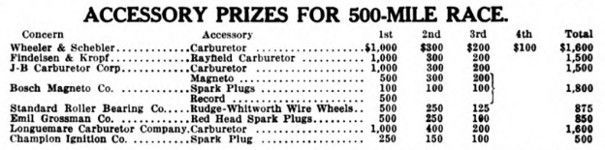
Not only did Goux draw down the first prize of $20,000 and several additional thousand dollars from the accessory manufacturers, but he also carried back to France with him the three trophies offered for the leader at the end of two, three and four hundred miles. All in all, it was a most successful day’s work by the French pilot and his success no doubt did much to encourage other European drivers to enter for the race this year.
Cole to Entertain Hoosier Race Visitors.
Although it is not represented in the race by any of its cars, the Cole Motor Car Co., of Indianapolis, is working hard to make the forthcoming 500-mile contest the greatest event ever held in the Hoosier capital. President J. J. Cole has sent out a sweeping invitation to the automobile trade throughout the United States and Canada to visit the Cole plant during the race week.
A dining room at the Severin Hotel has been engaged for the annual Cole dinner to the newspaper men of the country. J. J. Cole for the past four years has had the visiting newspapermen as his guests. This year the dinner will be an informal gathering.
Vice-President Thomas R. Marshall, former governor of Indiana, a Hoosier and particular friend of President Cole, has been asked to come to this dinner, as well as Governor Ralston of Indiana, the Speedway officials, the attending officials from the A. A. A. and the winners of the past three 500-mile races (Ray Harroun, Joe Dawson and Jules Goux).
Photos.
Page 786.
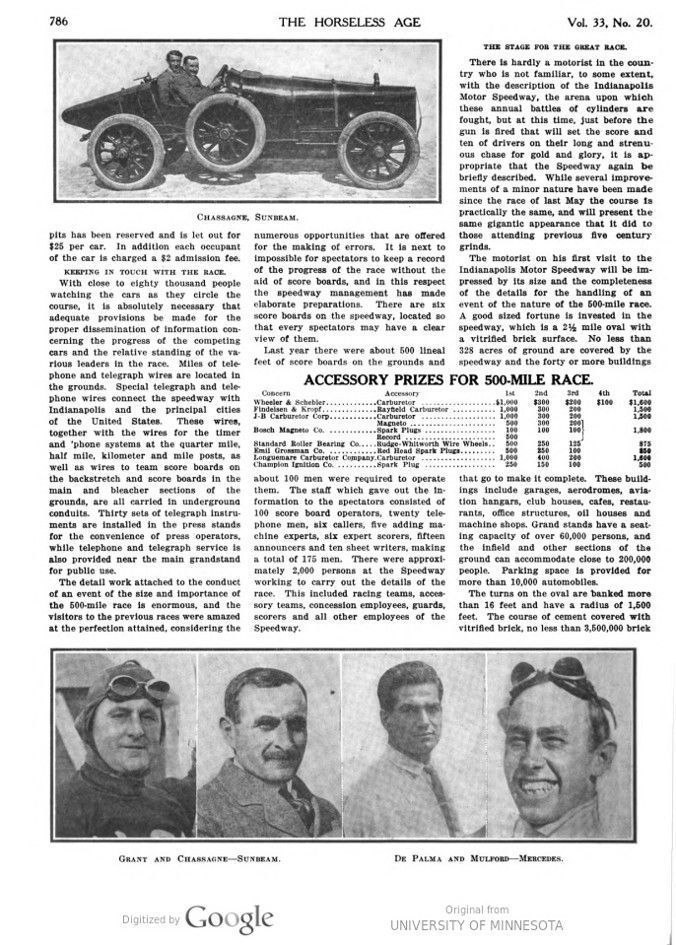
CHASSAGNE, SUNBEAM.
GRANT AND CHASSAGNE-SUNBEAM. DE PALMA AND MULFORD-MERCEDES.
Page 787.
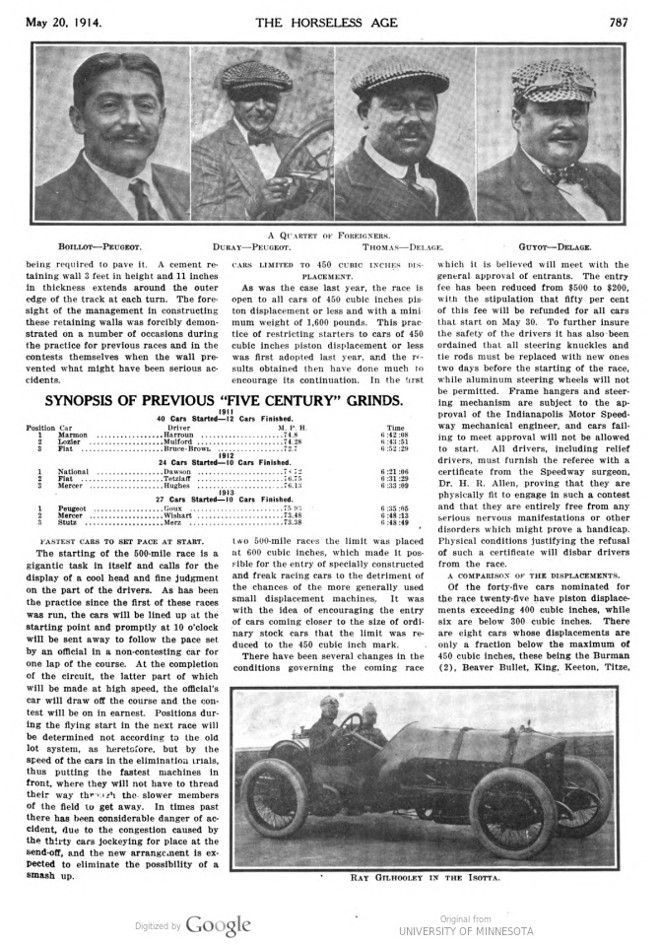
A QUARTET OF FOREIGNERS: BOILLOT-PEUGEOT. DURAY-PEUGEOT. THOMAS-DELAGE. GUYOT-DELAGE.
RAY GILHOOLEY IN THE ISOTTA.
Page 788.
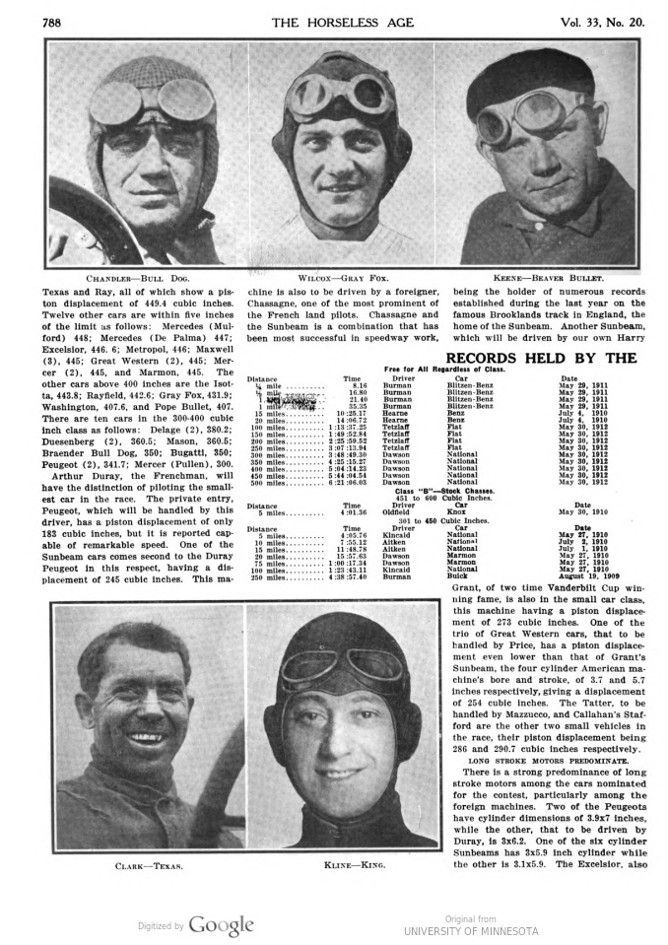
CHANDLER-BULL DOG. WILCOX-GRAY FOX. KEENE-BEAVER BULLET.
CLARK-TEXAS. KLINE-KING.
Page 789.
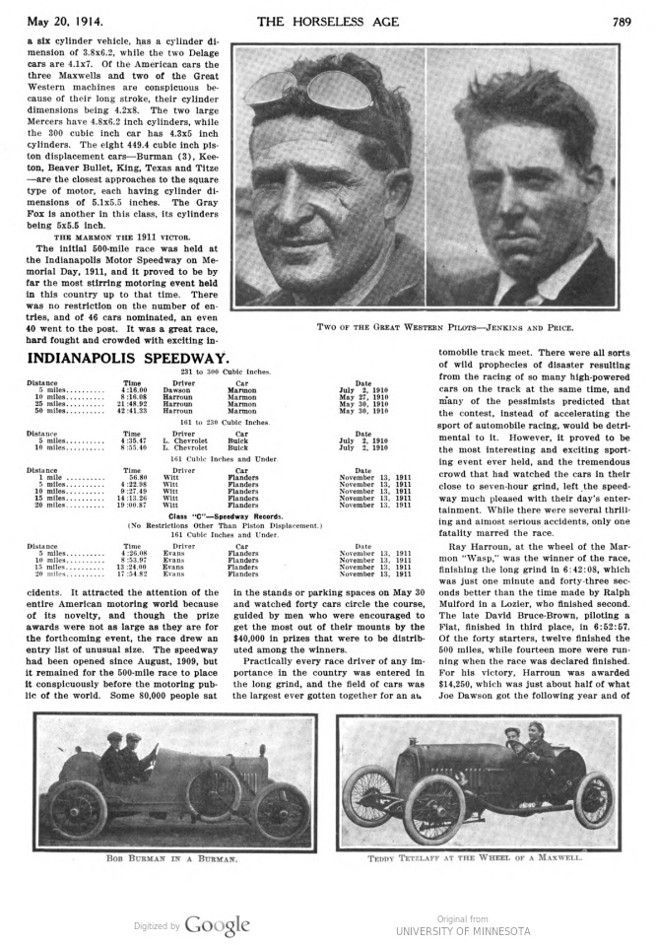
TWO OF THE GREAT WESTERN PILOTS – JENKINS AND PRICE.
BOB BURMAN IN A BURMAN. TEDDY TETZLAFF AT THE WHEEL OF A MAXWELL.
Page 790.
DIAGRAM OF THE SPEEDWAY. – KEENE AND THE BEAVER BULLET WHICH HE WILL DRIVE.
Page 791.
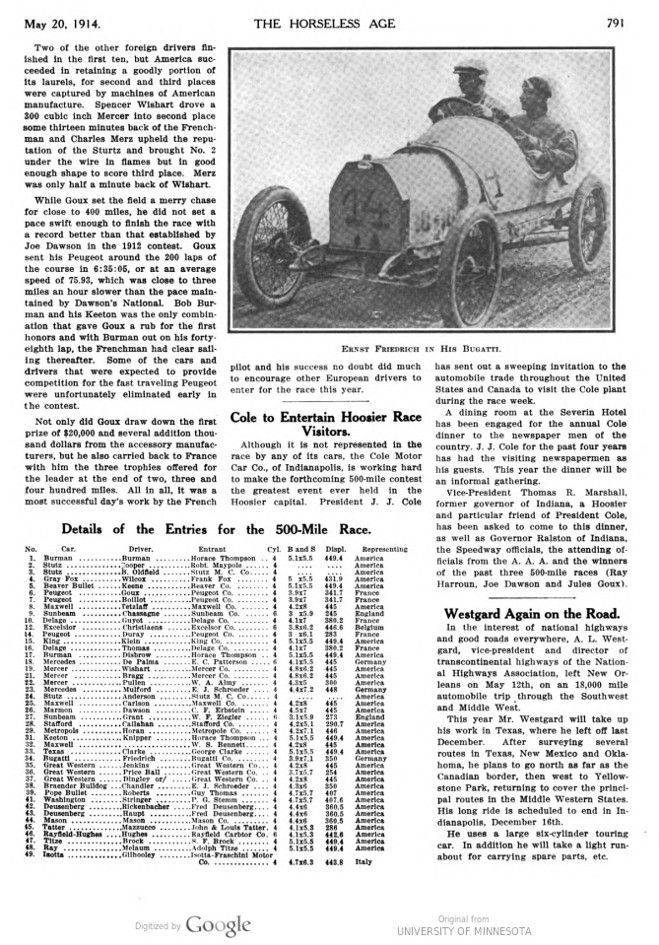
ERNST FRIEDRICH IN HIS BUGATTI. – Details of the Entries for the 500-Mile Race.
page 792.
CHRISTIAENS-EXCELSIOR. GREAT WESTERN WITH JENKINS AT THE WHEEL.
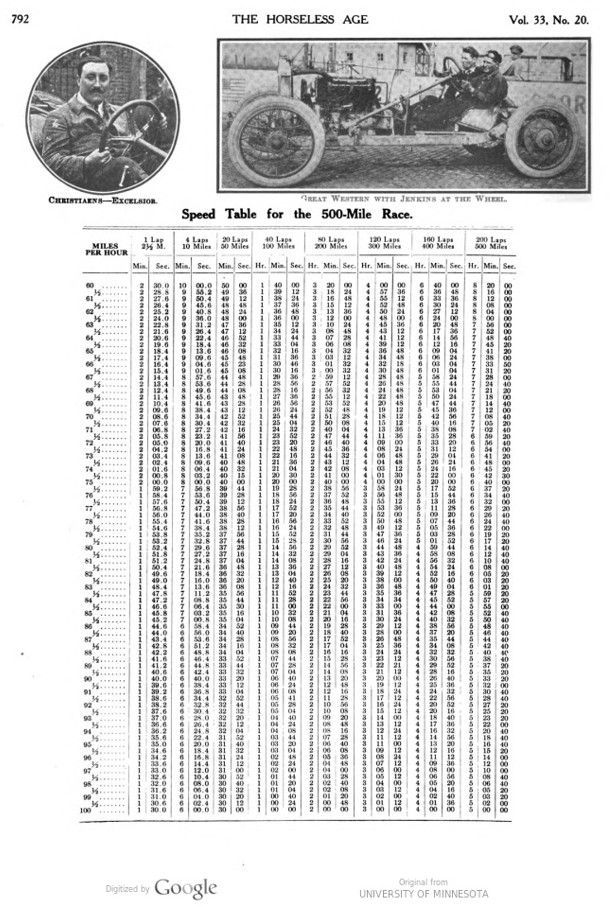
Speed Table for the 500-Mile Race.