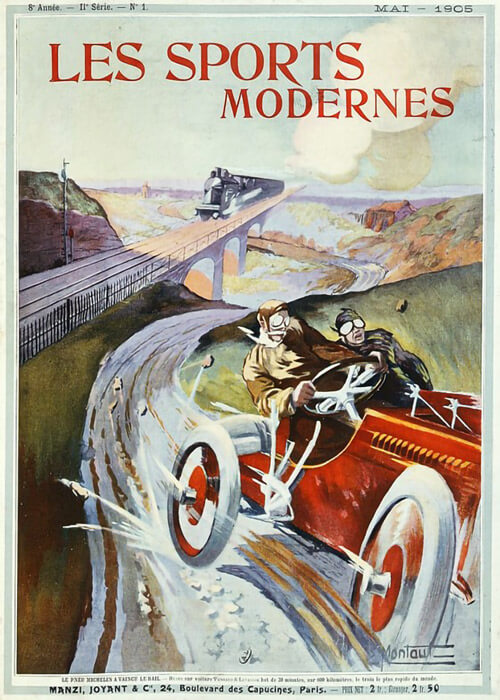
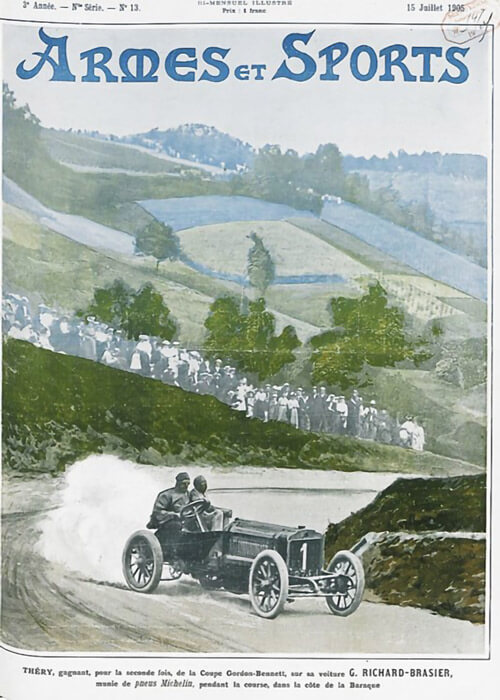
The Scientific American and the Scientific American Supplement both reported mostly on automobile events, as they happened. Mostly the Supplement gave info on technical features of the automobiles, whereas the Sceintific American dealt with the events. For 1903, I couldn’f hardly find anything in the Scientific American on the Paris-Madrid race, in contrast to it’s Supplement. This 20 June issue not only deals with the race itself, butit also describes technical features of cars like the Mors, the Panhard, De Diétrich, the Renault and the Mercedes. This article shows once more, that in those days people weren’t afraid of a “long-read”.


Text and photos with courtesy of hathitrust hathitrust.org, compiled by motorracingistory.com.
Scientific American Supplement Vol. LV (55), No. 1433, June 20, 1903.
THE PARIS-MADRID AUTOMOBILE RACE.
Specially prepared for the SCIENTIFIC AMERICAN SUPPLEMENT by our PARIS CORRESPONDENT.
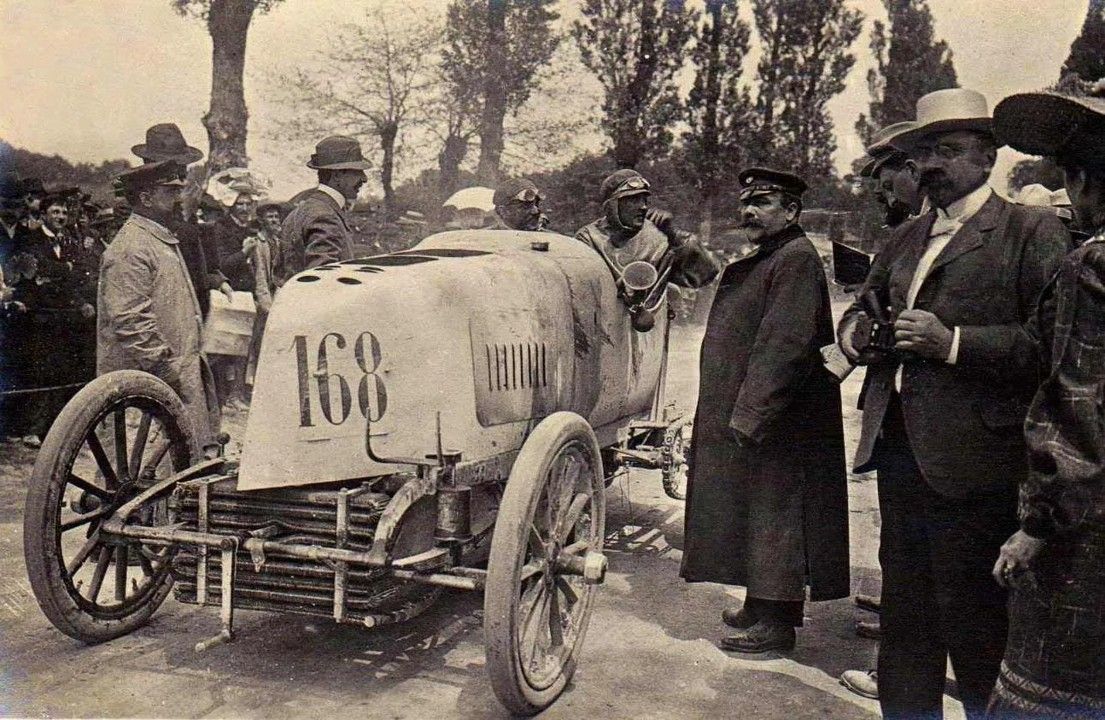
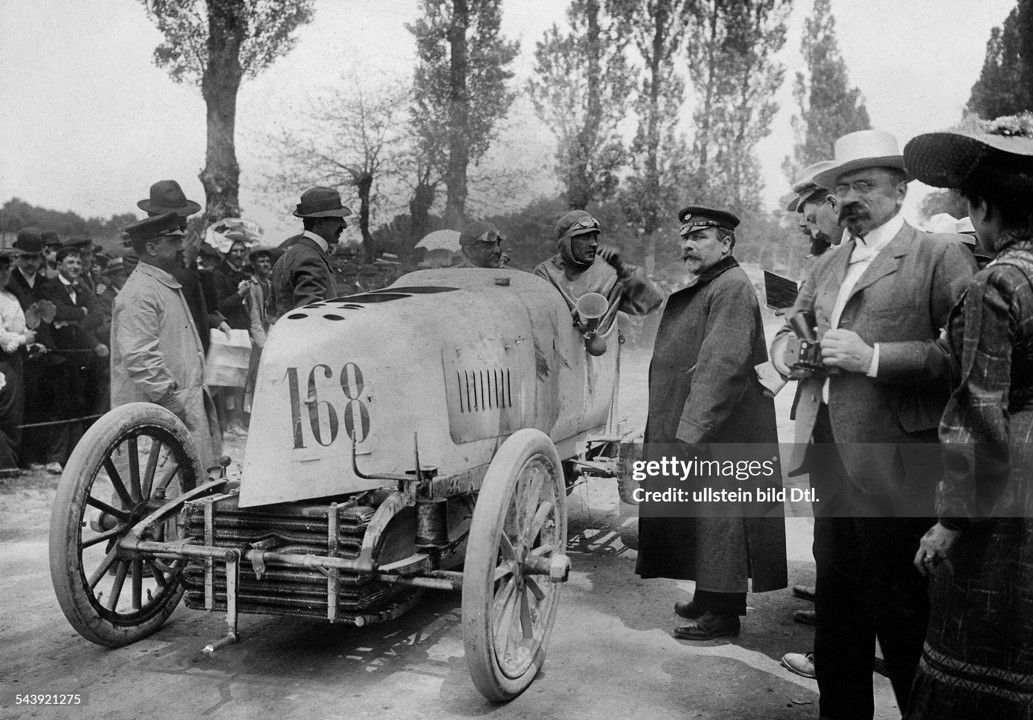
THE Paris-Madrid race was to be run in three stages: from Versailles to Bordeaux, or 552 kilometers, on the first day, the 24th of May; from Bordeaux to Vittoria (Spain) on the second day, 212 kilometers; and thence to Madrid on the third day, or 543 kilometers; a total of 1,307 kilometers (784.2 miles). The first stage, to Bordeaux, which was the only one allowed by the authorities, passed through Chartres, Poitiers, and Angoulème. A number of different villages were neutra- lized, and the chauffeurs were given from 5 to 25 minutes to make the passage. The total time which was allowed for passing through the towns was 3 hours 32 minutes; and this was not counted in the speed contest. The start was placed at Versailles so as to remove it to a considerable distance from the city and give the competitors a free road. The total number of starters, 228 in all, was far greater than ever before. The machines were classed as usual as heavy machines, light machines, voiturettes, and motor-bicycles. All had been carefully weighed at Paris and had a number painted on them indicating the order of the start. Many of the leading chauffeurs had numbers near the first of the series, but this was not always the case, as Gabriel, the winner of the race, had the number 168. There were some gaps between the numbers, as certain of the cars dropped out for various reasons, after receiving their numbers.
The winners, as will be observed, covered the distance to Bordeaux, 331.2 miles, in times varying from 5 hours, 13 minutes, 31 seconds, to over 14 hours. The latter were in most cases detained by accident, as most of the cars made high speeds. Gabriel on his Mors racer, and some of the others, must have reached 70 or 80 miles an hour. It will be noticed that the moto-cycles have been entirely replaced by the motor-bicycles; these make very fast time, and reach the speed of an express train.
A touring race had also been organized in connection with the speed race. The tourists started from Paris on the 13th of May, crossing France in a south-westerly direction to Bayonne, then crossing the Pyrenees and passing through Burgos, Valladolid, and Salamanca, to Madrid. This part of the programme was quite successful, and most of the tourists had reached Madrid before the news came that the race had been suspended and they could not see the finish. The tourist section included the Panhard, Mors, Mercedes, De Dion, Ader, Renault, Serpollet, and all the leading makes carrying from two to six persons, with motors ranging from 7 to 40 horse power. These long runs have been so successful that they are beginning to be regarded as a common occurrence, while only a few years ago this performance would have been considered remarkable. Besides, the chief interest centered in the speed race, and the appearance of the new cars was awaited with curiosity, as their construction had generally been kept a strict secret before the race, each of the makers fearing to give points to his competitors.
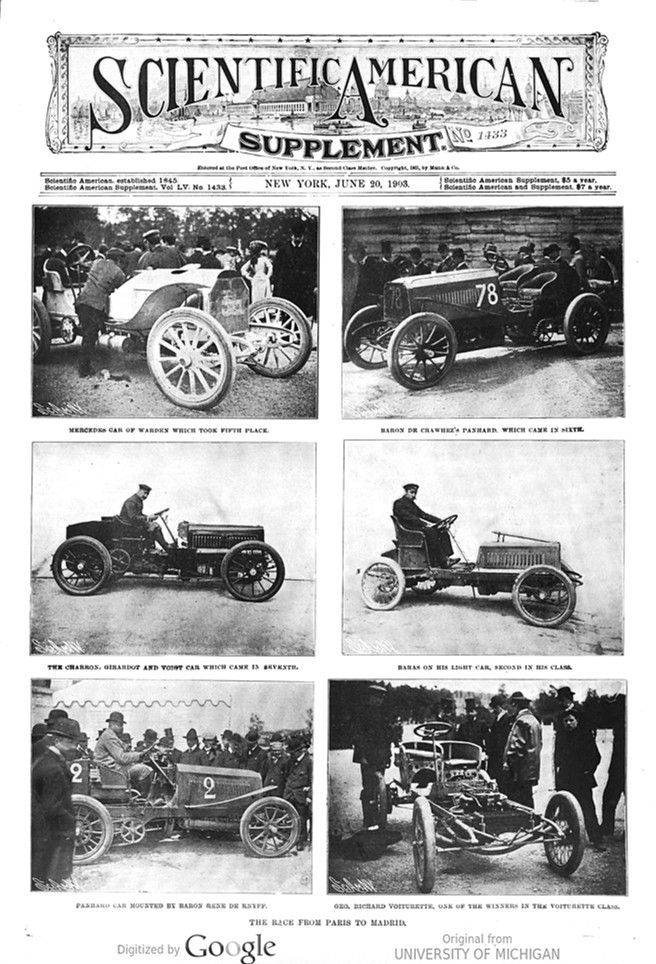
Attention has of course been attracted by the winning machines, and therefore a short description of each will be of interest. The engravings show the general appearance of some of the more important cars.
The Mors machines naturally take the first rank, as one of them won the race to Bordeaux and another took third place in the general list and second among the heavy cars, while another Mors, mounted by Achille Fournier, holds eighth place in the general list. All these machines are similar in appearance. They are of handsome design, and their general lines indicate that they are built for high speed. The torpedo, or boat shape, has been adopted, with a sharp point in front, while the rear also ends in a point. The radiator is almost concealed from view under the front part. The motor is built to give 80 or 90 horse power, and is one of the most powerful gasoline motors yet constructed for a racing machine. Magneto ignition is the type employed. The motor is well placed and solidly mounted in the front of the chassis. Instead of resting on the side bars of the frame by means of arms which are cast with the aluminium crankcase, the motor is lodged in a bed-plate of pressed steel which is proof against shocks. The suspension of the body is well carried out. To the usual springs is added a kind of braking device which deadens the oscillations of the springs after the car has passed an obstacle. This ingenious device was brought out not long ago by Truffault.
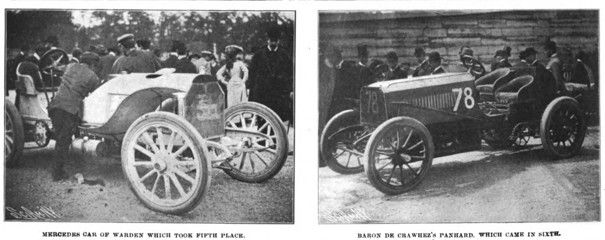
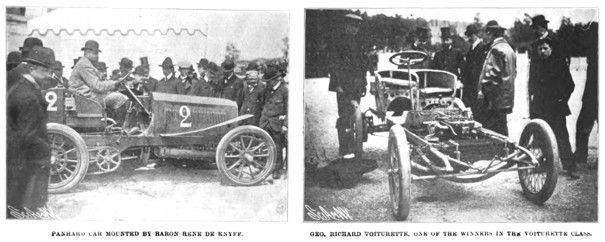
Next to the Mors, the Panhard & Levassor cars were the general favorites, although they did not succeed in taking higher than sixth place with Baron De Crawhez, owing to accidents which happened to the different cars. One of the Panhard racers was piloted by Réné de Knyff, who is well known for his different records, a third and fourth by Henri and Maurice Farman, and others by Chauchard, Teste, etc. The Panhard racer is equipped with a 70 horse power motor, and is thus not quite as powerful as its nearest competitors, the Mors and Mercedes. The exterior of the vehicle does not differ greatly from the preceding models. a square box front which is finished off by the radiator. One particular feature of the new racing car is the unusual position of the motor. The constructor wished to lower the center of gravity of the car by lowering the motor. At the same time he wished to give the latter a heavy flywheel of large diameter, but He solved without bringing it too near the ground. It has the problem by inclining the motor toward the front so that the lowest point of the crankcase and the lower edge of the flywheel are on the same level. The diameter and stroke of the motor are kept the same as last year’s type which was used in the Paris-Vienna race. The motor has four large cylinders with water jackets formed by an outside copper sheathing. The only difference in the operation of the new motor is that the admission valves are now operated mechanically. The new Krebs’ carbureter is employed which allows of keeping a constant mixture of gas and air at all speeds of the motor. The flywheel has been made heavier, owing to its increase in diameter. The chassis is built of pressed steel, and is very solid as well as light. In the center of the car are the seats for the driver and machinist which are placed rather high up. The racing machine has only three speeds, as it was desired to save weight by diminishing the number of gears in the transmitting mechanism rather than by lightening the chassis too much and depriving it of the necessary rigidity. Chain transmission is used from the countershaft to the rear wheels. The radiator, which forms the front end of the car, has been built in a compact form, and air is forced through it by a fan which is placed in front of the motor and is driven from it by a belt. The escaping gases come out of each of the four cylinders by a short pipe, and all four pipes are joined below to a long tube of large diameter like a stovepipe, which conducts the gases to the rear and serves as a muffling box. The suspension of the car body has been well carried out, and the ensemble forms an easy running machine of great solidity.
The new Mercedes racers attracted a great deal of attention. They are of German build and come from the Daimler works at Canstatt. This firm holds the first rank among German constructors, and it has a well-deserved reputation for automobiles of high quality, but this is the first year in which the Canstatt works have turned out a series of regular racing machines. During the Paris-Vienna race, some of the Mercedes cars came very near taking the first place, although they were only equipped with light motors. For the Paris-Madrid race two new types were built, one of 60 horse power and the other of 90 horse power. One of the 60 horse power machines ran not long ago at Nice, but this is the first appearance of the 90 horse power car, which was one of the most powerful machines in the race and was only exceeded by the Gobron-Brillié, which was built to be run with alcohol and rated at 110 horse power. The latter did not, however, succeed in taking a high place in the race. The Mercedes machines are built according to the standard type as to general appearance, and all the machines are about alike, differing only in the power of the motor. The type of motor used has 4 cylinders, and is of especially compact form. The long, square, bonnet is finished off by a radiator of the honeycombed pattern, which has a fan behind it. Contact ignition, with current from a magneto, is used. The speed-changing box has sets of gears which are always in mesh and the clutches of which are thrown in by a rack-and-pinion device, which is operated in turn by the speed-changing lever at the conductor’s hand. Mounted on the steering wheel are the levers for the gas admission to the motor and for regulating the ignition. The motor is thrown into gear by a new form of clutch in which a steel spiral winds around a cone and can be made to turn the latter by attaching the free end to the cone by means of a catch device, the whole working somewhat on the principle of the capstan.
The new De Dietrich cars are among the winners, they having succeeded in taking the third place among the heavy machines, under the skillful driving of the Englishman, Jarrott. This car had also the honor. of leading off at the start. The performance of these cars is all the more creditable from the fact that the system was only brought out last year. The De Dietrich Company decided to abandon their former system, and adopt the new type which had been designed by Turcat and Méry, two young engineers of Marseilles, and which showed great promise. Their expectations have therefore not been disappointed. The cars were built in slightly varying forms on the present occasion, but all are more or less boat-shaped, with a long pointed front and the rear either tapering or rounded off. The radiator, instead of being placed underneath the body as in the Mors, is placed directly in front of the pointed end. A 4-cylinder motor is used, with the cylinders grouped in pairs. The efficiency of the new system is due rather to the perfection of the details than to anything unusual in the construction. The chassis is built of wood, reinforced by pressed steel and braced across by steel tubes. The motor and the transmitting mechanism are supported upon a second frame at the front and inside the chassis, giving considerable rigidity to the whole. The wheels turn upon specially designed ball-bearings, and have an easy movement. The motor, which is built to run with either gasoline or alcohol, used gasoline in this race. The cylinders are cast in one piece with the water-jackets. The new De Dietrich machines made their first appearance at the Paris-Vienna race last year, in which three 16 horse power racers showed up very favorably in comparison with the heavier machines. The radiator for the water cooling is provided with a turbine pump of large output, but in case of accident to the pump, the cooling can still be carried out on the thermosiphon principle, owing to the disposition of the water reservoir. A magneto is used for the ignition, with an induction coil in reserve. An improved carbureter is employed, which assures a constant mixture at all speeds of the motor. It works at constant level, with an atomizer which uses a double air current. A friction-clutch couples the motor to the speed-changing box which gives four different speeds. In these cars the motor has been increased to 45 horse power on an average, or 60 maximum.
The Renault car was also one of the winners and upheld its reputation of last year. The new racers embody all the new points which have been illustrated in detail in the SCIENTIFIC AMERICAN. This year the racing machines of the Renault type, and in fact most of the others, were finished only a few days before the event, and were not to be seen before that time. After the race most of the machines were detained at Bordeaux, and have not returned to Paris at the time of the present writing, but it is expected to soon furnish a detailed description of these, as well as of the other leading machines.
The race was especially marked by the accidents which occurred to many of the leading chauffeurs and to many of those who were counted upon to win the race. The death of Marcel Renault, the winner of the Paris-Vienna race, who was precipitated from his machine against a tree and had his skull fractured, is deeply regretted. It is a curious fact that last year it was Louis Renault who met with an accident and could not finish, while his brother won the race, while this year the conditions have been reversed. The Renault brothers went into the construction of automobiles in a rather unusual way. They were great amateur yachtsmen, and had a small steam yacht, the “Cypris,” which they ran on the Seine near Paris. Having a small tool-shop for repairs, they had an idea of constructing a quadricycle in 1897 with a speed-changing transmission of their invention. Then they built a voiturette, to which they applied the same speed-changing device and brought out for the first time the jointed rod transmission which is now used so extensively. This voiturette was built for private use, but had such a success that they constructed others, and finally founded, in 1898, their present works just outside of Paris. The new machines soon became successful in the different races and, in 1899, Marcel Renault took second place with his voiturette in the Paris-Trouville and the Paris-Ostend races. The following year Louis Renault took the first place among the voiturettes in the race from Paris to Toulouse and back. After running in the Paris-Berlin, Marcel Renault became famous as the winner of the Paris-Vienna race of last year, showing that his light machine was to be counted upon as a competitor against the heavy cars, and this has also been proved in this year’s race by the second place which was won by Louis Renault. As a chauffeur, Marcel Renault was remarked for his sang froid, and for his skill as well as prudence in driving.
Two of the chauffeurs who met with serious accidents during the race were Lorraine Barrow and Stead. The case of the former is serious, but he will no doubt recover. Stead expects to be able to return to Paris within a short time, as his accident is not as grave as was reported at first.
One of the principal causes for stopping the race was the fact that a soldier was killed by one of the cars, some say while on duty, but this has since been denied. The official account of the accident, which took place near Angoulême, is as follows: The Tourand car, mounted by M. Tourand, arrived at the bridge of Le Couronne at a speed of over 70 miles an hour. The bridge formed a slight arch and made the car bound in the air. The machinist Normand, who had just then risen up to examine the route and was leaning over the car, lost his balance. Seeing himself about to be projected from the vehicle, he caught the arm of M. Tourand, giving the latter a brusque movement which caused the car to swing to the right and run into the bank. Upon the bank were placed several spectators, and one of these was the soldier Dupey, who, while trying to pull a child back out of the way, was struck by the car in the chest and instantly killed. The car, continuing on its course, ran into a tree and smashed to pieces, throwing the conductor and machinist out on the road, killing a spectator and severely wounding a second. This accident was therefore one of the most serious that occurred during the race.
Besides the more serious accidents, Fournier and De Knyff met with mishaps and could not finish, while M. Georges Richard, who was thrown from his machine, will probably escape without serious damage. The Americans did not meet with good fortune this year. Both Vanderbilt and Mr. Terry had accidents to their machines. Vanderbilt states that he gave up the race principally owing to a punctured tire, but he complained of the bad organization of the race, also. He had considerable difficulty at the start owing to various formalities. He says that the crowds of spectators all along the route were one of the greatest drawbacks to the chauffeurs, as imprudent persons advanced far into the roads in order to see the cars, and there was no one to control them, at least outside of the towns and villages. It was not surprising therefore that there were a great many accidents to the spectators, and upon learning this he was not sorry that he had given up the race. Baron de Forest, who was also stopped owing to a puncture of his tire, expressed the same opinion.
Mr. Terry, the well-known American chauffeur, had a very bad accident to his machine which obliged him to give up the race. Mr. Terry mounted a 60-horsepower Mercedes car, and 12 miles after the start, when he was going at a very high speed, at least 60 miles an hour, came alongside of one of his competitors just before the town of Cognières. On passing Cognières over a bad piece of road, Mr. Terry, who is a skillful driver, tried to pass the second car on the left hand side, but just then the latter made a turn to the left also, and in order to avoid a collision, Mr. Terry was obliged to turn his machine on to the sidewalk. This gave a rude shock and caused the tire of the left wheel to burst, but the car, running at a high speed, still drove ahead and passed the second machine. Then the left wheel broke, and although the motor was thrown out of gear, the car kept on for about a thousand feet, traveling sidewise along the road at a speed of 50 miles an hour. The shock had caused the gasoline reservoir to burst, and it contained 30 gallons of gasoline, which saturated the machine. The gasoline caught fire from the exhaust of the motor,. and when the car finally came to rest, it was enveloped in flames. All this time Mr. Terry, with rare sang froid, continued in the seat, but was forced to leave the burning vehicle. No accident occurred to either Mr. Terry or his machinist, but it is reported that the car was completely burned, together with two trees: at the side of the road.
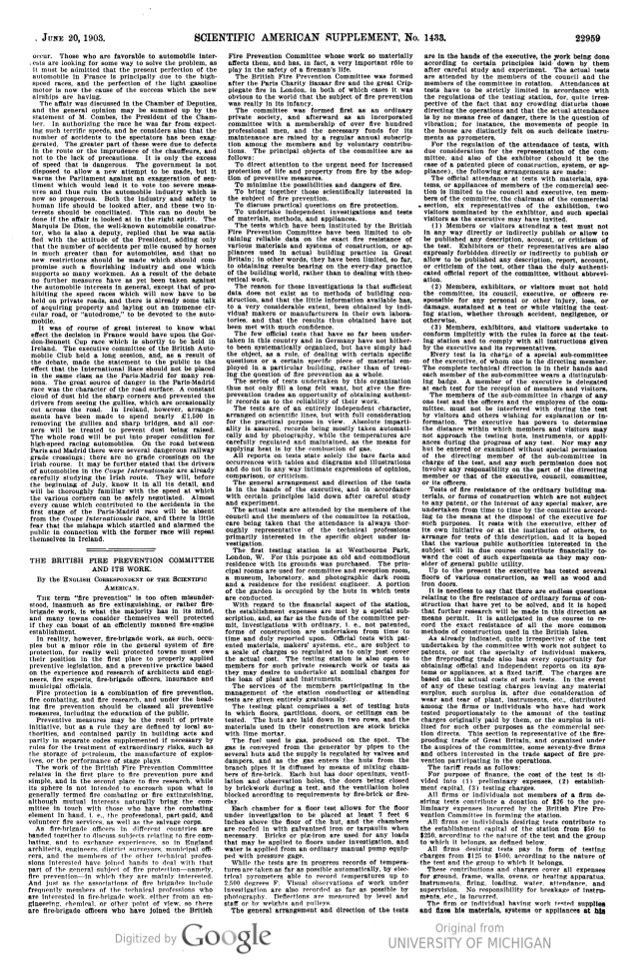
The wind-up of the event was as doleful as the beginning had been brilliant. The cars, on reaching Bordeaux, were kept under lock and key by the authorities, and as they were not allowed to leave under their own power, they had to be towed to the railway station by horses and thus sent back to Paris. Following the decision of the French government, the Spanish government also issued a decree forbidding the race in their territory. The different fêtes which had been organized to receive the chauffeurs had to be all countermanded. Considerable excitement was caused at Paris by the news of the accident, and many of the journals who are hostile to the automobile raised a great cry. Others took a calmer view of the matter, but nearly all agreed that the day of fast racing on the road was over, in France, as the speeds had now become so high that accidents were sure to occur. Those who are favorable to automobile interests are looking for some way to solve the problem, as it must be admitted that the present perfection of the automobile in France is principally due to the high-speed races, and the perfection of the light gasoline motor is now the cause of the success which the new airships are having.
The affair was discussed in the Chamber of Deputies, and the general opinion may be summed up by the statement of M. Combes, the President of the Chamber. In authorizing the race he was far from expecting such terrific speeds, and he considers also that the number of accidents to the spectators has been exaggerated. The greater part of these were due to defects in the route or the imprudence of the chauffeurs, and not to the lack of precautions. It is only the excess of speed that is dangerous. The government is not disposed to allow a new attempt to be made, but it warns the Parliament against an exaggeration of sentiment which would lead it to vote too severe measures and thus ruin the automobile industry which is now so prosperous. Both the industry and safety to human life should be looked after, and these two interests should be conciliated. This can no doubt be done if the affair is looked at in the right spirit. The Marquis De Dion, the well-known automobile constructor, who is also a deputy, replied that he was satisfied with the attitude of the President, adding only that the number of accidents per mile caused by horses is much greater than for automobiles, and that no new restrictions should be made which should compromise such a flourishing industry and one which supports so many workmen. As a result of the debate no further measures have as yet been taken against the automobile interests in general, except that of prohibiting the speed races which will now have to be held on private roads, and there is already some talk of acquiring property and laying out an immense circular road, or “autodrome,” to be devoted to the automobile.
It was of course of great interest to know what effect the decision in France would have upon the Gordon-Bennett Cup race which is shortly to be held in Ireland. The executive committee of the British Automobile Club held a long session, and, as a result of the debate, made the statement to the public to the effect that the International Race should not be placed in the same class as the Paris-Madrid for many reasons. The great source of danger in the Paris-Madrid race was the character of the road surface. A constant cloud of dust hid the sharp corners and prevented the drivers from seeing the gullies, which are occasionally cut across the road. In Ireland, however, arrangements have been made to spend nearly £1,500 in removing the gullies and sharp bridges, and all corners will be treated to prevent dust being raised. The whole road will be put into proper condition for high-speed racing automobiles. On the road between Paris and Madrid there were several dangerous railway grade crossings; there are no grade crossings on the Irish course. It may be further stated that the drivers of automobiles in the Coupe Internationale are already carefully studying the Irish route. They will, before the beginning of July, know it in all its detail, and will be thoroughly familiar with the speed at which the various corners can be safely negotiated. Almost every cause which contributed tc the accidents in the first stage of the Paris-Madrid race will be absent from the Coupe Internationale race, and there is little fear that the mishaps which startled and alarmed the public in connection with the former race will repeat themselves in Ireland.
Photos.
Page 22957 (frontpage).
THE RACE FROM PARIS TO MADRID.
MERCEDES CAR OF WARDEN WHICH TOOK FIFTH PLACE. – BARON DE CRAWHEZ’S PANHARD, WHICH CAME IN SIXTH.
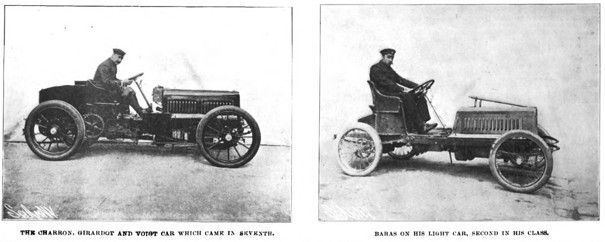
THE CHARRON, GIRARDOT AND VOIGT CAR WHICH CAME IN SEVENTH. – BARAS ON HIS LIGHT CAR, SECOND IN HIS CLASS.
PANHARD CAR MOUNTED BY BARON RENE DE KNYFF. – GEO. RICHARD VOITURETTE, ONE OF THE WINNERS IN THE VOITURETTE CLASS.