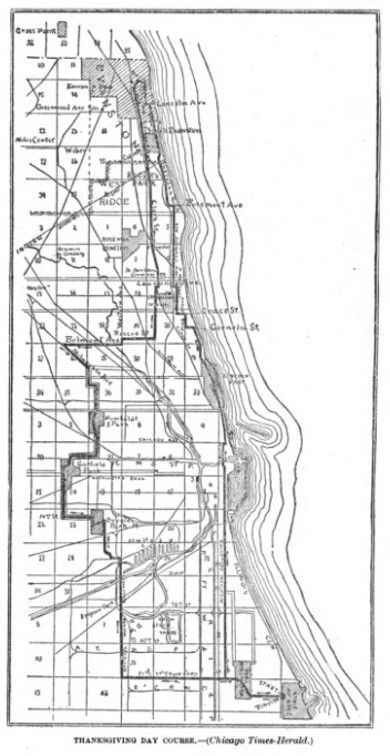
Just before the Times-Herald race, the route was changed slightly, of which the map is shown here as well as it’s description. Rules are also revised, in all now „only“ 27. One could get the impression, it’s more a contest for rule-makers than for car-drivers. Just jokin‘, I know. But 27 rules for some 52 miles course? Compare that with the Europen rules for the Gordon-Bennetts.
Text and photos with courtesy of hathitrust.org, www.hathitrust.org , compiled by motorracinghistory.
The Horseless Age – Vol. 1, No. 2, December 1895, pp. 29 – 32
Thanksgiving Day Route.
Synopsis of the Course and Revised Rules.
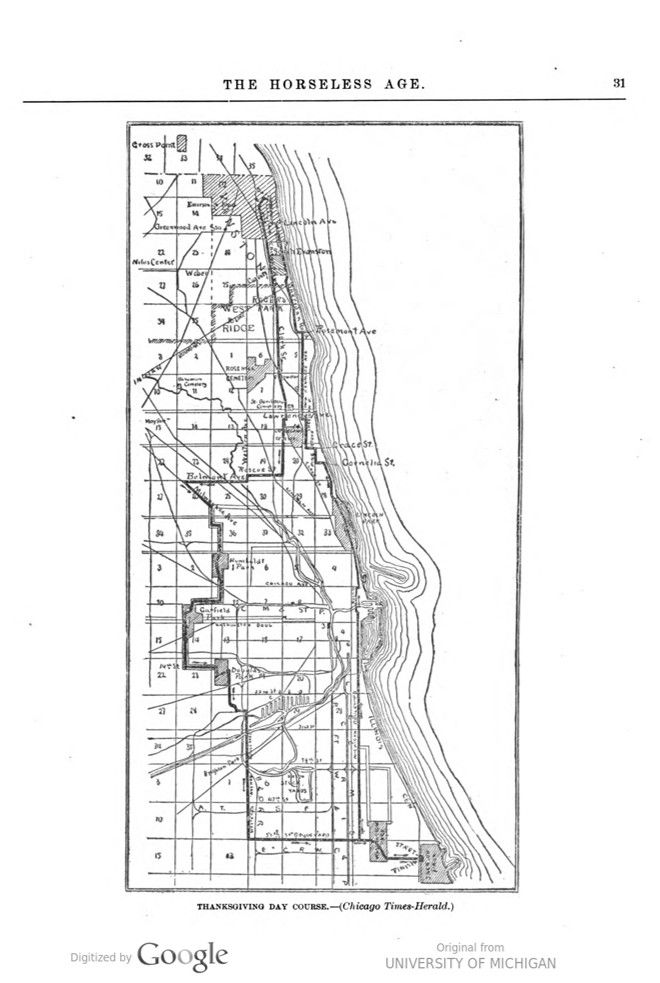
On page 31 will be found a map of the revised course which the engineers appointed by the Times-Herald have laid out for the Thanksgiving Day contest. As the day is a holiday, the competing vehicles will have a clearer course than would have been possible on an ordinary workday, and are expected to make better time in consequence.
The vehicles will be started at Midway Plaisance and Jackson Park, and will proceed west on the Midway through Washington Park and Fifty-fifth Street Boulevard to Michigan Boulevard, where they will turn north on this broad thoroughfare and sweep past the lake front, the auditorium, the public library, and across the Rush Street bridge.
On the north side the route continues up Rush Street, east on Chicago Avenue, and north along the beautiful Lake Shore drive through Lincoln Park, and by way of the Sheridan Road to Evanston. The return route is by way of North Clark Street, Ashland, Belmont and Milwaukee Avenues to the west park boulevard system, and east on Fifty-fifth Street Boulevard, through Washington Park, and the Midway to the starting point.
The route includes about fifty-five miles of roadway, and contains sections of all grades of pavement and roadway. Nothing but a severe snowstorm can render the route unfit for the test. The preliminary tests were held at 1557 Wabash Avenue, and L. L. Summers and John Lundie, the committee on tests began their work on Tuesday, Nov. 19. The Studebaker Brothers‘ Manufacturing Company kindly place this large building at the disposal of General Merrit and other judges, and arrangements have been perfected by which the various motocycles can be placed on exhibition in this room up to December 4.
RULES FOR THE RACE.
The judges have carefully revised the official rules, which are as follows:
ART. 1. The contest or race will be international in character, and any vehicle complying with the conditions may compete.
The vehicles shall have three or more running wheels, and shall derive their motive power from within themselves. No vehicle will be admitted to the competition which depends in any way upon muscular exertion except for the purpose of guidance.
ART. 2. The vehicles shall be capable of carrying at least two persons, one of whom shall be an umpire selected by the judges, the other or others may be the representatives of the owner of the vehicle. An umpire must accompany each vehicle over the route.
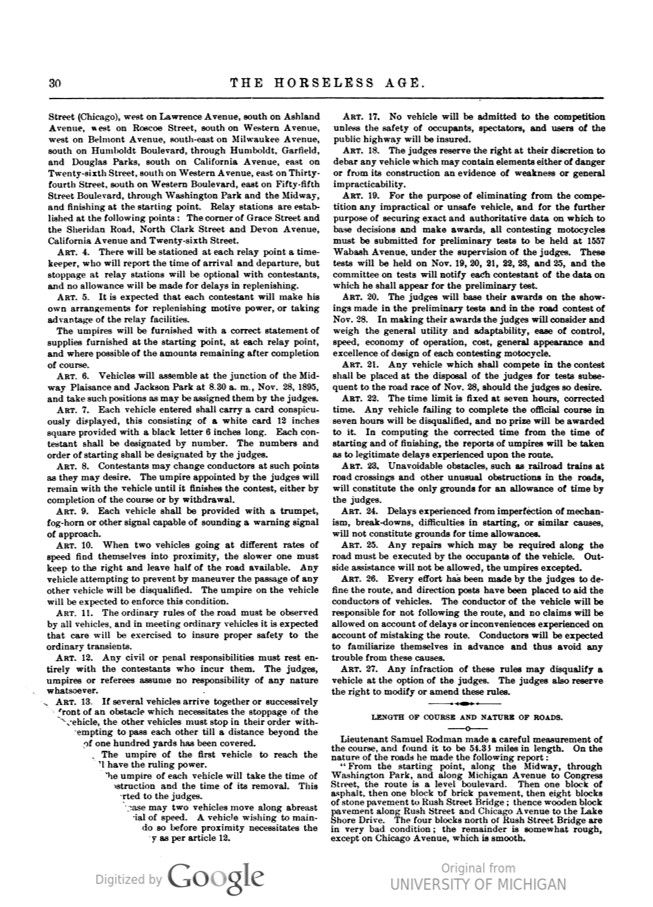
ART. 3. The route will be as follows: Starting at the junction of Midway Plaisance and Jackson Park, west on Midway Plaisance, through Washington Park past the floral triangle and refectory, west on Fifty-fifth, north on Michigan/Boulevard, over Rush Street bridge, north on Rush Street, east on Chicago Avenue, north on the Lake Shore drive, through Lincoln Park and the Sheridan Road to Cornelia Street, west on Cornelia, north on Pine Grove, east on Grace Street, north on the Sheridan Road, west on Lawrence Avenue, north on Kenmore Avenue, west on Rosemount Avenue, and north on Sheridan Road to the city limits of Evanston; in Evanston west on Lincoln Avenue, north on Forest Avenue, west on Davis Street, south on Chicago Avenue (Evanston) and Clark Street (Chicago), west on Lawrence Avenue, south on Ashland Avenue, west on Roscoe Street, south on Western Avenue, west on Belmont Avenue, south-east on Milwaukee Avenue, south on Humboldt Boulevard, through Humboldt, Garfield, and Douglas Parks, south on California Avenue, east on Twenty-sixth Street, south on Western Avenue, east on Thirty-fourth Street, south on Western Boulevard, east on Fifty-fifth Street Boulevard, through Washington Park and the Midway, and finishing at the starting point. Relay stations are established at the following points: The corner of Grace Street and the Sheridan Road, North Clark Street and Devon Avenue, California Avenue and Twenty-sixth Street.
ART. 4. There will be stationed at each relay point a time-keeper, who will report the time of arrival and departure, but stoppage at relay stations will be optional with contestants, and no allowance will be made for delays in replenishing.
ART. 5. It is expected that each contestant will make his own arrangements for replenishing motive power, or taking advantage of the relay facilities. The umpires will be furnished with a correct statement of supplies furnished at the starting point, at each relay point, and where possible of the amounts remaining after completion of course.
ART. 6. Vehicles will assemble at the junction of the Midway Plaisance and Jackson Park at 8.30 a. m., Nov. 28, 1895, and take such positions as may be assigned them by the judges.
ART. 7. Each vehicle entered shall carry a card conspicuously displayed, this consisting of a white card 12 inches square provided with a black letter 6 inches long. Each contestant shall be designated by number. The numbers and order of starting shall be designated by the judges.
ART. 8. Contestants may change conductors at such points as they may desire. The umpire appointed by the judges will remain with the vehicle until it finishes the contest, either by completion of the course or by withdrawal.
ART. 9. Each vehicle shall be provided with a trumpet, fog-horn or other signal capable of sounding a warning signal of approach.
ART. 10. When two vehicles going at different rates of speed find themselves into proximity, the slower one must keep to the right and leave half of the road available. Any vehicle attempting to prevent by maneuver the passage of any other vehicle will be disqualified. The umpire on the vehicle will be expected to enforce this condition.
ART. 11. The ordinary rules of the road must be observed by all vehicles, and in meeting ordinary vehicles it is expected that care will be exercised to insure proper safety to the ordinary transients.
ART. 12. Any civil or penal responsibilities must rest entirely with the contestants who incur them. The judges, umpires or referees assume no responsibility of any nature whatsoever.
ART. 13. If several vehicles arrive together or successively in front of an obstacle which necessitates the stoppage of the first vehicle, the other vehicles must stop in their order without attempting to pass each other till a distance beyond the obstacle of one hundred yards has been covered.
ART. 14. The umpire of the first vehicle to reach the obstacle, shall have the ruling power.
ART. 15. The umpire of each vehicle will take the time of arrival at an obstruction and the time of its removal. This time shall be reported to the judges.
ART. 16. In no case may two vehicles move along abreast of each other in a trial of speed. A vehicle wishing to maintain its position must do so before proximity necessitates the surrender of right of way as per article 12.
ART. 17. No vehicle will be admitted to the competition unless the safety of occupants, spectators, and users of the public highway will be insured.
ART. 18. The judges reserve the right at their discretion to debar any vehicle which may contain elements either of danger or from its construction an evidence of weakness or general impracticability.
ART. 19. For the purpose of eliminating from the competition any impractical or unsafe vehicle, and for the further purpose of securing exact and authoritative data on which to base decisions and make awards, all contesting motocycles must be submitted for preliminary tests to be held at 1557 Wabash Avenue, under the supervision of the judges. These tests will be held on Nov. 19, 20, 21, 22, 23, and 25, and the committee on tests will notify each contestant of the data on which he shall appear for the preliminary test.
ART. 20. The judges will base their awards on the showings made in the preliminary tests and in the road contest of Nov. 28. In making their awards the judges will consider and weigh the general utility and adaptability, ease of control, speed, economy of operation, cost, general appearance and excellence of design of each contesting motocycle.
ART. 21. Any vehicle which shall compete in the contest shall be placed at the disposal of the judges for tests subsequent to the road race of Nov. 28, should the judges so desire.
ART. 22. The time limit is fixed at seven hours, corrected time. Any vehicle failing to complete the official course in seven hours will be disqualified, and no prize will be awarded to it. In computing the corrected time from the time of starting and of finishing, the reports of umpires will be taken as to legitimate delays experienced upon the route.
ART. 23. Unavoidable obstacles, such as railroad trains at road crossings and other unusual obstructions in the roads, will constitute the only grounds for an allowance of time by the judges.
ART. 24. Delays experienced from imperfection of mechanism, break-downs, difficulties in starting, or similar causes, will not constitute grounds for time allowances.
ART. 25. Any repairs which may be required along the road must be executed by the occupants of the vehicle. Outside assistance will not be allowed, the umpires excepted.
ART. 26. Every effort has been made by the judges to de- fine the route, and direction posts have been placed to aid the conductors of vehicles. The conductor of the vehicle will be responsible for not following the route, and no claims will be allowed on account of delays or inconveniences experienced on account of mistaking the route. Conductors will be expected to familiarize themselves in advance and thus avoid any trouble from these causes.
ART. 27. Any infraction of these rules may disqualify a vehicle at the option of the judges. The judges also reserve the right to modify or amend these rules.
LENGTH OF COURSE AND NATURE OF ROADS.
Lieutenant Samuel Rodman made a careful measurement of the course, and found it to be 54.33 miles in length. On the nature of the roads he made the following report:
„From the starting point, along the Midway, through Washington Park, and along Michigan Avenue to Congress Street, the route is a level boulevard. Then one block of asphalt, then one block of brick pavement, then eight blocks of stone pavement to Rush Street Bridge; thence wooden block pavement along Rush Street and Chicago Avenue to the Lake Shore Drive. The four blocks north of Rush Street Bridge are in very bad condition; the remainder is somewhat rough, except on Chicago Avenue, which is smooth.
Thence the route is a comparatively level boulevard along Lake Shore Drive, through Lincoln Park, Cornelia Street, Pine Grove Avenue, Grace Street, Sheridan Road, Lawrence Avenue and Kenmore Avenue to Rosemont Avenue. Thence along Rosemont Avenue the road is heavy sand for two blocks; thence along Sheridan Road it is sandy for about a mile, and then sandy gravel to Lincoln Avenue, Evanston. Lincoln Avenue and Forest Avenue are good boulevard roads, except about five blocks on Forest Avenue south of Davis Street, Evanston, and Davis Street to Chicago Avenue, Evanston, which are soft and heavy traveling in wet weather. From Davis Street and Chicago Avenue, Evanston, south along Chicago Avenue to Devon Avenue, a distance of three and one-half miles, the route is good, smooth wooden block pavement.
Thence south along North Clark Street to Lawrence Avenue the route is rough and extremely muddy in wet weather. Thence along Lawrence Avenue and Ashland Avenue to Montrose Boulevard, good, hard macadam; thence along Ashland Avenue, Roscoe Street, Western Avenue, Belmont Avenue, Milwaukee Avenue and Humboldt Boulevard to Kedzie Avenue, good, smooth wooden block pavement. Thence to Colorado Avenue, Humboldt and Douglas Boulevards are good, hard macadam. Thence Douglas Boulevard is asphalt to the west end of Douglas Park. Thence through Douglas Park to Ogden and California Avenues the route is macadam. Thence along California Avenue the route is good block pavement to Twenty-fourth Street, and then Boulevard to California Avenue and Twenty-sixth Street. Thence Twenty-sixth Street and Western Avenue is good block pavement to the near vicinity of the drainage canal. From the latter point and across the Western Avenue Bridge the road is very bad. The soil being clay it becomes almost impassable in wet weather, and in its present condition is the one blot in the boulevard system. Across the bridge at Thirty-fourth Street the route is taken up along Western Avenue Boulevard, Garfield Boulevard, through Washington Park and along the Midway to the starting point at Jackson Park, a good, hard macadam route.“
TRACKS ALONG THE ROUTE.
„Following the motocycle route, I note the feature of streetcar tracks, taken in order, which are found along the route. These are as follows:
On Michigan avenue, from Adams to Randolph street.
On Chicago avenue, Evanston and North Clark street, Chicago, from Dempster street to Lawrence avenue.
On Ashland avenue, from Graceland avenue to Roscoe street.
On Roscoe street, from North Robey street to Western avenue.
On Belmont avenue, from Western avenue to Milwaukee avenue.
On Milwaukee avenue, from Belmont avenue to Humboldt boulevard.
On Twenty-sixth street, from California avenue to Western avenue.
Taken in order from the starting point, the railroad crossings are as follows:
Michigan avenue at Fortieth street. – Michigan avenue at Fifteenth street.
Rush street, just north of Rush street bridge.
Rosemont avenue, one block west of Kenmore avenue.
Sheridan road, one block north of Rosemont avenue.
Chicago avenue, south of Calvary Cemetery.
Belmont avenue at Kedzie avenue.
Humboldt boulevard, two blocks north of Humboldt Park.
Douglas boulevard, two blocks south of Polk street.
California avenue at West Nineteenth street.
Twenty-sixth street, near Western avenue.
Western avenue boulevard, near Thirty-sixth street. – Western avenue boulevard, near Thirty-ninth street. – Western avenue boulevard, near Forty-ninth street.
Garfield boulevard, one-quarter mile east of Western avenue boulevard.
Garfield boulevard at Desplaines street. – Garfield boulevard at Stewart avenue. – Garfield boulevard, near LaSalle street.
The entire route is generally level. There are few points where grades of any sharpness are experienced, and these are at the bridge over the Chicago, Milwaukee and St. Paul Railroad tracks on Humboldt boulevard, and at the Western avenue bridge, south of the drainage canal. There is a slight rise at the Rush street bridge and at the head of Lincoln Park. The route is admirably adapted for speeding. The turns are not sharp, the roads are wide, and of the entire distance only about five miles will afford difficulty even in wet weather.“
Photos.
Photo, page 32.
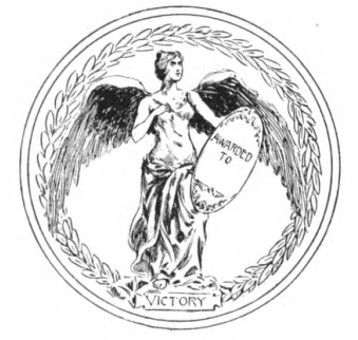
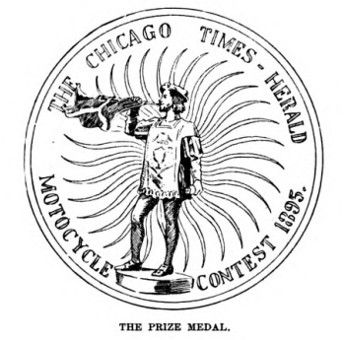
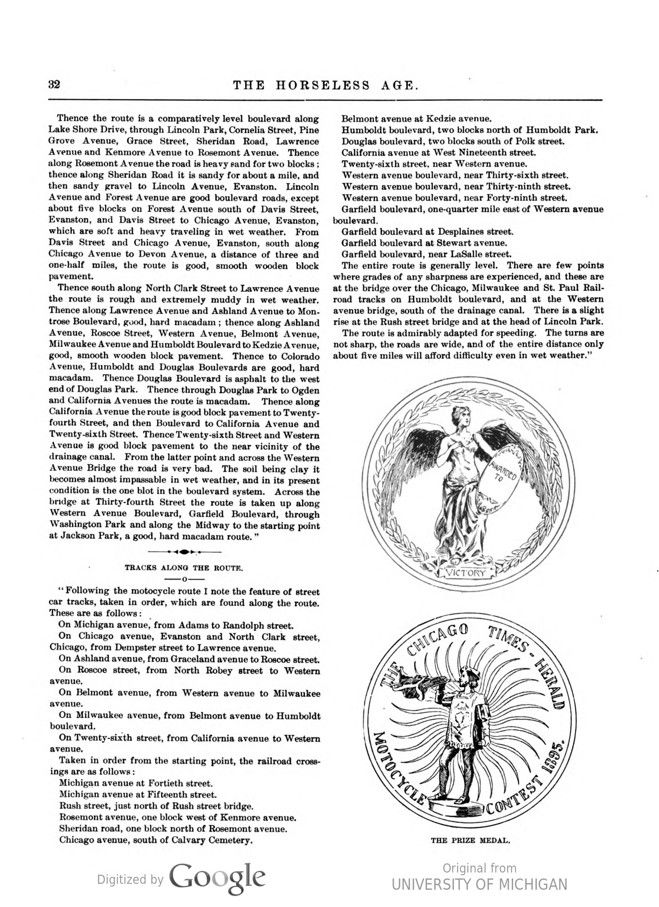
THE PRIZE MEDAL: VICTORY AWARDED ΤΟ *** / THE CHICAGO TIMES – HERALD 1895. MOTOCYCLE CONTEST 1895