Comment is on the way. 18.08.2026
Text and photos with courtesy of hathitrust.org, www.hathitrust.org , compiled by motorracinghistory.
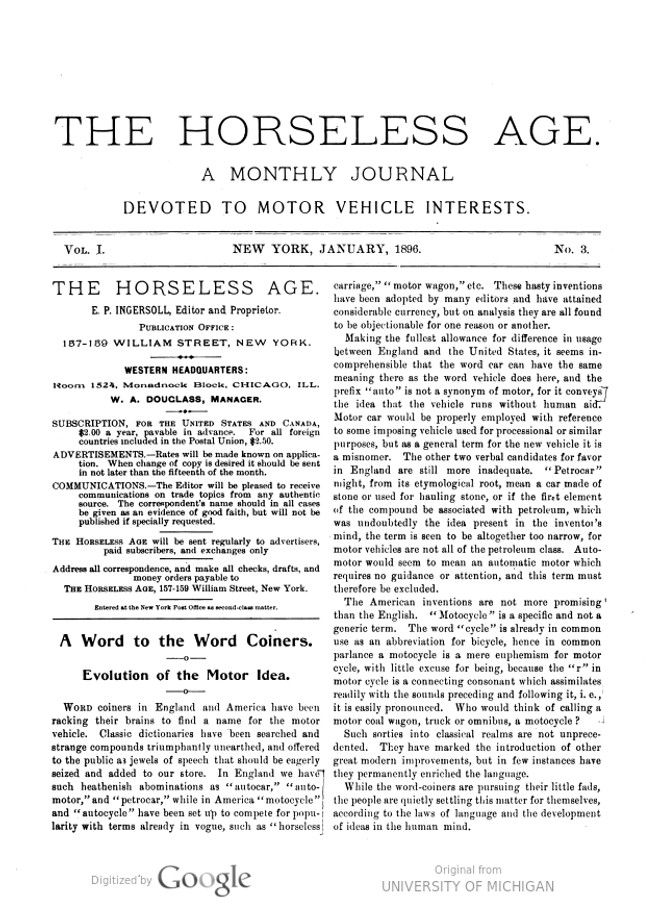
The Horseless Age – Vol. 1, No. 3, January 1896, pp. 29 – 30
TIMES-HERALD CONTEST.
Through Snow and Slush Contestants Struggle on-A Severe Test and a Signal Triumph.
Notwithstanding that Chicago had been visited by a severe snowstorm the day before the date set for the motor vehicle contest, and the snow and slush lay from six to eight inches deep over the course, the judges were true to their word and ordered the contestants to the starting point at Midway Plaisance and Jackson Park.
On the previous evening, eleven inventors had signified their intention of engaging in the race, but at 9 o’clock the next morning only six wagons had put in an appearance. The others being deterred by the terrible condition of the roads, or by the incompleteness of their machines.
The wagons which appeared at the starting point were : The electrobat of Morris & Salom; the gasolene wagon of the Duryea Motor Wagon Co.; the Benz wagon of the H. Mueller Manufacturing Co., Decatur, Ill.; the Benz wagon of the De La Vergne Refrigerating Machine Co.; the Roger wagon, owned by R. H. Macy & Co., and the electric wagon of Harold Sturges.
Morris and Salom were unable to make arrangements for supply stations over the entire length of the course, and announced that they would simply make a short run to show that the electric wagon could make satisfactory headway through deep snow. They made the run to Lincoln Park and part of the way back, when their supply of batteries gave out and they were compelled to stop. Henry G. Morris conducted and Hiram Percy Maxim acted as umpire.
The Duryeas came to the scene of the race, and returned after the finish by their own power. They were unable to complete the new and improved wagons on which they have been engaged for about two months, and were obliged to enter the old experimental wagon, which was built two years ago, has been run several thousand miles over ordinary roads, and was forced into the ditch with such disastrous consequences during the Consolation Race, November 2nd. The Duryea company were aware of its weakness, and scarcely dared hope that it would carry them over the course. But it did and brought them first to the winning post.
At 8.55 the judges gave the word to the Duryeas, and the wagon passed out through the crowd at a lively pace. The occupants being J. Frank Duryea, and Arthur W. White, the umpire appointed for the vehicle.
Shortly afterward the Benz wagon of the De La Vergne Co. was sent off under the guidance of Frederick C. Haas, and with James F. Bate as umpire, but the wheels slipped in the deep snow, and Mr. Haas decided to withdraw from the competition.
The Macy wagon started at 8.59 with J. O’Connor as operator and Lieutenant Samuel Rodman, Jr., as umpire. The deep snow of the Midway Plaisance proved too much for this wagon as it had for the Benz wagon, and it had to be assisted over the bad spot by Mr. O’Connor.
The Sturges electric wagon started at 9.01, carrying Harold Sturges, the owner, and T. T. Bennett, the umpire, but the Mueller wagon owing to a delay in reaching the starting point, did not get off until six minutes past ten. Oscar Mueller conducted, and Charles B. King acted as umpire.
The speed of the wagons varied according to the condition of the roads. Where snow was deep or slush was plenty they toiled through the mess as best they could, but on certain stretches, conditions were more favorable for speed, and some lively sprinting was witnessed by the thousands of spectators who lined the way, and cheered heartily as each contestant passed.
As this was the first opportunity motor wagon inventors had had of testing the operation of the rubber tire in snow, some misgivings were felt, and an odd device was resorted to prevent slipping. The tires of the Mueller and Duryea wagons were wound with twine under the impression that this would give a firmer grip on the snow. The occupants of the Duryea wagon soon dispensed with this make shift as it appeared to them unnecessary. One of the occupants of the Mueller wagon also busied himself in sanding the belt from time to time to prevent its slipping.
The Sturges wagon reached Lincoln Park at 12.15, and soon afterward abandoned the race, the deep snow of the Midway having proved so great a tax upon its motor that the conductor had to make frequent stops to keep it from burning out.
The Duryea wagon led from the beginning of the race, but the steering apparatus broke, necessitating a delay during which the Macy wagon passed the competitor. The Macy wagon led until Evanston was reached, where the Duryea again took the lead. The trip of the Macy machine was spiced with adventure. The vehicle collided with a street car in the city, and not very long afterwards it disputed the way with a heavy coach, and came out of the encounter with a broken steering gear and other infirmities, which speedily became chronic, and brought the machine to a stand-still finally at 6.15 P. M., twenty-five minutes behind the Duryea.
The Duryea machine arrived at the finish at 7.18, ten hours and twenty-eight minutes from the time of starting. Taking into account the delays for repairs, etc., the Duryea wagon made an average of about 7½ miles an hour, the actual time the vehicle was in motion being 7½ hours. Some time was also lost by losing the course at Lawrence Avenue on the return.
THE AWARDS.
The judges after several days consultation made the following awards:
An award of $2,000 to the Duryea Motor Wagon Co., of Springfield, Mass., for best performance in the road race, for range of speed and pull, with compactness of design.
An award of $1,500 to the H. Mueller & Co. motocycle, of Decatur, Ill., for performance in the road race and economy in operation.
An award of $500 to the R. H. Macy & Co. motocycle, of New York, for showing made in the road race.
An award of $500 to the Sturges electric motocycle, of Chicago, for showing made in the road race.
An award of the Times-Herald gold medal to the Morris & Salom electrobat, of Philadelphia, for best showing made in the official tests, for safety, ease of control, absence of noise, vibration, heat or odor, cleanliness and general excellence of design and workmanship.
The following special awards were made by the committee on tests for meritorious points in design:
An award of $200 to the G. W. Lewis motocycle, of Chicago, for friction-driving device and brake, and a reduction gear for increasing speed.
An award of $150 to the Haynes & Appeson. gasolene motocycle, of Kokomo, Ind., for plan of preventing vibration by balance of driving engines.
An award of $100 to the Max Hertel gasolene motocycle, of Chicago, for a device for starting the motor from the operator’s seat in the vehicle.
An award of $50 to the De la Vergne Refrigerating Machine Co. of New York, for counterbalance on engine.
There were present as judges and associates, Professor John P. Barrett, city electrician; Leland L. Summers, editor of Electrical Engineering; C. P. Kimball, the well-known carriage manufacturer; Colonel Marshall I. Ludington, of the United States army; J. Allen Hornsby, secretary of the board of judges. Major-General Wesley Merritt was represented by Colonel Ludington, and Henry Tinken, of St. Louis, by Mr. Kimball.
On November 29th, Morris & Salom, manufacturers of the „electrobat,“ wrote a lengthy letter to the judges of the Times-Herald Race, in which they claimed the following points of superiority in their vehicles:
1st.- Absolute safety.
2nd – No noise.
3rd.- No vibration.
4th. – No heat.
5th. – No odor.
6th. – Simplicity of construction.
7th. – Ease of handling.
8th. – Perfect control.
9th. – Cleanliness.
10th. – Economy of power.
11th. – Economy of operation.
12th. – Cost.
13th. – Elegance of design, and freedom from mechanical appearance.
These points they took up and argued separately, contending that they were entitled to the award.