The Times-Herald Contest originally was set for November 2, 1895. Alas, it showed that only a handfull of contestants proved able to actually have their vehicle ready-for-go in that short of time. Therefore, a new date was set on Thanksgiving day, November 28. But for those available in November 2, a day earlier was announced that a consolation race was to be held for them. This report summarizes that 2nd November consolation race.
Text and photos with courtesy of hathitrust.org, www.hathitrust.org , compiled by motorracinghistory.
The Horseless Age – Vol. 1, No. 2,December 1895, pp. 13 – 15
The Trial and Postponement.
Brief Review of the Preliminary Tests and the Consolation Race.
Owing to a general feeling among those who had entered in the Times-Herald Contest that insufficient time had been allowed them for preparation, the judges wisely decided to postpone the event until Thanksgiving Day, November 28th. Only eight vehicles could be mustered on the Washington Driving Park on Friday, the day before the race, and one or two of these were in an unfinished condition.
They were:
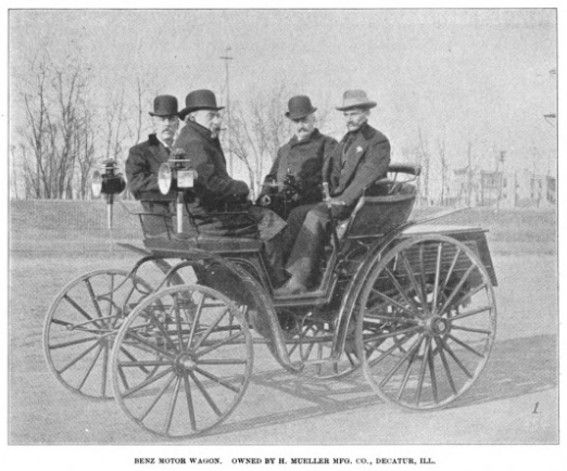
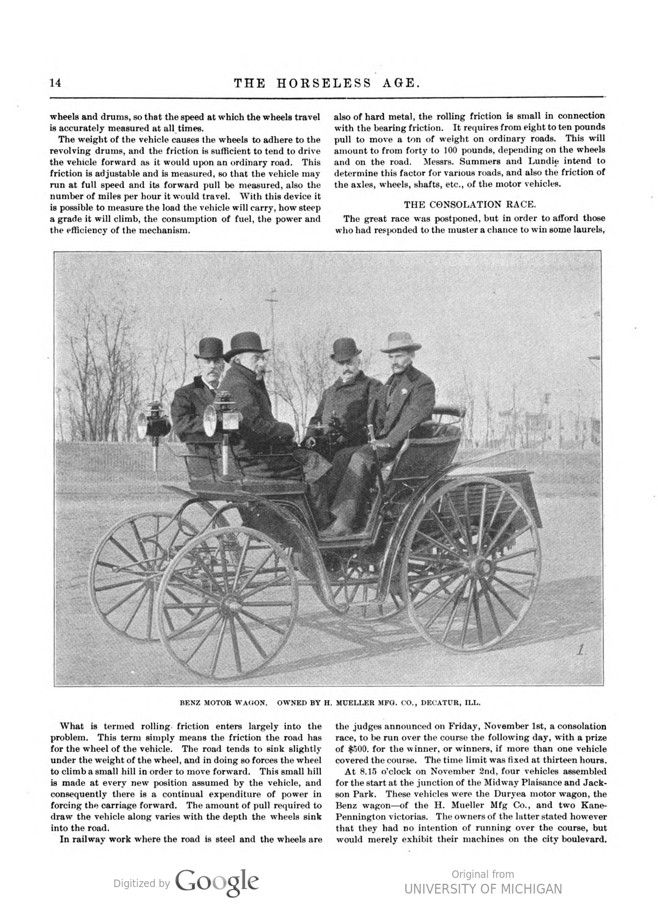
The Benz wagon, imported from Mannheim, Germany, and owned by the H. Mueller Mfg Co., Decatur, Ill.;
The Duryea wagon, of the Duryea Motor Wagon Co., Springfield, Mass.;
two electric wagons built by Morris & Salom, Philadelphia, Pa.;
a motor bicycle and two victorias entered by Thos. Kane & Co., Chicago, Ill., and
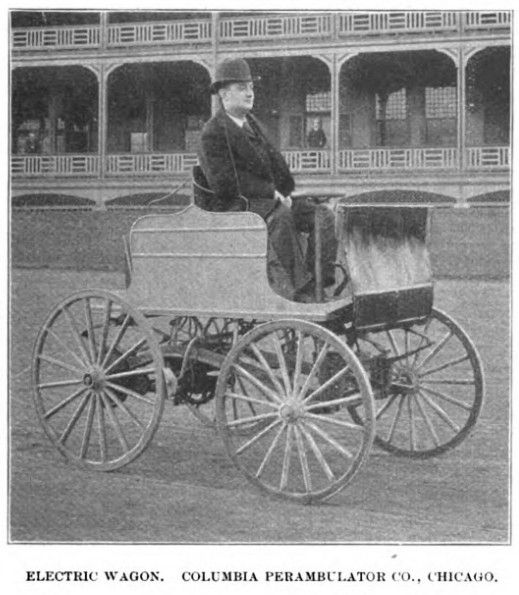
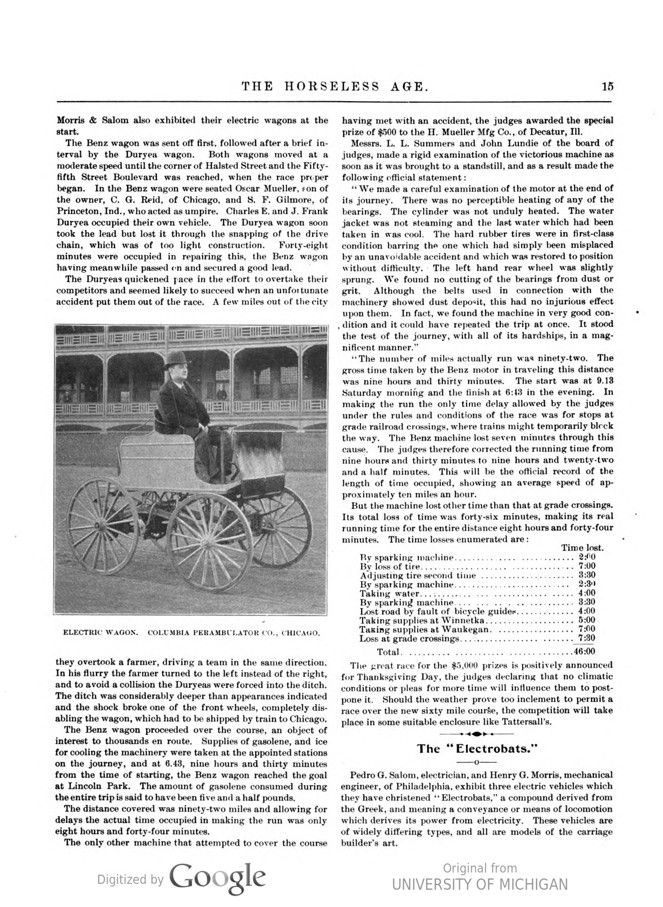
an unfinished electric wagon exhibited by the Columbia Perambulator Co., Chicago, Ill.
A large crowd of experts and curiosity seekers gathered around these vehicles as they were put through their paces on the track, some of those present having come from remote points to witness the exhibition.
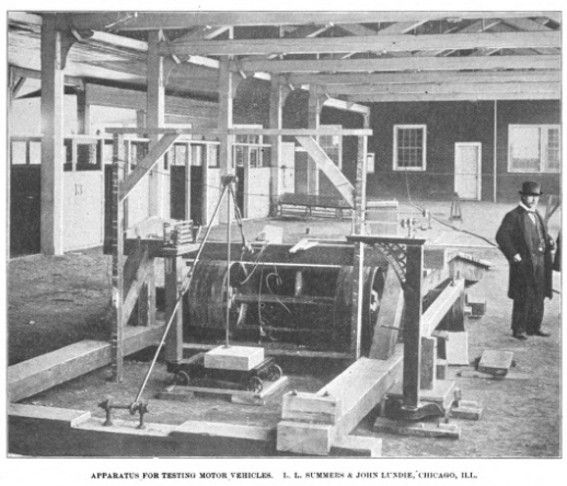
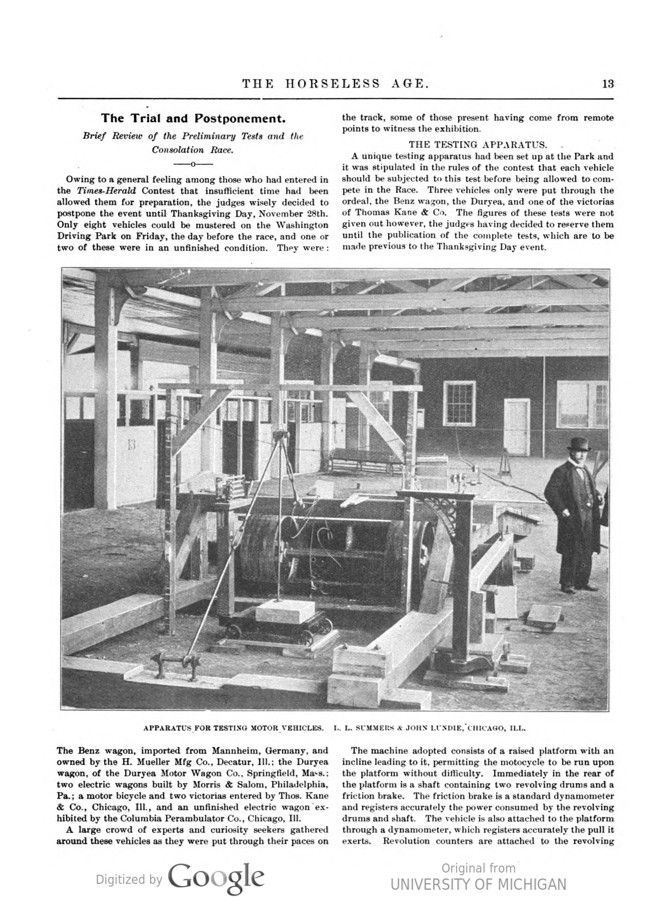
THE TESTING APPARATUS.
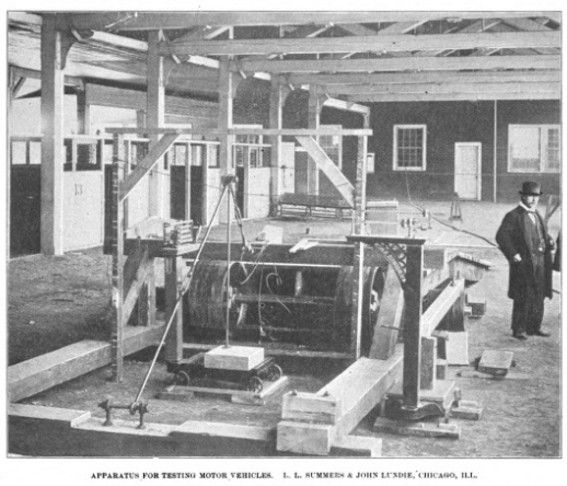
A unique testing apparatus had been set up at the Park and it was stipulated in the rules of the contest that each vehicle should be subjected to this test before being allowed to compete in the Race. Three vehicles only were put through the ordeal, the Benz wagon, the Duryea, and one of the victorias of Thomas Kane & Co. The figures of these tests were not given out however, the judges having decided to reserve them until the publication of the complete tests, which are to be made previous to the Thanksgiving Day event.
The machine adopted consists of a raised platform with an incline leading to it, permitting the motocycle to be run upon the platform without difficulty. Immediately in the rear of the platform is a shaft containing two revolving drums and a friction brake. The friction brake is a standard dynamometer and registers accurately the power consumed by the revolving drums and shaft. The vehicle is also attached to the platform through a dynamometer, which registers accurately the pull it exerts. Revolution counters are attached to the revolving wheels and drums, so that the speed at which the wheels travel is accurately measured at all times.
The weight of the vehicle causes the wheels to adhere to the revolving drums, and the friction is sufficient to tend to drive the vehicle forward as it would upon an ordinary road. This friction is adjustable and is measured, so that the vehicle may run at full speed and its forward pull be measured, also the number of miles per hour it would travel. With this device it is possible to measure the load the vehicle will carry, how steep a grade it will climb, the consumption of fuel, the power and the efficiency of the mechanism.
What is termed rolling friction enters largely into the problem. This term simply means the friction the road has for the wheel of the vehicle. The road tends to sink slightly under the weight of the wheel, and in doing so forces the wheel to climb a small hill in order to move forward. This small hill is made at every new position assumed by the vehicle, and consequently there is a continual expenditure of power in forcing the carriage forward. The amount of pull required to draw the vehicle along varies with the depth the wheels sink into the road.
In railway work where the road is steel and the wheels are also of hard metal, the rolling friction is small in connection with the bearing friction. It requires from eight to ten pounds pull to move a ton of weight on ordinary roads. This will amount to from forty to 100 pounds, depending on the wheels and on the road. Messrs. Summers and Lundie intend to determine this factor for various roads, and also the friction of the axles, wheels, shafts, etc., of the motor vehicles.
THE CONSOLATION RACE.
The great race was postponed, but in order to afford those who had responded to the muster a chance to win some laurels, the judges announced on Friday, November 1st, a consolation race, to be run over the course the following day, with a prize of $500. for the winner, or winners, if more than one vehicle covered the course. The time limit was fixed at thirteen hours. At 8.15 o’clock on November 2nd, four vehicles assembled for the start at the junction of the Midway Plaisance and Jackson Park. These vehicles were the Duryea motor wagon, the Benz wagon – of the H. Mueller Mfg Co., and two Kane-Pennington victoria’s. The owners of the latter stated however that they had no intention of running over the course, but would merely exhibit their machines on the city boulevard. Morris & Salom also exhibited their electric wagons at the start.
The Benz wagon was sent off first, followed after a brief interval by the Duryea wagon. Both wagons moved at a moderate speed until the corner of Halsted Street and the Fifty-fifth Street Boulevard was reached, when the race proper began. In the Benz wagon were seated Oscar Mueller, son of the owner, C. G. Reid, of Chicago, and S. F. Gilmore, of Princeton, Ind., who acted as umpire. Charles E. and J. Frank Duryea occupied their own vehicle. The Duryea wagon soon took the lead but lost it through the snapping of the drive chain, which was of too light construction. Forty-eight minutes were occupied in repairing this, the Benz wagon having meanwhile passed on and secured a good lead.
The Duryeas quickened pace in the effort to overtake their competitors and seemed likely to succeed when an unfortunate accident put them out of the race. A few miles out of the city they overtook a farmer, driving a team in the same direction. In his flurry the farmer turned to the left instead of the right, and to avoid a collision the Duryeas were forced into the ditch. The ditch was considerably deeper than appearances indicated and the shock broke one of the front wheels, completely disabling the wagon, which had to be shipped by train to Chicago.
The Benz wagon proceeded over the course, an object of interest to thousands en route. Supplies of gasolene, and ice for cooling the machinery were taken at the appointed stations on the journey, and at 6.43, nine hours and thirty minutes from the time of starting, the Benz wagon reached the goal at Lincoln Park. The amount of gasolene consumed during the entire trip is said to have been five and a half pounds.
The distance covered was ninety-two miles and allowing for delays the actual time occupied in making the run was only eight hours and forty-four minutes.
The only other machine that attempted to cover the course having met with an accident, the judges awarded the special prize of $500 to the H. Mueller Mfg Co., of Decatur, Ill.
Messrs. L. L. Summers and John Lundie of the board of judges, made a rigid examination of the victorious machine as soon as it was brought to a standstill, and as a result made the following official statement:
„We made a careful examination of the motor at the end of its journey. There was no perceptible heating of any of the bearings. The cylinder was not unduly heated. The water jacket was not steaming and the last water which had been taken in was cool. The hard rubber tires were in first-class condition barring the one which had simply been misplaced by an unavoidable accident and which was restored to position without difficulty. The left hand rear wheel was slightly sprung. We found no cutting of the bearings from dust or grit. Although the belts used in connection with the machinery showed dust deposit, this had no injurious effect upon them. In fact, we found the machine in very good condition and it could have repeated the trip at once. It stood the test of the journey, with all of its hardships, in a magnificent manner.“
„The number of miles actually run was ninety-two. The gross time taken by the Benz motor in traveling this distance was nine hours and thirty minutes. The start was at 9.13 Saturday morning and the finish at 6:43 in the evening. In making the run the only time delay allowed by the judges under the rules and conditions of the race was for stops at grade railroad crossings, where trains might temporarily block the way. The Benz machine lost seven minutes through this cause. The judges therefore corrected the running time from nine hours and thirty minutes to nine hours and twenty-two and a half minutes. This will be the official record of the length of time occupied, showing an average speed of approximately ten miles an hour.
But the machine lost other time than that at grade crossings. Its total loss of time was forty-six minutes, making its real running time for the entire distance eight hours and forty-four minutes. The time losses enumerated are:
……………………………………………… (Time lost)
By sparking machine………….………… 2:00
By loss of tire…………….….……………… 7:00
Adjusting tire second time……………. 3:30
By sparking machine……………………. 2:30
Taking water………………….………….…. 4:00
By sparking machine………..………..… 3:30
Lost road by fault of bicycle guides. 4:00
Taking supplies at Winnetka………… 5:00
Taking supplies at Waukegan…..….. 7:00
Loss at grade crossings………………… 7:30
Total……………………………….…….…….. 46:00
The great race for the $5,000 prizes is positively announced for Thanksgiving Day, the judges declaring that no climatic conditions or pleas for more time will influence them to postpone it. Should the weather prove too inclement to permit a race over the new sixty-mile course, the competition will take place in some suitable enclosure like Tattersall’s.
Photos.
Page 13. APPARATUS FOR TESTING MOTOR VEHICLES. L. L. SUMMERS & JOHN LUNDIE, CHICAGO, ILL.
Page 14. BENZ MOTOR WAGON. OWNED BY H. MUELLER MFG. CO., DECATUR, ILL.
Page 15. ELECTRIC WAGON. COLUMBIA PERAMBULATOR CO., CHICAGO.