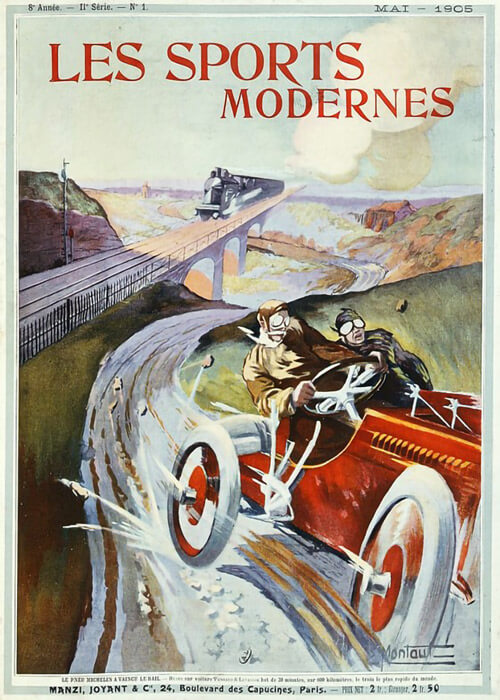
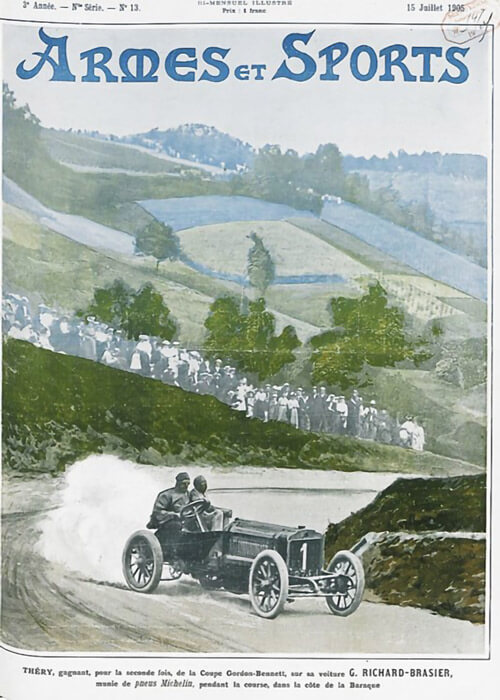
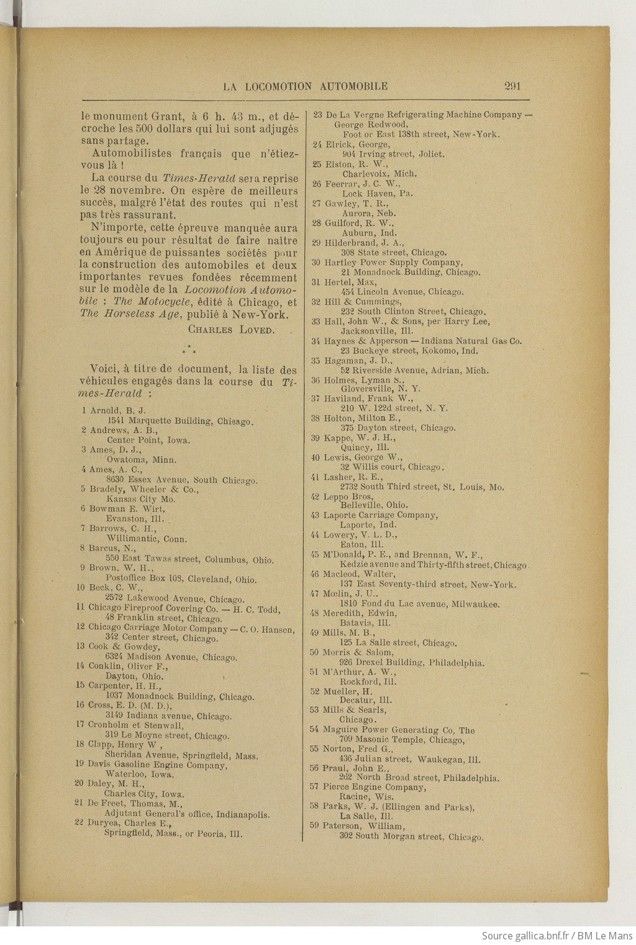
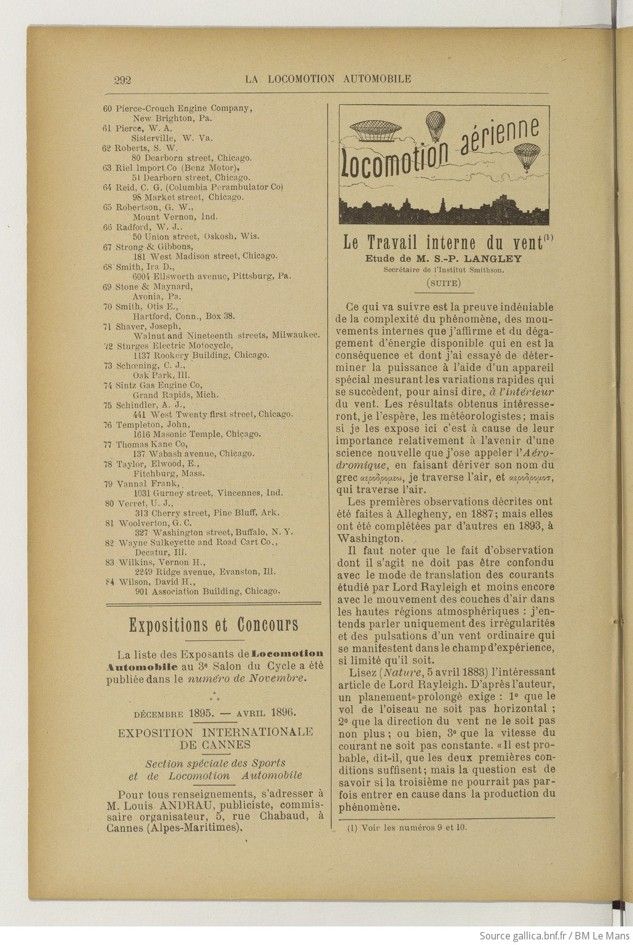
If anyone might have tought that Europe wouldn’t be interested in US motor racing: here’s proof of the contrary. In it’s first active publishing year, the French magazine La Locomotion Automobile publishes an extensive report on the first American motoring race, half a year after the Paris-Bordeaux race. A complete list of the 84 contestants even is provided. (Translation by DeepL).
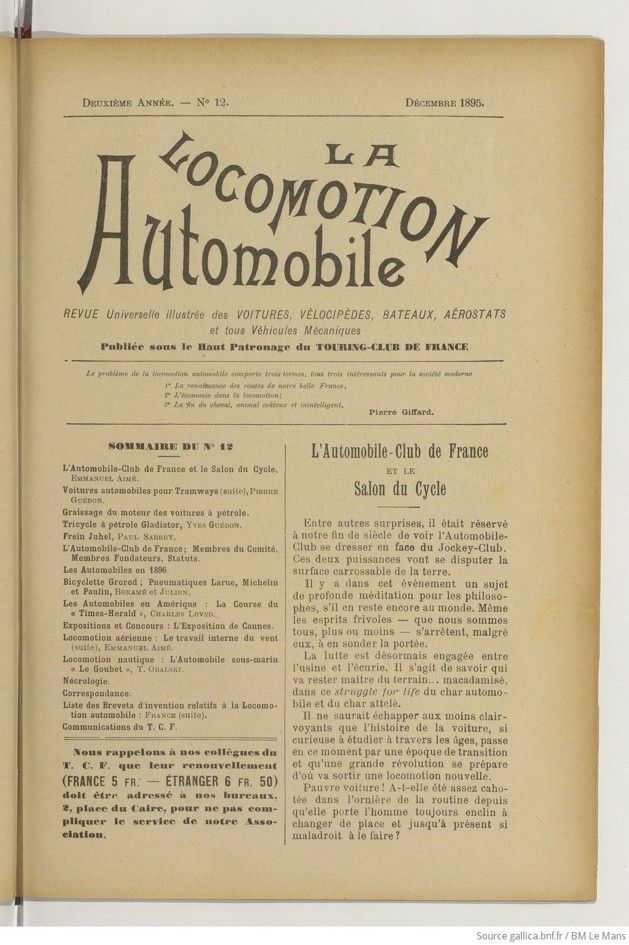
With courtesy of the Bibliothèque national francais gallica.bnf.fr
Text and photos compiled by motorracinghistory; Translation by DeepL deepl.com
La Locomotion Automobile — 2nd Year, No. 12, December 1895, pages 285-292
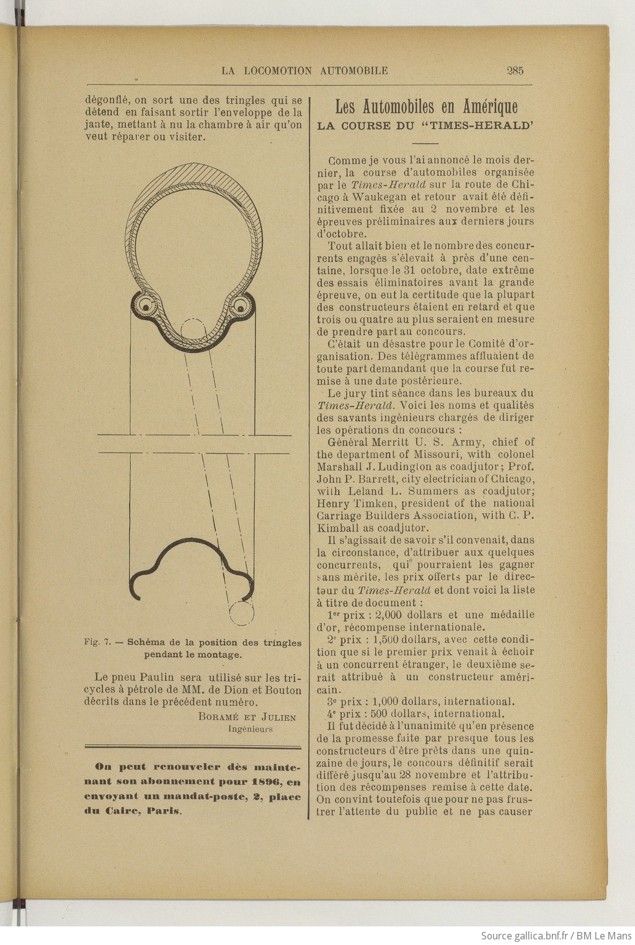
Automobiles in America – THE “TIMES-HERALD” RACE
As I announced last month, the automobile race organized by the Times-Herald on the route from Chicago to Waukegan and back had been definitively set for November 2, with the preliminary heats scheduled for the last days of October.
Everything was going smoothly, and the number of registered competitors had reached nearly a hundred, when on October 31, the final date for the qualifying trials for the main event, it became clear that most of the manufacturers were behind schedule and that at most three or four would be able to take part in the competition.
It was a disaster for the Organizing Committee. Telegrams were pouring in from all directions requesting that the race be postponed to a later date.
The jury held a meeting in the offices of the Times-Herald. Here are the names and titles of the distinguished engineers charged with directing the competition’s operations:
General Merritt, U.S. Army, Chief of the Department of Missouri, with Colonel Marshall J. Ludington as his assistant; Prof. John P. Barrett, City Electrician of Chicago, with Leland L. Summers as his assistant; Henry Timken, President of the National Carriage Builders Association, with C. P. Kimball as his assistant.
The question was whether, under the circumstances, it was appropriate to award the prizes offered by the editor of the Times-Herald, a list of which is provided here for reference, to the few competitors who might deserve them:
1st prize: $2,000 and a gold medal, an international award.
2nd prize: $1,500, on the condition that if the first prize were to go to a foreign competitor, the second prize would be awarded to an American builder.
3rd prize: $1,000, international.
4th prize: $500, international.
It was unanimously decided that, given the promise made by nearly all the manufacturers to be ready within about fifteen days, the final competition would be postponed until November 28 and the awarding of the prizes would be deferred to that date. It was agreed, however, that in order not to disappoint the public’s expectations and to spare curious onlookers the frustration of a needless inconvenience, the announced race would take place the following day among the competitors, and that a sum of $500, an additional donation from the Times-Herald, would be distributed to those who completed the course.
The published rules were, moreover, to be followed in full. I am transcribing a few more excerpts here to supplement the information contained in my previous article.
The Route
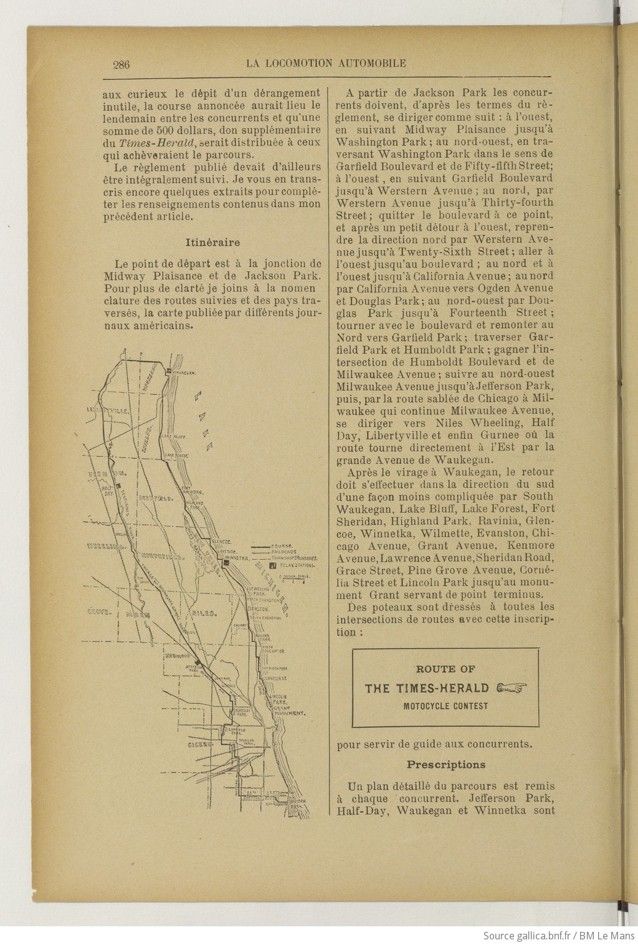
The starting point is at the junction of Midway Plaisance and Jackson Park. For greater clarity, I am including the map published by various American newspapers along with the list of roads to be followed and the areas to be traversed.
From Jackson Park, the competitors must, according to the rules, proceed as follows: westward, following Midway Plaisance to Washington Park; northwest, crossing Washington Park toward Garfield Boulevard and Fifty-fifth Street; west, following Garfield Boulevard to Western Avenue; north, along Western Avenue to Thirty-fourth Street; leave the boulevard at this point, and after a short detour to the west, resume heading north along Western Avenue to Twenty-Sixth Street; head west to the boulevard; north and west to California Avenue; north on California Avenue toward Ogden Avenue and Douglas Park; northwest through Douglas Park to Fourteenth Street; turn onto the boulevard and head north toward Garfield Park; cross Garfield Park and Humboldt Park; reach the intersection of Humboldt Boulevard and Milwaukee Avenue; follow Milwaukee Avenue northwest to Jefferson Park, then, via the Chicago-Milwaukee gravel road, which continues as Milwaukee Avenue—head toward Niles, Wheeling, Half Day, Libertyville, and finally Gurnee, where the road turns directly east onto Waukegan Avenue.
After the turn at Waukegan, the return trip should be made southward via the less complicated route through South Waukegan, Lake Bluff, Lake Forest, Fort Sheridan, Highland Park, Ravinia, Glencoe, Winnetka, Wilmette, Evanston, Chicago Avenue, Grant Avenue, Kenmore Avenue, Lawrence Avenue, Sheridan Road, Grace Street, Pine Grove Avenue, Cornelia Street, and Lincoln Park to the Grant Monument, which serves as the finish line.
Signs have been erected at all intersections bearing the inscription: ROUTE OF THE TIMES-HERALD TO MOTORCYCLE CONTEST to guide the competitors.
Rules
A detailed map of the course is provided to each competitor. Jefferson Park, Half-Day, Waukegan, and Winnetka are the only stations where refueling is permitted.
At each relay station, a timekeeper is stationed to record the arrival and departure times.
Each competitor must make his or her own arrangements for supplies, unless he or she prefers to take advantage of the provisions offered to all at the various stations.
Entered vehicles must assemble at the intersection of Midway Plaisance and Jackson Park at 7:30 a.m. and occupy the spaces assigned by the jury.
Each car must display, in a clearly visible location, a white square plate measuring twelve inches on each side, bearing an inscription in black letters 6 inches high and the number assigned by the jury overseeing the start.
From Jackson Park to Halsted Street, the cars must drive without attempting to pass one another, maintaining their order of travel and their distances from one another. Upon reaching this final stop, they must come to a halt and then set off again at the starter’s signal.
Each vehicle is required to have three lights illuminated no later than 5:00 p.m.: two at the front and a third, with a red lens, at the rear. A horn and a fog horn are also required.
When two vehicles traveling in the same direction at different speeds are in close proximity, the slower vehicle must move to the right and leave the left side of the road clear. Any driver who, through their maneuvers, attempts to block the path of their rival will be disqualified.
If several vehicles arrive together or in succession at an obstacle requiring a stop, all must stop in the order in which they were traveling, without attempting to pass one another before the road is clear.
A referee appointed by the jury remains on each car at all times throughout the competition to ensure compliance with the rules.
This abundance of regulations is rather curious given the shortage of entrants that caused the Times-Herald competition to fail. I nevertheless believe it is useful to bring these points of the regulations to your attention, even if they are not being applied this time, as they remain in effect for the final race, scheduled for November 28, and La Locomotion automobile has made it a rule to present to its readers everything, both abroad and in France, that is of interest to the history of motorcycles (the term adopted in America to refer to horseless carriages).
The Race.
The route from Chicago to Waukegan and back was measured by bicycle over the past few days, using bicycles equipped with cyclometers, by Lieutenant Samuel Rodman Jr. of the United States Artillery, N. H. Van Sicklen, A. J. Nicolet, and J. P. Gunther. The total distance is estimated to be between 90 and 92 miles, approximately 150 kilometers, and can be broken down roughly as follows:
From the starting point to Jefferson Park…18.05
From Jefferson Park to Half Day………….…… 18.72
From Half Day to Waukegan……………………. 17.52
From Waukegan to Winnetka…………………… 18.24
From Winnetka to the Grant Monument …. 17.76
Total ………………………………………………………… 90.74
This route, on which future races organized in Chicago will likely be held, will become a classic, just as the Paris-Bordeaux route already is. Your French drivers would do well to study it in detail if they plan to come, someday, to take part in races in the United States. What a pity they didn’t think of it this year. All the honors would have gone to them, and they would have once again demonstrated the superiority of your engineers over American engineers when it comes to motorcycle construction. That’s what everyone here agrees on. And do you know what else people say? I’ll tell you, in confidence, though I don’t entirely share this point of view: it’s that such a wonderful opportunity to completely triumph over your American competitors may never come your way again. The only thing they lacked this time, it’s said, was time. Next year, they’ll be ready: their wealthy companies and new factories will be in full swing.
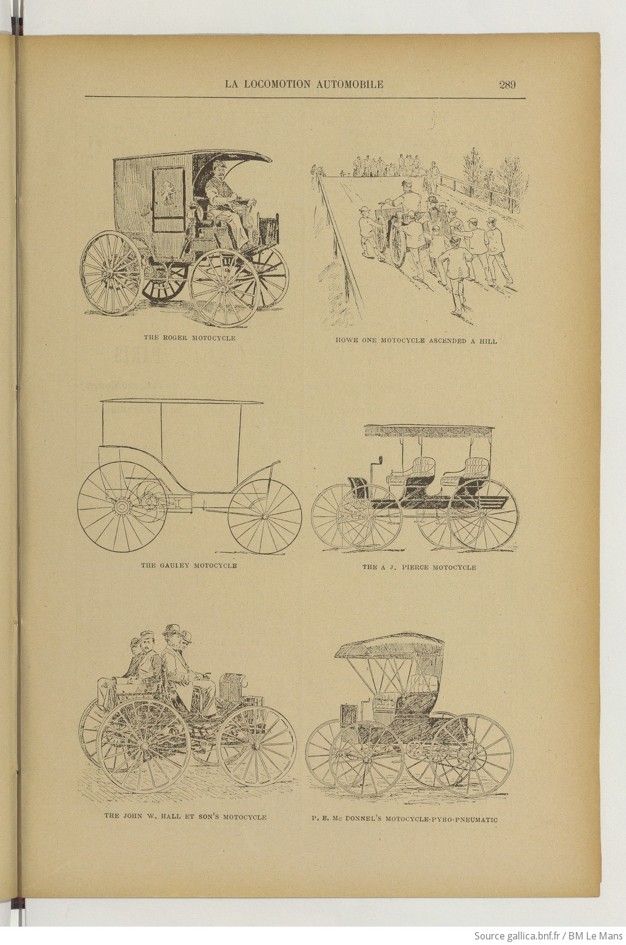
I am presenting to you, again, simply as a document of historical interest, certain types of motorcycles currently being manufactured, some of which were unable to participate in the race on November 2 but will take part in the one on the 28th. The captions accompanying them indicate their origin.
In any case, there is one area in which the United States will not be able to compete with France for a long time. Indeed, there is no comparison to be made between our poor, barely marked roads and the marvelous roads of your beautiful country, which is truly a motorist’s paradise on earth.
The best we have is the Chicago-Waukegan highway, and that’s not saying much. Consequently, the results obtained on both sides of the Atlantic will be difficult to compare.
The maximum time allowed for participants in the November 2 race to complete the course and be eligible for prizes is 13 hours. This figure was not chosen at random; it is proportional to 150 kilometers, just as the 100-hour time limit for the Paris-Bordeaux race is proportional to a distance of 1,200 kilometers, and that is why the Jury selected it.
Here now is the account of the race.
It is 8:30 a.m., and the fog has barely lifted from the low-lying areas of Jackson Park when the starting signal is given. There is no crowd like the one you had on June 11 at Place de l’Étoile. Of the half-million spectators reported by the newspapers, there are about 400 onlookers forming an escort for the only two motorcycles present.
Here now, based on a humorous but accurate illustration, is the order and composition of the procession:
Marshal F.-U. Adams, on horseback;
The Jury, in a carriage;
Reporters, on bicycles;
The Benz Motorcycle, built by the H. Mueller Company of Decatur;
Reporters, on horseback;
The Charles E. Duryea Motorcycle, BUILT BY THE DURYEA BROTHERS OF Springfield, Mass.
SPECTATORS IN CARRIAGES.
Employees of the Illinois Central Railroad, on foot.
A farmer riding a yellow horse.
Onlookers on bicycles.
This procession gradually thins out as it heads down Midway.
In the end, the only ones left following the competitors are:
F. U. Adams.
One of the jury’s cars.
Reporters.
Bicyclists.
The race starts off slowly and continues without incident all the way to Douglas Park.
Along the way, the motorcycles are joined by the Kane-Pennington machine, which had started late.
The Duryea motorcycle leaves Douglas Park and turns onto West Twenty-second Street at 9:50 a.m. Ten minutes later, the Benz motorcycle leaves Douglas Park. From there to Garfield Park, it gains two minutes on the ten-minute lead held by the first motorcycle.
But from that point on, everything goes wrong. The vehicles slow down more and more, even coming to a stop, and when they start up again, their drivers implore onlookers to give them room, as if the engine were temperamental.
Further on is a downhill stretch: the motorcycles hurtle down it at breakneck speed and with deafening noise. But an uphill climb follows, conquered with a supreme effort by the heavy machines, which resume their erratic pace on the descent that comes next.
The Kane-Pennington motorcycle is twenty minutes behind despite its elegance and enormous tires. It stops at the Saint-Paul viaduct, halfway up the slope, and is pushed by a dozen onlookers and children, whose efforts are depicted in the illustration opposite, and manages, with great difficulty, to reach the top of the hill, where a group of velocipede riders greets it with taunts. Disqualified, it withdraws from the race.
The Duryea motorcycle falls into a ditch at Prairiesville. Its chain is broken; it is repaired, but the vehicle is unable to continue the race.
The Benz-Mueller motorcycle now has no competitor. It climbs the hills like a ship, tackling from right to left.
From Jefferson Park to Niles, its wheels sink a foot into the dust; it moves forward only with extreme slowness.
Two miles further on, the car stops, overheated, glowing red-hot. Its driver, Mr. Reed, applies ice to cool it down. But what an appetite it has!
They feed it enormous blocks of ice, shovelfuls; everything melts, and it is still not sated, not cooled down.
Yet it sets off again, still racing back and forth.
At 2:45 p.m., it passes in front of Waukegan House, stops, sets off again at 3:00 p.m., and finally arrives at the finish line, the Grant Monument, at 6:43 p.m. 43 m., and claims the $500 prize awarded to her outright.
French motorists, if only you had been there!
The Times-Herald race will be held again on November 28. We hope for better results, despite the road conditions, which aren’t very reassuring.
Regardless, this failed event will always be credited with giving rise in America to powerful automobile manufacturing companies and two major magazines recently founded on the model of Locomotion Automobile:: The Motorcycle, published in Chicago, and The Horseless Age, published in New York.
Charles Loved.
* * *
For your reference, here is the list of vehicles participating in the Times-Herald race:
1 Arnold, B. J. 154L Marquette Building, Chicago.
2 Andrews, A. B., Center Point, Iowa.
3 Ames, D. J., Owatoma, Minn.
4 Ames, A. C., 8630 Essex Avenue, South Chicago.
5 Bradely, Wheeler & Co., Kansas City Mo.
6 Bowman E. Wirt, Evanston, 111.
7 Barrows, C. H., Willimantic, Conn.
8 Bareus, N., 550 East Tawas Street, Columbus, Ohio.
9 Brown, W. H., Postofïice Box 108, Cleveland, Ohio.
10 Beck, C. W., 2572 Lakewood Avenue, Chicago.
11 Chicago Fireproof Covering Co. — H. C. Todd, 48 Franklin street, Chicago.
12 Chicago Carriage Motor Company — C. O. Hansen, 342 Center street, Chicago.
13 Cook & Gowdey, 6324 Madison Avenue, Chicago.
14 Conklin, Oliver F., Dayton, Ohio.
15 Carpenter, H. H., 1037 Monadnock Building, Chicago.
16 Cross, E. D. (M. D.), 3149 Indiana avenue, Chicago.
17 Cronholm et Stenwall, 319 Le Moyne street, Chicago.
18 Clapp, Henry W, Sheridan Avenue, Springfield, Mass.
19 Davis Gasoline Engine Company, Waterloo, Iowa.
20 Daley, M. H., Charles City, Iowa.
21 De Freet, Thomas, M., Adjutant General’s office, Indianapolis.
22 Duryea, Charles E., Springfleld, Mass., or Peoria, ILL.
23 De La Vergne Refrigerating Machine Company — George Redwood, Foot or East 138th street, New-York.
24 Elrick, George, 904 Irving street, Joliet.
25 Elston, R. W., Charlevoix, Mich.
26 Feerrar, J. C. W., Lock Haven, Pa.
27 Gawley, T. R., Aurora, Neb.
28 Guilford, R. W., Auburn, Ind.
29 Hilderbrand, J. A., 308 State street, Chicago.
30 Hartley Power Supply Company, 21 Monadnock Building, Chicago.
31 Hertel, Max, 454 Lincoln Avenue, Chicago.
32 Hill & Cummings, 232 South Clinton Street, Chicago.
33 Hall, John W., & Sons, per Harry Lee, Jacksonville, ILL.
34 Haynes & Apperson — Indiana Natural Gas Co. 23 Buckeye street, Kokomo, Ind.
35 Hagaman, J. D., 52 Riverside Avenue, Adrian, Mich.
36 Holmes, Lyman S., Gloversville, N. Y.
37 Haviland, Frank W., 210 W. 122d street, N. Y.
38 Holton, Milton E., 375 Dayton street, Chicago.
39 Kappe, W. J. H., Quincy, ILL.
40 Lewis, George W., 32 Willis court, Chicago,
41 Lasher, R. E., 2732 South Third street, St. Louis, Mo.
42 Leppo Bros, Belleville, Ohio.
43 Laporte Carriage Company, Laporte, Ind.
44 Lowery, Y. L. D., Eaton, ILL.
45 McDonald, P. E., and Brennan, W. F., Kedzie avenue and Thirty-flfth street, Chicago.
46 Macleod, Walter, 137 East Seventy-third street, New-York.
47 Mœlin, J. U., 1810 Fond du Lac avenue, Milwaukee.
48 Meredith, Edwin, Batavia, ILL.
49 Mills, M. B., 125 La Salle street, Chicago.
50 Morris & Salom, 926 Drexel Building, Philadelphia.
51 M’Arthur, A. W., Rockford, ILL.
52 Mueller, H. Decatur, ILL.
53 Mills & Searls, Chicago.
54 Maguire Power Generating Co, The 709 Masonic Temple, Chicago.
55 Norton, Fred G.. 436 Julian street, Waukegan, ILL.
56 Praul, John E., 262 North Broad street, Philadelphia.
57 Pierce Engine Company, Racine, Wis.
58 Parks, W. J. (Ellingen and Parks), La Salle, ILL.
59 Paterson, William, 302 South Morgan street, Chicago.
60 Pierce-Crouch Engine Company, New Brighton, Pa.
61 Pierce, W. A., Sisterville, W. Va.
62 Roberts, S. W., 80 Dearborn street, Chicago.
63 Riel lmport Co (Benz Motor), 51 Dearborn street, Chicago.
64 Reid, C. G. (Columbia Perambulator Co) 95 Market street, Chicago.
65 Robertson, G. W., Mount Vernon, lnd.
66 Radford, W. J. 50 Union street, Oskosh, Wis.
67 Strong & Gibbons, 181 West Madison street, Chicago.
68 Smith, Ira D., 6004 Ellsworth avenue, Pittsburg, Pa.
69 Stone & Maynard, Avonia, Pa.
70 Smith, Otis E., Hartford, Conn., Box 38.
71 Shaver, Joseph, Walnut and Nineteenth streets, Milwaukee.
72 Sturges Electric Motocycle, 1137 Rookery Building, Chicago.
73 Schœning, C. J., Oak Parle, ILL.
74 Sintz Gas Engine Co, Grand Rapids, Mich.
75 Schindler, A. J., 441 West Twenty first street, Chicago.
76 Templeton, John, 1616 Masonic Temple, Chicago.
77 Thomas Kane Co, 137 Wabash avenue, Chicago.
78 Taylor, Elwood, E., Fitchburg, Mass.
79 Vannal Frank, 1031 Gurney street, Vincennes, lnd.
80 Verret, U. J., 313 Cherry street, Pine Bluff, Ark.
81 Woolverton, G. C. 327 Washington street, Buffalo, N. Y.
82 Wayne Sulkeyette and Road Cart Co., Decatur, ILL.
83 Wilkins, Vernon H., 2249 Ridge avenue, Evanston, ILL.
84 Wilson, David H., 901 Association Building, Chicago.
Photos. Pag 289.
THE ROGER MOTOCYCLE – HOWE ONE MOTOCYCLE ASCENDED A HILL – THE GAULEY MOTOCYCLE – THE A J. PIERCE MOTOCYCLE – THE JOHN W. HALL ET SON’S MOTOCYCLE – P. E. Mc DONNEL’S MOTOCYCLE-PYRO-PNEUMATIC