Introduction on the title is on it’s way.

With permission of hathitrust hathitrust.org == Text and fotos compiled by motorracinghistory motorracinghistory.com
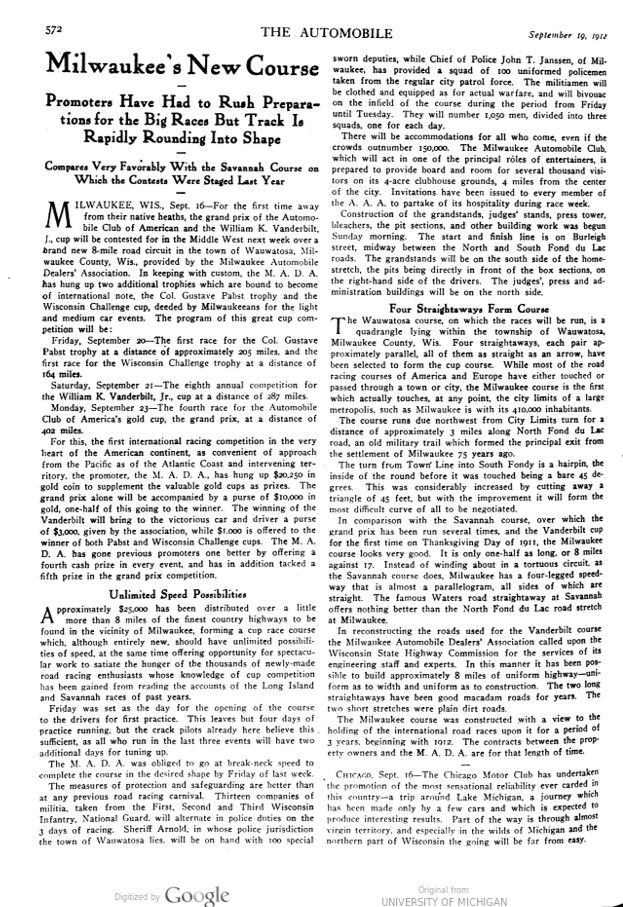
THE AUTOMOBILE — Volume XXVII 27, No. 12, September 19, 1912, page 572
Milwaukee’s New Course
Promoters Have Had to Rush Preparations for the Big Races But Track Is Rapidly Rounding Into Shape
Compares Very Favorably With the Savannah Course on Which the Contests Were Staged Last Year
MILWAUKEE, WIS., Sept. 16 – For the first time away from their native heaths, the grand prix of the Automobile Club of American and the William K. Vanderbilt, J., cup will be contested for in the Middle West next week over a brand new 8-mile road circuit in the town of Wauwatosa, Milwaukee County, Wis., provided by the Milwaukee Automobile Dealers’ Association. In keeping with custom, the M. A. D. A. has hung up two additional trophies which are bound to become of international note, the Col. Gustave Pabst trophy and the Wisconsin Challenge cup, deeded by Milwaukeeans for the light and medium car events. The program of this great cup com- petition will be:
Friday, September 20 – The first race for the Col. Gustave Pabst trophy at a distance of approximately 205 miles, and the first race for the Wisconsin Challenge trophy at a distance of 164 miles.
Saturday, September 21 – The eighth annual competition for the William K. Vanderbilt, Jr., cup at a distance of 287 miles.
Monday, September 23 – The fourth race for the Automobile Club of America’s gold cup, the grand prix, at a distance of 402 miles.
For this, the first international racing competition in the very heart of the American continent, as convenient of approach from the Pacific as of the Atlantic Coast and intervening te ritory, the promoter, the M. A. D. A., has hung up $20,250 in gold coin to supplement the valuable gold cups as prizes. The grand prix alone will be accompanied by a purse of $10,000 in gold, one-half of this going to the winner. The winning of the Vanderbilt will bring to the victorious car and driver a purse of $3,000, given by the association, while $1,000 is offered to the winner of both Pabst and Wisconsin Challenge cups. The M. A. D. A. has gone previous promoters one better by offering a fourth cash prize in every event, and has in addition tacked a fifth prize in the grand prix competition.
Unlimited Speed Possibilities
Approximately $25,000 has been distributed over a little more than 8 miles of the finest country highways to be found in the vicinity of Milwaukee, forming a cup race course which, although entirely new, should have unlimited possibilities of speed, at the same time offering opportunity for spectacu- lar work to satiate the hunger of the thousands of newly-made road racing enthusiasts whose knowledge of cup competition has been gained from reading the accounts of the Long Island and Savannah races of past years.
Friday was set as the day for the opening of the course to the drivers for first practice. This leaves but four days of practice running, but the crack pilots already here believe this sufficient, as all who run in the last three events will have two additional days for tuning up.
The M. A. D. A. was obliged to go at break-neck speed to complete the course in the desired shape by Friday of last week.
The measures of protection and safeguarding are better than at any previous road racing carnival. Thirteen companies of militia, taken from the First, Second and Third Wisconsin Infantry, National Guard, will alternate in police duties on the 3 days of racing. Sheriff Arnold, in whose police jurisdiction the town of Wauwatosa lies. will be on hand with 100 special sworn deputies, while Chief of Police John T. Janssen, of Milwaukee, has provided a squad of 100 uniformed policemen taken from the regular city patrol force. The militiamen will be clothed and equipped as for actual warfare, and will bivouac on the infield of the course during the period from Friday until Tuesday. They will number 1,050 men, divided into three squads, one for each day.
There will be accommodations for all who come, even if the crowds outnumber 150,000. The Milwaukee Automobile Club, which will act in one of the principal roles of entertainers, is prepared to provide board and room for several thousand visi- tors on its 4-acre clubhouse grounds, 4 miles from the center of the city. Invitations have been issued to every member of the A. A. A. to partake of its hospitality during race week.
Construction of the grandstands, judges’ stands, press tower, bleachers, the pit sections, and other building work was begun Sunday morning. The start and finish line is on Burleigh street, midway between the North and South Fond du Lac roads. The grandstands will be on the south side of the home- stretch, the pits being directly in front of the box sections, on the right-hand side of the drivers. The judges’, press and ad- ministration buildings will be on the north side.
Four Straightaways Form Course
The Wauwatosa course, on which the races will be run, is a quadrangle lying within the township of Wauwatosa, Milwaukee County, Wis. Four straightaways, each pair approximately parallel, all of them as straight as an arrow, have been selected to form the cup course. While most of the road racing courses of America and Europe have either touched or passed through a town or city, the Milwaukee course is the first which actually touches, at any point, the city limits of a large metropolis, such as Milwaukee is with its 410,000 inhabitants.
The course runs due northwest from City Limits turn for a distance of approximately 3 miles along North Fond du Lac road, an old military trail which formed the principal exit from the settlement of Milwaukee 75 years ago.
The turn from Town Line into South Fondy is a hairpin, the inside of the round before it was touched being a bare 45 de- grees. This was considerably increased by cutting away a triangle of 45 feet, but with the improvement it will form the most difficult curve of all to be negotiated.
In comparison with the Savannah course, over which the grand prix has been run several times, and the Vanderbilt cup for the first time on Thanksgiving Day of 1911, the Milwaukee course looks very good. It is only one-half as long, or 8 miles against 17. Instead of winding about in a tortuous circuit, as the Savannah course does, Milwaukee has a four-legged speedway that is almost a parallelogram, all sides of which are straight. The famous Waters road straightaway at Savannah offers nothing better than the North Fond du Lac road stretch at Milwaukee.
In reconstructing the roads used for the Vanderbilt course the Milwaukee Automobile Dealers’ Association called upon the Wisconsin State Highway Commission for the services of its engineering staff and experts. In this manner it has been possible to build approximately 8 miles of uniform highway – uniform as to width and uniform as to construction. The two long straightaways have been good macadam roads for years. The two short stretches were plain dirt roads.
The Milwaukee course was constructed with a view to the holding of the international road races upon it for a period of 3 years, beginning with 1912. The contracts between the property owners and the M. A. D. A. are for that length of time.