June 2026: Additional comment to be written still.
With permission of hathitrust hathitrust.org == Text and fotos compiled by motorracinghistory motorracinghistory.com
MOTOR WORLD Vol. XLIII, No. 9, March 3, 1915
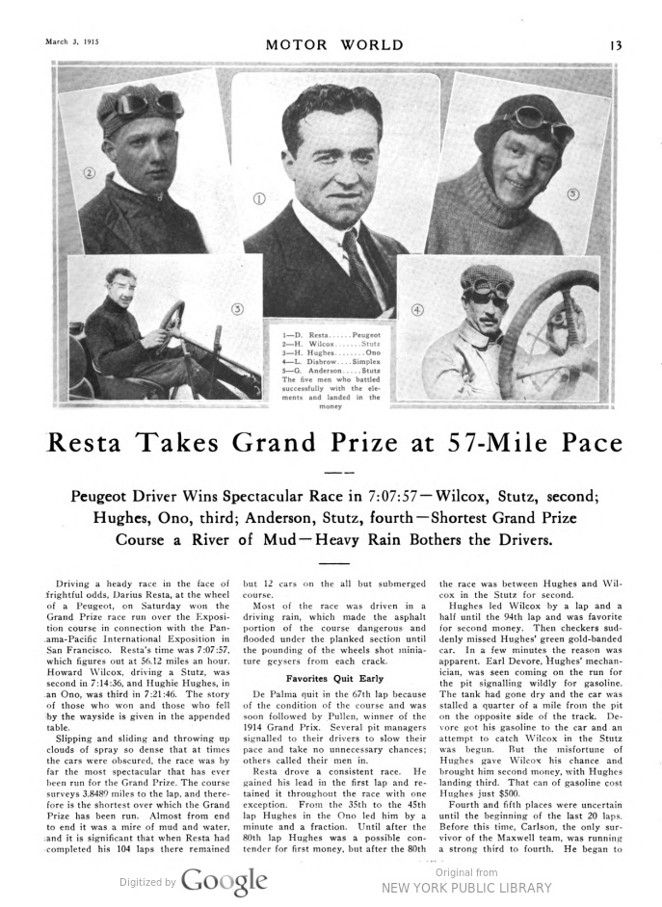
Resta Takes Grand Prize at 57-Mile Pace
Peugeot Driver Wins Spectacular Race in 7:07:57 – Wilcox, Stutz, second; Hughes, Ono, third; Anderson, Stutz, fourth – Shortest Grand Prize Course a River of Mud – Heavy Rain Bothers the Drivers.
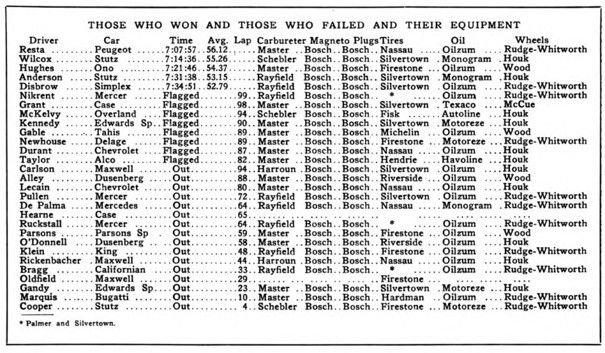
Driving a heady race in the face of frightful odds, Darius Resta, at the wheel of a Peugeot, on Saturday won the Grand Prize race run over the Exposition course in connection with the Pan- Lama-Pacific International Exposition in San Francisco. Resta’s time was 7:07:57, which figures out at 56.12 miles an hour. Howard Wilcox, driving a Stutz, was second in 7:14:36, and Hughie Hughes, in an Ono, was third in 7:21:46. The story of those who won and those who fell by the wayside is given in the appended table.
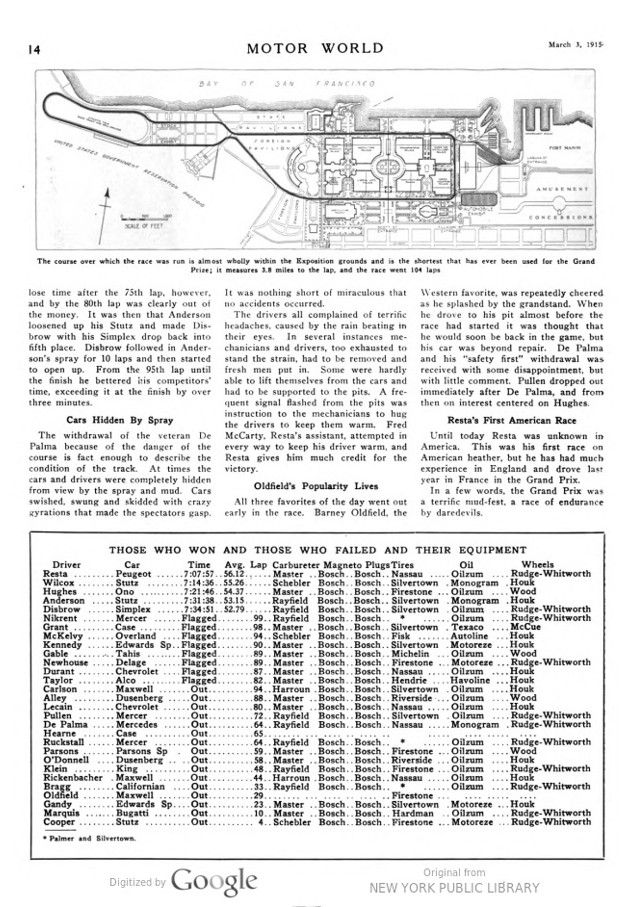
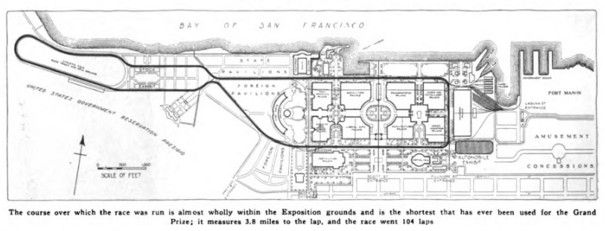
Slipping and sliding and throwing up clouds of spray so dense that at times the cars were obscured, the race was by far the most spectacular that has ever been run for the Grand Prize. The course surveys 3.8489 miles to the lap, and therefore is the shortest over which the Grand Prize has been run. Almost from end to end it was a mire of mud and water, and it is significant that when Resta had completed his 104 laps there remained but 12 cars on the all but submerged course.
Most of the race was driven in a driving rain, which made the asphalt portion of the course dangerous and flooded under the planked section until the pounding of the wheels shot miniaure geysers from each crack.
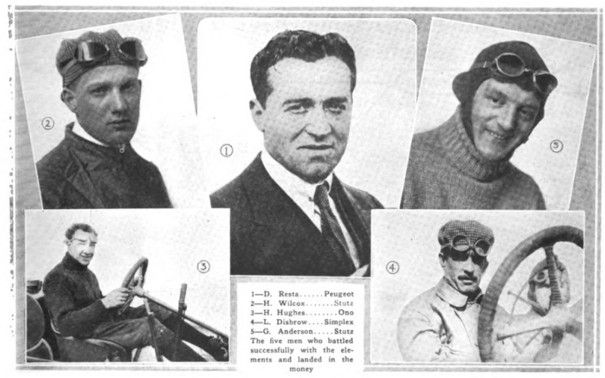
1 – D. Resta…. Peugeot
2 – H. Wilcox… Stutz
3 – H. Hughes.. Ono
4 – L. Disbrow.. Simplex
5 – G. Anderson Stutz
The five men who battled successfully with the elements and landed in the money
Favorites Quit Early
De Palma quit in the 67th lap because of the condition of the course and was soon followed by Pullen, winner of the 1914 Grand Prix. Several pit managers signalled to their drivers to slow their pace and take no unnecessary chances; others called their men in.
Resta drove a consistent race. He gained his lead in the first lap and retained it throughout the race with one exception. From the 35th to the 45th lap Hughes in the Ono led him by a minute and a fraction. Until after the 80th lap Hughes was a possible contender for first money, but after the 80th, the race was between Hughes and Wilcox in the Stutz for second.
Hughes led Wilcox by a lap and a half until the 94th lap and was favorite for second money. Then checkers suddenly missed Hughes’ green gold-banded car. In a few minutes the reason was apparent. Earl Devore, Hughes’ mechanician, was seen coming on the run for the pit signaling wildly for gasoline. The tank had gone dry and the car was stalled a quarter of a mile from the pit on the opposite side of the track. Devore got his gasoline to the car and an attempt to catch Wilcox in the Stutz was begun. But the misfortune of Hughes gave Wilcox his chance and brought him second money, with Hughes landing third. That can of gasoline cost Hughes just $500.
Fourth and fifth places were uncertain until the beginning of the last 20 laps. Before this time, Carlson, the only survivor of the Maxwell team, was running a strong third to fourth. He began to lose time after the 75th lap, however, and by the 80th lap was clearly out of the money. It was then that Anderson loosened up his Stutz and made Disbrow with his Simplex drop back into fifth place. Disbrow followed in Ander- son’s spray for 10 laps and then started to open up. From the 95th lap until the finish he bettered his competitors’ time, exceeding it at the finish by over three minutes.
Cars Hidden By Spray
The withdrawal of the veteran De Palma because of the danger of the course is fact enough to describe the condition of the track. At times the cars and drivers were completely hidden from view by the spray and mud. Cars swished, swung and skidded with crazy gyrations that made the spectators gasp. It was nothing short of miraculous that no accidents occurred.
The drivers all complained of terrific headaches, caused by the rain beating in their eyes. In several instances mechanicians and drivers, too exhausted to stand the strain, had to be removed and fresh men put in. Some were hardly able to lift themselves from the cars and had to be supported to the pits. A frequent signal flashed from the pits was instruction to the mechanicians to hug the drivers to keep them warm. Fred McCarty, Resta’s assistant, attempted in every way to keep his driver warm, and Resta gives him much credit for the victory.
Oldfield’s Popularity Lives
All three favorites of the day went out early in the race. Barney Oldfield, the Western favorite, was repeatedly cheered as he splashed by the grandstand. When he drove to his pit almost before the race had started it was thought that he would soon be back in the game, but his car was beyond repair. De Palma and his “safety first” withdrawal was received with some disappointment, but with little comment. Pullen dropped out immediately after De Palma, and from then on interest centered on Hughes.
Resta’s First American Race
Until today Resta was unknown in America. This was his first race on American heather, but he has had much experience in England and drove last year in France in the Grand Prix. In a few words, the Grand Prix was a terrific mud-fest, a race of endurance by daredevils.
Photos.
Page 14.
BAY OF SAN FRANCISCO – – STATE PAVILIONS – FOREIGN PAVILIONS – STOCK EXHIBIT – UNITED STATES GOVERNMENT RESERVATION PRESIDIO – FORT MASON – AUTOMOBILE EXHIBIT – AMUSEMENT CONCESSIONS
The course over which the race was run is almost wholly within the Exposition grounds and is the shortest that has ever been used for the Grand Prize; it measures 3.8 miles to the lap, and the race went 104 laps
THOSE WHO WON AND THOSE WHO FAILED AND THEIR EQUIPMENT (table)