June 2026: Additional comment to be written still.
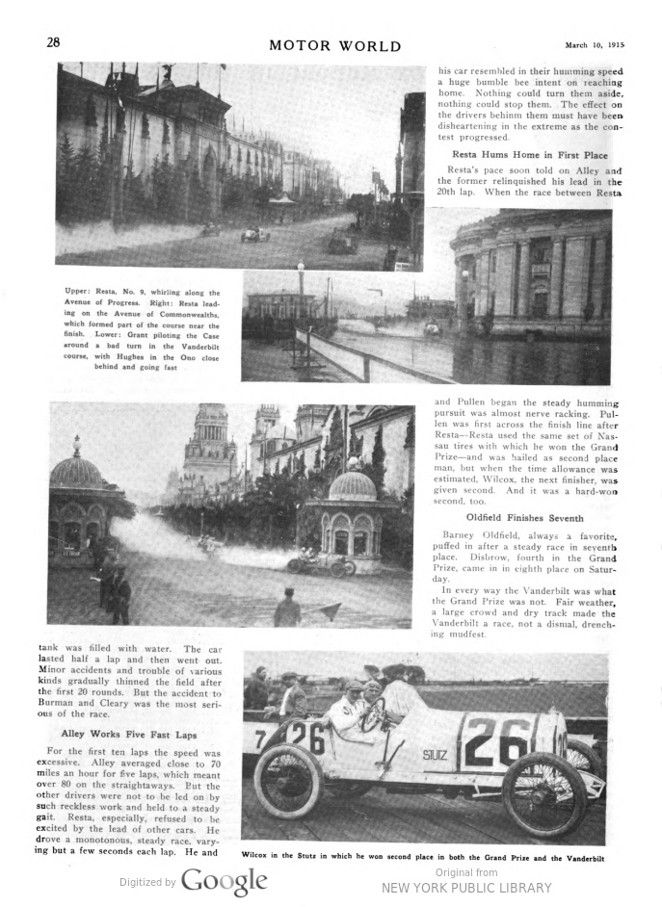
With permission of hathitrust hathitrust.org == Text and fotos compiled by motorracinghistory motorracinghistory.com
MOTOR WORLD Vol. XLIII, No. 10, March 10, 1915
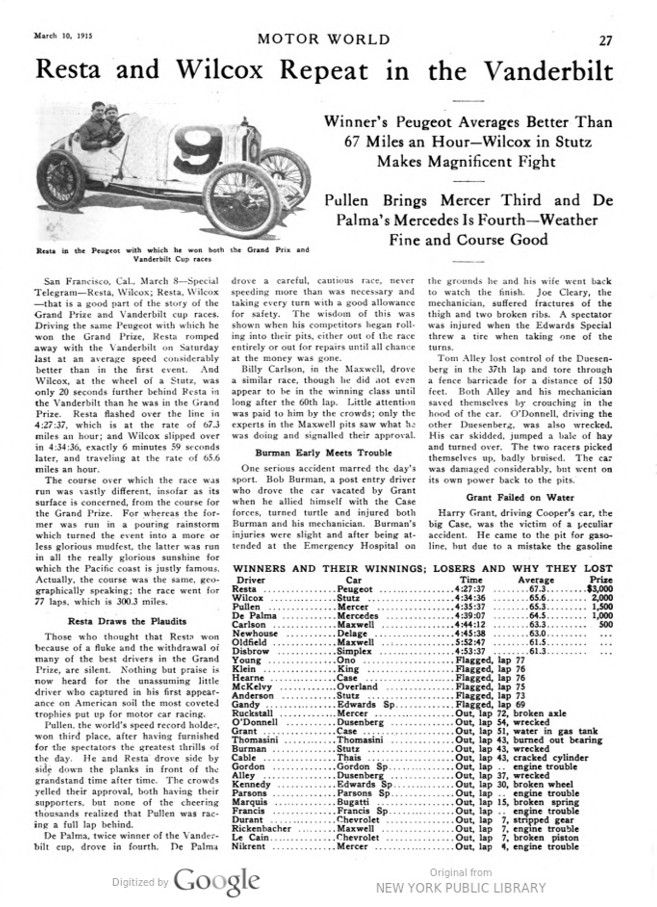
Resta and Wilcox Repeat in the Vanderbilt
Winner’s Peugeot Averages Better Than 67 Miles an Hour – Wilcox in Stutz Makes Magnificent Fight
Pullen Brings Mercer Third and De Palma’s Mercedes Is Fourth – Weather Fine and Course Good
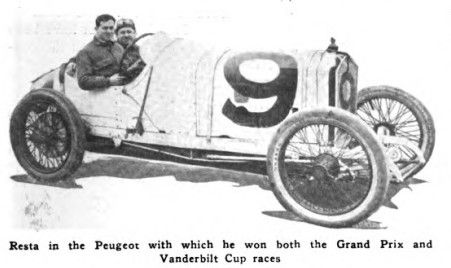
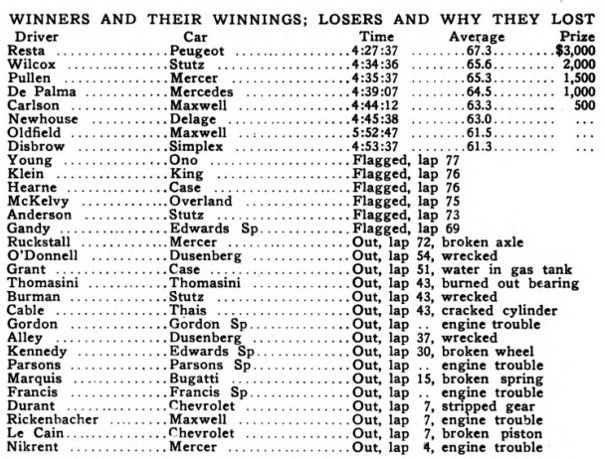
San Francisco, Cal., March 8 – Special Telegram – Resta, Wilcox; Resta, Wilcox – that is a good part of the story of the Grand Prize and Vanderbilt cup races. Driving the same Peugeot with which he won the Grand Prize, Resta romped away with the Vanderbilt on Saturday last at an average speed considerably better than in the first event. And Wilcox, at the wheel of a Stutz, was only 20 seconds further behind Resta in the Vanderbilt than he was in the Grand Prize. Resta flashed over the line in 4:27:37, which is at the rate of 67.3 miles an hour; and Wilcox slipped over in 4:34:36, exactly 6 minutes 59 seconds later, and traveling at the rate of 65.6 miles an hour.
The course over which the race was run was vastly different, insofar as its surface is concerned, from the course for the Grand Prize. For whereas the former was run in a pouring rainstorm which turned the event into a more or less glorious mud-fest, the latter was run in all the really glorious sunshine for which the Pacific coast is justly famous. Actually, the course was the same, geographically speaking; the race went for 77 laps, which is 300.3 miles.
Resta Draws the Plaudits
Those who thought that Resta won because of a fluke and the withdrawal of many of the best drivers in the Grand Prize, are silent. Nothing but praise is heard for the unassuming little driver who captured in his first appearance on American soil the most coveted trophies put up for motor car racing.
Pullen, the world’s speed record holder, won third place, after having furnished for the spectators the greatest thrills of the day. He and Resta drove side by side down the planks in front of the grandstand time after time. The crowds yelled their approval, both having their supporters, but none of the cheering thousands realized that Pullen was racing a full lap behind.
De Palma, twice winner of the Vanderbilt cup, drove in fourth. De Palma drove a careful, cautious race, never speeding more than was necessary and taking every turn with a good allowance for safety. The wisdom of this was shown when his competitors began rolling into their pits, either out of the race entirely or out for repairs until all chance at the money was gone.
Billy Carlson, in the Maxwell, drove a similar race, though he did not even appear to be in the winning class until long after the 60th lap. Little attention was paid to him by the crowds; only the experts in the Maxwell pits saw what he was doing and signaled their approval.
Burman Early Meets Trouble
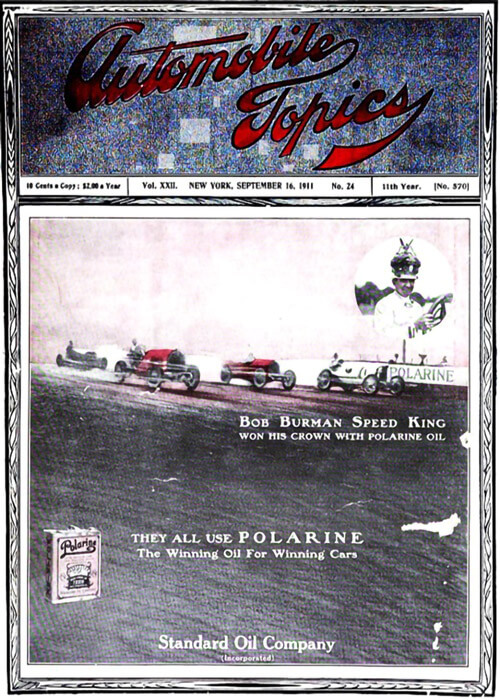
One serious accident marred the day’s sport. Bob Burman, a post entry driver who drove the car vacated by Grant when he allied himself with the Case forces, turned turtle and injured both Burman and his mechanician. Burman’s injuries were slight and after being attended at the Emergency Hospital on the grounds he and his wife went back to watch the finish. Joe Cleary, the mechanician, suffered fractures of the thigh and two broken ribs. A spectator was injured when the Edwards Special threw a tire when taking one of the turns.
Tom Alley lost control of the Duesenberg in the 37th lap and tore through a fence barricade for a distance of 150 feet. Both Alley and his mechanician saved themselves by crouching in the hood of the car. O’Donnell, driving the other Duesenberg, was also wrecked. His car skidded, jumped a bale of hay and turned over. The two racers picked themselves up, badly bruised. The car was damaged considerably, but went on its own power back to the pits.
Grant Failed on Water
Harry Grant, driving Cooper’s car, the big Case, was the victim of a peculiar accident. He came to the pit for gasoline, but due to a mistake the gasoline tank was filled with water. The car lasted half a lap and then went out. Minor accidents and trouble of various kinds gradually thinned the field after the first 20 rounds. But the accident to Burman and Cleary was the most serious of the race.
Alley Works Five Fast Laps
For the first ten laps the speed was excessive. Alley averaged close to 70 miles an hour for five laps, which meant over 80 on the straightaways. But the other drivers were not to be led on by such reckless work and held to a steady gait. Resta, especially, refused to be excited by the lead of other cars. He drove a monotonous, steady race, varying but a few seconds each lap. He and his car resembled in their humming speed a huge bumble bee intent on reaching home. Nothing could turn them aside, nothing could stop them. The effect on the drivers behind them must have been disheartening in the extreme as the contest progressed.
Resta Hums Home in First Place
Resta’s pace soon told on Alley and the former relinquished his lead in the 20th lap. When the race between Resta and Pullen began the steady humming pursuit was almost nerve racking. Pullen was first across the finish line after Resta – Resta used the same set of Nassau tires with which he won the Grand Prize – and was hailed as second place man, but when the time allowance was estimated, Wilcox, the next finisher, was given second. And it was a hard-won second, too.
Oldfield Finishes Seventh
Barney Oldfield, always a favorite, puffed in after a steady race in seventh place. Disbrow, fourth in the Grand Prize, came in in eighth place on Saturday.
In every way the Vanderbilt was what the Grand Prize was not. Fair weather, a large crowd and dry track made the Vanderbilt a race, not a dismal, drenching mud-fest.
Photos.
Page 27.
Resta in the Peugeot with which he won both the Grand Prix and Vanderbilt Cup races – WINNERS AND THEIR WINNINGS; LOSERS AND WHY THEY LOST
Page 28.
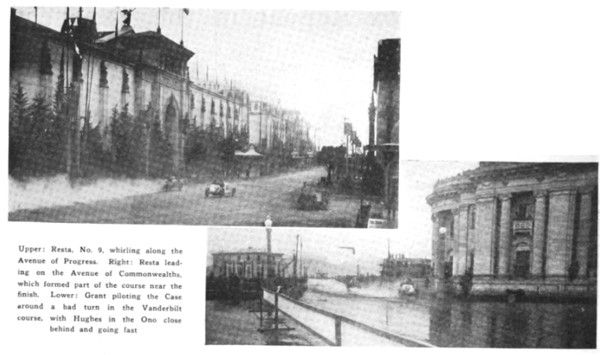
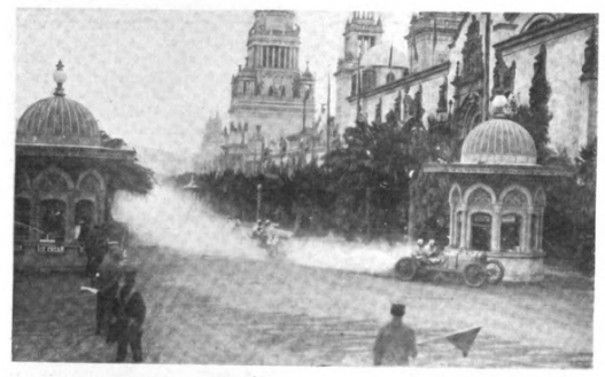
Upper: Resta, No. 9, whirling along the Avenue of Progress.
Right: Resta leading on the Avenue of Commonwealths, which formed part of the course near the finish.
Lower: Grant piloting the Case around a bad turn in the Vanderbilt course, with Hughes in the Ono close behind and going fast
Wilcox in the Stutz in which he won second place in both the Grand Prize and the Vanderbilt