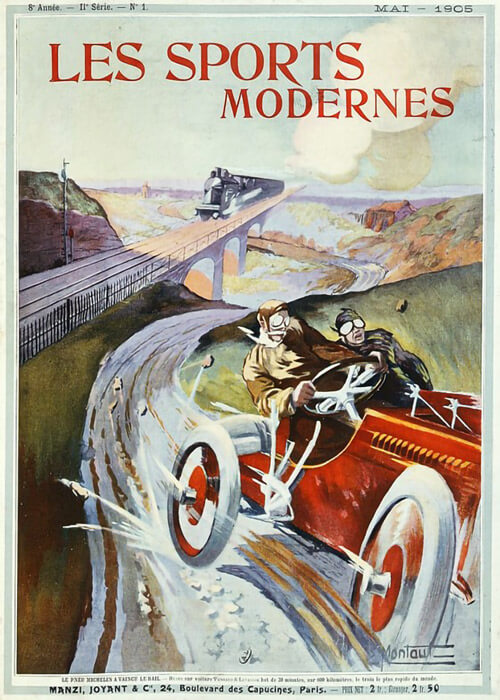
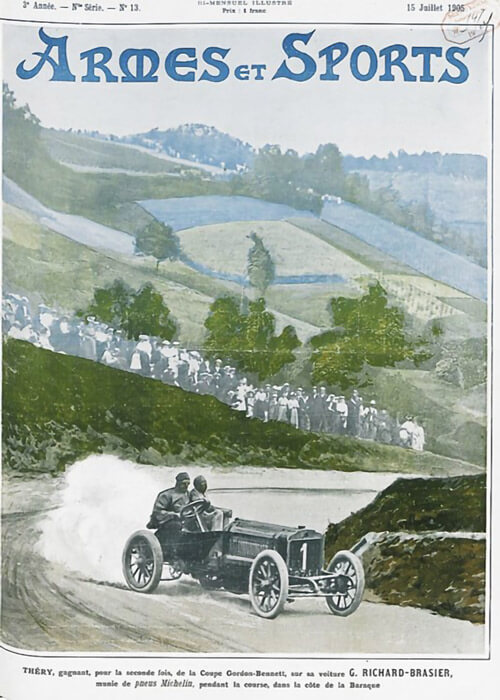
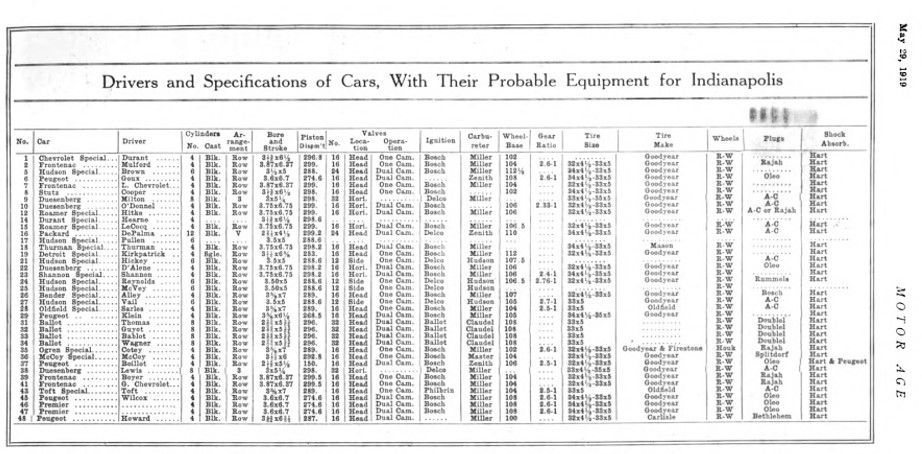
After the first World War, the first Indianapolis 500 returned and was christened in the Liberty Sweepstakes. Next to several American brands like the Packard, Hudson, Duesenberg and Frontenac, the French Ballot racing cars were the only new European representatives after Sunbeam withdrew before the race. Some Prewar Peugeots were driven by Americans, of which one would be the winner in Howard Wilcox. Here now, a description of many cars and their technical aspects. Written by Darwin S. Hatch, who already reported many times in early racing times with impressive articles.
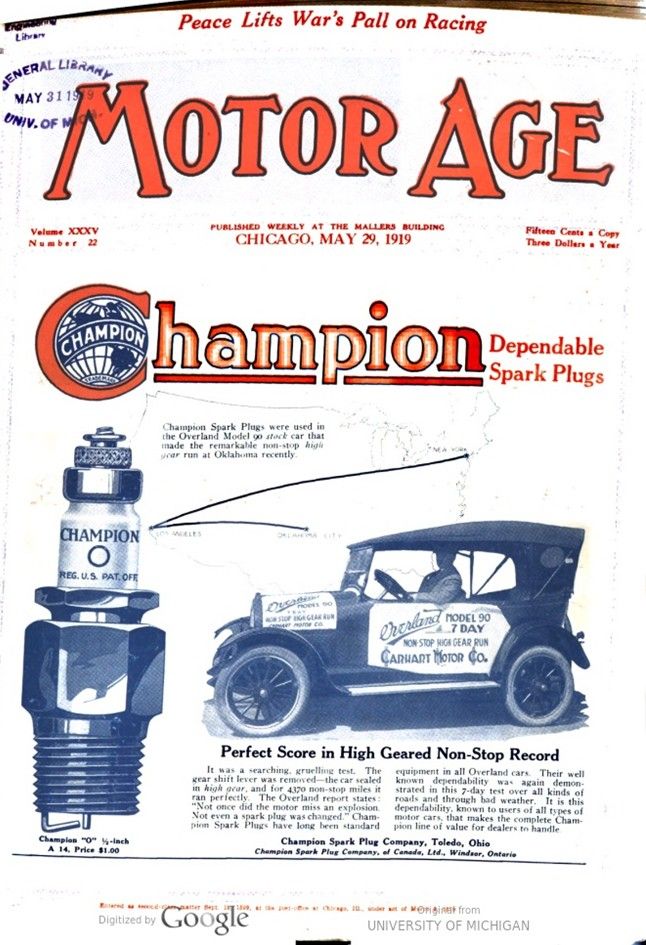
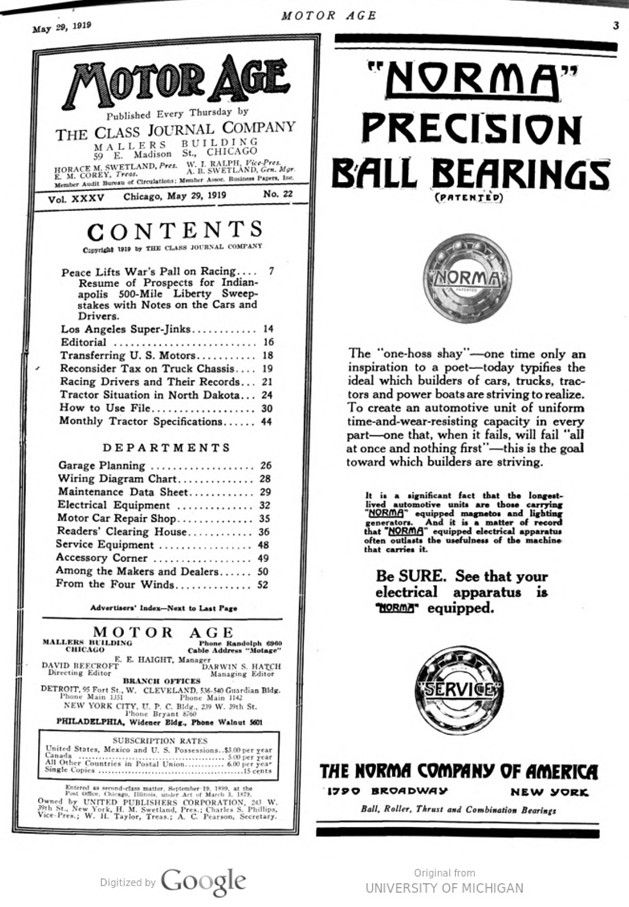
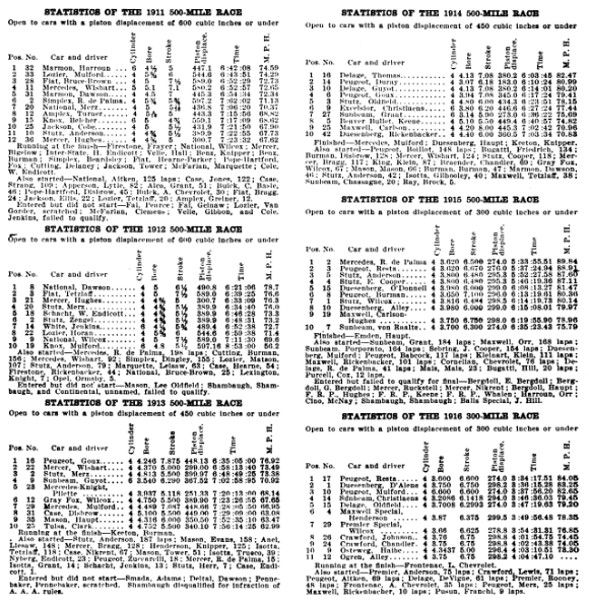
Text and jpegs by courtesy of hathitrust.org www.hathitrust.org, compiled by motorracinghistory.com
MOTOR AGE – Vol. XXV 35, No. 22, May 29, 1919
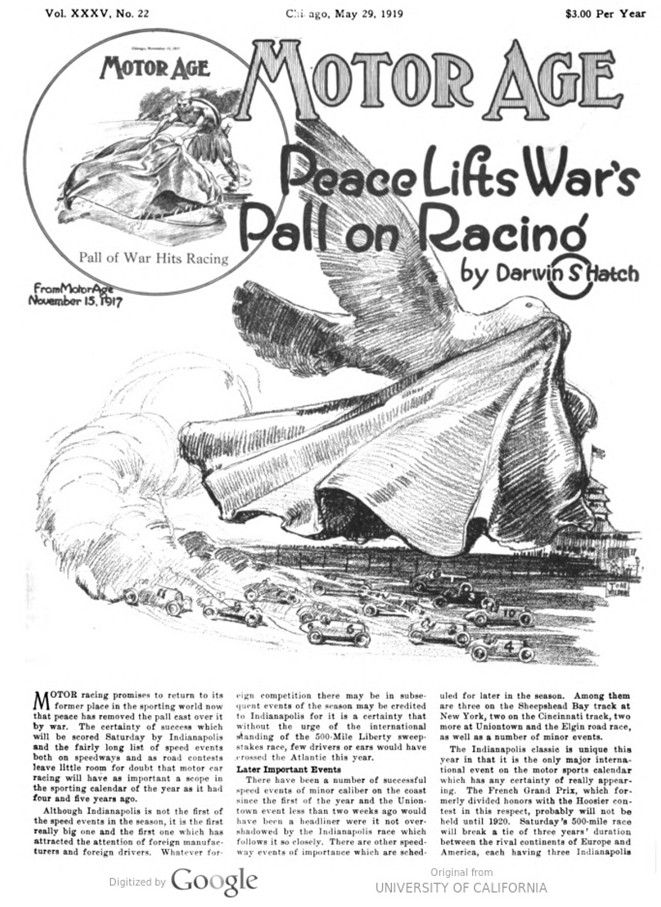
Peace Lifts War’s Pall on Racing,
by Darwin S Hatch
(Fall of War Hits Racing – From Motor Age November 15, 1917)
MOTOR racing promises to return to its spotting world now that peace has removed the pall cast over it by war. The certainty of success which will be scored Saturday by Indianapolis and the fairly long list of speed events both on speedways and as road contests leave little room for doubt that motor car racing will have as important a scope in the sporting calendar of the year as it had four and five years ago.
Although Indianapolis is not the first of the speed events in the season, it is the first really big one and the first one which has attracted the attention of foreign manufacturers and foreign drivers. Whatever foreign competition there may be in subsequent events of the season may be credited to Indianapolis for it is a certainty that without the urge of the international standing of the 500-Mile Liberty sweepstakes race, few drivers or cars would have crossed the Atlantic this year.
Later Important Events
There have been a number of successful speed events of minor caliber on the coast since the first of the year and the Uniontown event less than two weeks ago would have been a headliner were it not overshadowed by the Indianapolis race which follows it so closely. There are other speedway events of importance which are scheduled for later in the season. Among them are three on the Sheepshead Bay track at New York, two on the Cincinnati track, two more at Uniontown and the Elgin road race, as well as a number of minor events.
The Indianapolis classic is unique this year in that it is the only major international event on the motor sports calendar which has any certainty of really appearing. The French Grand Prix, which formerly divided honors with the Hoosier contest in this respect, probably will not be held until 1920. Saturday’s 500-mile race will break a tie of three years‘ duration between the rival continents of Europe and America, each having three Indianapolis championship races to her credit out of the total of six conducted on the big Hoosier oval.
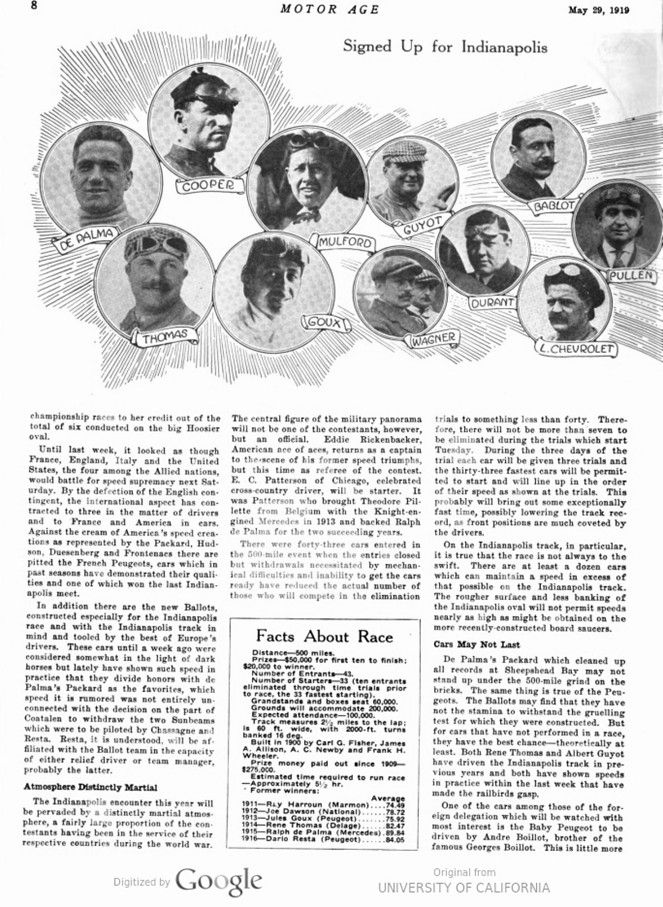
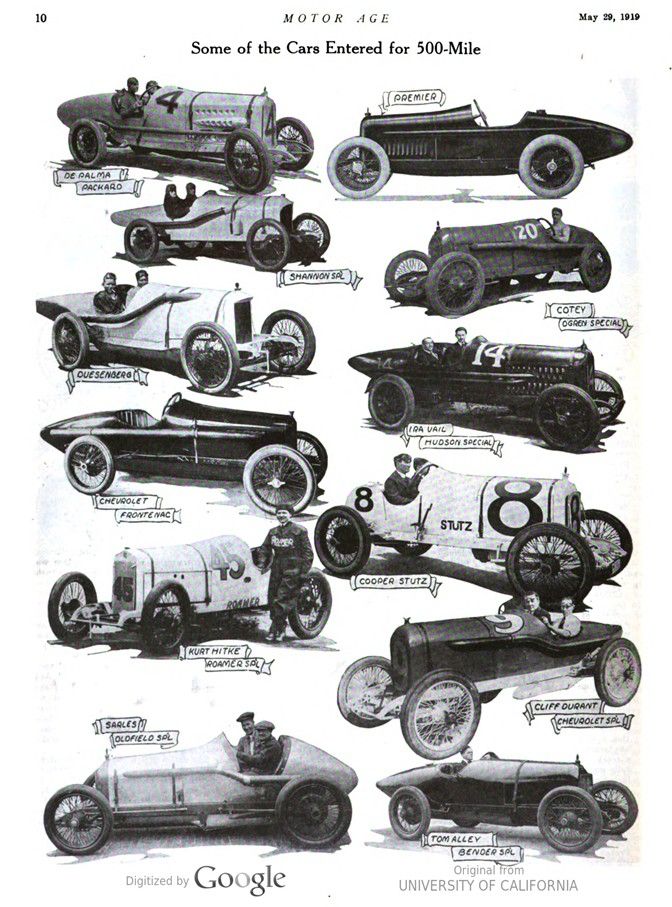
Until last week, it looked as though France, England, Italy and the United States, the four among the Allied nations, would battle for speed supremacy next Saturday. By the defection of the English contingent, the international aspect has contracted to three in the matter of drivers and to France and America in cars. Against the cream of America’s speed creations as represented by the Packard, Hudson, Duesenberg and Frontenacs there are pitted the French Peugeots, cars which in past seasons have demonstrated their qualities and one of which won the last Indianapolis meet.
In addition, there are the new Ballots, constructed especially for the Indianapolis race and with the Indianapolis track in mind and tooled by the best of Europe’s drivers. These cars until a week ago were considered somewhat in the light of dark horses but lately have shown such speed in practice that they divide honors with de Palma’s Packard as the favorites, which speed it is rumored was not entirely unconnected with the decision on the part of Coatalen to withdraw the two Sunbeams which were to be piloted by Chassagne and Resta. Resta, it is understood, will be affiliated with the Ballot team in the capacity of either relief driver or team manager, probably the latter.
Atmosphere Distinctly Martial
The Indianapolis encounter this year will be pervaded by a distinctly martial atmosphere, a fairly large proportion of the contestants having been in the service of their respective countries during the world war. The central figure of the military panorama will not be one of the contestants, however, but an official. Eddie Rickenbacker, American ace of aces, returns as a captain to the scene of his former speed triumphs, but this time as referee of the contest. E. C. Patterson of Chicago, celebrated cross-country driver, will be starter. It was Patterson who brought Theodore Pillette from Belgium with the Knight-engined Mercedes in 1913 and backed Ralph de Palma for the two succeeding years.
There were forty-three cars entered in the 500-mile event when the entries closed but withdrawals necessitated by mechanical difficulties and inability to get the cars ready have reduced the actual number of those who will compete in the elimination trials to something less than forty. Therefore, there will not be more than seven to be eliminated during the trials which start Tuesday. During the three days of the trial each car will be given three trials and the thirty-three fastest cars will be permitted to start and will line up in the order of their speed as shown at the trials. This probably will bring out some exceptionally fast time, possibly lowering the track record, as front positions are much coveted by the drivers.
On the Indianapolis track, in particular, it is true that the race is not always to the swift. There are at least a dozen cars which can maintain a speed in excess of that possible on the Indianapolis track. The rougher surface and less banking of the Indianapolis oval will not permit speeds nearly as high as might be obtained on the more recently constructed board saucers.
Cars May Not Last
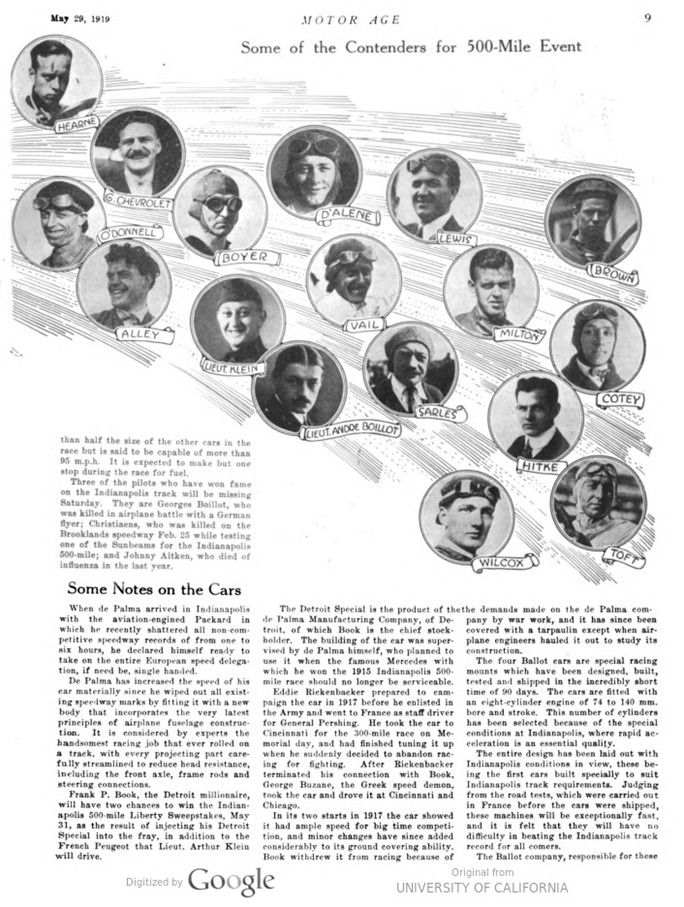
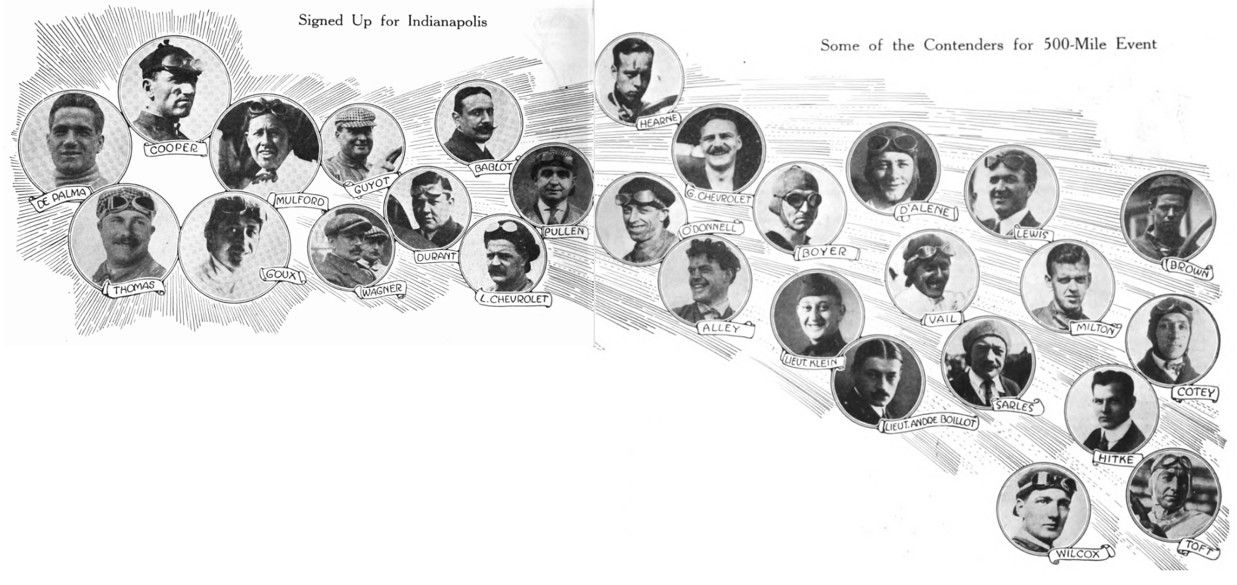
De Palma’s Packard, which cleaned up all records at Sheepshead Bay may not stand up under the 500-mile grind on the bricks. The same thing is true of the Peugeots. The Ballots may find that they have not the stamina to withstand the grueling test for which they were constructed. But for cars that have not performed in a race, they have the best chance – theoretically at least. Both Rene Thomas and Albert Guyot have driven the Indianapolis track in previous years and both have shown speeds in practice within the last week that have made the railbirds gasp.
One of the cars among those of the foreign delegation which will be watched with most interest is the Baby Peugeot to be driven by Andre Boillot, brother of the famous Georges Boillot. This is little more than half the size of the other cars in the race but is said to be capable of more than 95 m.p.h. It is expected to make but one stop during the race for fuel.
Three of the pilots who have won fame on the Indianapolis track will be missing Saturday. They are Georges Boillot, who was killed in airplane battle with a German flyer; Christiaens, who was killed on the Brooklands speedway Feb. 25 while testing one of the Sunbeams for the Indianapolis 500-mile; and Johnny Aitken, who died of influenza in the last year.
Some Notes on the Cars
When de Palma arrived in Indianapolis with the aviation-engined Packard in which he recently shattered all non-competitive speedway records of from one to six hours, he declared himself ready to take on the entire European speed delegation, if need be, single handed.
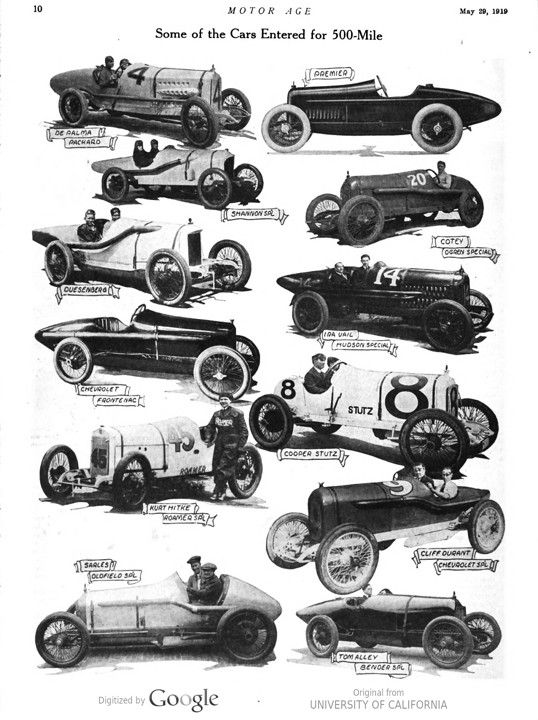
De Palma has increased the speed of his car materially since he wiped out all existing speedway marks by fitting it with a new body that incorporates the very latest principles of airplane fuselage construction. It is considered by experts the handsomest racing job that ever rolled on a track, with every projecting part carefully streamlined to reduce head resistance, including the front axle, frame rods and steering connections.
Frank P. Book, the Detroit millionaire, will have two chances to win the Indianapolis 500-mile Liberty Sweepstakes, May 31, as the result of injecting his Detroit Special into the fray, in addition to the French Peugeot that Lieut. Arthur Klein will drive.
The Detroit Special is the product of the de Palma Manufacturing Company, of Detroit, of which Book is the chief stockholder. The building of the car was supervised by de Palma himself, who planned to use it when the famous Mercedes with which he won the 1915 Indianapolis 500-mile race should no longer be serviceable.
Eddie Rickenbacker prepared to campaign the car in 1917 before he enlisted in the Army and went to France as staff driver for General Pershing. He took the car to Cincinnati for the 300-mile race on Memorial Day and had finished tuning it up when he suddenly decided to abandon racing for fighting. After Rickenbacker terminated his connection with Book, George Buzane, the Greek speed demon, took the car and drove it at Cincinnati and Chicago.
In its two starts in 1917 the car showed it had ample speed for big time competition, and minor changes have since added considerably to its ground covering ability. Book withdrew it from racing because of the demands made on the de Palma company by war work, and it has since been covered with a tarpaulin except when airplane engineers hauled it out to study its construction.
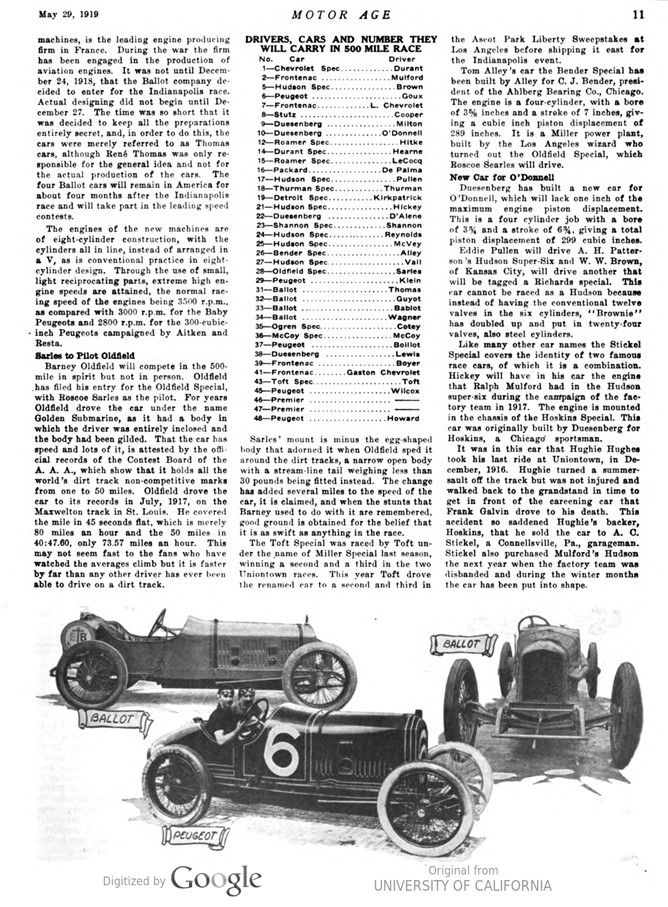
The four Ballot cars are special racing mounts which have been designed, built, tested and shipped in the incredibly short time of 90 days. The cars are fitted with an eight-cylinder engine of 74 to 140 mm. bore and stroke. This number of cylinders has been selected because of the special conditions at Indianapolis, where rapid acceleration is an essential quality.
The entire design has been laid out with Indianapolis conditions in view, these being the first cars built specially to suit Indianapolis track requirements. Judging from the road tests, which were carried out in France before the cars were shipped, these machines will be exceptionally fast, and it is felt that they will have no difficulty in beating the Indianapolis track record for all comers.
The Ballot company, responsible for these machines, is the leading engine producing firm in France. During the war the firm has been engaged in the production of aviation engines. It was not until December 24, 1918, that the Ballot company decided to enter for the Indianapolis race. Actual designing did not begin until December 27. The time was so short that it was decided to keep all the preparations entirely secret, and, in order to do this, the cars were merely referred to as Thomas cars, although René Thomas was only responsible for the general idea and not for the actual production of the cars. The four Ballot cars will remain in America for about four months after the Indianapolis race and will take part in the leading speed contests.
The engines of the new machines are of eight-cylinder construction, with the cylinders all in line, instead of arranged in a V, as is conventional practice in eight- cylinder design. Through the use of small, light reciprocating parts, extreme high engine speeds are attained, the normal racing speed of the engines being 3500 r.p.m., as compared with 3000 r.p.m. for the Baby Peugeots and 2800 r.p.m. for the 300-cubic-inch Peugeots campaigned by Aitken and Resta.
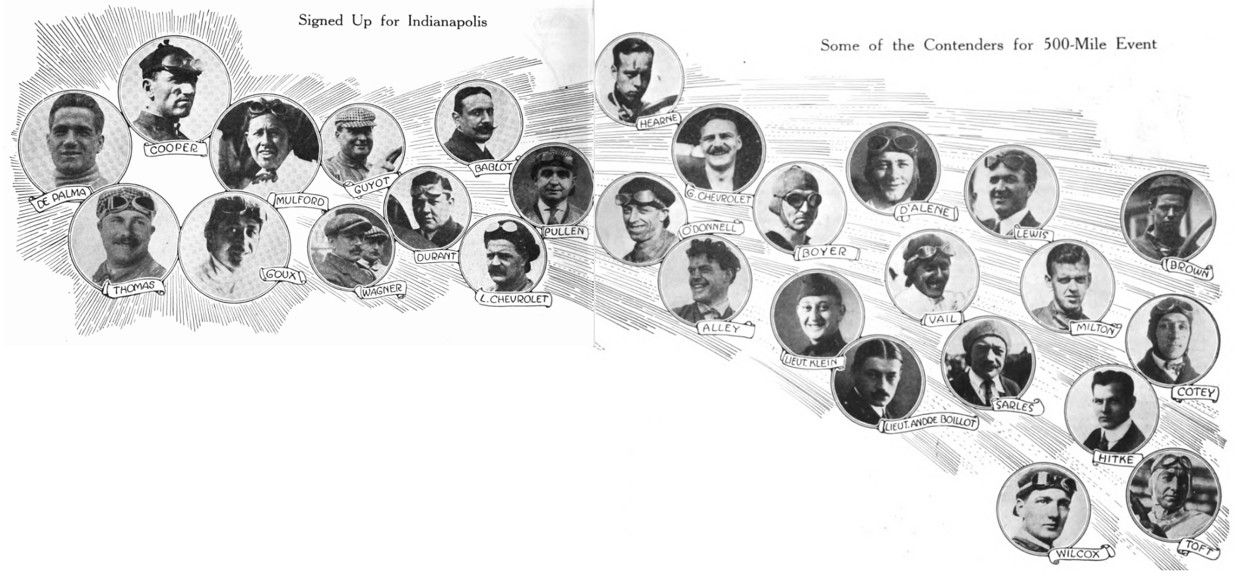
Sarles to Pilot Oldfield
Barney Oldfield will compete in the 500- mile in spirit but not in person. Oldfield has filed his entry for the Oldfield Special, with Roscoe Sarles as the pilot. For years Oldfield drove the car under the name Golden Submarine, as it had a body in which the driver was entirely inclosed and the body had been gilded. That the car has speed and lots of it, is attested by the official records of the Contest Board of the A. A. A., which show that it holds all the world’s dirt track non-competitive marks from one to 50 miles. Oldfield drove the car to its records in July 1917, on the Maxwelton track in St. Louis. He covered the mile in 45 seconds flat, which is merely 80 miles an hour and the 50 miles in 40:47.60, only 73.57 miles an hour. This may not seem fast to the fans who have watched the averages climb but it is faster by far than any other driver has ever been able to drive on a dirt track.
Sarles‘ mount is minus the egg-shaped body that adorned it when Oldfield sped it around the dirt tracks, a narrow open body with a stream-line tail weighing less than 30 pounds being fitted instead. The change has added several miles to the speed of the car, it is claimed, and when the stunts that Barney used to do with it are remembered, good ground is obtained for the belief that it is as swift as anything in the race.
The Toft Special was raced by Toft under the name of Miller Special last season, winning a second and a third in the two Uniontown races. This year Toft drove the renamed car to a second and third in the Ascot Park Liberty Sweepstakes at Los Angeles before shipping it east for the Indianapolis event.
Tom Alley’s car the Bender Special has been built by Alley for C. J. Bender, president of the Ahlberg Bearing Co., Chicago. The engine is a four-cylinder, with a bore of 3% inches and a stroke of 7 inches, giving a cubic inch piston displacement of 289 inches. It is a Miller power plant, built by the Los Angeles wizard who turned out the Oldfield Special, which Roscoe Searles will drive.
New Car for O’Donnell
has built a new car for O’Donnell, which will lack one inch of the maximum engine piston displacement. This is a four-cylinder job with a bore of 34 and a stroke of 64, giving a total piston‘ displacement of 299 cubic inches.
Eddie Pullen will drive A. H. Patter- son’s Hudson Super-Six and W. W. Brown, of Kansas City, will drive another that will be tagged a Richards special. This car cannot be raced as a Hudson because instead of having the conventional twelve valves in the six cylinders, „Brownie“ has doubled up and put in twenty-four valves, also steel cylinders.
Like many other car names, the Stickel Special covers the identity of two famous race cars, of which it is a combination. Hickey will have in his car the engine that Ralph Mulford had in the Hudson super-six during the campaign of the fac- tory team in 1917. The engine is mounted in the chassis of the Hoskins Special. This car was originally built by Duesenberg for Hoskins, a Chicago sportsman.
It was in this car that Hughie Hughes took his last ride at Uniontown, in December, 1916. Hughie turned a summer- sault off the track but was not injured and walked back to the grandstand in time to get in front of the careening car that Frank Galvin drove to his death. This accident so saddened Hughie’s backer, Hoskins, that he sold the car to A. C. Stickel, a Connellsville, Pa., garageman. Stickel also purchased Mulford’s Hudson the next year when the factory team was disbanded and during the winter months the car has been put into shape.
Hitke’s Roamer car was built for Eddie Hearne by Fred Duesenberg. It is entered in Indianapolis by C. Y. Kenworthy, manager of the Roamer Motor Car Co., of Chicago, who recently purchased the car from Hearne, when the latter hooked up with Clifford Durant and his Chevrolet team.
Hearne dropped out of the big time racing some seasons ago for a whirl at the dirt circles, but when he came back, he picked a Duesenberg for a mount. He also gave Fred Duesenberg an order to build him the Roamer Duesenberg. Hitke at the time was employed by Duesenberg and helped build the car. Recently he has been superintendent for the Roamer Company and when Kenworthy bought the car from Hearne put in a bid for the mount and landed it.
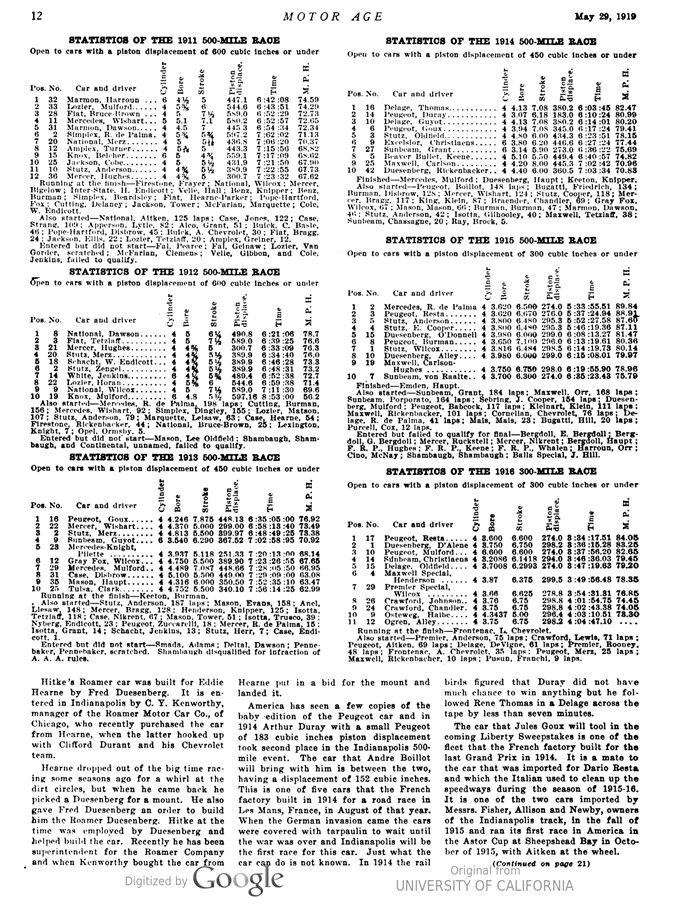
America has seen a few copies of the baby edition of the Peugeot car and in 1914 Arthur Duray with a small Peugeot of 183 cubic inches piston displacement took second place in the Indianapolis 500-mile event. The car that Andre Boillot will bring with him is between the two, having a displacement of 152 cubic inches. This is one of five cars that the French factory built in 1914 for a road race in Les Mans, France, in August of that year. When the German invasion came the cars were covered with tarpaulin to wait until the war was over and Indianapolis will be the first race for this car. Just what the car can do is not known. In 1914 the rail birds figured that Duray did not have much chance to win anything but he followed Rene Thomas in a Delage across the tape by less than seven minutes.
The car that Jules Goux will tool in the coming Liberty Sweepstakes is one of the fleet that the French factory built for the last Grand Prix in 1914. It is a mate to the car that was imported for Dario Resta and which the Italian used to clean up the speedways during the season of 1915-16. It is one of the two cars imported by Messrs. Fisher, Allison and Newby, owners of the Indianapolis track, in the fall of 1915 and ran its first race in America in the Astor Cup at Sheepshead Bay in October of 1915, with Aitken at the wheel. (Continued on page 21)