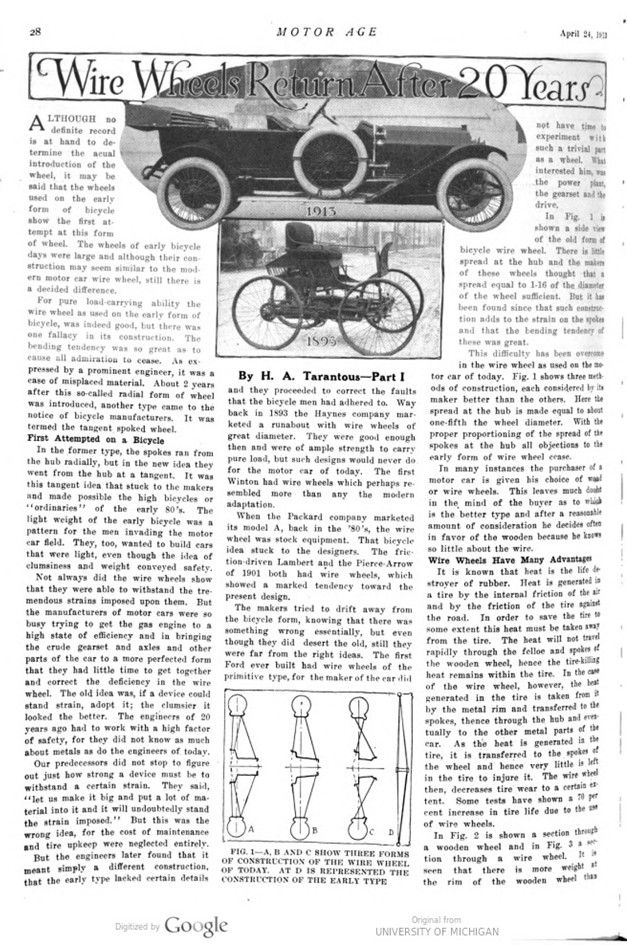
Text and jpegs by courtesy of hathitrust.org www.hathitrust.org, compiled by motorracinghistory.com
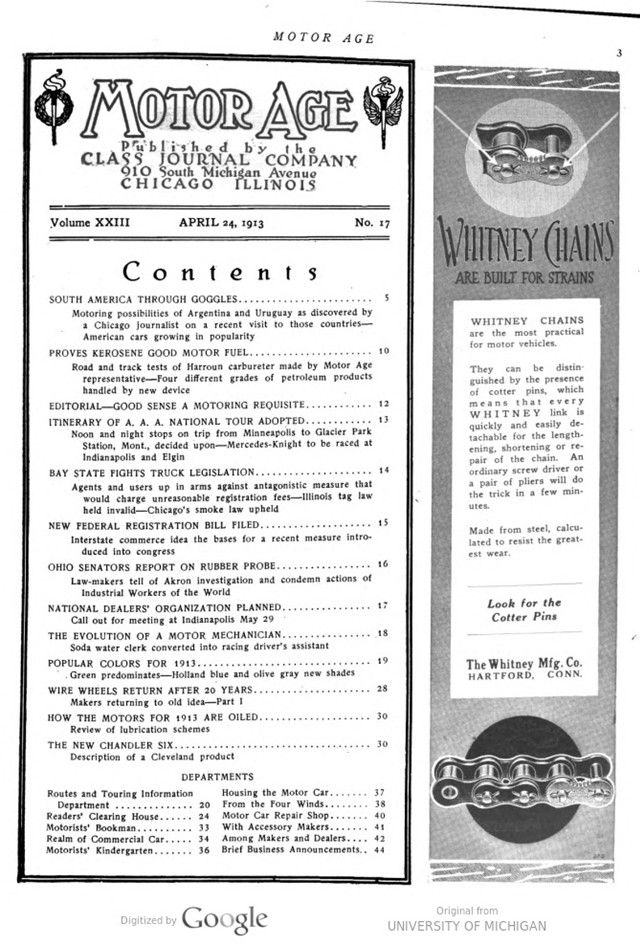
Motor Age, Vol. XXIII (23), No.17, April 24, 1925
Wire Wheels Return After 20 Years
By H. A. Tarantous – Part I
ALTHOUGH no definite record is at hand to determine the actual introduction of the wheel, it may be said that the wheels used on the early form of bicycle show the first attempt at this form of wheel. The wheels of early bicycle days were large and although their construction may seem similar to the mod- ern motor car wire wheel, still there is a decided difference.
For pure load-carrying ability the wire wheel as used on the early form of bicycle, was indeed good, but there was one fallacy in its construction. The bending tendency was so great as to cause all admiration to cease. As expressed by a prominent engineer, it was a case of misplaced material. About 2 years after this so-called radial form of wheel was introduced, another type came to the notice of bicycle manufacturers. It was termed the tangent spoked wheel.
First Attempted on a Bicycle
In the former type, the spokes ran from the hub radially, but in the new idea they went from the hub at a tangent. It was this tangent idea that stuck to the makers and made possible the high bicycles or „‚ordinaries“? of the early 80’s. The light weight of the early bicycle was a pattern for the men invading the motor car field. They, too, wanted to build cars that were light, even though the idea of clumsiness and weight conveyed safety.
Not always did the wire wheels show that they were able to withstand the tremendous strains imposed upon them. But the manufacturers of motor cars were so busy trying to get the gas engine to a high state of efficiency and in bringing the crude gearset and axles and other parts of the car to a more perfected form that they had little time to get together and correct the deficiency in the wire wheel. The old idea was, if a device could stand strain, adopt it; the clumsier it looked the better. The engineers of 20 years ago had to work with a high factor of safety, for they did not know as much about metals as do the engineers of today.
Our predecessors did not stop to figure out just how strong a device must be to withstand a certain strain. They said, „let us make it big and put a lot of material into it and it will undoubtedly stand the strain imposed.“ But this was the wrong idea, for the cost of maintenance and tire upkeep were neglected entirely.
But the engineers later found that it meant simply a different construction, that the early type lacked certain details and they proceeded to correct the faults that the bicycle men had adhered to. Way back in 1893 the Haynes company marketed a runabout with wire wheels of great diameter. They were good enough then and were of ample strength to carry pure load, but such designs would never do. for the motor car of today. The first Winton had wire wheels which perhaps resembled more than any the modern adaptation.
When the Packard company marketed its model A, back in the ’80’s, the wire wheel was stock equipment. That bicycle idea stuck to the designers. The friction-driven Lambert and the Pierce-Arrow of 1901 both had wire wheels, which showed a marked tendency toward the present design.
The makers tried to drift away from the bicycle form, knowing that there was something wrong essentially, but even though they did desert the old, still they were far from the right ideas. The first Ford ever built had wire wheels of the primitive type, for the maker of the car did not have time to experiment with such a trivial part as a wheel. What interested him, was the power plant, the gearset and the drive.
In Fig. 1 is shown a side view of the old form of bicycle wire wheel. There is little spread at the hub and the makers of these wheels thought that a spread equal to 1-16 of the diameter of the wheel sufficient. But it has been found since that such construction adds to the strain on the spokes and that the bending tendency of these was great.
This difficulty has been overcome in the wire wheel as used on the motor car of today. Fig. 1 shows three methods of construction, each considered by its maker better than the others. Here the spread at the hub is made equal to about one-fifth the wheel diameter. With the proper proportioning of the spread of the spokes at the hub all objections to the early form of wire wheel cease.
In many instances the purchaser of a motor car is given his choice of wood or wire wheels. This leaves much doubt in the mind of the buyer as to which is the better type and after a reasonable amount of consideration he decides often in favor of the wooden because he knows so little about the wire.
Wire Wheels Have Many Advantages
It is known that heat is the life destroyer of rubber. Heat is generated in a tire by the internal friction of the air and by the friction of the tire against the road. In order to save the tire to some extent this heat must be taken away from the tire. The heat will not travel rapidly through the felloe and spokes of the wooden wheel, hence the tire-killing heat remains within the tire. In the case of the wire wheel, however, the heat generated in the tire is taken from it by the metal rim and transferred to the spokes, thence through the hub and eventually to the other metal parts of the car. As the heat is generated in the tire, it is transferred to the spokes of the wheel and hence very little is left in the tire to injure it. The wire wheel then, decreases tire wear to a certain extent. Some tests have shown a 70 per cent increase in tire life due to the use of wire wheels.
In Fig. 2 is shown a section through a wooden wheel and in Fig. 3 a section through wire wheel. It is seen that there is more weight at the rim of the wooden wheel than at the rim of the wire wheel. The greater the weight on the rim of the wheels of a motor car, the more difficult it is to start the car. This means more power is required to start a car whose wheels have a high peripheral weight. It has been proven that wire wheels have less peripheral weight than wooden. But, the less the peripheral weight the less work required the start it and since work is indirectly a representation of fuel consumption, it follows that the wire-wheeled car will use less fuel than the car with wooden wheels.
Wire Wheels Help Starting
Not very long ago an E. M. F. 30 pulled a 100-ton railroad locomotive a considerable distance. The remarkable part of the feat was not the pulling of the engine, but getting the initial start. In other words after the load is moving and has inertia, little energy is required to keep it going. It is the starting that requires great effort. So with the motor car.
Going back to the car with the wooden wheels or those with heavy rims and felloes. Once that car gets started the stored-up energy in the wheels will make it an easy matter for the car to keep going. But, due to inertia, the wheels will tend to keep going all the time, just like the flywheel keeps revolving after the motor has stopped. When the brakes are applied greater effort will be required to bring the car to a standstill. Every time the brakes are applied there is wear on the tires.
Now time is a big factor in braking. Therefore the greater the length of time the brakes are applied the greater the tire wear. With wheels of high rim weight the brakes must be applied for a greater length of time than if low rim weight wheels are used. Since little braking effort is required to halt a car with wire wheels and since braking injures tires, we conclude that the wire wheel saves tire wear in this way also.
Comparing the distribution of load in a wire wheel and that in a wooden wheel; in the latter type the load is carried by a single spoke and therefore in a straight line as shown in Fig. 4. However, in the wire wheel the load distribution is not only above the hub, but over half the circumference. In the wooden wheel the support is rigid al- most, whereas in the wire wheel the link is flexible. The added flexibility of the wire wheel is a much desired feature inasmuch as the shock absorbing qualities of the modern motor car are not to be boasted about.
Appearance is merely a matter of opinion, so it cannot be said that the wire wheel is more comely than the wooden type, but a canvas has shown that the majority of motorists are inclined to give as their opinion that the wire wheel is better looking than the conventional form.
Wooden Wheel Has Features
Adherents of the wood wheel point out that the wire wheel may be knocked out of line easily, because it is not rigid. Any non-rigid metallic body will not remain in the same condition continually. Metal contracts and expands with a change in temperature. The metal spokes of the wire wheel will then be longer or shorter at one time than at another. If the wooden wheel is given a blow the wood may be cut but only that part which received the blow would be affected. A blow on a wire wheel may injure not only the part hit directly, but the surrounding parts. A wheel must be true to give a high efficiency and since there is a possibility of the wire wheel itself being out of alignment, then the wooden wheel is to be preferred.
With few exceptions all metals are acted upon by the air. They oxidize. The enamel on the spokes of the wire wheel must be perfect in order to protect the metal beneath. It is almost impossible to enamel metal perfectly. The enamel will fall off if the spokes come in contact with a hard body. The wire wheel may fail then on account of the action of rust. We can see any defects in wood, but often a shipment of steel will go through certain tests, but in actual service that steel may fall down.
Arguments against wire wheels are in a sense, reasons for the continued use of the wooden. Again, in touring through muddy country, it has been found that the wire wheels become caked with mud more so than wooden wheels, which makes them extremely heavy, encourages corrosion and makes them appear somewhat unsightly.
Demountable Rim Not Advantageous
The demountable rim feature of the wooden wheel is very desirable but if the wire wheel is made with a demountable rim, the peripheral or rim weight is increased and the starting ability of the car made more difficult. It was stated before that initial starting required more work than pulling after the car had gotten under way. But adding a demountable rim to the wire wheel brings it nearer to the wooden wheel in its action. If the demountable rim is not used, an extra wheel must be carried.
We continue to build houses with wooden skeletons, but steel is better – though it costs more. The wire wheel costs more than the wooden and, initial cost being a great factor, we have another argument in favor of the wooden wheel. Engineers are working toward simplicity in motor car construction, yet the wire wheel with its many parts makes for complexity.
Photo captions.
FIG. 1-A, B AND C SHOW THREE FORMS OF CONSTRUCTION OF THE WIRE WHEEL OF TODAY. AT D IS REPRESENTED THE CONSTRUCTION OF THE EARLY TYPE
FIG. 2 – SECTION THROUGH A WOODEN WHEEL AT THE RIM, SHOWN FOR THE PURPOSE OF COMPARISON WITH THE WIRE WHEEL IN FIG. 3
FIG. 3-SECTION THROUGH WIRE WHEEL AT THE RIM. ILLUSTRATION IS TO GIVE THE IDEA OF LIGHT WEIGHT
FIG. 4 THE WOODEN WHEEL AT THE LEFT CARRIES ITS LOAD ON ONE SPOKE. THIS COLUMNLIKE SUPPORT IS TO BE COMPARED WITH THAT OF THE WIRE WHEEL AT THE RIGHT. WHICH CARRIES ITS LOAD IN SUSPENSION