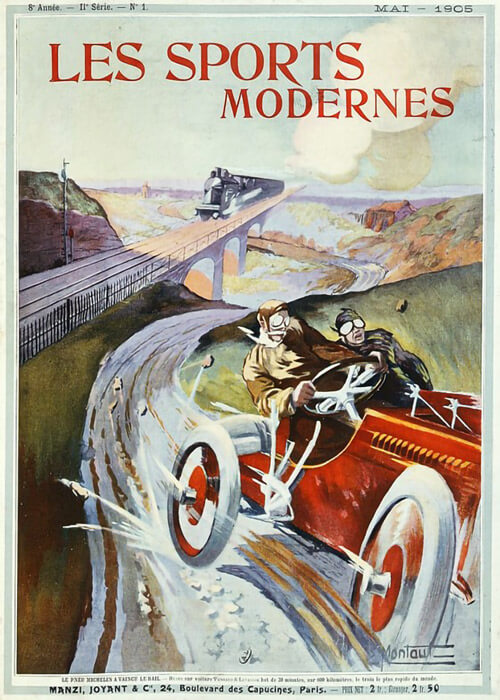
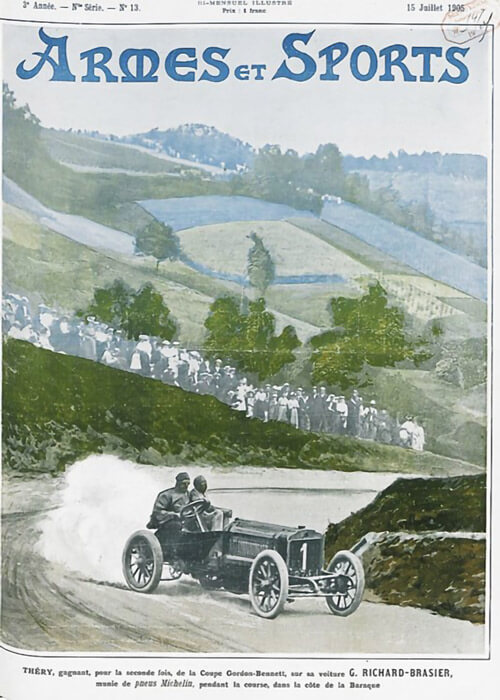
Of the eleven originally foreseen contestants, some couldn’t make it to the staring line. So only six really got on the way, four gasolines and two electrics. They gathered all six in line for the Jackson Park World’s Fairgrounds. The race in itself is more or less, summarised in this two-page article.
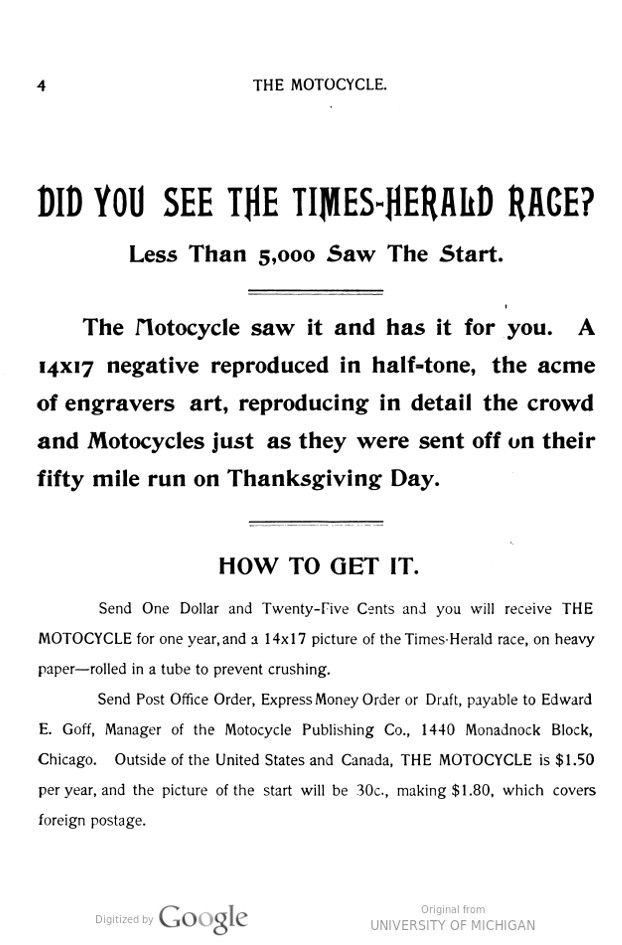
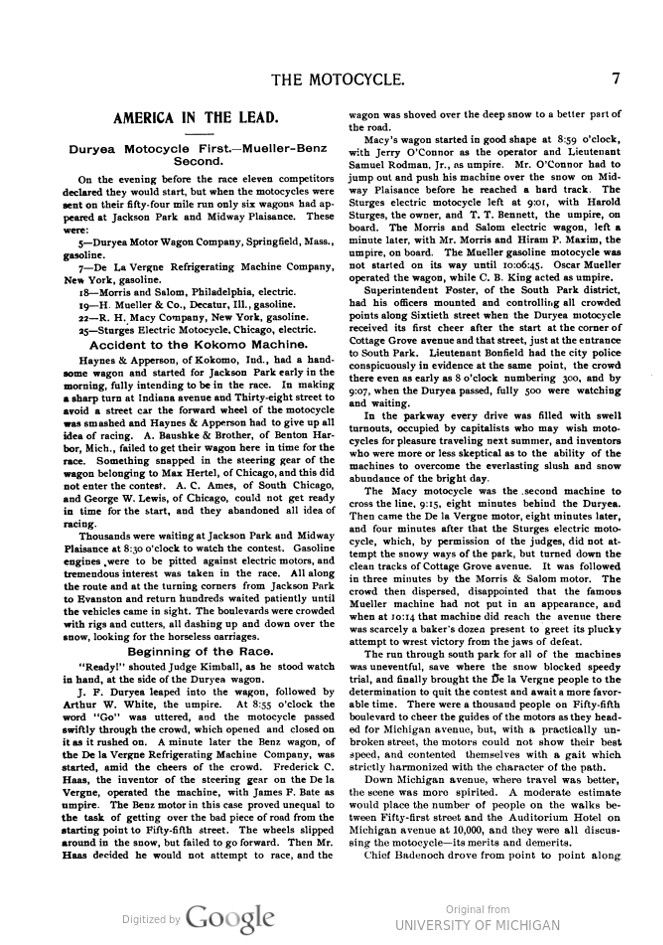
With permission of hathitrust hathitrust.org == Text and fotos compiled by motorracinghistory
The Motocycle (Automobile) — Vol. 1, No. 2, November 1895
The Times-Herald Race: AMERICA IN THE LEAD.
Duryea Motocycle First. – Mueller-Benz Second.
On the evening before the race eleven competitors declared they would start, but when the motocycles were sent on their fifty-four mile run only six wagons had appeared at Jackson Park and Midway Plaisance. These were:
5 – Duryea Motor Wagon Company, Springfield, Mass., gasoline.
7 – De La Vergne Refrigerating Machine Company, New York, gasoline.
18 – Morris and Salom, Philadelphia, electric.
19 – H. Mueller & Co., Decatur, Ill., gasoline.
22 – R. H. Macy Company, New York, gasoline.
25 – Sturges Electric Motocycle, Chicago, electric.
Accident to the Kokomo Machine.
Haynes & Apperson, of Kokomo, Ind., had a handsome wagon and started for Jackson Park early in the morning, fully intending to be in the race. In making a sharp turn at Indiana Avenue and Thirty-eight street to avoid a streetcar the forward wheel of the motocycle was smashed and Haynes & Apperson had to give up all idea of racing. A. Baushke & Brother, of Benton Harbor, Mich., failed to get their wagon here in time for the race. Something snapped in the steering gear of the wagon belonging to Max Hertel, of Chicago, and this did not enter the contest. A. C. Ames, of South Chicago, and George W. Lewis, of Chicago, could not get ready in time for the start, and they abandoned all idea of racing.
Thousands were waiting at Jackson Park and Midway Plaisance at 8:30 o’clock to watch the contest. Gasoline engines were to be pitted against electric motors, and tremendous interest was taken in the race. All along the route and at the turning corners from Jackson Park to Evanston and return hundreds waited patiently until the vehicles came in sight. The boulevards were crowded with rigs and cutters, all dashing up and down over the snow, looking for the horseless carriages.
Beginning of the Race.
„Ready!“ shouted Judge Kimball, as he stood watch in hand, at the side of the Duryea wagon.
J. F. Duryea leaped into the wagon, followed by Arthur W. White, the umpire. At 8:55 o’clock the word „Go“ was uttered, and the motocycle passed swiftly through the crowd, which opened and closed on it as it rushed on. A minute later the Benz wagon, of the De la Vergne Refrigerating Machine Company, was started, amid the cheers of the crowd. Frederick C. Haas, the inventor of the steering gear on the De la Vergne, operated the machine, with James F. Bate as umpire. The Benz motor in this case proved unequal to the task of getting over the bad piece of road from the starting point to Fifty-fifth street. The wheels slipped around in the snow, but failed to go forward. Then Mr. Haas decided he would not attempt to race, and the wagon was shoved over the deep snow to a better part of the road.
Macy’s wagon started in good shape at 8:59 o’clock, with Jerry O’Connor as the operator and Lieutenant Samuel Rodman, Jr., as umpire. Mr. O’Connor had to jump out and push his machine over the snow on Midway Plaisance before he reached a hard track. The Sturges electric motocycle left at 9:01, with Harold Sturges, the owner, and T. T. Bennett, the umpire, on board. The Morris and Salom electric wagon, left a minute later, with Mr. Morris and Hiram P. Maxim, the umpire, on board. The Mueller gasoline motocycle was not started on its way until 10:06:45. Oscar Mueller operated the wagon, while C. B. King acted as umpire.
Superintendent Foster, of the South Park district, had his officers mounted and controlling all crowded points along Sixtieth street when the Duryea motocycle received its first cheer after the start at the corner of Cottage Grove avenue and that street, just at the entrance to South Park. Lieutenant Bonfield had the city police conspicuously in evidence at the same point, the crowd there even as early as 8 o’clock numbering 300, and by 9:07, when the Duryea passed, fully 500 were watching and waiting.
In the parkway every drive was filled with swell turnouts, occupied by capitalists who may wish motocycles for pleasure traveling next summer, and inventors who were more or less skeptical as to the ability of the machines to overcome the everlasting slush and snow abundance of the bright day.
The Macy motocycle was the second machine to cross the line, 9:15, eight minutes behind the Duryea. Then came the De la Vergne motor, eight minutes later, and four minutes after that the Sturges electric motocycle, which, by permission of the judges, did not attempt the snowy ways of the park, but turned down the clean tracks of Cottage Grove avenue. It was followed in three minutes by the Morris & Salom motor. The crowd then dispersed, disappointed that the famous Mueller machine had not put in an appearance, and when at 10:14 that machine did reach the avenue there was scarcely a baker’s dozen present to greet its plucky attempt to wrest victory from the jaws of defeat.
The run through south park for all of the machines was uneventful, save where the snow blocked speedy trial, and finally brought the De la Vergne people to the determination to quit the contest and await a more favorable time. There were a thousand people on Fifty-fifth boulevard to cheer the guides of the motors as they headed for Michigan avenue, but, with a practically unbroken street, the motors could not show their best speed, and contented themselves with a gait which strictly harmonized with the character of the path.
Down Michigan avenue, where travel was better, the scene was more spirited. A moderate estimate would place the number of people on the walks between Fifty-first street and the Auditorium Hotel on Michigan avenue at 10,000, and they were all discussing the motocycle – its merits and demerits.
Chief Badenoch drove from point to point along the avenue observing the arrangement of his officers. This arrangement was admirable. As Park row was approached the crowds overlapped the pavements and, with the innumerable vehicles on the avenue, threatened to make the way impassable. The officers were vigorous in their efforts to have the avenue free, and in this they succeeded. The judges, after the start, had come to the Leland Hotel, where they observed the Duryea and the others pass. The Macy was the second to pass the Auditorium. It overtook the Duryea at Rush and Erie streets, where the latter temporarily broke down. But the Macy machine, before achieving this triumph, created great excitement near the Art Institute by colliding with an Adams street horse car from the rear. The machine had taken the rail behind the car, and when the car stopped, in an effort to stop also, the motor slid on the rail and staved in the rear dashboard of the car. No one was hurt, and the delay was only that of a moment.
When the Sturges motocycle passed the Leland the judges and a crowd of spectators shouted: „Good boy, Sturges.“
The Mueller machine was also cheered and the excitement was great when at Tower place it passed the Morris & Salom motor and began its long effort to overtake the Macy, and if possible conquer the Duryea. A shout came from the Mueller crowd as they passed the north side water tower: „We are just one hour and sixteen minutes out from Jackson Park.“
The distance was all of nine miles, and the spectators on the pavements and even in the windows of L. Z. Leiter’s mansion applauded back.
The football games were interfered with as to an early attendance on the benches. The street car lines from the west and north and south brought all the „rooters“ to the route of the motocycles. The colors of Michigan and the University of Chicago, of Boston. and the Chicago Athletic Association lent brightness, if that were possible, to one of the brightest Thanksgiving mornings Chicago has ever seen. People did not mind standing in the yielding snow. Those on Rush street, Tower place and the North Shore Drive waited for all of three hours before they saw the first wheel. They were enthusiastic. Passing through the groups gathered here and there it was surprising to hear the scientific discussion going on as the merits of motocycles and the eventual good they were to work in urging forward the „good roads“ problem of America.
Some horses shied – a few; some children stared, but thanks to the tremendous agitation in favor of the horseless vehicle started in this country by The Times-Herald few there were that did not have an intelligent conception of the nature of „the beast.“ Even so sedate a man as Lieutenant Hubbard, of police fame, had decided early in the morning that the Duryea machine was certain to win.
Streams of people poured into Lincoln Park to see the big race go by. By 10 o’clock all of the approaches to the Grant Monument were covered, and a large crowd had collected on the level ground in front of it. By 10:20 both sides of the driveway were lined with people for a long distance in either direction. A raw wind was blowing, and General Grant sat closer on his horse and seemed to be glad that his left ear was protected by a large patch of snow. At 10:30 No. 22, the R. H. Macy Co., wagon came in sight and was loudly applauded. It was going at a conservative gate, about six miles an hour, but looked as though it could have gone faster if there were any occasion for it. It was just forty minutes ahead of No. 5, the Duryea wagon, which was going at seven to eight miles an hour and was evidently trying to overtake No. 22. Not half of the crowd had remained in the cold wind to see the second contestant, but had straggled over to the ball grounds to look at a football game. Just thirty-two minutes later, at 11:42, No. 19, the H. Mueller & Co., wagon came into sight and puffed its way slowly and laboriously through the park. Its pneumatic tires had been wrapped with twine to keep them from slipping, and one of the operatives was sanding the belt on the motor for the same reason.
The crowd was chilly, the football players thought of their Thanksgiving dinner, and everybody went home.
At 12:15 the Sturgis Electric Motocycle, No. 25, moved slowly through the park. It carried three people. The driver claimed that the battery had been overworked getting through the deep snow of the Midway, and that he had been compelled to make frequent long stops to keep it from burning out. At the north end of the park the hopelessness of the race was apparent, and the machine was pulled off the course.
After passing through Lincoln Park the Duryea wagon still kept behind the Macy motocycle, but it was making quick time with the determination to overtake its rival. The practically unbeaten roads to the first relay station proved trying to the vehicles, the rubber-tired wheels slipping in the snow.
The Race a Great Success.
Frederick U. Adams, who had charge of the race for H. H. Kohlsaat, said last night that the contest was satisfactory in every particular and that the tests threw those made recently in France far in the rear. He said:
„The Paris-Bordeaux race was worthless from a scientific standpoint, but the contest of today may result in the establishment of good data concerning what many believe the vehicle of the future. The progress of the preliminary tests has been watched by thousands of manufacturers in every part of the world and there is no doubt that there will be a great interest in the manufacture of these horseless vehicles now that it has been demonstrated what can be done with them“.