An overview what some of the drivers and cars did during the race, as well as some mechanical mishaps.
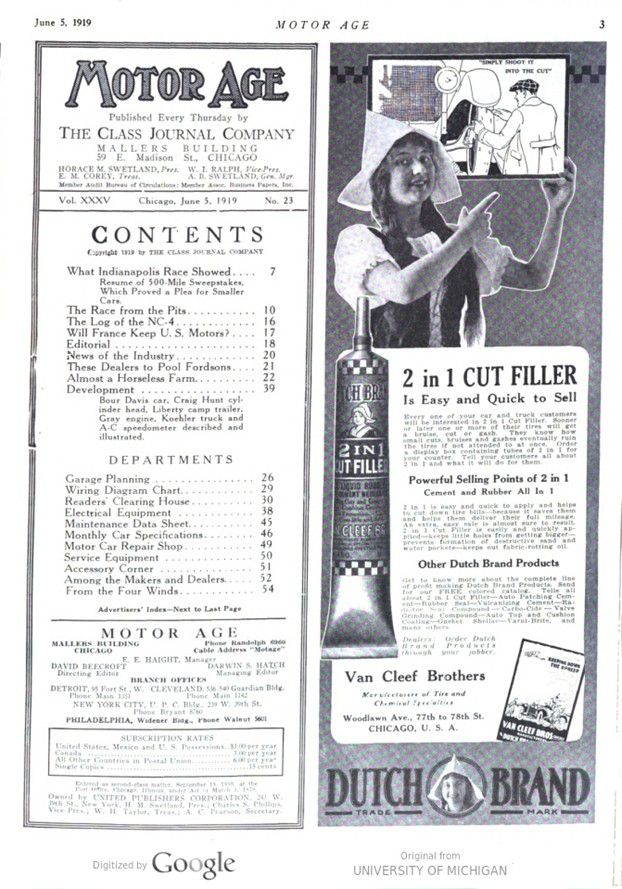
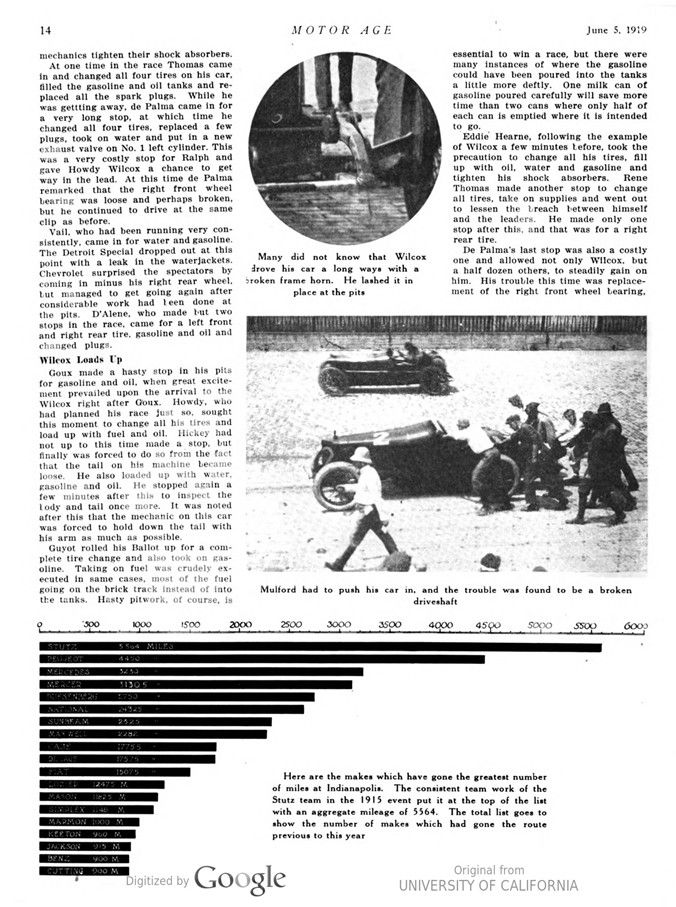
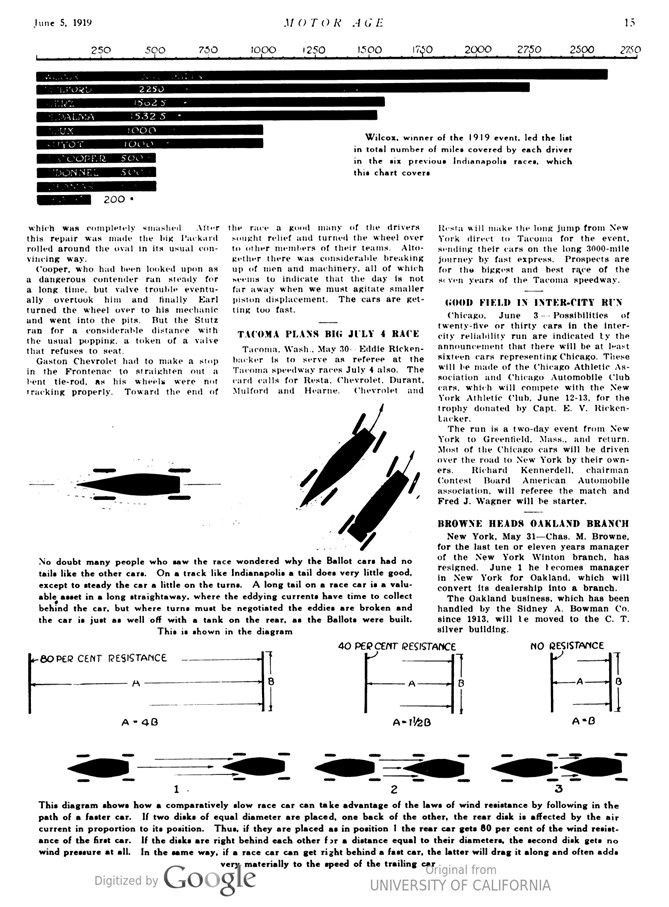
Text and jpegs by courtesy of hathitrust.org www.hathitrust.org, compiled by motorracinghistory.com
MOTOR AGE – Vol. XXV 35, No. 23, June 5, 1919
The Race from the Pits
Analysis of Mechanical Troubles Met by Cars
By B. M. Ikert – Motor Age Editorial Staff
SIXTY-SIX of the 106 stops at the pits of the 500-mile race were for tires, the old offenders. Fouled plugs were in evidence also on a good many jobs, but not to the extent that might have been expected, considering the high engine speeds. There were a lot of mechanical breakdowns that well might have been avoided had a little more time and attention been given to the preparation of the cars and engines. Take the Durant Special, which was forced out early in the race because the hose connections from top of engine to radiator were seemingly not properly made and had to be taped from time to time and the radiator wired to overcome vibration.
If there is such a thing as consistency in stopping at the pits, Howard in the Peugeot deserves first honors, as his mount had to be halted twelve times owing to oiling troubles. The mechanic’s efforts to pump oil were to no avail, for there was no rise in the pressure system and the car had to be driven to the pits at regular intervals to supply the necessary pressure. Next to make the greatest number of stops was the Hudson Special driven by Haibe, who drove up to the pits ten times. Nine stops were made by the Detroit Special due to everything from plug failure to an enormous desire of the cooling system for water.
Seven stops had to be made by Louis Chevrolet, whose fleet and lightweight Frontenac did not want to keep its rear and front wheels in their normal places. Chevrolet states that, due to light hub construction on the wire wheels and the quick getaway of the Frontenacs and their great speeds, it becomes a relatively easy matter to twist off the axle ends. In the latter part of the race Chevrolet broke the steering knuckle on the right side and cleverly brought his cars to the pits. Inspection of the broken member seemed to indicate the metal had become crystalized, resulting in breakage. Before the race, Chevrolet had fitted new knuckles, which appeared to be anything but the chrome-vanadium kind necessary for fast work. Louis, however, brought out an old knuckle and fitted it and a new tie-bar, which had been damaged when the car was driven in with the wheel gone.
During the brake tests in the morning Boyer in the Frontenac applied his brake unintentionally and broke out a portion of the aluminum brake shoe carrier. This may have been the beginning of his undoing, for he was forced out of the race early when the left rear wheel came off and wrecked the axle member on that side. The other Frontenac driven by Mulford was put in the also-ran brigade by breaking its driveshaft.
The first car to come in was the Durant Special, which was losing water from the radiator hose connections. Water was taken on and the stop consumed nearly 5 min. Then came Haibe in the Hudson, which was suffering from plug trouble. At this point with the race hardly on Roscoe Sarles in the Oldfield Special came in, and an examination of the trouble showed broken valve rocker arm, which forced him out. He was the first to leave the race for good.
The first tire change was made on the Shannon Special, which had to put on a new left rear shoe. The Detroit Special then rolled in and lingered 5 min., to change plugs. All this was done in the first half hour of the race. Haibe came in soon with spark plug trouble, followed by Goux, who needed a right rear tire. The pit work here was a little clumsy, and it was common to see mechanics drop hammers and jacks in the anxiety to get quick action. A Johnny Aitken was needed to get the necessary rapidity of action without making a fuss about it, as was the custom of the famous Johnny.
No. 18 car, driven by Thurman came to the pits for water and changed plugs. This was Thurman’s only stop before his fatal accident. Durant came in again to lash his hose connections in place, and right on his heels came Goux, who was forced to change a left front tire. Wilcox, who had been driving at a terrific pace up to this time, was noted coming into the pits and had to fit a new right front tire. This was one of the fast changes made, being done in 19 sec. by the pitmen. It was not long after this that Joe Boyer was forced out with the broken rear wheel and axle. Haibe stopped 24 sec. at the pits for a right rear tire, and the Detroit Special drove up as Haibe was getting out. The former’s engine was suffering from valve trouble, some of the sticking, particularly the exhaust valves.
At about 12 o’clock Rene Thomas made his first stop for a right rear and front tire. After him came Bablot in the Ballot for an adjustment on the magneto holding-down mechanism. The terrific pace set by de Palma evidently was telling on the Ballot cars, as trouble like that befalling Bablot was hardly expected from the much-touted French speed creations.
Mulford Breaks Driveshaft
Ralph Mulford drew up just the other side of the pits, where his car refused to answer to the coaxing of the driver. Mulford’s trouble was a broken driveshaft. The Detroit Special was making regular stops at the pits now for water. This indicated that there was something wrong, perhaps with the oiling system, or the pistons inclining to freeze up some. The McCoy Special drew up after the Detroit Special, and when the bonnet was lifted, the engine was hardly visible from the great amount of oil leaking from the joints. The car finally was forced out.
The next cars to slow down at the pits for various reasons were Haibe’s Hudson, which needed a left front tire, Tommy Milton’s Duesenberg, which was not firing right from distributer trouble. The next car to pull up was the Roamer, with Hitke up, for fuel. Lecocq, also in a Roamer, drove up for a right rear tire, followed by Eddie Hearne, who changed both right rear and front tires. At this point Toft’s car was forced out of the running with a broken connecting rod. Right after this Eddie O’Donnell came to grief in his Duesenberg, which also broke a connecting rod. True to its habit, the Haibe-Hudson combination was stopping periodically for water.
Chevrolet stopped for a left rear tire and right after him de Palma came in for his first stop to replace a right rear and front tire and take on gasoline and water. He stopped for about 1½ min. Hardly had he gotten away when Haibe came in again for his usual quota of water, but he surprised the spectators this time by also taking on oil and gasoline, besides changing the right rear and front tires. Bablot also drove up for a tire change and took on fuel. The Durant Special stopped for a relief driver and tightened a loose steering member. Rene Thomas made his second stop for oil, a left rear tire and general inspection of his mount. Thomas took things very easy and apparently was in no great haste to get under way, quite in contrast to the excitable Goux.
Hardly had the pitmen seen Thomas get away when the Detroit Special rolled in for a drink of water and Howard in the Peugeot spent over 5 min. at the pits for gasoline, oil, water and two tire changes.
Rene Thomas had a little difficulty with one of his oil leads and was forced to stop for 3 min. at the pits to tighten the lead going to the oil gage on the dash. Bablot’s car came in for gasoline, water and right rear tire. O’Donnell drove the No. 10 Duesenberg into his pits to try to loosen a stuck valve. Eddie got down and listened on the air intake of the carbureter while his mechanic cranked the engine and detected an intake valve that was not seating. Fred Duesenberg, who was in the pit, advised dismantling the job, and further examination showed a broken connecting rod, so the car had to be relegated to the garages back of the pits.
Howard appeared regularly with his Peugeot at the pits but was not able to overcome the difficulty previously mentioned. Art Klein drove his Peugeot in, owing to the fact that the exhaust pipe support on the rear had broken loose from the frame, necessitating an emergency repair. At 1:30 the Shannon Special stopped for gasoline, and the driver took advantage of the delay to tighten the shock absorbers. In fact, it was quite common to see drivers and mechanics tighten their shock absorbers.
At one time in the race Thomas came in and changed all four tires on his car, filled the gasoline and oil tanks and replaced all the spark plugs. While he was gettting away, de Palma came in for a very long stop, at which time he changed all four tires, replaced a few plugs, took on water and put in a new exhaust valve on No. 1 left cylinder. This was a very costly stop for Ralph and gave Howdy Wilcox a chance to get way in the lead. At this time de Palma remarked that the right front wheel bearing was loose and perhaps broken, but he continued to drive at the same clip as before.
Vail, who had been running very consistently, came in for water and gasoline. The Detroit Special dropped out at this point with a leak in the water-jackets. Chevrolet surprised the spectators by coming in minus his right rear wheel, but managed to get going again after considerable work had been done at the pits. D’Alene, who made but two stops in the race, came for a left front and right rear tire, gasoline and oil and changed plugs.
Wilcox Loads Up
Goux made a hasty stop in his pits for gasoline and oil, when great excitement prevailed upon the arrival to the Wilcox right after Goux. Howdy, who had planned his race just so, sought this moment to change all his tires and load up with fuel and oil. Hickey had not up to this time made a stop, but finally was forced to do so from the fact that the tail on his machine became loose. He also loaded up with water, gasoline and oil. He stopped again a few minutes after this to inspect the body and tail once more. It was noted after this that the mechanic on this car was forced to hold down the tail with his arm as much as possible.
Guyot rolled his Ballot up for a complete tire change and also took on gasoline. Taking on fuel was crudely executed in same cases, most of the fuel going on the brick track instead of into the tanks. Hasty pitwork, of course, is essential to win a race, but there were many instances where the gasoline could have been poured into the tanks a little more deftly. One milk can of gasoline poured carefully will save more time than two cans where only half of each can is emptied where it is intended to go.
Eddie Hearne, following the example of Wilcox a few minutes before, took the precaution to change all his tires, fill up with oil, water and gasoline and tighten his shock absorbers. Rene Thomas made another stop to change all tires, take on supplies and went out to lessen the breach between himself and the leaders. He made only one stop after this, and that was for a right rear tire.
De Palma’s last stop was also a costly one and allowed not only Wilcox, but a half dozen others, to steadily gain on him. His trouble this time was replacement of the right front wheel bearing, which was completely smashed. After this repair was made the big Packard rolled around the oval in its usual convincing way.
Cooper, who had been looked upon as a dangerous contender ran steady for a long time, but valve trouble eventually overtook him and finally Earl turned the wheel over to his mechanic and went into the pits. But the Stutz ran for a considerable distance with the usual popping, a token of a valve that refuses to seat.
Gaston Chevrolet had to make a stop in the Frontenac to straighten out a bent tie-rod, as his wheels were not tracking properly. Toward the end of the race a good many of the drivers sought relief and turned the wheel over to other members of their teams. Altogether there was considerable breaking up of men and machinery, all of which seems to indicate that the day is not far away when we must agitate smaller piston displacement. The cars are getting too fast.
Photos.
Page 10.
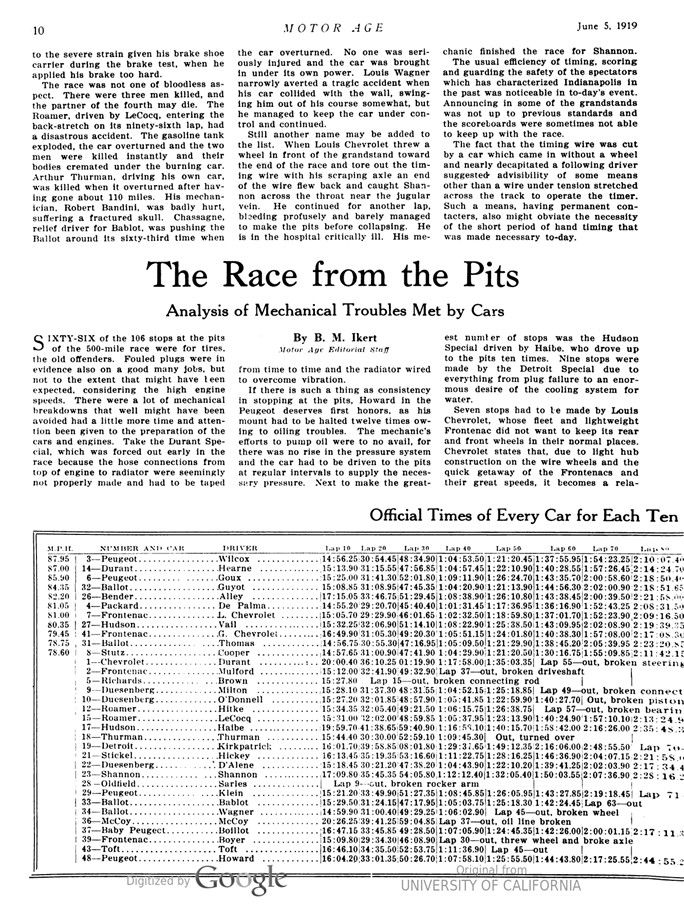
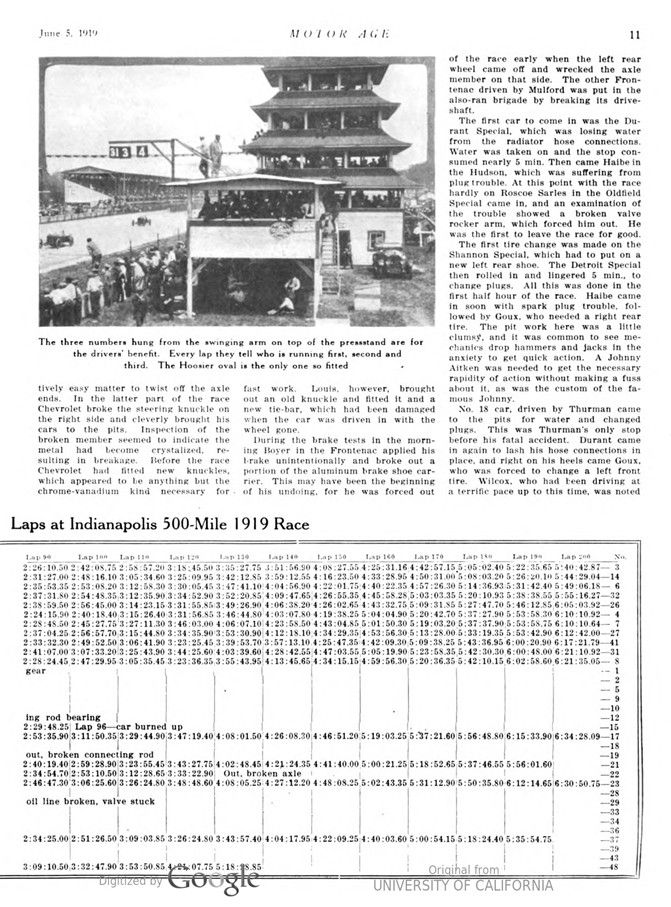
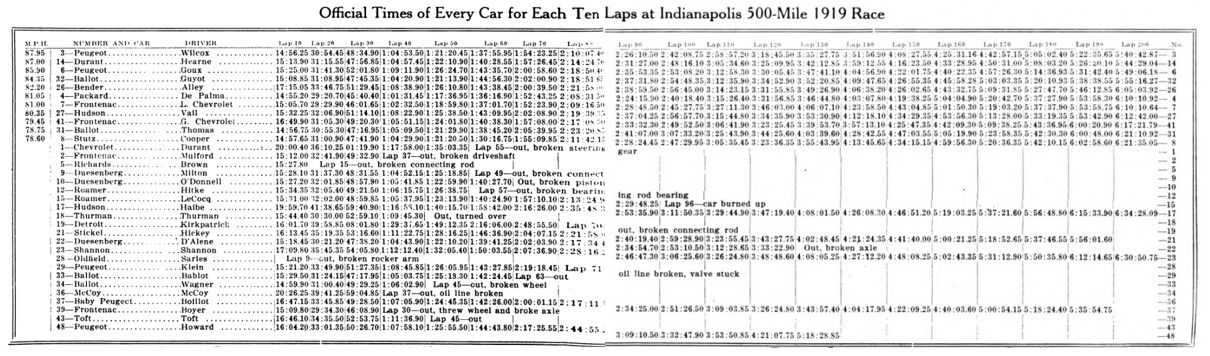
Official Times of Every Car for Each Ten Laps at Indianapolis 500-Mile 1919 Race
Page 11.
The three numbers hung from the swinging arm on top of the press stand are for the drivers‘ benefit. Every lap they tell who is running first, second and third. The Hoosier oval is the only one so fitted
Page 12.
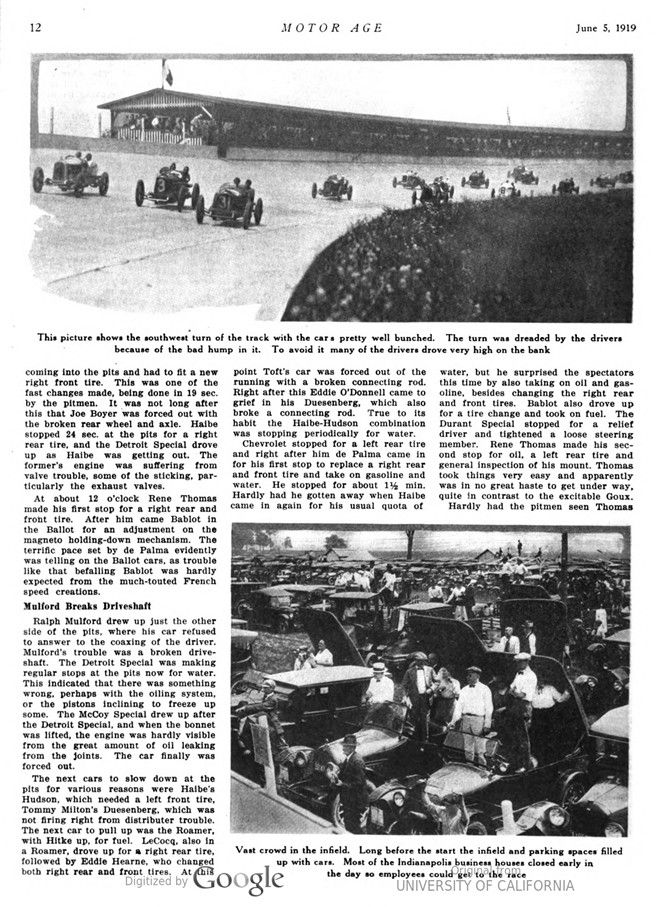
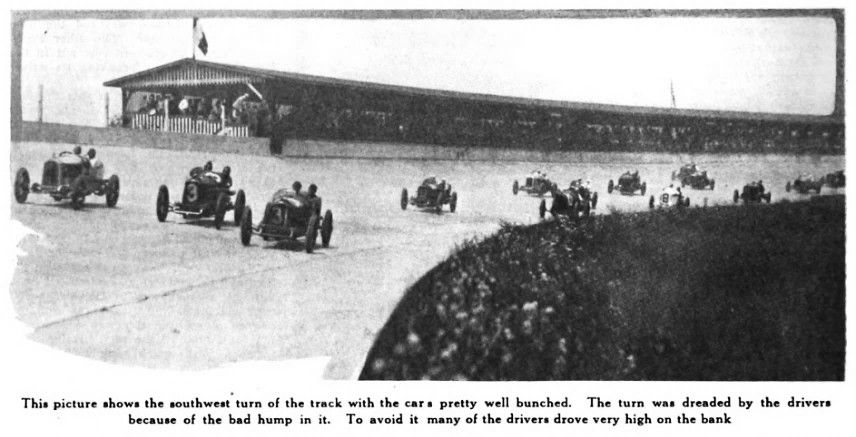
This picture shows the southwest turn of the track with the cars pretty well bunched. The turn was dreaded by the drivers because of the bad hump in it. To avoid it many of the drivers drove very high on the bank
Vast crowd in the infield. Long before the start the infield and parking spaces filled Most of the Indianapolis business houses closed early in the day so employees could get to the race up with cars.
Page 13.
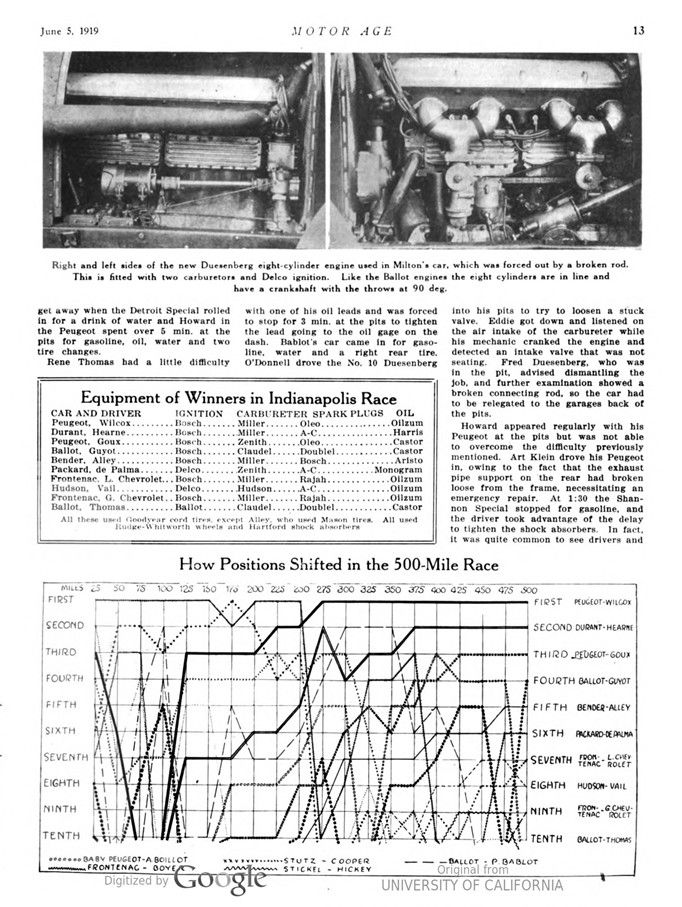
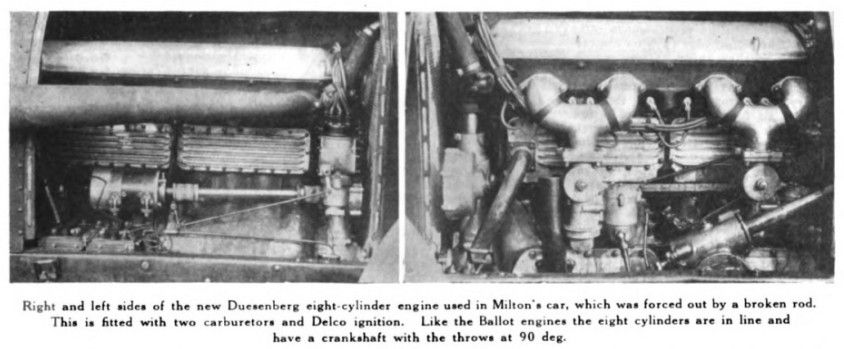
Right and left sides of the new Duesenberg eight-cylinder engine used in Milton’s car, which was forced out by a broken rod. This is fitted with two carburetors and Delco ignition. Like the Ballot engines the eight cylinders are in line and have a crankshaft with the throws at 90 deg.
Equipment of Winners in Indianapolis Race – CAR AND DRIVER, IGNITION, CARBURETER, SPARK PLUGS, OIL
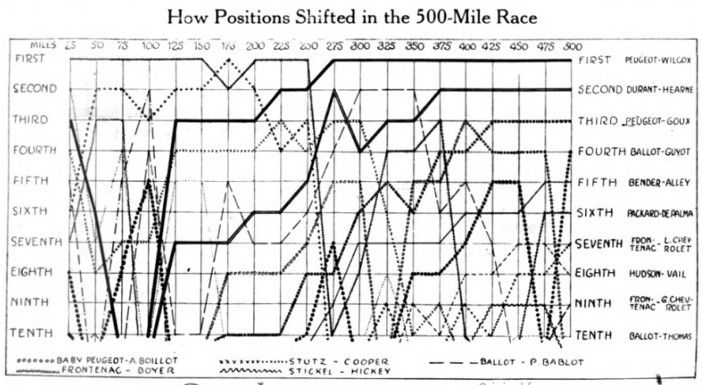
How Positions Shifted in the 500-Mile Race
Page 14.
Many did not know that Wilcox drove his car a long ways with a broken frame horn. He lashed it in place at the pits
Mulford had to push his car in, and the trouble was found to be a broken driveshaft
Here are the makes which have gone the greatest number of miles at Indianapolis. The consistent teamwork of the Stutz team in the 1915 event put it at the top of the list with an aggregate mileage of 5564. The total list goes to show the number of makes which had gone the route previous to this year
STUTZ 5564 MILES – PEUGEOT 4450 – MERCEDES 3230 – MERCER 31305 – DUESENBERG 2750 – NATIONAL 24325 – SUNBEAM 2325 – MAXWELL 2282 – CASE 1775.5 – DELAGE 17575 – FIAT 15075 – LOZIER 12475 – MASON 11825 – SIMPLEX 1148 – MARMON 1000 – KEETON 960 – JACKSON 915 – BENZ 900 – CUTTING 900
Pag 15.
Wilcox, winner of the 1919 event, led the list in total number of miles covered by each driver in the six previous Indianapolis races, which this chart covers
WILCOX 2610 MILES – MULFORD 2250 – MERZ 1562.5 – DE PALMA 1532.5 – GOUX 1000 – GUYOT 1000 – E. COOPER 500 – O’DONNEL 500 – THOMAS 500 – L.CHEVROLET 200