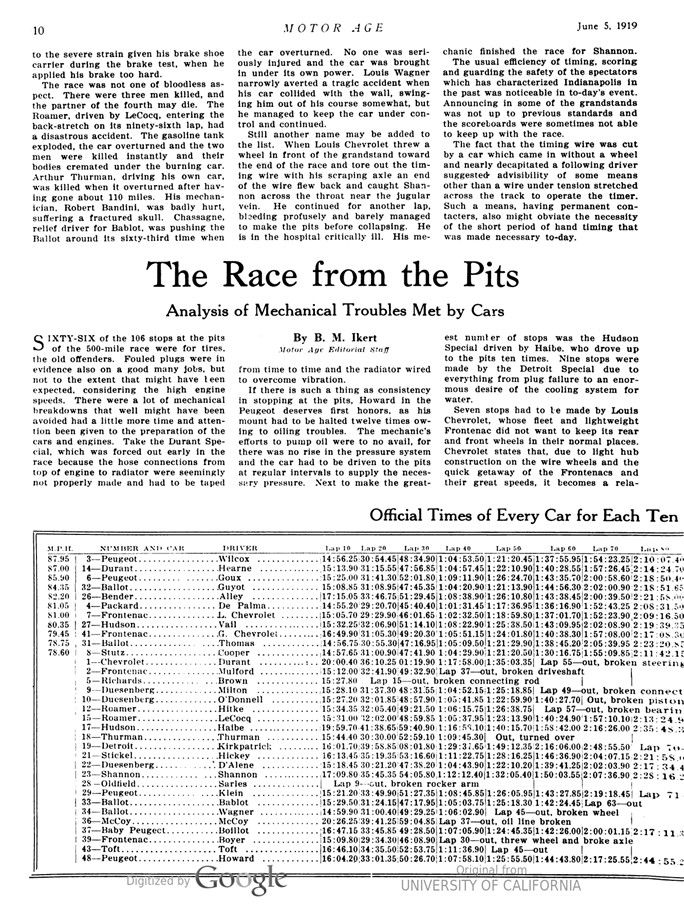
A summary of the 1919 Indianapolis Liberty Sweepstakes by Darwin S. Hatch, after he wrote the indtroduction. The second article on the 500-mile race will be concerned with the mechanical troubles.
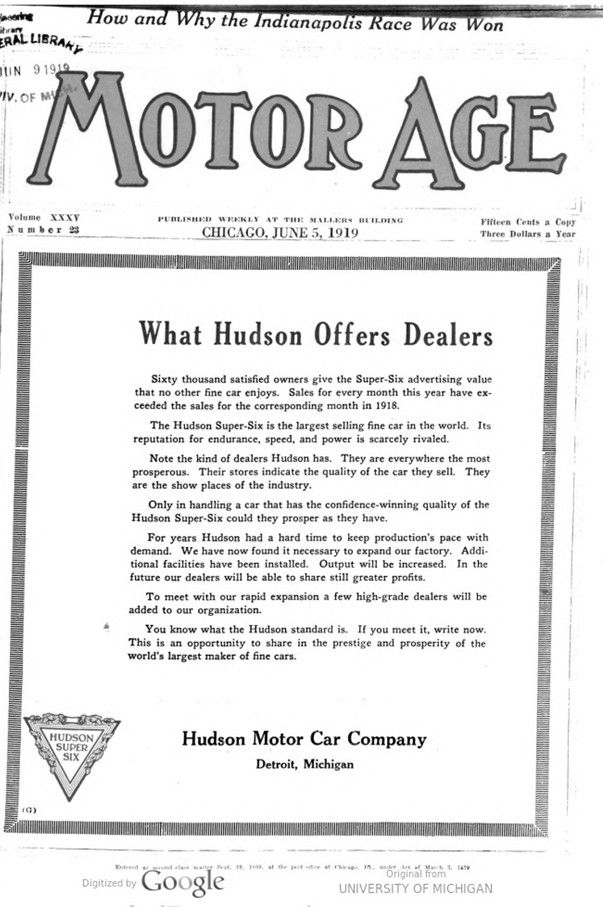
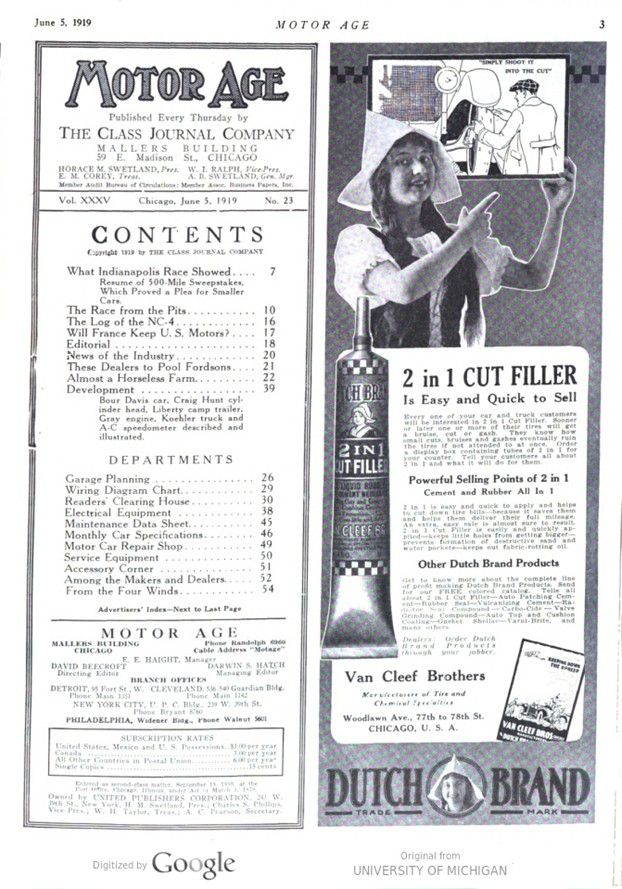
Text and jpegs by courtesy of hathitrust.org www.hathitrust.org, compiled by motorracinghistory.com
MOTOR AGE – Vol. XXV 35, No. 23, June 5, 1919
Race Is Plea for Smaller Cars
Victory Sweepstakes Won by Wilcox May Be Last 300-Cu. In. Classic On Hoosier Oval-Indianapolis to Lower Piston Displacement Limit to 183 Cu. In. Next Year
By Darwin S. Hatch – Managing Editor Motor Age
PROPHECIES that motor racing never would come back into popular favor were adequately disproved by the attendance and enthusiasm at Indianapolis.
Estimates of the attendance varied all the way from 75,000 to 125,000. Which of these is correct, it is impossible to say, but vacant seats were few in the vast grandstand and bleachers, paddock and parking spaces were filled. Whatever the actual number of spectators, the turnout was sufficient to show the interest in the public, in general, and the delegations from other cities by train and motor indicated that it was in no way localized.
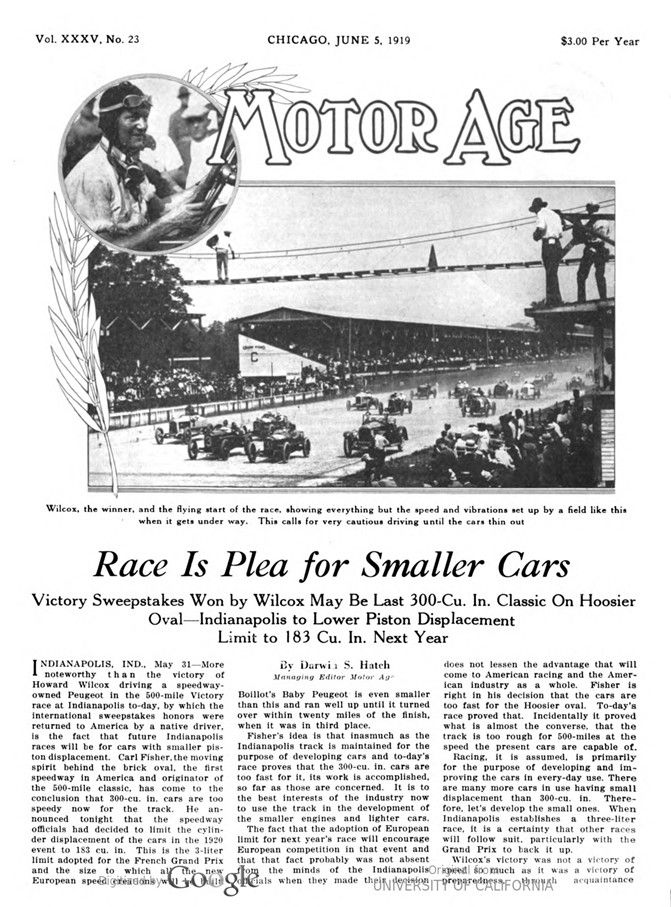
INDIANAPOLIS, IND., May 31 – More noteworthy than the victory of Howard Wilcox driving a speedway- owned Peugeot in the 500-mile Victory race at Indianapolis to-day, by which the international sweepstakes honors were returned to America by a native driver, is the fact that future Indianapolis races will be for cars with smaller pis- ton displacement. Carl Fisher, the moving spirit behind the brick oval, the first speedway in America and originator of the 500-mile classic, has come to the conclusion that 300-cu. in. cars are too speedy now for the track. He an- nounced tonight that the speedway officials had decided to limit the cylin- der displacement of the cars in the 1920 event to 183 cu. in. This is the 3-liter limit adopted for the French Grand Prix and the size to which all the new European speed creations will be built. Boillot’s Baby Peugeot is even smaller than this and ran well up until it turned over within twenty miles of the finish, when it was in third place.
Fisher’s idea is that inasmuch as the Indianapolis track is maintained for the purpose of developing cars and to-day’s race proves that the 300-cu. in. cars are too fast for it, its work is accomplished, so far as those are concerned. It is to the best interests of the industry now to use the track in the development of the smaller engines and lighter cars. The fact that the adoption of European limit for next year’s race will encourage European competition in that event and that that fact probably was not absent from the minds of the Indianapolis officials when they made their decision does not lessen the advantage that will come to American racing and the Amer- ican industry as a whole. Fisher is right in his decision that the cars are too fast for the Hoosier oval. To-day’s race proved that. Incidentally it proved what is almost the converse, that the track is too rough for 500-miles at the speed the present cars are capable of.
Racing, it is assumed, is primarily for the purpose of developing and im- proving the cars in every-day use. There are many more cars in use having small displacement than 300-cu. in. There- fore, let’s develop the small ones. When Indianapolis establishes a three-liter race, it is a certainty that other races will follow suit, particularly with the Grand Prix to back it up.
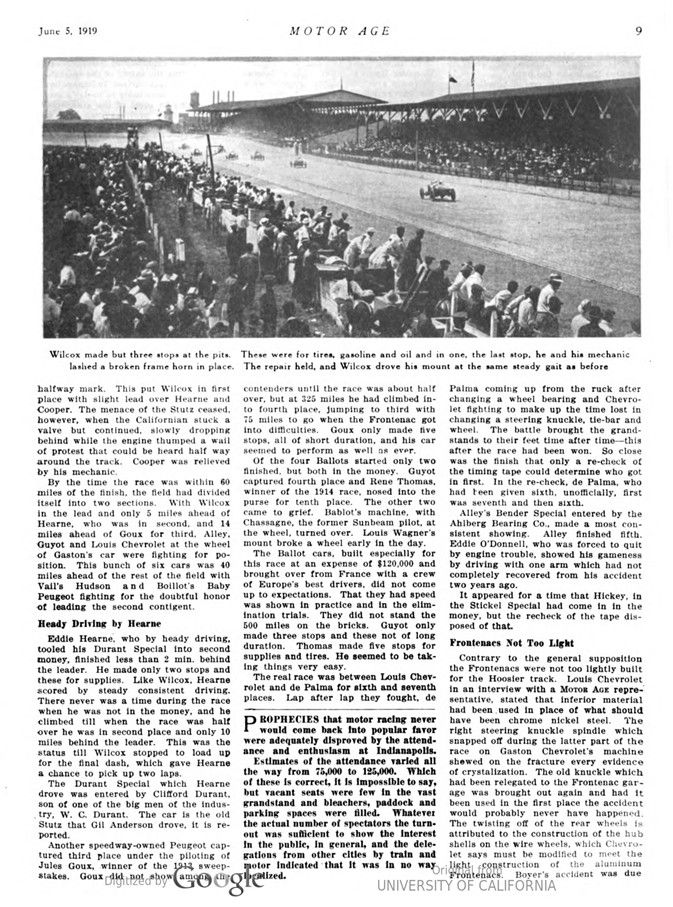
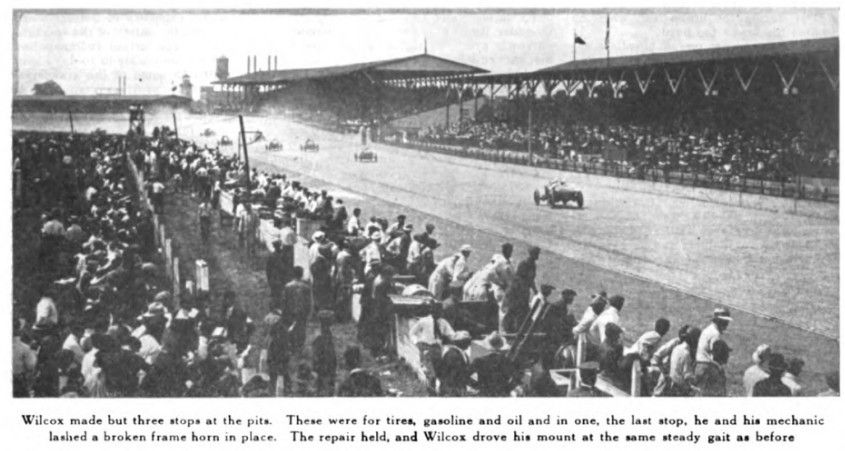
Wilcox’s victory was not a victory of speed so much as it was a victory of preparedness, through acquaintance with the track and generalship – combined, as always, with good luck. The Peugeot, which carried Wilcox under the wire a winner is the same car that the late Aitken campaigned so successfully. It has been worked over so much and new parts of American manufacture incorporated, so it is now not wholly foreign. Wilcox has it in such shape that he went through the race today without having to make any adjustments on it except that he had to tape the left front frame horn which had cracked during the latter part of the race. His three short halts at the pits were for tires and supplies. He did not drive exceptionally hard, made no exceptionally fast laps. He won because others, who drove faster while on the track, could not keep going.
Goux’s car is a Peugeot only in part. The engine is a Premier, which replaced the French engine broken up in practice.
The race this year did not hang up a record for the distance. Wilcox’s time was not quite 7 min. greater than de Palma’s record for the 500 miles in 1915. To-day’s average speed was 87.95 m.p.h., 1.89 m.p.h. less than the 1915 record of. 89.84 m.p.h.
If de Palma or Louis Chevrolet, who between them led the field for the first half of the race, could have kept up their pace, the track record for the distance would have been broken. De Palma led the field for the first 150 miles at an average or better than 92 m.p.h. His stop threw Chevrolet in the lead, and the speed dropped to 90 m.p.h. The Italian came to the fore again and hopped the pace up to 91.6 m.p.h. until an exhaust valve and front wheel bearing put him down in the ruck. His speed of 92.20 at the 100-mile mark is a track record for that distance.
Wilcox led through the entire last half of the race, taking the pace when the Packard was moored at the pits for repairs. The Peugeot which the winner piloted was well up among the leaders most of the way. It was in third place at 25 miles and sixth at 50. Then Wilcox fell clear out of the money for nearly 50 miles but climbed steadily until at 125 miles he was back in third place and crowding de Palma and Louis Chevrolet. He took second place when the Frontenac hung up at the pits at 225 miles and was in position to take advantage of de Palma’s difficulty at the halfway mark. This put Wilcox in first place with slight lead over Hearne and Cooper. The menace of the Stutz ceased, however, when the Californian stuck a valve but continued, slowly dropping behind while the engine thumped a wail of protest that could be heard half way around the track. Cooper was relieved by his mechanic.
By the time the race was within 60 miles of the finish, the field had divided itself into two sections. With Wilcox in the lead and only 5 miles ahead of Hearne, who was in second, and 14 miles ahead of Goux for third, Alley, Guyot and Louis Chevrolet at the wheel of Gaston’s car were fighting for position. This bunch of six cars was 40 miles ahead of the rest of the field with Vail’s Hudson and Boillot’s Baby Peugeot fighting for the doubtful honor of leading the second contingent.
Heady Driving by Hearne
Eddie Hearne, who by heady driving, tooled his Durant Special into second money, finished less than 2 min. behind the leader. He made only two stops and these for supplies. Like Wilcox, Hearne scored by steady consistent driving. There never was a time during the race when he was not in the money, and he climbed till when the race was half over he was in second place and only 10 miles behind the leader. This was the status till Wilcox stopped to load up for the final dash, which gave Hearne a chance to pick up two laps.
The Durant Special which Hearne drove was entered by Clifford Durant, son of one of the big men of the industry, W. C. Durant. The car is the old Stutz that Gil Anderson drove, it is reported.
Another speedway-owned Peugeot captured third place under the piloting of Jules Goux, winner of the 1913 sweepstakes. Goux did not show among the contenders until the race was about half over, but at 325 miles he had climbed into fourth place, jumping to third with 75 miles to go when the Frontenac got into difficulties. Goux only made five stops, all of short duration, and his car seemed to perform as well as ever.
Of the four Ballots started only two finished, but both in the money. Guyot captured fourth place and Rene Thomas, winner of the 1914 race, nosed into the purse for tenth place. The other two came to grief. Bablot’s machine, with Chassagne, the former Sunbeam pilot, at the wheel, turned over. Louis Wagner’s mount broke a wheel early in the day.
The Ballot cars, built especially for this race at an expense of $120,000 and brought over from France with a crew of Europe’s best drivers, did not come up to expectations. That they had speed was shown in practice and in the elimination trials. They did not stand the 500 miles on the bricks. Guyot only made three stops and these not of long duration. Thomas made five stops for supplies and tires. He seemed to be taking things very easy.
The real race was between Louis Chevrolet and de Palma for sixth and seventh places. Lap after lap they fought, de Palma coming up from the ruck after changing a wheel bearing and Chevrolet fighting to make up the time lost in changing a steering knuckle, tie-bar and wheel. The battle brought the grandstands to their feet time after time – this after the race had been won. So close was the finish that only a re-check of the timing tape could determine who got in first. In the re-check, de Palma, who had been given sixth, unofficially, first was seventh and then sixth.
Alley’s Bender Special entered by the Ahlberg Bearing Co., made a most consistent showing. Alley finished fifth. Eddie O’Donnell, who was forced to quit by engine trouble, showed his gameness by driving with one arm which had not completely recovered from his accident two years ago.
It appeared for a time that Hickey, in the Stickel Special had come in in the money, but the recheck of the tape disposed of that.
Frontenacs Not Too Light
Contrary to the general supposition the Frontenacs were not too lightly built for the Hoosier track. Louis Chevrolet in an interview with a Motor Age representative, stated that inferior material had been used in place of what should have been chrome nickel steel. The right steering knuckle spindle which snapped off during the latter part of the race on Gaston Chevrolet’s machine showed on the fracture every evidence of crystallization. The old knuckle which had been relegated to the Frontenac garage was brought out again and had it been used in the first place the accident would probably never have happened. The twisting off of the rear wheels is attributed to the construction of the hub shells on the wire wheels, which Chevrolet says must be modified to meet the light construction of the aluminum Frontenacs. Boyer’s accident was due to the severe strain given his brake shoe carrier during the brake test, when he applied his brake too hard.
The race was not one of bloodless aspect. There were three men killed, and the partner of the fourth may die. The Roamer, driven by LeCocq, entering the backstretch on its ninety-sixth lap, had a disastrous accident. The gasoline tank exploded, the car overturned and the two men were killed instantly and their bodies cremated under the burning car. Arthur Thurman, driving his own car, was killed when it overturned after having gone about 110 miles. His mechanician, Robert Bandini, was badly hurt, suffering a fractured skull. Chassagne, relief driver for Bablot, was pushing the Ballot around its sixty-third time when the car overturned. No one was seriously injured and the car was brought in under its own power. Louis Wagner narrowly averted a tragic accident when his car collided with the wall, swinging him out of his course somewhat, but he managed to keep the car under control and continued.
Still another name may be added to the list. When Louis Chevrolet threw a wheel in front of the grandstand toward the end of the race and tore out the timing wire with his scraping axle an end of the wire flew back and caught Shannon across the throat near the jugular vein. He continued for another lap, bleeding profusely and barely managed to make the pits before collapsing. He is in the hospital critically ill. His mechanic finished the race for Shannon.
The usual efficiency of timing, scoring and guarding the safety of the spectators which has characterized Indianapolis in the past was noticeable in today’s event. Announcing in some of the grandstands was not up to previous standards and the scoreboards were sometimes not able to keep up with the race.
The fact that the timing wire was cut by a car which came in without a wheel and nearly decapitated a following driver suggested advisability of some means other than a wire under tension stretched across the track to operate the timer. Such a means, having permanent contactors, also might obviate the necessity of the short period of hand timing that was made necessary today.
Photos.
Page 7.
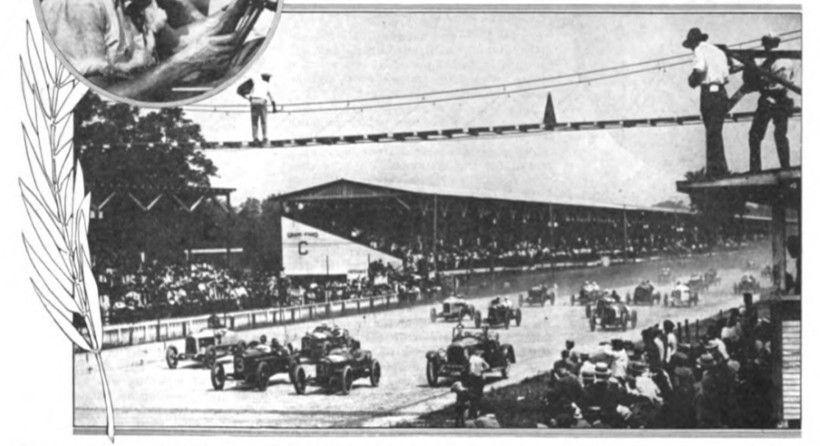
Wilcox, the winner, and the flying start of the race, showing everything but the speed and vibrations set up by a field like this when it gets under way. This calls for very cautious driving until the cars thin out.
Page 8.
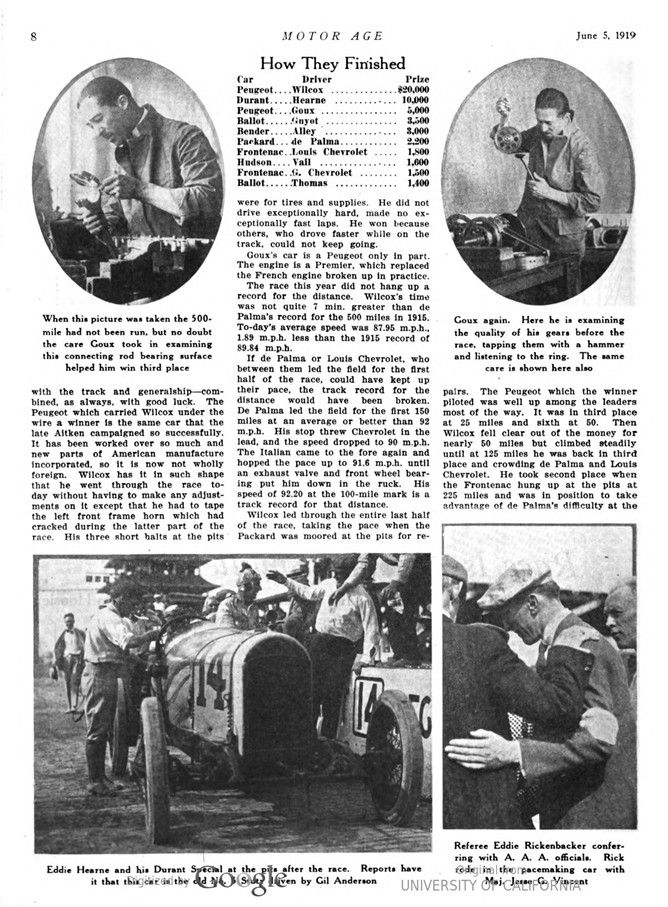
How They Finished (table)
When this picture was taken the 500-mile had not been run, but no doubt the care Goux took in examining this connecting rod bearing surface helped him win third place
Goux again. Here he is examining the quality of his gears before the race, tapping them with a hammer and listening to the ring. The same care is shown here also
Eddie Hearne and his Durant Special at the pits after the race. Reports have it that this car is the old No. 5 Stutz driven by Gil Anderson
Referee Eddie Rickenbacker conferring with A. A. A. officials. Rick rode in the pace making car with Maj. Jesse G. Vincent
Page 9.
Wilcox made but three stops at the pits. These were for tires, gasoline and oil and in one, the last stop, he and his mechanic lashed a broken frame horn in place.
The repair held, and Wilcox drove his mount at the same steady gait as before