The magazine Motor World, having started at around 1900, gave this condensed, but none the less complete view of the most important race events in the 1919 Liberty Sweepstakes, even writing on the lethal accidents.
Text and jpegs by courtesy of hathitrust.org www.hathitrust.org, compiled by motorracinghistory.com
MOTOR WORLD – Vol. LIX 59, No. 10, June 4, 1919
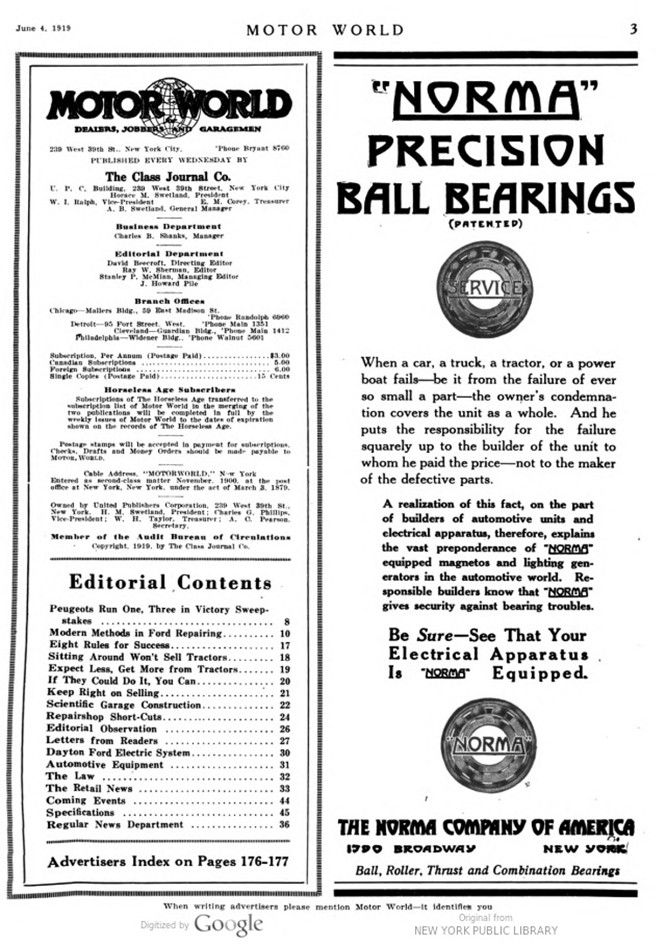
Peugeots Run One, Three in Victory Sweepstakes
Wilcox Leads Hearne Home at 87.12 M. P. H. with Goux Third –
DePalma Leads for First Half but Finishes Sixth –
Smaller Cars to Race Next Year
INDIANAPOLIS, IND., May 31 – It is maintained by the drivers, the team managers, and everyone connected with the Indianapolis International Victory Sweepstake run, that further development of the racing cars will come, only after smaller engines have been adopted. That this is true can be seen from a study of the race and comparisons with former attempts. All the cars in the race were designed for terrific speeds, but were not designed for the wear and tear that a brick pavement can give. Consequently, while the race was fast and well run, most of the stops at the pits were made as a result of the tremendous vibration shaking something loose.
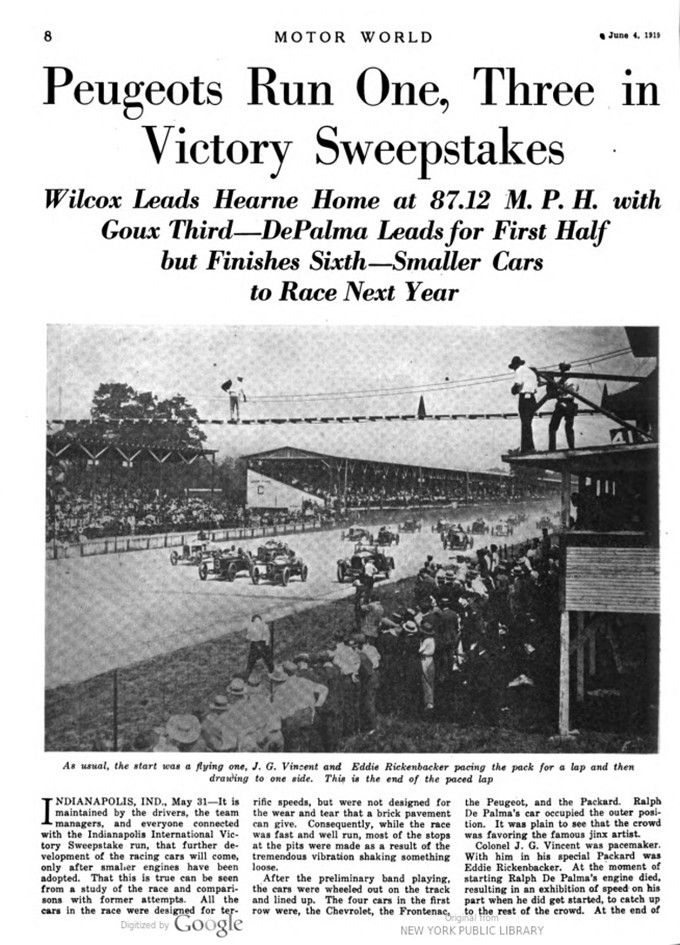
After the preliminary band playing, the cars were wheeled out on the track and lined up. The four cars in the first row were, the Chevrolet, the Frontenac, the Peugeot, and the Packard. Ralph De Palma’s car occupied the outer position. It was plain to see that the crowd was favoring the famous jinx artist.
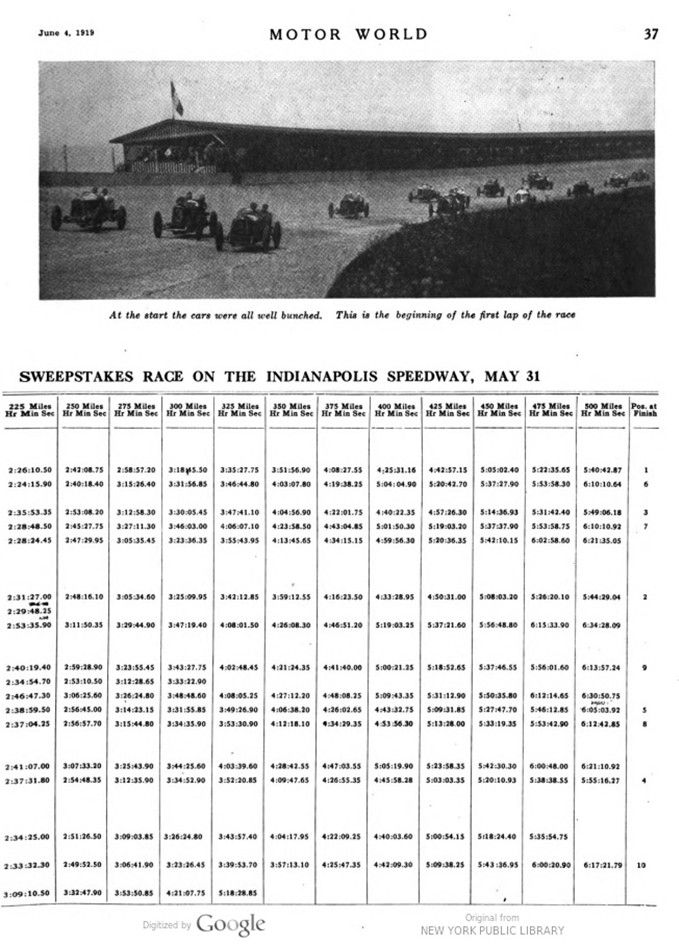
Colonel J. G. Vincent was pacemaker. With him in his special Packard was Eddie Rickenbacker. At the moment of starting Ralph De Palma’s engine died, resulting in an exhibition of speed on his part when he did get started, to catch up to the rest of the crowd. At the end of the pace making lap, the cars were nicely in position, all bunched in rows of fours. It was noted after the race had started that there were thirty-four cars on the track, but after the second lap this extra man was flagged off.
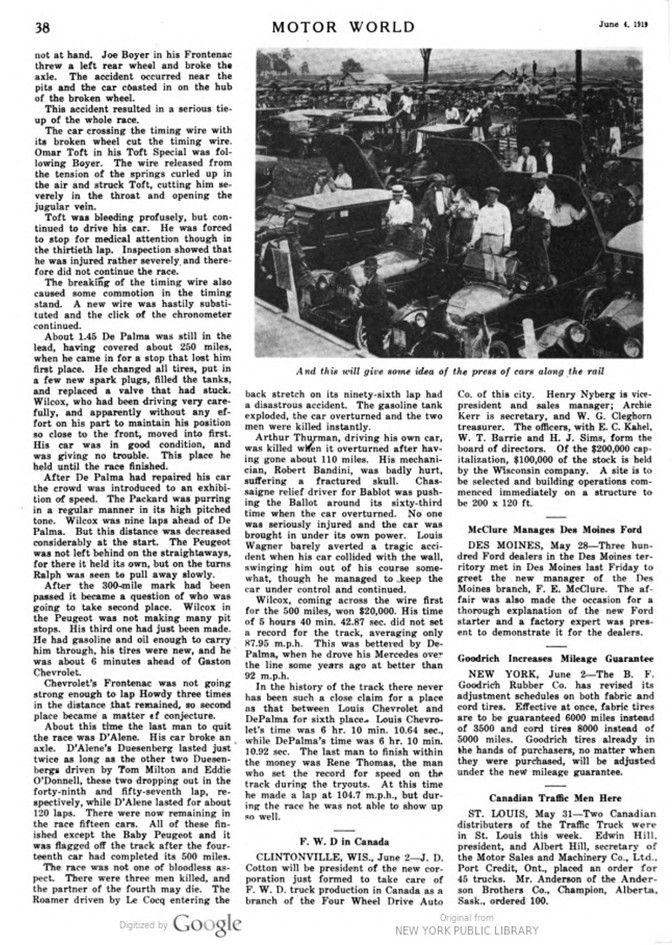
The attendance at the speedway was the largest in the history of the track. It was estimated by Speedway officials that there were over 100,000 present. In addition, there were great numbers of machines in the center of the oval and around the inside of the ring. The roads leading to the course were heavily congested with traffic an hour after the race had started.
De Palma took the lead at the start and held it continuously. The first lap was timed at a speed of 92.7 m.p.h. This is the rate at which De Palma was reeling off the miles until his trouble started. Wilcox, who drove very consistently and who had very little trouble, followed in the wake of the Packard almost all the way. The first car to roll into the pits was the Durant Special. The hose connection to the radiator was losing water at a fast rate. This stop cost the Durant car five minutes.
Much was expected from the Oldfield Special. During the preliminary runs it had reeled off some very fast laps. During the race, however, it stayed in the pits for the last 480 miles. Sarles, the Oldfield driver, headed for the pits at the ninth lap. An examination showed that he had a broken rocker arm. This put him out of the race for the trouble could not be remedied. This was the first car to drop out of the race entirely. The next was the Richards, driven by Brown, a broken connecting rod being the cause.
The Ballot cars were regarded with everything from apprehension to the “I told you so” spirit. At the end of the first 25 miles Rene Thomas was 1.55 seconds behind De Palma. The other three Ballot cars were slightly behind. The cars were bunched very closely for the first few miles, but the stragglers were soon lapped by De Palma, Wilcox, Cooper, Thomas, and Gaston Chevrolet. From then on keeping track of the race in chronological order became almost impossible.
The one hundredth mile saw three cars drop out. The pace set by the Packard was beginning to tell. Tires were being changed in wholesale quantities, oil lines were breaking and coming loose, magnetos were shaking from their bases, radiators losing all the water, and worse, the pace was so fast that the timers could not catch up to the drivers as they crossed and again crossed the wire.
At this stage of the run, Ralph Mulford dropped out, his Frontenac having broken the drive shaft. McCoy in the McCoy car was forced out because an oil line broke and repair facilities were not at hand. Joe Boyer in his Frontenac threw a left rear wheel and broke the axle. The accident occurred near the pits and the car coasted in on the hub of the broken wheel.
This accident resulted in a serious tie-up of the whole race.
The car crossing the timing wire with its broken wheel cut the timing wire. Omar Toft in his Toft Special was following Boyer. The wire released from the tension of the springs curled up in the air and struck Toft, cutting him severely in the throat and opening the jugular vein.
Toft was bleeding profusely, but continued to drive his car. He was forced to stop for medical attention though in the thirtieth lap. Inspection showed that he was injured rather severely and therefore did not continue the race.
The breaking of the timing wire also caused some commotion in the timing stand. A new wire was hastily substituted and the click of the chronometer continued.
About 1.45 De Palma was still in the lead, having covered about 250 miles, when he came in for a stop that lost him first place. He changed all tires, put in a few new spark plugs, filled the tanks, and replaced a valve that had stuck. Wilcox, who had been driving very carefully, and apparently without any effort on his part to maintain his position so close to the front, moved into first. His car was in good condition, and was giving no trouble. This place he held until the race finished.
After De Palma had repaired his car, the crowd was introduced to an exhibition of speed. The Packard was purring in a regular manner in its high-pitched tone. Wilcox was nine laps ahead of De Palma. But this distance was decreased considerably at the start. The Peugeot was not left behind on the straightaways, for there it held its own, but on the turns, Ralph was seen to pull away slowly.
After the 300-mile mark had been passed it became a question of who was going to take second place. Wilcox in the Peugeot was not making many pit stops. His third one had just been made. He had gasoline and oil enough to carry him through, his tires were new, and he was about 6 minutes ahead of Gaston Chevrolet.
Chevrolet’s Frontenac was not going strong enough to lap Howdy three times in the distance that remained, so second place became a matter of conjecture. About this time the last man to quit the race was D’Alene. His car broke an axle. D’Alene’s Duesenberg lasted just twice as long as the other two Duesenbergs driven by Tom Milton and Eddie O’Donnell, these two dropping out in the forty-ninth and fifty-seventh lap, respectively, while D’Alene lasted for about 120 laps. There were now remaining in the race fifteen cars. All of these finished except the Baby Peugeot and it was flagged off the track after the fourteenth car had completed its 500 miles.
The race was not one of bloodless aspect. There were three men killed, and the partner of the fourth may die. The Roamer driven by Le Cocq entering the back stretch on its ninety-sixth lap had a disastrous accident. The gasoline tank exploded, the car overturned and the two men were killed instantly.
Arthur Thurman, driving his own car, was killed when it overturned after having gone about 110 miles. His mechanician, Robert Bandini, was badly hurt, suffering a fractured skull. Chassagne relief driver for Bablot was pushing the Ballot around its sixty-third time when the car overturned. No one was seriously injured and the car was brought in under its own power. Louis Wagner barely averted a tragic accident when his car collided with the wall, swinging him out of his course some- what, though he managed to keep the car under control and continued.
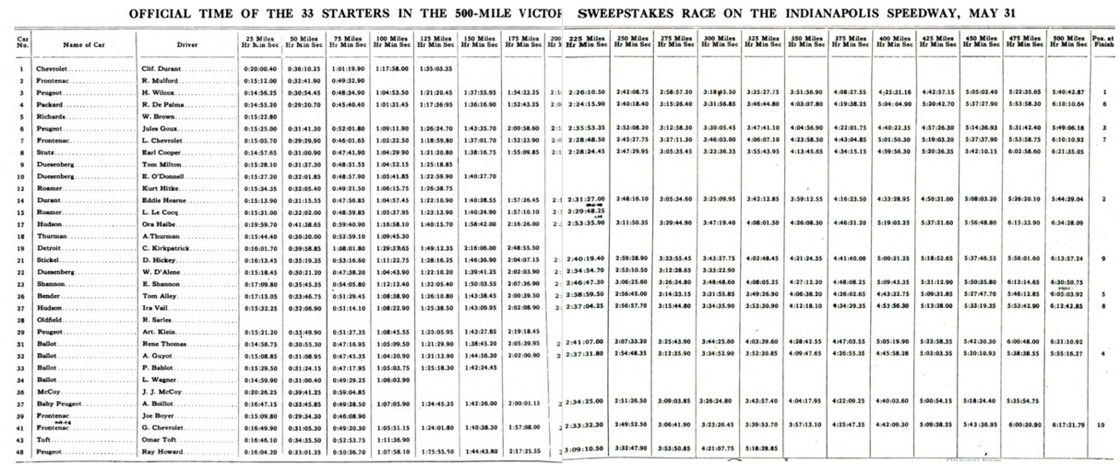
Wilcox, coming across the wire first for the 500 miles, won $20,000. His time of 5 hours 40 min. 42.87 sec. did not set a record for the track, averaging only 87.95 m.p.h. This was bettered by DePalma, when he drove his Mercedes over the line some years ago at better than 92 m.p.h.
In the history of the track there never has been such a close claim for a place as that between Louis Chevrolet and DePalma for sixth place.. Louis Chevrolet’s time was 6 hr. 10 min. 10.64 sec., while DePalma’s time was 6 hr. 10 min. 10.92 sec. The last man to finish within the money was Rene Thomas, the man who set the record for speed on the track during the tryouts. At this time he made a lap at 104.7 m.p.h., but during the race he was not able to show up so well.
Photos.
Page 8.
As usual, the start was a flying one, J. G. Vincent and Eddie Rickenbacker pacing the pack for a lap and then drawing to one side. This is the end of the paced lap
Page 9.
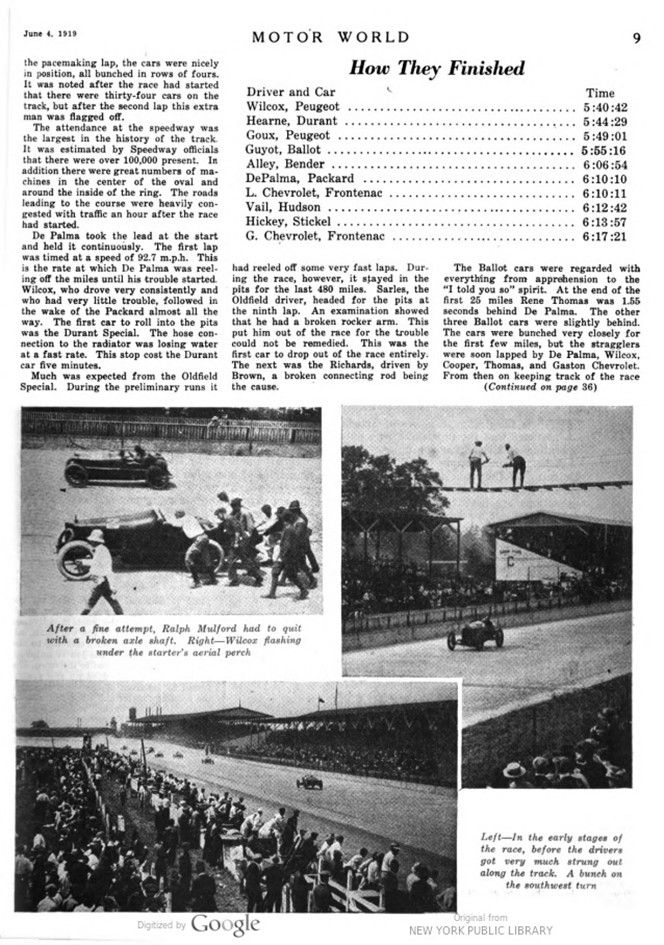
How They Finished
Driver and Car Time
Wilcox, Peugeot 5:40:42
Hearne, Durant 5:44:29
Goux, Peugeot 5:49:01
Guyot, Ballot 5:55:16
Alley, Bender 6:06:54
DePalma, Packard 6:10:10
L. Chevrolet, Frontenac 6:10:11
Vail, Hudson 6:12:42
Hickey, Stickel 6:13:57
G. Chevrolet, Frontenac 6:17:21
After a fine attempt, Ralph Mulford had to quit with a broken axle shaft. Right-Wilcox flashing under the starter’s aerial perch
Left – In the early stages of the race, before the drivers got very much strung out along the track. A bunch on the southwest turn
Page 36 – 38.
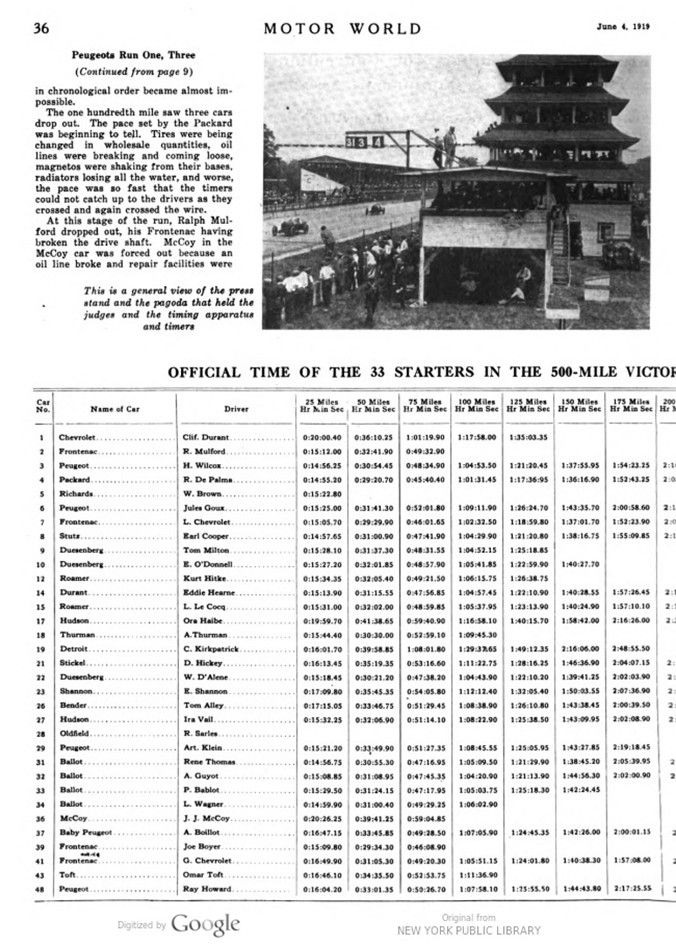
This is a general view of the press stand and the pagoda that held the judges and the timing apparatus and timers
At the start the cars were all well bunched. This is the beginning of the first lap of the race
OFFICIAL TIME OF THE 33 STARTERS IN THE 500-MILE VICTOR SWEEPSTAKES RACE ON THE INDIANAPOLIS SPEEDWAY, MAY 31
And this will give some idea of the press of cars along the rail