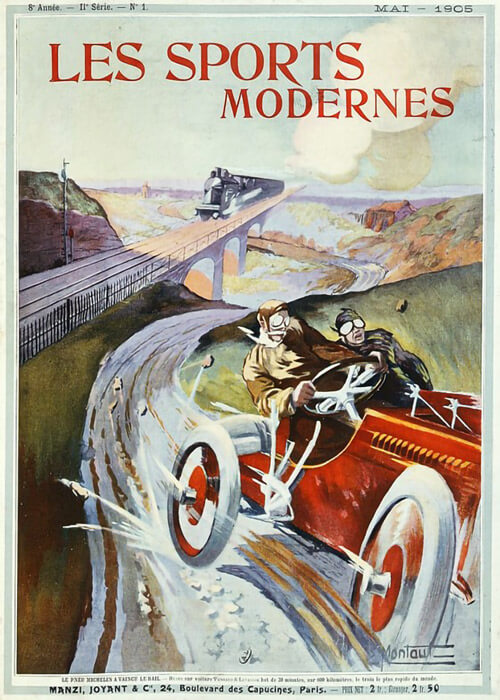
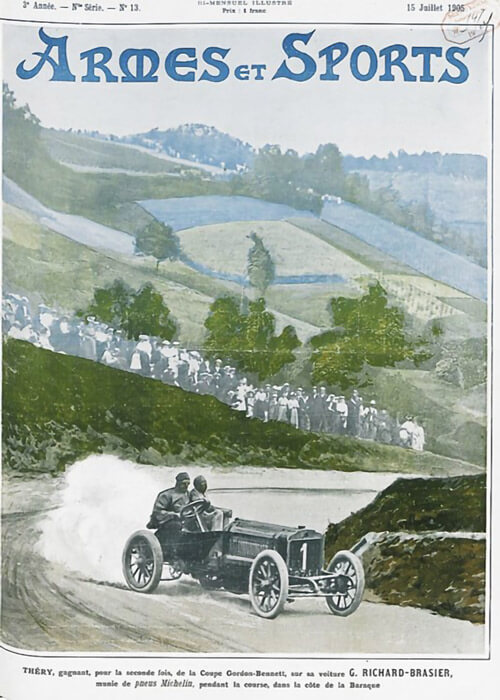
The 1897 Paris-Dieppe race of July here was reported by the young automotive magazine The Automotor and Horseless Vehicle Journal, in its second year and seated in London. Started reporting the newly City-to-City races on public roads. Although, in similarity to the US The Horseless Age, she reported and discussed mainly technical issues, race events also came into her scope. In this article, items such as the difference classes A-D and the prizes are explained, as well as the enry list, time tables, grades of the course and more, finally concluding that tha race was a succes.,
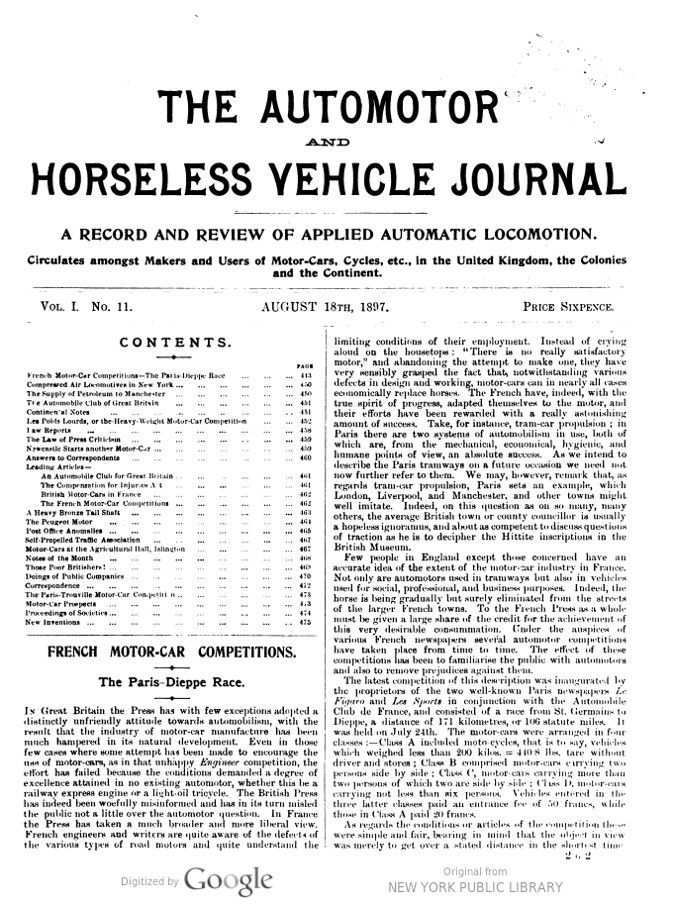
With permission of hathitrust hathitrust.org == Text and fotos compiled by motorracinghistory
The Automotor and Horseless Vehicle Journal — Volume I, No. 11, August 18, 1897
FRENCH MOTOR-CAR COMPETITIONS. – The Paris-Dieppe Race.
IN Great Britain the Press has with few exceptions adopted a distinctly unfriendly attitude towards automobilism, with the result that the industry of motor-car manufacture has been much hampered in its natural development. Even in those few cases where some attempt has been made to encourage the use of motor-cars, as in that unhappy Engineer competition, the effort has failed because the conditions demanded a degree of excellence attained in no existing automotor, whether this be a railway express engine or a light-oil tricycle. The British Press has indeed been woefully misinformed and has in its turn misled the public not a little over the automotor question.
In France the Press has taken a much broader and more liberal view. French engineers and writers are quite aware of the defects of the various types of road motors and quite understand the limiting conditions of their employment. Instead of crying aloud on the housetops: „There is no really satisfactory motor,“ and abandoning the attempt to make one, they have very sensibly grasped the fact that, notwithstanding various defects in design and working, motor-cars can in nearly all cases economically replace horses. The French have, indeed, with the true spirit of progress, adapted themselves to the motor, and their efforts have been rewarded with a really astonishing amount of success.
Take, for instance, tram-car propulsion; in Paris there are two systems of automobilism in use, both of which are, from the mechanical, economical, hygienic, and humane points of view, an absolute success. As we intend to describe the Paris tramways on a future occasion, we need not now further refer to them. We may, however, remark that, as regards tram-car propulsion, Paris sets an example, which London, Liverpool, and Manchester, and other towns might well imitate. Indeed, on this question as on so many, many others, the average British town or county councillor is usually a hopeless ignoramus, and about as competent to discuss questions of traction as he is to decipher the Hittite inscriptions in the British Museum.
Few people in England except those concerned have an accurate idea of the extent of the motor-car industry in France. Not only are automotors used in tramways but also in vehicles used for social, professional, and business purposes. Indeed, the horse is being gradually but surely eliminated from the streets of the larger French towns. To the French Press as a whole must be given a large share of the credit for the achievement of this very desirable consummation. Under the auspices of various French newspapers several automotor competitions have taken place from time to time. The effect of these competitions has been to familiarise the public with automotors and also to remove prejudices against them.
The latest competition of this description was inaugurated by the proprietors of the two well-known Paris newspapers Le Figaro and Les Sports in conjunction with the Automobile Club de France, and consisted of a race from St. Germains to Dieppe, a distance of 171 kilometres, or 106 statute miles. It was held on July 24th.
The motor-cars were arranged in four classes :
Class A included moto-cycles, that is to say, vehicles which weighed less than 200 kilos. = 440 8 lbs. tare without driver and stores;
Class B comprised motor-cars carrying two persons side by side;
Class C, motor-cars carrying more than two persons of which two are side by side;
Class D, motor-cars carrying not less than six persons.
Vehicles entered in the three latter classes paid an entrance fee of 50 francs, while those in Class A paid 20 francs. As regards the conditions or articles of the competition these were simple and fair, bearing in mind that the object in view was merely to get over a stated distance in the shortest time. There were no restrictions except those indicated in the classes, It was, in fact, a go-as-you-please contest.
Of course such a competition has after all but little interest or value to the purely technical expert who wants data – in the present case unattainable. To the general public, however, who does not care a bit whether the engine of the train which conveys them to the seaside is a „simple“ or „compound,“ or how it is propelled, the Paris-Dieppe competition is of great interest as it shows that really high speeds can be attained in practice, and that is all the public wants to know. We shall not then attempt to do more on this occasion than simply describe the proceedings, leaving our readers to form their own opinions as to the relative merits of the competing motors.
The prizes offered for competition were both numerous and costly. They were as follows:
For the vehicle which accomplished the distance in the shortest time, irrespective of class, and quite independent of the prize attaching to its class, a gold medal given by the Auto- mobile Club of France.
For the second vehicle, a silver medal given by the Automobile Club of France.
For the third vehicle, a bronze medal given by the Automobile Club of France.
For the first arrival in Class A an Objet d’Art of the value of 1,000 francs, in addition to an Objet d’Art of the value of the entrance money.
For the second arrival in Class A an Objet d’Art valued at 500 francs, in addition to another Objet d’Art valued at a quarter of the entrance money.
For the third of this class an Objet d’Art worth a quarter of the entrance money.
For the first arrival in Class B an Objet d’Art valued at 2,000 francs, in addition to another Objet d’Art worth half the entrance money.
For the second arrival in this class prizes the same as the second in Class A.
For the first voiture built before January 1st, 1896, a prize given by the President of the French Republic.
For the third arrival in Class B the same as the third arrival in Class A.
For the second arrival an Objet d’Art worth 250 francs, and another worth a quarter of the entrance money.
For the first arrival in Class C an Objet d’Art worth 1,000 francs, and another worth half the entrance money.
For the third arrival an Objet d’Art worth a quarter of the entrance money.
For the first arrival in Class Dan Objet d’Art worth 500 francs and half the entrance money.
For the second arrival an Objet d’Art worth 250 francs, and another worth a quarter of the entrance money.
For the third arrival in Class D an Objet d’Art worth a quarter of the entrance money.
In addition to these prizes there was one, a silver gilt medal, offered by the Chamber of Commerce de Beauvais, which was given to the vehicle first passing through that town.
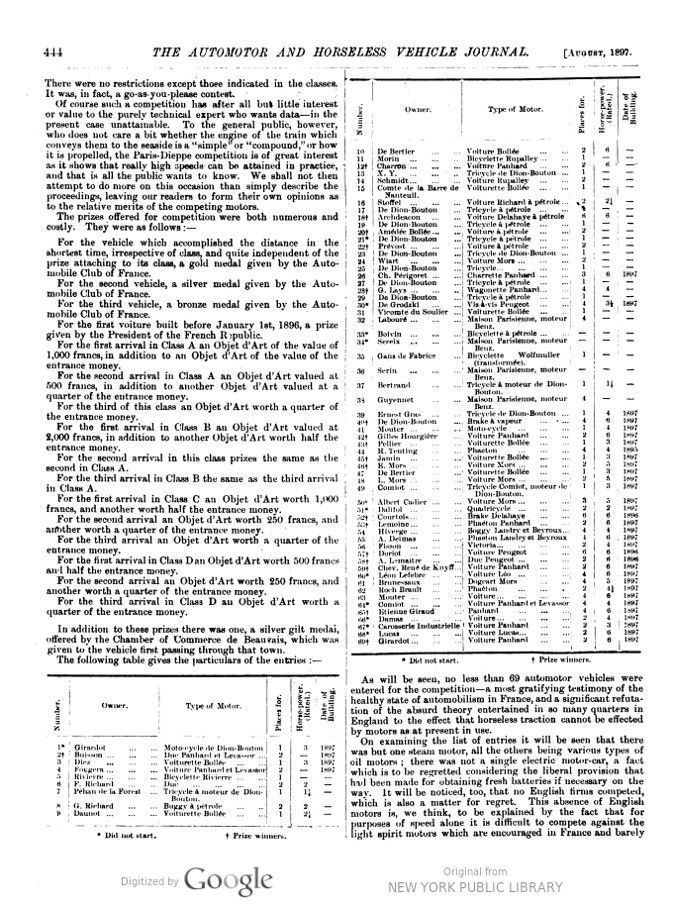
The following table gives the particulars of the entries: (see table of page 444).
As will be seen, no less than 69 automotor vehicles were entered for the competition – a most gratifying testimony of the healthy state of automobilism in France, and a significant refutation of the absurd theory entertained in so many quarters in England to the effect that horseless traction cannot be effected by motors as at present in use.
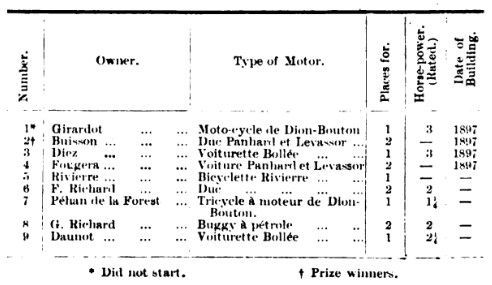
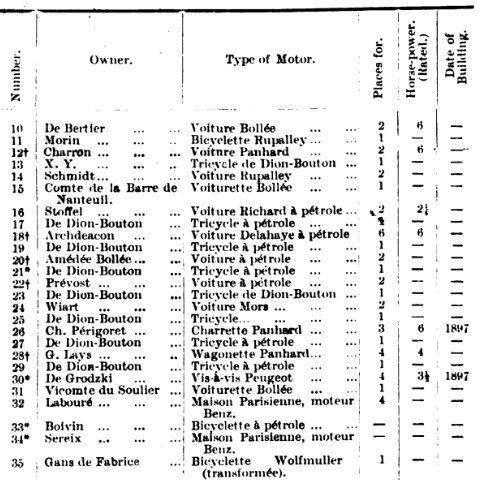

On examining the list of entries it will be seen that there was but one steam motor, all the others being various types of oil motors; there was not a single electric motor-car, a fact which is to be regretted considering the liberal provision that had been made for obtaining fresh batteries if necessary on the way. It will be noticed, too, that no English firms competed, which is also a matter for regret. This absence of English motors is, we think, to be explained by the fact that for purposes of speed alone it is difficult to compete against the light spirit motors which are encouraged in France and barely tolerated in England, and which are not likely to be much used here.
The competition was made the occasion for a special fête throughout the district traversed by the motor-cars. Special trains were run from all adjacent towards to Dieppe. At the latter place the preparations were on a most extensive scale, the principal streets were decorated with flags and banners, while the municipality, under M. Roger, the Mayor, had arranged a series of festivities at the Casino. Nothing, in short, was left undone to secure the celebration of the competition with becoming éclat.
As showing the importance with which the competition was regarded in France, we may say that the Dieppe Municipality despatched one of its Councillors, M. Jubault, who was accompanied by M. Aubry, the editor of Les Sports, to London to personally invite Sir David Salomons and the members of the Self-Propelled Traffic Association to be the guests of the municipality. Unfortunately, Sir David was unable to attend, but the S.P.T.A. was ably represented by Mr. Worby Beaumont, M.I.C.E., &c., Mr. A. Barr (secretary), the Hon. C. S. Rolls, Mr. Stanley Spooner, Mr. Redwood (son of the distinguished Professor of that name), Mr. G. H. Little (technical editor of the AUTO-MOTOR, &c.). Most of these had travelled from London the night previous, and were met on arrival at Dieppe by members of the local committee, and escorted to the Hotel Royal and the Métropole, where they were the guests of the municipality, and furnished with a free pass for everything.
A very pleasing feature of the competition was the sup- port and encouragement given to it by the authorities. Everyone from the prefect to the local gendarme did their utmost to make the thing a success. Nothing could exceed the courtesy and kindness of the various officials, especially to the foreign guests. The municipality of St. Germains and of the other towns passed en route, the Direction of Le Chemin de Fer de l’Ouest, and the municipality of Dieppe, under M. Roger, the Mayor, assisted by M. De la Rue, who was especially charged with the care and comfort of the English official visitors, did everything with the utmost tact and consideration.
The arrangements were generally in the hands of a committee composed of members of the Automobile Club and others, but the actual executive duties were entrusted to M. J. H. Aubry, the editor of Les Sports and to M. Paul Meyan, of the Figaro. These gentlemen most ably discharged their by no means light duties, and were indefatigable in their efforts to promote the success of the competition. The former gentleman showed himself an expert starter and timer, and marshalled the motors like a general; while the latter acted as inspector-general, and saw that all arrangements were properly carried out en route.

At St. Germains M. L. Desoyer, the Mayor, made equally excellent arrangements, stationing policemen at the various points and level crossings so as to warn the drivers of the automotors of the approach of trains and in other ways to render assistance. In this task he was ably seconded by the principal residents, among whom we must not omit to mention M. Ledoray, an enthusiastic automobilist. A graceful act on the part of the inhabitants of St. Germains was the presenting to each driver of an automotor a bouquet ornamented with the national ribbons. At the various road-junctions officials were stationed to indicate the route and to afford assistance, while at convenient intervals were stores of petroleum, coal, water, &c.; also at the level crossings on the railways the station masters had special orders to facilitate the passage of the motors. Just fancy an English official of any kind whatever, whether a railway director, a local magistrate, a policeman, or beadle, facilitating in any way whatever the passage of a motor-car !
Soon after seven o’clock on the 24th ult. the motor-cars assembled at L’Avenue de la Grande Armée at St. Germains. The weather was beautiful, a nice westerly breeze was blowing, and the sky was cloudless. A large and fashionable crowd had assembled at the point of departure, and lined each side of the avenue. The motor-cars were not arranged in the order of their numbers, and this occasioned some little delay. One or two minor mishaps occurred, but among so many vehicles this could hardly be avoided. As nine o’clock approached, the various motors were mostly running light, and they were nearly all literally vibrating with suppressed energy.
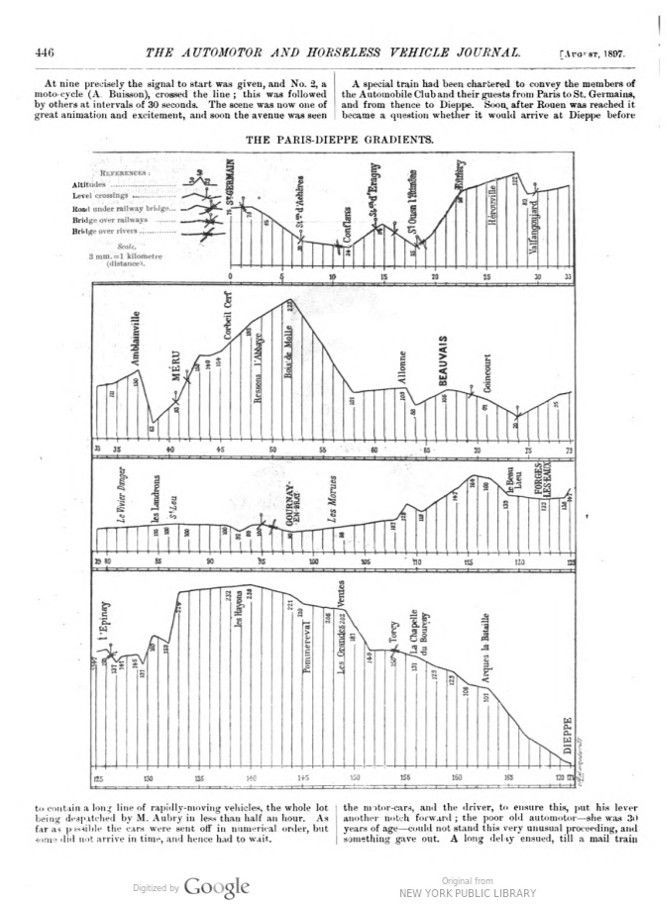
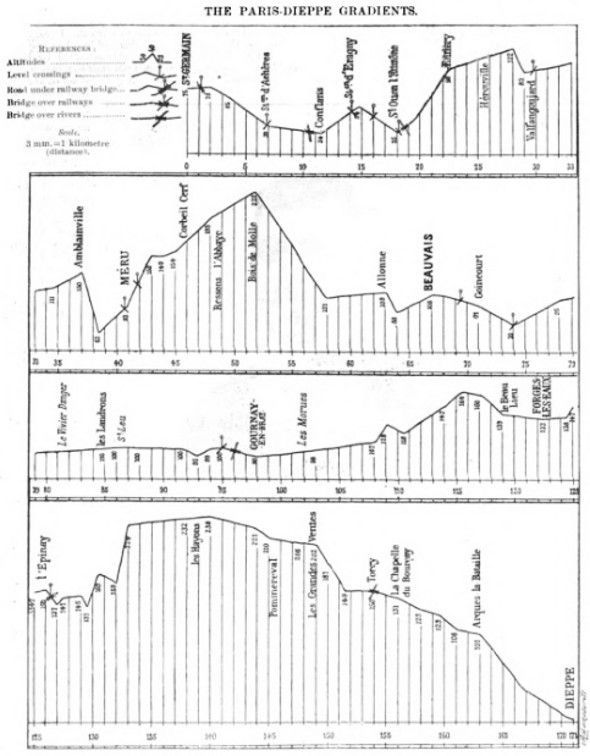
As may be imagined, the noise made by so many machines, the excited words of direction from drivers to their attendants, the loudly-expressed comments of friends, the cheers of the crowd, made it impossible to hear oneself speak. Added to this were the heat and the dust, and one can picture the scene: it was like a Derby day at Epson, but without the vulgarity of the latter. On the next page will be found a sectional chart showing the gradients, &c., on the route, together with the bridges, level crossings, &c.
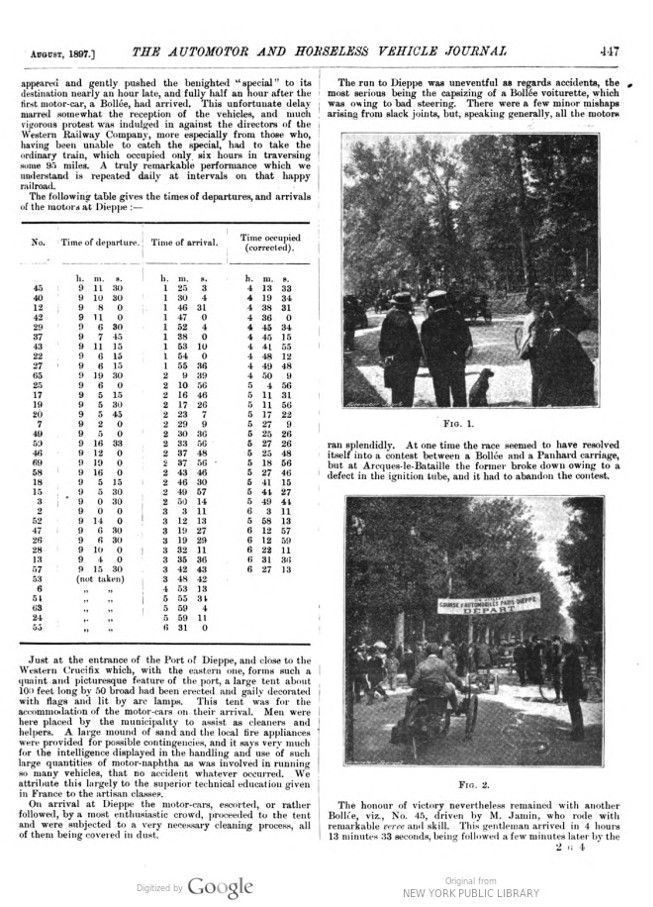
At nine precisely the signal to start was given, and No. 2, a moto-cycle (A. Buisson), crossed the line; this was followed by others at intervals of 30 seconds. The scene was now one of great animation and excitement, and soon the avenue was seen to contain a long line of rapidly-moving vehicles, the whole lot being despatched by M. Aubry in less than half an hour. As far as possible the cars were sent off in numerical order, but some did not arrive in time, and hence had to wait.
A special train had been chartered to convey the members of the Automobile Club and their guests from Paris to St. Germains, and from thence to Dieppe. Soon, after Rouen was reached it became a question whether it would arrive at Dieppe before the motor-cars, and the driver, to ensure this, put his lever another notch forward; the poor old automotor – she was 30 years of age – could not stand this very unusual proceeding, and something gave out. A long delay ensued, till a mail train appeared and gently pushed the benighted „special“ to its destination nearly an hour late, and fully half an hour after the first motor-car, a Bollée, had arrived. This unfortunate delay marred somewhat the reception of the vehicles, and much vigorous protest was indulged in against the directors of the Western Railway Company, more especially from those who, having been unable to catch the special, had to take the ordinary train, which occupied only six hours in traversing some 95 miles. A truly remarkable performance which we understand is repeated daily at intervals on that happy railroad.
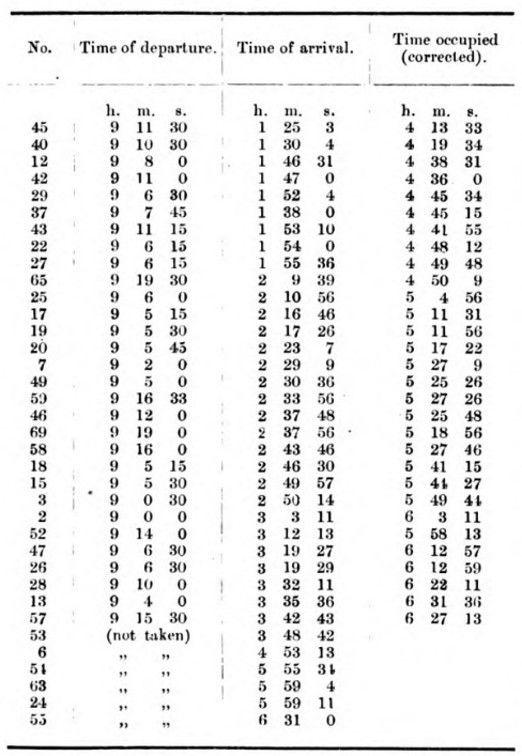
The following table gives the times of departures, and arrivals of the motors at Dieppe: (see table on page 447).
Just at the entrance of the Port of Dieppe, and close to the Western Crucifix which, with the eastern one, forms such a quaint and picturesque feature of the port, a large tent about 100 feet long by 50 broad had been erected and gaily decorated with flags and lit by arc lamps. This tent was for the accommodation of the motor-cars on their arrival. Men were here placed by the municipality to assist as cleaners and helpers.
A large mound of sand and the local fire appliances were provided for possible contingencies, and it says very much for the intelligence displayed in the handling and use of such large quantities of motor-naphtha as was involved in running so many vehicles, that no accident whatever occurred. We attribute this largely to the superior technical education given in France to the artisan classes.
On arrival at Dieppe the motor-cars, escorted, or rather followed, by a most enthusiastic crowd, proceeded to the tent and were subjected to a very necessary cleaning process, all of them being covered in dust.
The run to Dieppe was uneventful as regards accidents, the most serious being the capsizing of a Bollée voiturette, which was owing to bad steering. There were a few minor mishaps arising from slack joints, but, speaking generally, all the motors ran splendidly. At one time the race seemed to have resolved itself into a contest between a Bollée and a Panhard carriage, but at Arcques-le-Bataille the former broke down owing to a defect in the ignition tube, and it had to abandon the contest.
The honour of victory nevertheless remained with another Bollée, viz., No. 45, driven by M. Jamin, who rode with remarkable verve and skill. This gentleman arrived in 4 hours 13 minutes 33 seconds, being followed a few minutes later by the „De Dion steam brake. The next arrival was M. Charron on No. 12, a Panhard carriage.
This Bollée, which, ridden by M. Jamin, did the distance in the shortest time, and thus won the race, is a motor-tricycle, the rear wheel being the driving wheel, and the two front ones the steering wheels. The motor is placed horizontally and drives the rear wheel by gearing. The cylinder has a large radiating surface and thus no jacket water is needed; the carburetter is of the Panhard and Levassor type; the motor shaft makes from 800 to 1,200 revs. per minute, and the power developed is from 3 to 4. There are three speed gears ranging from five miles. The driving wheel is 750 mm. in diameter, and the front ones 800. All wheels have pneumatic tyres. The oil tank will contain enough oil (naphtha) for a run of 72 miles. The total weight of the motor-car is only 355 lbs.
Referring to the foregoing tables, it will be seen that out of 69 entries, 57 started, and of these 31 arrived, besides the six late starters whose times were not taken. These comprised 14 moto-cycles, Class A; 10 two-seat vehicles, Class B; 5 four-seat vehicles, Class C; and 2 six-seat vehicles, Class D. Class A the first arrive was a Bollée voiturette, very cleverly driven by M. Jamin, who covered the distance in 4 hours 13 minutes 33 seconds, or at the astonishing average rate of 24.5 miles per hour. In Class B, the first to arrive was the Panhard motor driven by M. Gilles Hourgière, who occupied 4 hours 36 minutes on the journey, or at the rate of 23:04 miles per hour. In Class C, the winner was the steam wagonette of M. Count de Dion, which took 4 hours 19 minutes 34 seconds on the journey, or at the rate of 245 miles per hour, while in Class D, the winner was M. Courtois, who drove a Delahaye wagonette, which did the distance in 5 hours 58 minutes 13 seconds, or at the rate of 17.7 miles per hour. It will thus be seen that the performances are remarkably good. To analyse them and appreciate them fully we require to know the horse-power developed, weights, and other particulars, of which it is extremely difficult to obtain reliable information, and what is available is not too reliable. Thus the steam wagonette of Count de Dion is officially quoted as being of 6½ horsepower, but it is easily seen that the actual horse-power must be nearer 26. In view of this absence of accurate data we have not thought it necessary to describe the vehicles at length, more especially as most of them have already been described, and in most cases illustrated, in our columns. The prizes were awarded as follows: –
In the moto-cycle section, Class A, the first and second prizes went to MM. Jamin and Pellier, who rode Bollée’s Nos. 45 and 43.
In Class B the winners were M. Gilles Hourgière (Panhard, No. 42); M. Charron (also a Panhard, No. 12); M. Prévost Peugeot, No 22); M. Amédée Bollée (Bollée, No. 20); Chev. de Knyff (Panhard, No. 59); M. Girardot (Panhard, No. 69): M. Emile Mors (Mors, No. 46); M. Lemaître (Peugeot, No. 58); M. Buisson (Panhard, No. 2); and M. Lays (Panhard, No. 28).
In Class C, MM. de Dion et Bouton were first with No. 40, steam brake; then M. Giraud (Panhard, No. 65); M. Archdeacon (Delahaye, No. 18); M. Lemoine (Panhard, No. 53).
In Class D (heavy vehicles), the first prize was awarded to M. Courtois (Delahaye, No. 52), and the second to M. Doriot (Peugeot, No. 57).
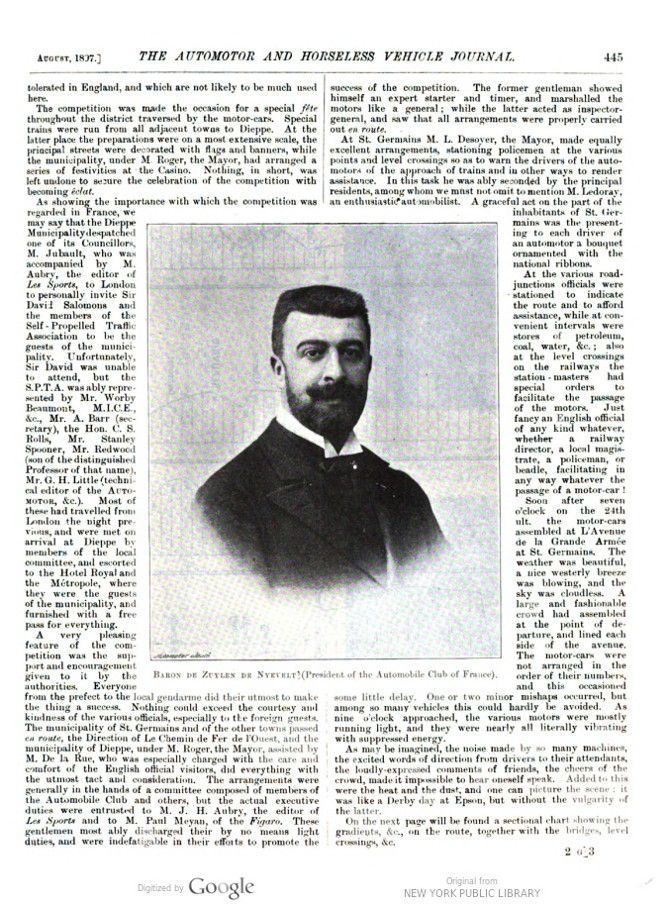
Perhaps, the most however, remarkable achievement in motor-car running is that of M. Stanislaw Grodzki, who, in his Peugeot, ran from Varsovie, in Russia, to Paris in 10 days. The mean speed was 180 kilometres, or 110 miles, per day. The intention of M. Grodzki was to participate in the race, but he arrived a few hours too late to enter, and in things automobile the laws are like those of the Medes and Persians and Jockey Club. Hence he was not a starter. He, however, came along in the procession, and his car looked none the worse for its long journey across Europe. His solid-rubber tyres stood the journey remarkably well. Several other motor-cars proceeded to Dieppe, and took part in the procession. The one that excited the most admiration was a handsome and very elegant brougham built to the order of M. le Baron de Zuylen. In the opinion of those conversant with the art of carriage building this brougham is the best example of the application of an oil motor to a private visiting carriage that has yet been produced.
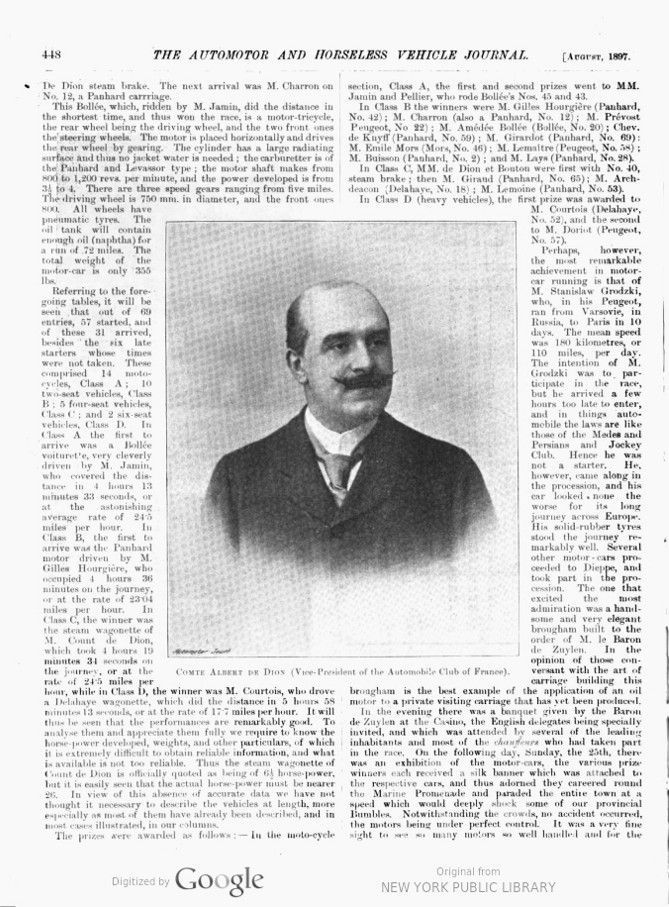
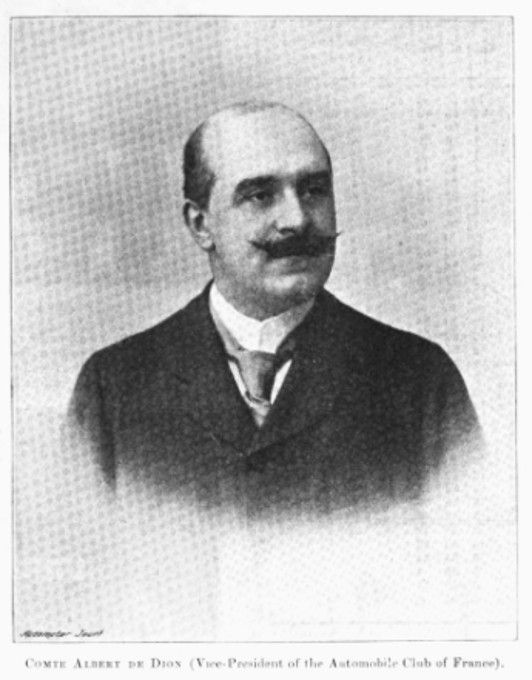
In the evening there was a banquet given by the Baron de Zuylen at the Casino, the English delegates being specially invited, and which was attended by several of the leading inhabitants and most of the chauffeurs who had taken part in the race. On the following day, Sunday, the 25th, there was an exhibition of the motor-cars, the various prize winners each received a silk banner which was attached to the respective cars, and thus adorned they careered round the Marine Promenade and paraded the entire town at a speed which would deeply shock some of our provincial Bumbles. Notwithstanding the crowds, no accident occurred, the motors being under perfect control. It was a very fine sight to see So many motors so well handled and for the most part presenting a very smart appearance. In the evening there was another banquet at the Casino, followed by a concert and ball. At the banquet 150 guests were present, including M. Roger, the Mayor of Dieppe; M. Hendlé, Prefect of the Seine-Inférieure; the Baron Zuylen de Nyevelt, President of the Automobile Club of France; Comte Albert de Dion, Vice-President of the Automobile Club of France; MM. Breton (Deputé), Lee-Jortin (Dieppe English Consul), Jubault, de Lucenski, Aubry, the delegates from the Self-Propelled Traffic Association, De Bouton, Avigdor, Bollée, &c., &c.
There were the usual speeches of an enthusiastic description in favour of automobilism, M. J. H. Aubry proposing the health of Sir David Salomons and the members of the Self- Propelled Traffic Association, in which he asked the chauffeurs to drink to the health of their English colleagues. He then added, in English :-„Gentlemen, we are very happy to drink in your presence to Sir David Salomons’s health, to yours, to the members of the Self-Propelled Traffic Association, and to the spreading of our common ideas and feelings all over the United Kingdom.“
As will be gathered, the Paris-Dieppe competition was a huge success, reflecting credit on all participating in it, and it was fittingly concluded by festivities which were, if anything, on a rather too extensive scale. The greatest courtesy and cordiality were manifested towards the English visitors, who one and all came away with the impression of having had a most instructive and pleasant visit. It only remains for us to congratulate the municipality of Dieppe, the Automobile Club, and our contemporaries Les Sports and Le Figaro upon the success which has deservedly attended the competition. We do not, however, congratulate La Compagnie de l’Ouest. When so many have facilitated our task and rendered it pleasant, it were perhaps invidious to mention names, but we cannot conclude without expressing our sense of the services rendered us by MM. Aubry, Jubault, and De la Rue. For ourselves we are glad to have assisted in doing some little thing towards building up l’entente cordiale between France and Great Britain which we trust may never be disturbed.
—————————-
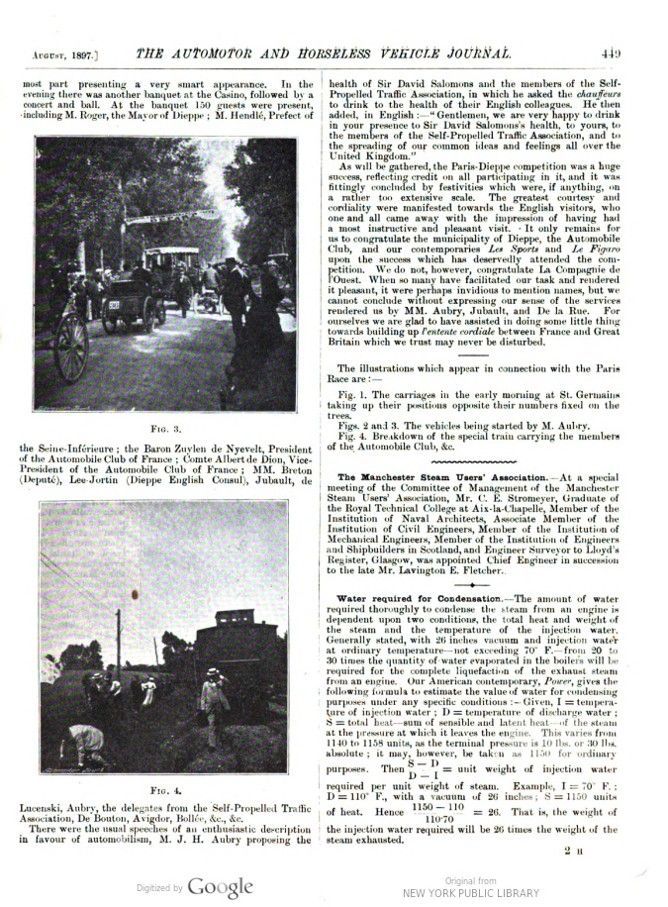
The illustrations which appear in connection with the Paris Race are: –
Fig. 1. The carriages in the early morning at St. Germains taking up their positions opposite their numbers fixed on the trees.
Figs. 2 and 3. The vehicles being started by M. Aubry.
Fig. 4. Breakdown of the special train carrying the members of the Automobile Club, &c.