This report shows two significant items of the pre-Cup year. First, a letter from Sir David Salomon of the A.C. Britain to the secretary of the A.C. France, in a first reaction of the rules, that were distributed earlier by the ACF. The second part may not be that important, but the “Club Banquet to Mr. Zuylen” shows how and by whom discussions on motorracing were handed in those days. It’s a bit lengthy, that’s right; but it gives a fine impression on how opinions on motorracing were in those days.
Text and photos with courtesy of hathitrust hathitrust.org, compiled by motorracingistory.com.
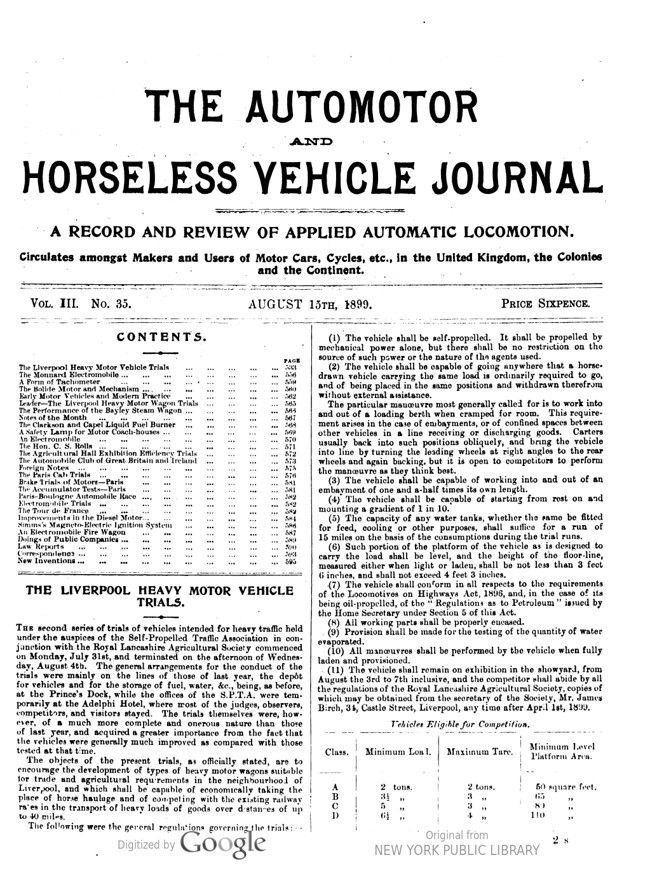
THE AUTOMOTOR AND HORSELESS VEHICLE JOURNAL – Vol. III, No. 35, August 15, 1899
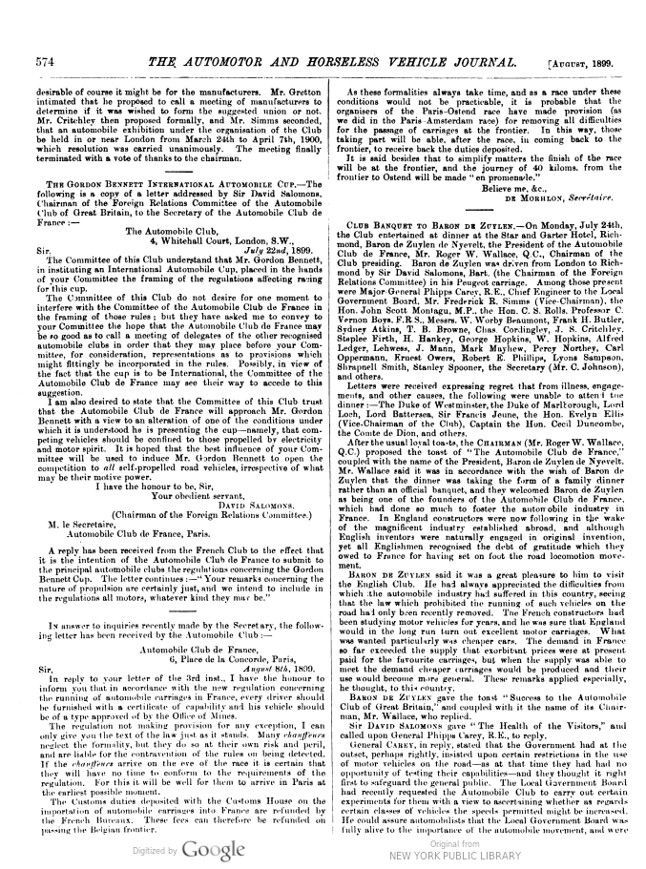
THE GORDON BENNETT INTERNATIONAL AUTOMOBILE CUP.
– The following is a copy of a letter addressed by Sir David Salomons, Chairman of the Foreign Relations Committee of the Automobile Club of Great Britain, to the Secretary of the Automobile Club de France: –
The Automobile Club, 4, Whitehall Court, London, S.W., July 22nd, 1899.
Sir.
The Committee of this Club understand that Mr. Gordon Bennett, in instituting an International Automobile Cup, placed in the hands of your Committee the framing of the regulations affecting racing for this cup.
The Committee of this Club do not desire for one moment to interfere with the Committee of the Automobile Club de France in the framing of those rules; but they have asked me to convey to your Committee the hope that the Automobile Club de France may be so good as to call a meeting of delegates of the other recognised automobile clubs in order that they may place before your Committee, for consideration, representations as to provisions which might fittingly be incorporated in the rules. Possibly, in view of the fact that the cup is to be International, the Committee of the Automobile Club de France may see their way to accede to this suggestion.
I am also desired to state that the Committee of this Club trust that the Automobile Club de France will approach Mr. Gordon Bennett with a view to an alteration of one of the conditions under which it is understood he is presenting the cup-namely, that competing vehicles should be confined to those propelled by electricity and motor spirit. It is hoped that the best influence of your Committee will be used to induce Mr. Gordon Bennett to open the competition to all self-propelled road vehicles, irrespective of what may be their motive power.
I have the honour to be, Sir,
Your obedient servant,
DAVID SALOMONS. (Chairman of the Foreign Relations Committee.)
M. le Secretaire, Automobile Club de France, Paris.
——
A reply has been received from the French Club to the effect that it is the intention of the Automobile Club de France to submit to the principal automobile clubs the regulations concerning the Gordon Bennett Cup. The letter continues: – ‘Your remarks concerning the nature of propulsion are certainly just, and we intend to include in the regulations all motors, whatever kind they may be.”
——
In answer to inquiries recently made by the Secretary, the following letter has been received by the Automobile Club: –
Automobile Club de France, 6, Place de la Concorde, Paris, August 8th, 1899.
Sir,
In reply to your letter of the 3rd inst., I have the honour to inform you that in accordance with the new regulation concerning the running of automobile carriages in France, every driver should be furnished with a certificate of capability and his vehicle should be of a type approved of by the Office of Mines.
The regulation not making provision for any exception, I can only give you the text of the law just as it stands. Many chauffeurs neglect the formality, but they do so at their own risk and peril, and are liable for the contravention of the rules on being detected. If the chauffeurs arrive on the eve of the race it is certain that they will have no time to conform to the requirements of the regulation. For this it will be well for them to arrive in Paris at the earliest possible moment.
The Customs duties deposited with the Customs House on the importation of automobile carriages into France are refunded by the French Bureaux. These fees can therefore be refunded on passing the Belgian frontier.
As these formalities always take time, and as a race under these conditions would not be practicable, it is probable that the organisers of the Paris-Ostend race have made provision (as we did in the Paris-Amsterdam race) for removing all difficulties for the passage of carriages at the frontier. In this way, those taking part will be able, after the race, in coming back to the frontier, to receive back the duties deposited. It is said besides that to simplify matters the finish of the race will be at the frontier, and the journey of 40 kiloms. from the frontier to Ostend will be made “en promenade.”
Believe me, &c., DE MORHLON, Secrétaire.
CLUB BANQUET TO BARON DE ZUYLEN. – On Monday, July 24th, the Club entertained at dinner at the Star and Garter Hotel, Rich mond, Baron de Zuylen de Nyevelt, the President of the Automobile Club de France, Mr. Roger W. Wallace, Q.C., Chairman of the Club presiding. Baron de Zuylen was driven from London to Richmond by Sir David Salomons, Bart. (the Chairman of the Foreign Relations Committee) in his Peugeot carriage. Among those present were Major General Phipps Carey, R. E., Chief Engineer to the Local Government Board, Mr. Frederick R. Simms (Vice-Chairman), the Hon. John Scott Montagu, M.P., the Hon. C. S. Rolls, Professor C. Vernon Boys, F.R.S., Messrs. W. Worby Beaumont, Frank H. Butler, Sydney Atkins, T. B. Browne, Chas. Cordingley, J. S. Critchley, Staplee Firth, H. Hankey, George Hopkins, W. Hopkins, Alfred Ledger, Lehwess, J. Mann, Mark Mayhew, Percy Northey, Carl Oppermann, Ernest Owers, Robert E. Phillips, Lyons Sampson, Shrapnell Smith, Stanley Spooner, the Secretary (Mr. C. Johnson), and others.
Letters were received expressing regret that from illness, engagements, and other causes, the following were unable to attend the dinner – The Duke of Westminster, the Duke of Marlborough, Lord Loch, Lord Battersea, Sir Francis Jeune, the Hon. Evelyn Ellis (Vice-Chairman of the Club), Captain the Hon. Cecil Duncombe, the Comte de Dion, and others.
After the usual loyal toasts, the CHAIRMAN (Mr. Roger W. Wallace, Q.C.) proposed the toast of “The Automobile Club de France,” coupled with the name of the President, Baron de Zuylen de Nyevelt. Mr. Wallace said it was in accordance with the wish of Baron de Zuylen that the dinner was taking the form of a family dinner rather than an official banquet, and they welcomed Baron de Zuylen as being one of the founders of the Automobile Club de France, which had done so much to foster the automobile industry in France. In England constructors were now following in the wake of the magnificent industry established abroad, and although English inventors were naturally engaged in original invention, yet all Englishmen recognised the debt of gratitude which they owed to France for having set on foot the road locomotion movement.
BARON DE ZUYLEN said it was a great pleasure to him to visit the English Club. He had always appreciated the difficulties from which the automobile industry had suffered in this country, seeing that the law which prohibited the running of such vehicles on the road had only been recently removed. The French constructors had been studying motor vehicles for years, and he was sure that England would in the long run turn out excellent motor carriages. What was wanted particularly was cheaper cars. The demand in France so far exceeded the supply that exorbitant prices were at present paid for the favourite carriages, but when the supply was able to meet the demand cheaper carriages would be produced and their use would become more general. These remarks applied especially, he thought, to this country.
BARON DE ZUYLEN gave the toast “Success to the Automobile Club of Great Britain,” and coupled with it the name of its Chairman, Mr. Wallace, who replied.
Sir DAVID SALOMONS gave “The Health of the Visitors,” and called upon General Phipps Carey, R.E., to reply.
General CAREY, in reply, stated that the Government had at the outset, perhaps rightly, insisted upon certain restrictions in the use of motor vehicles on the road-as at that time they had had no opportunity of testing their capabilities-and they thought it right first to safeguard the general public. The Local Government Board had recently requested the Automobile Club to carry out certain experiments for them with a view to ascertaining whether as regards certain classes of vehicles the speeds permitted might be increased. He could assure automobilists that the Local Government Board was fully alive to the importance of the automobile movement, and were always willing to consider representations of automobilists, and he had no doubt would in the long run make such concessions to their views as might in the opinion of the Board be compatible with the safety of the public.
The Hon. JOHN SCOTT MONTAGU, M.P., gave the “Health of the Secretary” (Mr. Johnson). The Secretary replied.
Mr. ROGER W. WALLACE proposed the toast of “The Press.” He stated that as the dinner was of an informal nature members of the Press had not been invited to be present, but he was glad to recognise at the table members of the Club who were also proprietors of important technical journals. He had already had an opportunity at a recent meeting of the Show Committee of thanking the technical Press for the ready assistance they had given the Club in its endeavours to promote the automobile industry; but on this occasion, seeing that Mr. Alfred Harmsworth was present, he wished more particularly to refer to the general Press and to couple with this toast the name of Mr. Harmsworth. Mr. Harmsworth had stepped out from amongst the proprietors of other London morning papers and had declared boldly in favour of automobilism. It required no small amount of courage for a newspaper proprietor to stand up for a new movement, which was receiving so cold a recognition in so many quarters. He (the Chairman) felt certain that it would give members of the Club a special delight to show Mr. Harmsworth how thoroughly they appreciated his action in this matter.
Mr. ALFRED HARMSWORTH, in replying, stated that apart from the support to automobilism which had been rendered by the newspapers with which he was connected, he was himself an enthusiastic automobilist, and he believed most thoroughly that the movement had an enormous future in this country. He thought that the inhabitants of the United Kingdom could not over-rate the great stimulus which the French people had given to mechanics, and he hoped that thanks would always be given to the French constructors for this veritable mechanical triumph.
The CHAIRMAN read the telegram announcing the result of the Tour de France Race, which had kindly been sent to the Club by the editor of Le Matin. The following reply was read, unanimously adopted, and despatched to the editor of Le Matin : – “Members of the British Automobile Club, at the dinner at which Baron de Zuylen honours them with his presence, beg to thank you for telegraphing the results of your interesting race. They beg to congratulate you on its splendid success, and ask you to convery their hearty congratulations to the successful competitors. Baron de Zuylen joins in these congratulations. Please accept my compliments. – ROGER W. WALLACE, Chairman of the Automobile Club of Great Britain, London.”
The CHAIRMAN then gave the toast of “The Judges,” and coupled with it the names of Professor Vernon Boys, F.R.S., and Mr. W. Worby Beaumont.
Sir DAVID SALOMONS, with reference to the heavy vehicle trials of the Liverpool centre of the Automobile Club (viz., the Liverpool Self-Propelled Traffic Association), stated that if a fund were started by the Automobile Club towards assisting in the defrayment of the cost of the Liverpool trials he would be glad to subscribe 20 guineas.
The CHAIRMAN stated he thought such a fund should be started at the London Clubhouse, and that he would be pleased to add 20 guineas. Mr. Frederic R. Simms (the Vice-Chairman) also stated that he would be glad to subscribe five guineas, and Mr. Ernest Owers likewise offered a similar amount. The Chairman expressed a hope that other members would subscribe to this fund.
Mr. SHRAPNELL SMITH (the Hon. Secretary of the Liverpool Branch) tendered his thanks for the offer of assistance, and said that the Council of the Liverpool branch hoped that members of the central body would make a point of being present at the trials.
BARON DE ZUYLEN then announced that Mr. Gordon Bennett had recently informed the Automobile Club de France that he intended to lodge in their hands a gold cup as an International Automobile Cup, and that challenges for this cup might be sent through the recognised automobile club of any country, and that any nation which could win an International race against France would become the holders of the cup. He (Baron de Zuylen) would be looking forward to receive at no distant date a challenge from the British Automobile Club for a race for this cup.
The return journey from Richmond was made by the majority of the company on automobile vehicles.
——