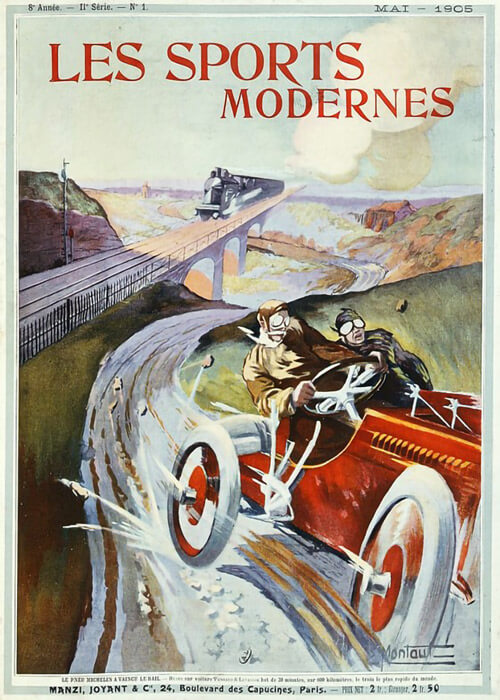
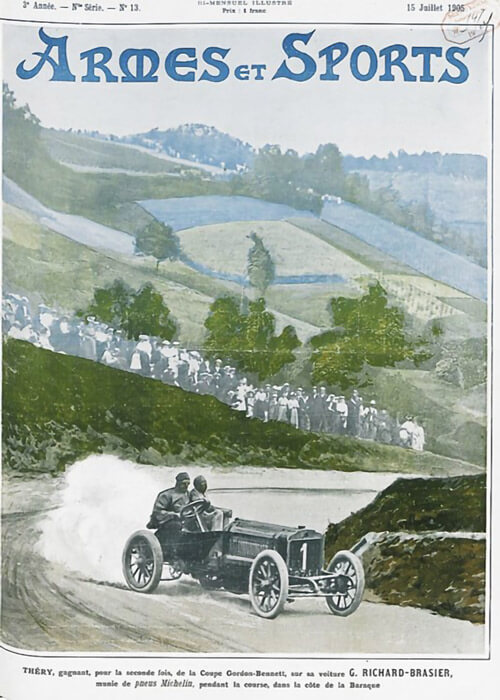
Already before it started, The Horseless Age feared no good for the second Gordon bennett Cup race of 1901. Originally, it might have looked like a contest between the German Mercedes and the French Panhard and Mors racing cars. But alas, Germany withdrew from the Gordon Bennet event, in favor of the much longer Paris-Berlin city-to-city race. Another sign of the more than less interest in the young Gordon Bennett Cup by several (if not many) automobile manufacturers.
With permission of hathitrust hathitrust.org == Text and fotos compiled by motorracinghistory
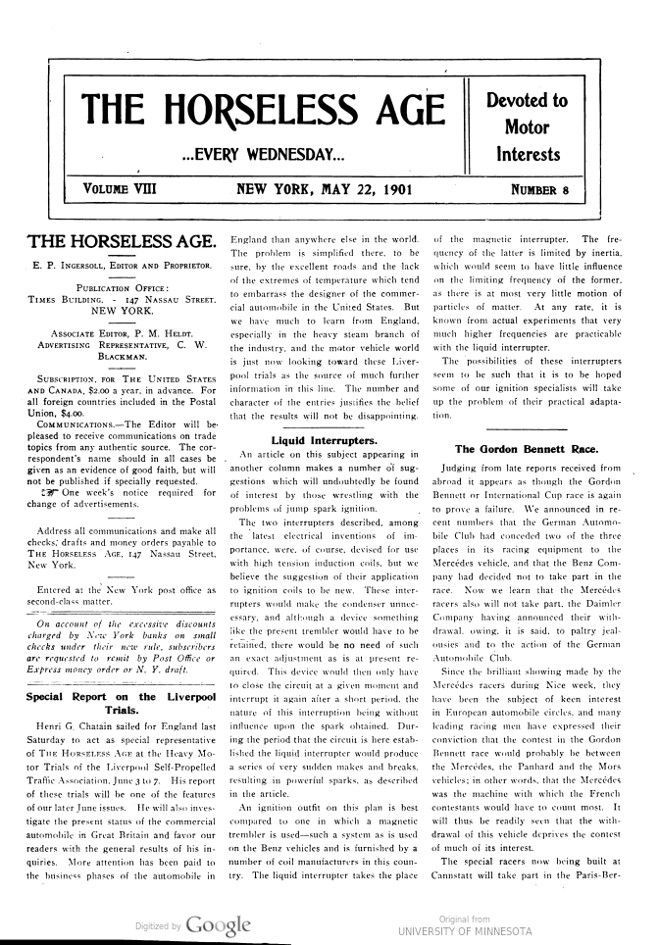
THE HORSELESS AGE — Volume 8, No. 8, May 22, 1901
The Gordon-Bennett Race.
Judging from late reports received from abroad it appears as though the Gordon Bennett or International Cup race is again to prove a failure. We announced in recent numbers that the German Automobile Club had conceded two of the three places in its racing equipment to the Mercédes vehicle, and that the Benz Company had decided not to take part in the Now we learn that the Mercedes racers also will not take part, the Daimler Company having announced their withdrawal, owing, it is said, to paltry jealousies and to the action of the German Automobile Club. race.
Since the brilliant showing made by the Mercédes racers during Nice week, they have been the subject of keen interest in European automobile circles, and many leading racing men have expressed their conviction that the contest in the Gordon Bennett race would probably be between the Mercédes, the Panhard and the Mors vehicles; in other words, that the Mercédes was the machine with which the French contestants would have to count most. It will thus be readily seen that the withdrawal of this vehicle deprives the contest of much of its interest.
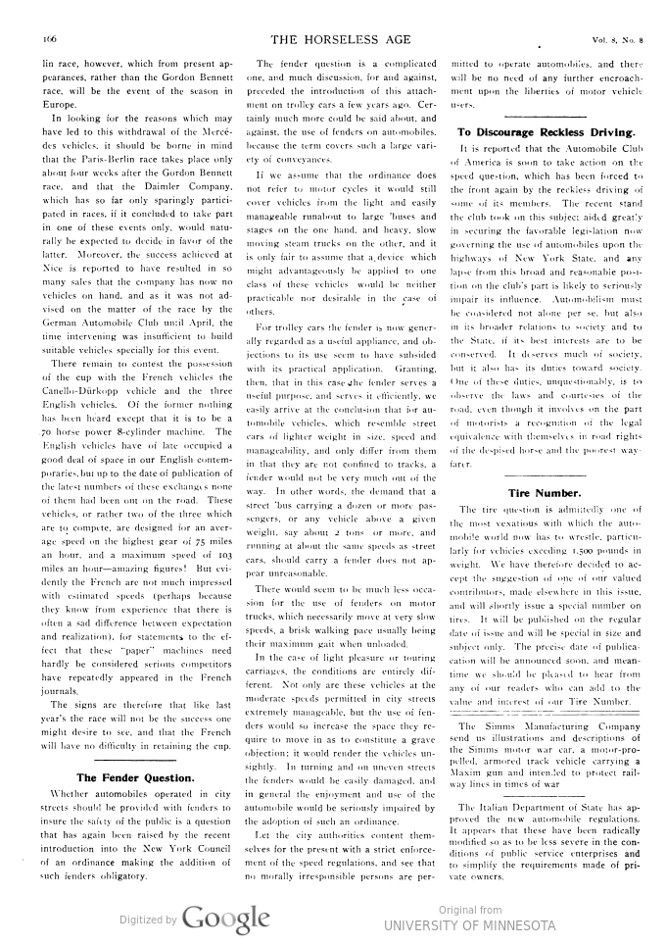
The special racers now being built at Cannstatt will take part in the Paris-Berlin race, however, which from present appearances, rather than the Gordon Bennett race, will be the event of the season in Europe.
In looking for the reasons which may have led to this withdrawal of the Mercédes vehicles, it should be borne in mind that the Paris-Berlin race takes place only about four weeks after the Gordon Bennett race, and that the Daimler Company, which has so far only sparingly participated in races, if it concluded to take part in one of these events only, would naturally be expected to decide in favor of the latter. Moreover, the success achieved at Nice is reported to have resulted in so many sales that the company has now no vehicles on hand, and as it was not ad- vised on the matter of the race by the German Automobile Club until April, the time intervening was insufficient to build suitable vehicles specially for this event.
There remain to contest the possession of the cup with the French vehicles the Canello-Dürkopp vehicle and the three English vehicles. Of the former nothing has been heard except that it is to be a 70 horsepower 8-cylinder machine. The English vehicles have of late occupied a good deal of space in our English contemporaries, but up to the date of publication of the latest numbers of these exchanges none of them had been out on the road. These vehicles, or rather two of the three which are to compete, are designed for an average speed in the highest gear of 75 miles an hour, and a maximum speed of 103 miles an hour-amazing figures! But evidently the French are not much impressed with estimated speeds (perhaps because they know from experience that there is often a sad difference between expectation and realization), for statements to the effect that these „paper“ machines need hardly be considered serious competitors have repeatedly appeared in the French journals. The signs are therefore that like last year’s the race will not be the success one might desire to see, and that the French will have no difficulty in retaining the cup.