During the second half of the twenties, most magazines seem to have lost their interest in racing in general. The Indianapolis 500 was no exception in that way. I have the impression, that normal automotive issues such as new passenger cars and in particular the car manufacturing industry was more in focus. For one part understandible, as after the world war, the American automotive industry seemingly grew and grew forevermore. But the reduced interest for racing could have been disappointing for those being interested in it.
Text and jpegs by courtesy of hathitrust.org www.hathitrust.org, compiled by motorracinghistory.com
Automotive Industries, Vol. 56, No. 22, June 4, 1927
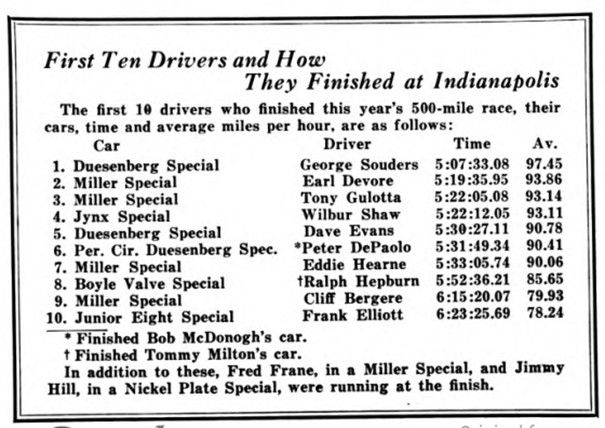
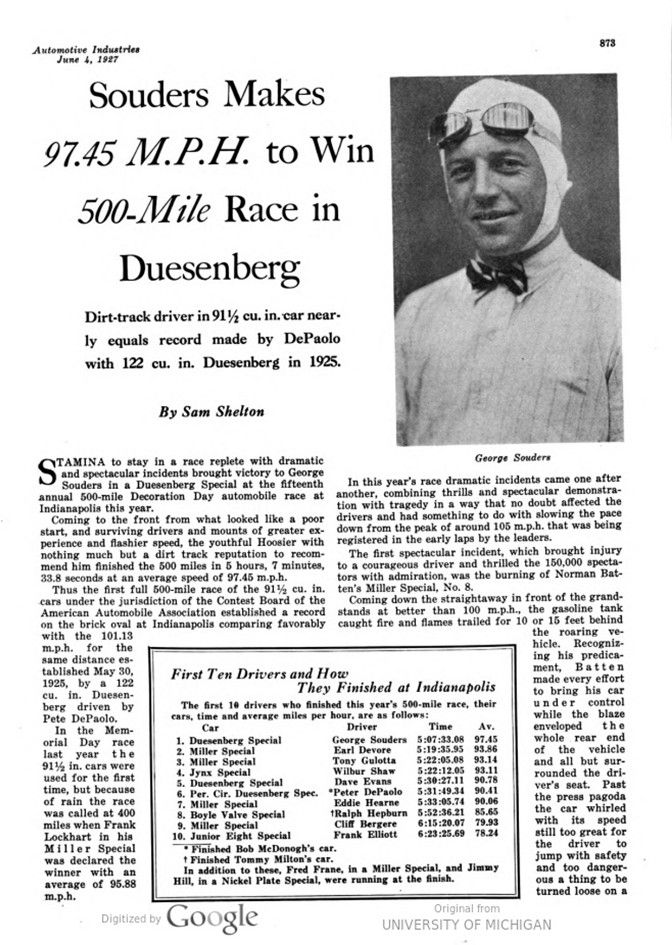
Souders Makes 97.45 M.P.H. to Win 500-Mile Race in Duesenberg
Dirt-track driver in 91½ cu. in. car nearly equals record made by DePaolo with 122 cu. in. Duesenberg in 1925.
By Sam Shelton
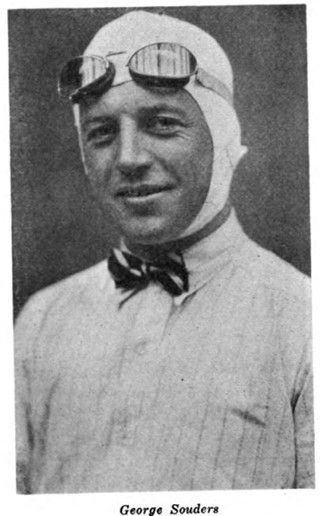
STAMINA to stay in a race replete with dramatic and spectacular incidents brought victory to George Souders in a Duesenberg Special at the fifteenth annual 500-mile Decoration Day automobile race at Indianapolis this year.
Coming to the front from what looked like a poor start, and surviving drivers and mounts of greater experience and flashier speed, the youthful Hoosier with nothing much but a dirt track reputation to recommend him finished the 500 miles in 5 hours, 7 minutes, 33.8 seconds at an average speed of 97.45 m.p.h.
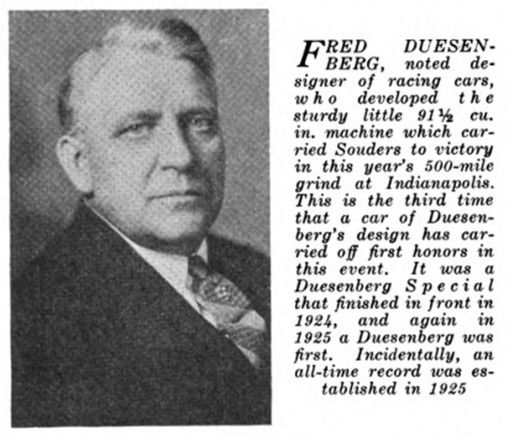
Thus, the first full 500-mile race of the 912 cu. in. cars under the jurisdiction of the Contest Board of the American Automobile Association established a record on the brick oval at Indianapolis comparing favorably with the 101.13 m.p.h. for the same distance established May 30, 1925, by a 122 cu. in. Duesenberg driven by Pete DePaolo.
In the Memorial Day race last year, the 91½ in. cars were used for the first time, but because of rain the race was called at 400 miles when Frank Lockhart in his Miller Special was declared the winner with an average of 95.88 m.p.h.
In this year’s race dramatic incidents came one after another, combining thrills and spectacular demonstration with tragedy in a way that no doubt affected the drivers and had something to do with slowing the pace down from the peak of around 105 m.p.h. that was being registered in the early laps by the leaders.
The first spectacular incident, which brought injury to a courageous driver and thrilled the 150,000 spectators with admiration, was the burning of Norman Batten’s Miller Special, No. 8.
Coming down the straightaway in front of the grandstands at better than 100 m.p.h., the gasoline tank caught fire and flames trailed for 10 or 15 feet behind the roaring vehicle. Recognizing his predicament, Batten made every effort to bring his car under control while the blaze enveloped the whole rear end of the vehicle and all but surrounded the driver’s seat. Past the press pagoda the car whirled with its speed still too great for the driver to jump with safety and too dangerous a thing to be turned loose on a track where 32 other daring drivers were racing.
Holding the steering wheel with one hand, Batten was standing upright in the cockpit to escape in whatever degree he could the heat of the raging flames. Not until he neared the south end of the pits did the car slow down enough for the driver to jump, and then as he sprawled to the ground the blaze shot many feet into the air in full view of all in the grandstands.
Although he suffered burns on his back and hands and was taken to the hospital, Batten was not seriously injured. A little later, as a group of bunched cars approached the south turn, Henry Kohlert, driving his Miller Special. No. 23, rode high upon the bank and tangled wheels with car No. 25, driven by Cliff Bergere. Kohlert’s car turned over and rolled down the bank, leaving the driver lying in the middle of the track. Kohlert was carried off the track and to the hospital, suffering from serious injuries. Car No. 25 continued in the race. This accident occurred in front of one of the grandstands.
When in its twenty-fourth lap, car No. 18, a front-drive Cooper Special, driven by Jules Ellingboe, hit the wall on the north turn and was wrecked and the driver was seriously injured.
Although there were other instances of failure of cars at critical times, not until near the finish was the height of the dramatic reached. After battling gamely against odds, the two Duesenbergs, No. 32 and No. 24, had attained first and second places respectively. With a three-lap lead over No. 24, No. 32 had just been given the checkered flag announcing it had finished when No. 24 started its 198th lap, apparently certain of second place, being four laps ahead of its nearest competitor.
But as it came around to finish the lap, with Babe Stapp at the wheel, it was slowing down. The pit crew urged Stapp to continue, but he could not. His rear axle drive gear was broken, and the second prize was snatched from his hands, with only two laps to go.
From the start of the race at 10 a. m. to the finish of the winner at 7 minutes and some seconds past 3 o’clock, there was a succession of surprises and disappointments, leaders dropped out and cars that had not been reckoned with took leading positions. Drivers with national reputations found themselves unhorsed and mere youngsters from the dirt tracks sprang into the limelight.
Frank Lockhart, the young star and surprise of a year ago, who has since proved his mettle on other tracks, was the undisputed leader for 81 laps until he had to stop to refuel. Although he lost the lead, he soon regained it and held it until his 119th lap, when his car, a Miller Special No. 2, went out with a broken connecting rod. He won $10,900 of lap prizes, the award being $100 for the winner of each of the 200 laps.
Charles Bauman, another dirt track youngster, who took the lead when Lockhart made his pit stop, held it for 10 laps, winning $1,000 in prize money, but after his 91st lap he met misfortune, breaking a pinion gear in the rear axle. Bauman was driving a Miller Special.
The next car to bask in the temporary glory of a prospective winner was the Cooper Special No. 14, started by Bob McDonogh, and later wheeled by Pete DePaolo, whose own Miller had dropped out in its 31st lap. Mc-Donogh had kept his car well up in the front rank and when Lockhart went out he was in second place ready to grab the lead. DePaolo relieved him as driver and held the car in front for 30 laps, winning $3,000 in lap prize money. Then at about 350 miles the engine in No. 14 began acting erratically, spitting and coughing. It lost speed and never regained its stride. It kept pegging along and was able to finish in the money by reason of the good start that it had.
It was after No. 14 slowed down that George Souder’s Duesenberg forged to the front and soon gained its invincible lead. This car made no stop until 400 miles, and then, with a safe margin over its companion Duesenberg, which was No. 24, Souders wisely brought it into the pit for gasoline, oil, water and a change of tires.
Thus refreshed, it took the track again with little delay and ran beautifully until it brought home the first prize of $20,000.
There started in the race 33 cars in 11 rows of three each. Positions were determined according to time made in the qualifying trials. Frank Lockhart had the pole position in the first row, having qualified at 120.1 m.p.h. for 10 miles.
All of the cars starting qualified at better than 100 m.p.h. and some which qualified at better than 90 were not permitted to start because of the number being limited to 33.
The pacemaker for the start was a LaSalle roadster with T. E. Myers, General Manager of the speedway as passenger, and Willard Rader as driver.
Preceding the start an official car of the A.A.A., carrying Val Haresnape, secretary of the Contest Board, E. V. Rickenbacker, chairman of the Contest Board, and C. F. Kettering, referee, had circled the track.
As the pacemaker brought the cars down the stretch at more than 100 m.p.h. and as nearly as possible in their starting positions, the official starter, George Townsend, president of the Moto Meter Co., waved the red flag that signaled the beginning of the race.
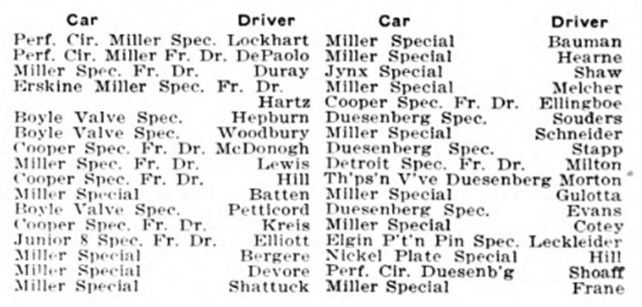
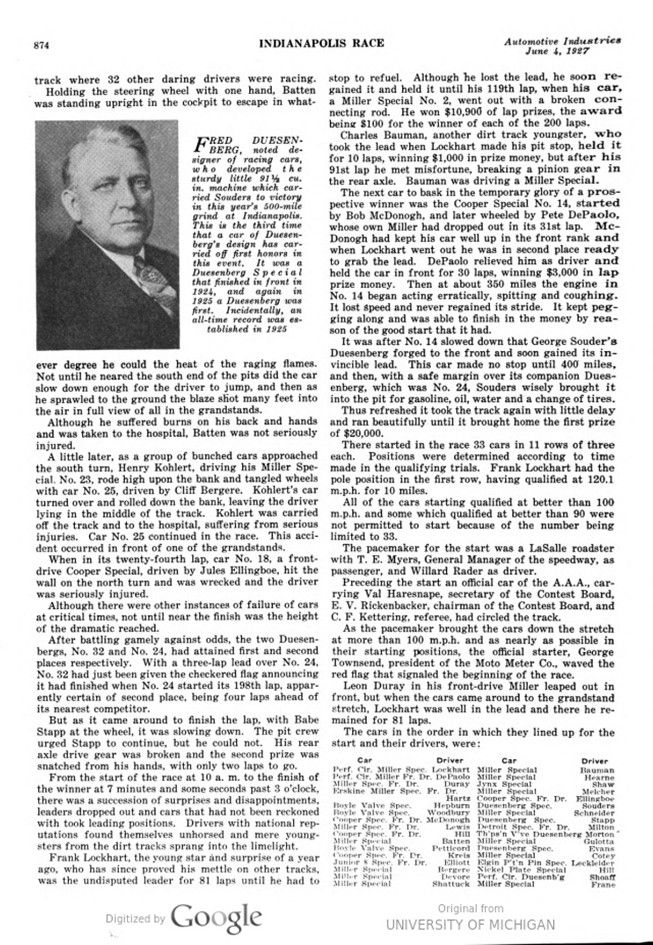
Leon Duray in his front-drive Miller leaped out in front, but when the cars came around to the grandstand stretch, Lockhart was well in the lead and there he remained for 81 laps. The cars in the order in which they lined up for the start and their drivers, were: