Text and jpegs by courtesy of hathitrust.org www.hathitrust.org, compiled by motorracinghistory.com
Automobile Trade Journal, Vol. 31, No. 12, June 1, 1927
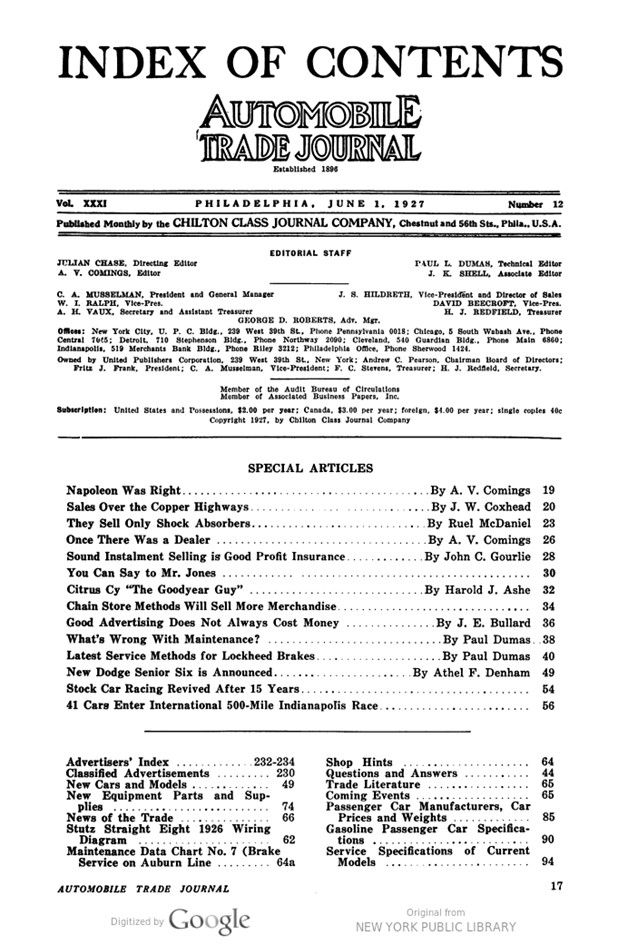
41 Cars Enter International 500 Mile Indianapolis Race
11 Front Drives and Duesenberg Specials, With Offset Engine, Feature Annual Race
Fernic of Roumania With Bugatti, Lone Foreign Entrant
FEATURED by the initial appearance of the newly designed Duesenbergs with offset engines and propeller shaft, 41 racing cars of 91½ in. displacement will compete in the Fifteenth Annual 500-Mile International Sweepstakes over the 22-mile brick track at Indianapolis, on Memorial Day, May 30.
While it is the biggest entry list since 1919 there is but a slight taste of international flavor with only one foreign driver competing, he being George G. Fernic of Roumania, who has entered a Bugatti and will make his first appearance on an American track.
While the majority of cars will make their first appearance of the season before the crowd of probably 150,000 spectators, the racing qualities and make-up of the cars are known. There are several „dark horses“ which include the four Cooper. front wheel drive specials, the front wheel drive car entered by Tommy Milton and the new Duesenbergs. By offsetting the engine and propeller shaft, it permits the driver in the Duesenbergs to sit alongside of the shaft instead of over top, thus permitting him to be lower to the ground, which lends toward driver safety.
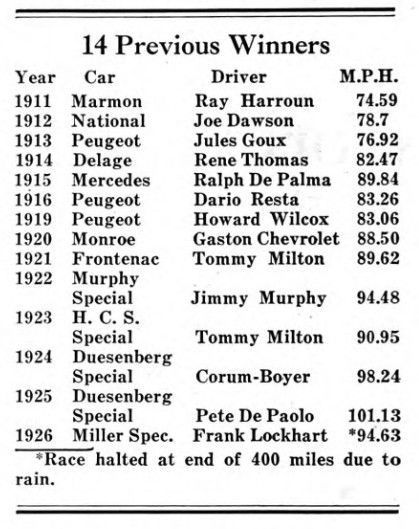
Never since the start of the series of races inaugurated by Carl Fisher, has there been a sure prediction as to the winner. Starting with engines of 600 cu. in. displacement down to the present type of 91½, speed records have been established and the mark of 101.13 miles per hour, made by Pete De Paolo in 1925, stands as a record to shoot at by the thirty-three drivers who will face the starter.
Last year was the first time for the 91½ jobs to compete at Indianapolis, and Frank Lockhart, the youth from the Coast, set the pace after a 100-miles until the race was called at 400 miles due to rain. Lockhart’s mark for 400 miles of 94.63 miles per hour and new records for distances up to 500 miles may be made by the small jobs.
During the series of fourteen races only one driver has twice finished ahead of the field and Tommy Milton has that honor, winning in 1921 and 1923. As to the makers of cars repeating victories, Peugeot and Miller hold the honors with three victories. Cars designed by Louis Chevrolet and Fred Duesenberg have each won twice.
The front wheel drive job has demonstrated this year that it has to be given considerable thought when figuring out a winner. In the first two races held this year front wheel drives have led the field, at Los Angeles, Leon Duray won, and at Hammonton, N. J., Dave Lewis was the winner.
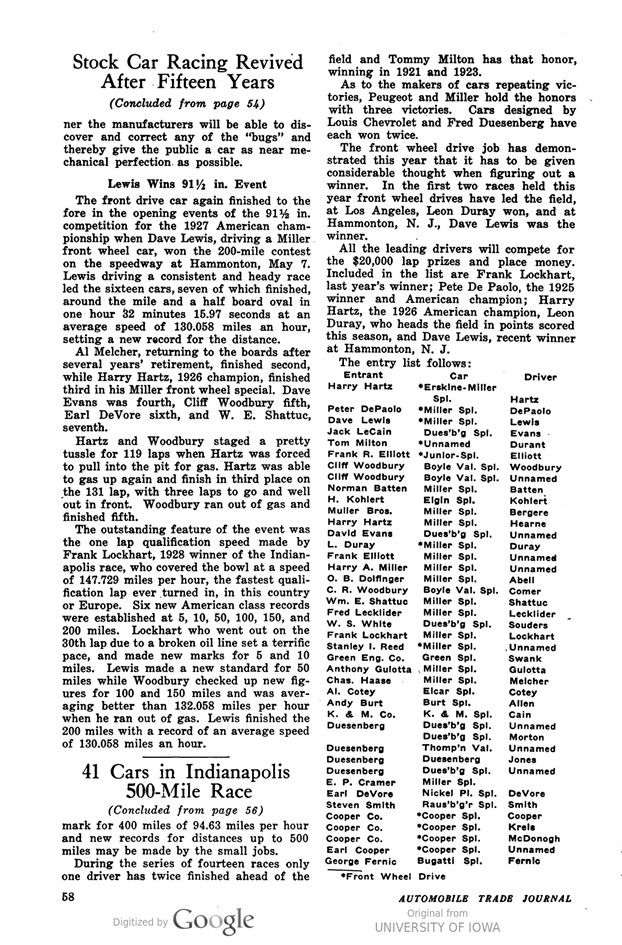
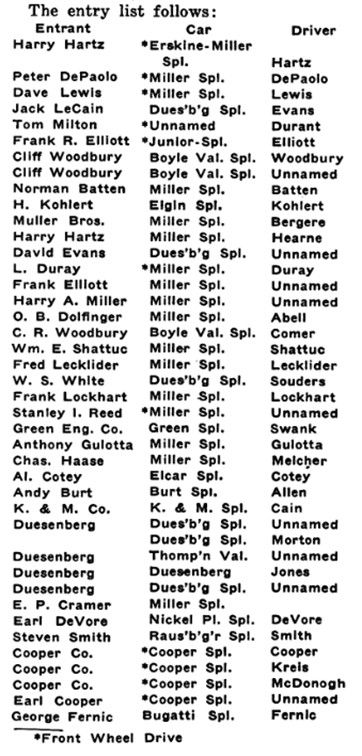
All the leading drivers will compete for the $20,000 lap prizes and place money. Included in the list are Frank Lockhart, last year’s winner; Pete De Paolo, the 1925 winner and American champion; Harry Hartz, the 1926 American champion, Leon Duray, who heads the field in points scored this season, and Dave Lewis, recent winner at Hammonton, N. J.
The entry list follows:
Photos.
Page 56.
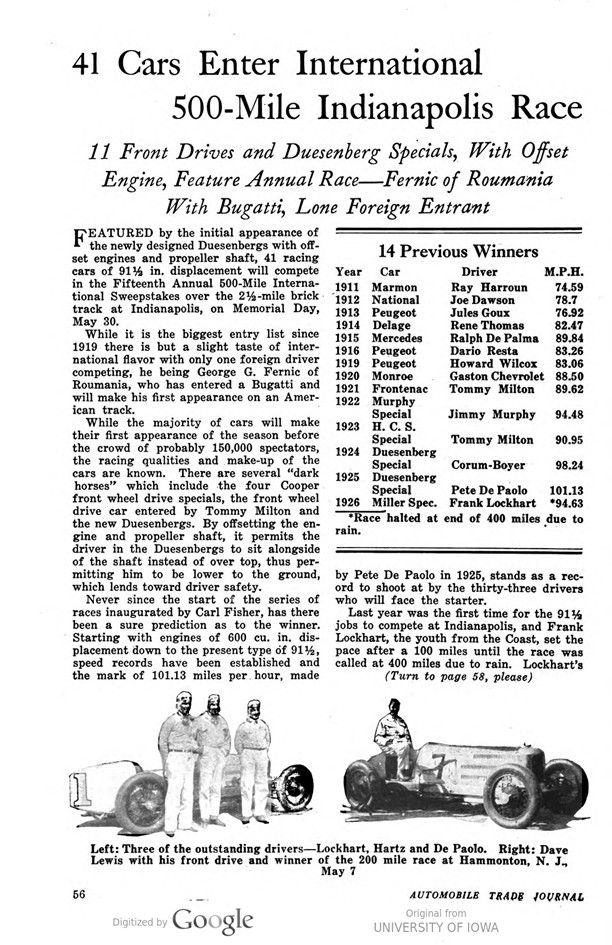
Left: Three of the outstanding drivers – Lockhart, Hartz and De Paolo.
Right: Dave Lewis with his front drive and winner of the 200-mile race at Hammonton, N. J., May 7